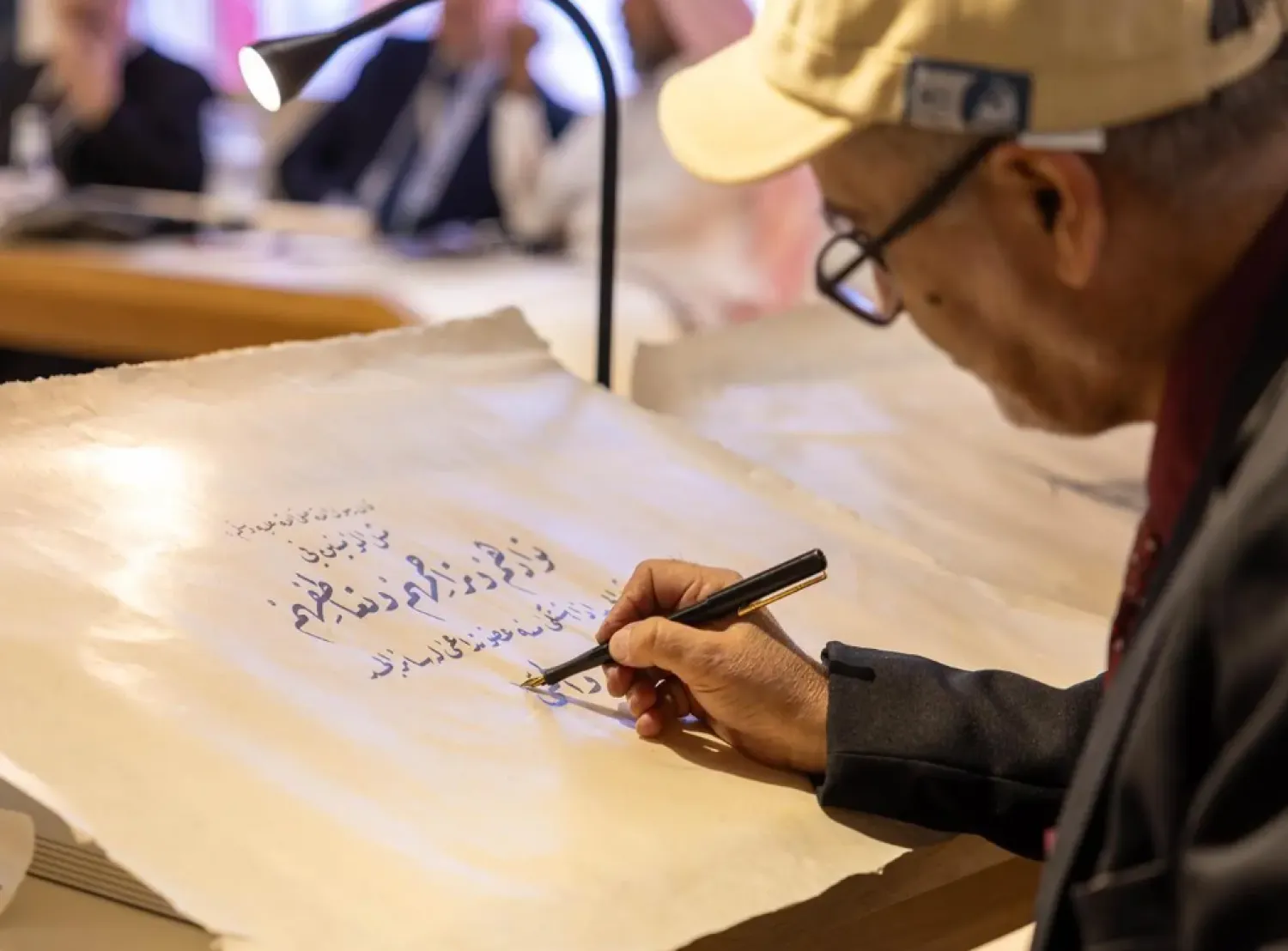
Second Arabic Calligraphy Competition Kicks Off at Riyadh International Book Fair

Nine calligraphers representing seven countries are participating, with their works to be evaluated by a specialized jury - SPA
TT

Second Arabic Calligraphy Competition Kicks Off at Riyadh International Book Fair

Nine calligraphers representing seven countries are participating, with their works to be evaluated by a specialized jury - SPA

The second edition of the Prince Mohammed bin Salman Global Center for Arabic Calligraphy Initiative Competition began Friday as part of the Riyadh International Book Fair and will run until October 4.

Nine calligraphers representing seven countries—Saudi Arabia, Jordan, Kuwait, Egypt, Oman, Türkiye, and Indonesia—are participating, with their works to be evaluated by a specialized jury.

The competition is a core effort of the initiative to support and highlight Arabic calligraphy as an integral part of Saudi cultural identity and a component of Arab and Islamic heritage.

It aims to enhance the art form's local and international presence, thereby achieving the goals of Saudi Vision 2030.


Bayeux Tapestry is at the British Museum after Secret Journey from France

Workers prepare to unload a specially designed crate (back L) carrying the Bayeux Tapestry at the British Museum in central London early on July 10, 2026. (Photo by Richard A. Brooks / AFP)
TT

Bayeux Tapestry is at the British Museum after Secret Journey from France

Workers prepare to unload a specially designed crate (back L) carrying the Bayeux Tapestry at the British Museum in central London early on July 10, 2026. (Photo by Richard A. Brooks / AFP)

After almost 1,000 years, the Bayeux Tapestry is back on English soil.

In scenes like a heist movie in reverse, the priceless Medieval artwork was spirited into the British Museum on Friday in the dead of night, after a high-tech, tight-security operation where any slip-up could have spelled disaster.

On loan from its home in France, the tapestry will go on display at the London museum from Sept. 10 until July 2027. It's a public homecoming for a vivid visual record of the 1066 Norman invasion, the last successful conquest of England.

The tapestry's arrival in London has been widely anticipated, but due to security concerns all details of when and how it would arrive have been kept under wraps.

“It feels extraordinary that after so much work and planning and care and thought that it’s actually happening,” The Associated Press quoted British Museum Director Nicholas Cullinan as saying as he awaited the arrival after a secrecy-shrouded journey.

“It’s the first time in 1,000 years that such an important piece of British — French too — history is going to be on these shores,” he said. “It’s incredibly exciting.”

The 70-meter (230-foot) tapestry was folded accordion-style in a climate-controlled case that was placed inside a shock-absorbing cradle. That went into a truck that crossed from France on a vehicle shuttle train through the Channel Tunnel.

After an 11-hour, 350-mile (560-kilometer) trip, escorted by police, the truck backed slowly into a loading bay at the museum, where workers gingerly eased the container, the size of a small car, to the ground. Museum staff and British and French diplomats who had been watching in hushed silence broke into applause.

The priceless cargo will spend several days acclimatizing before it is carefully unpacked and unfolded for an exhibition that the museum expects to be one of the most popular in its history. Some 100,000 tickets were sold in their first day on sale this month.

“It was like trying to get tickets to Glastonbury,” Cullinan said. “I don’t take for granted that people care that much about a 1,000-year-old embroidery. I think that’s an amazing thing.”

The tapestry is a symbol of Anglo-French relations Stitched in wool thread on linen fabric, the artwork depicts the events leading up to the Battle of Hastings in October 1066, when William, Duke of Normandy defeated King Harald’s Anglo-Saxon army. The invasion ended Saxon rule and made William the Conqueror the first Norman king of England.

Historians believe the tapestry was commissioned by Bishop Odo of Bayeux, William’s half brother, and was probably sewn by women in England — possibly nuns — before being taken across the Channel. It has spent most of the last millennium in the town of Bayeux in northwest France, apart from two short periods at the Louvre in Paris.

The tapestry symbolizes the sometimes fractious, intertwined histories of France and Britain, and securing the loan was a high-stakes diplomatic mission. It was announced during a state visit to the UK by French President Emmanuel Macron in July 2025. The loan coincides with renovations at the museum in Bayeux that houses it.

In return, the British Museum will loan treasures from the Sutton Hoo hoard — artifacts from a 7th century Anglo Saxon ship burial — and other items to museums in Normandy.

Retired British diplomat Peter Ricketts, who helped secure the deal as the UK’s special envoy for the tapestry, said “it’s an extraordinary mark of friendship and confidence in the UK to entrust this object to us for a year.”

“Macron, when he offered us the tapestry, I think he understood that it would have far more impact in the UK than it does in France, because it’s more fundamental to our national story,” he said. Everybody (in Britain) knows 1066.”

It's a vivid record of 11th century life and death It features 627 people and 737 animals and tells its story in 58 scenes brimming with vivid and sometimes gory detail. There are scenes of hand-to-hand combat, mutilated bodies and the unlucky Harold, felled by an arrow through his eye.

“It has an emotional richness that is really difficult to get from written sources,” said Millie Horton-Insch, project curator for the British Museum exhibition. “It just brings people closer to this history than any other object can. It’s not the same as reading a text. You are looking at something that was handled by the people who lived through it and felt compelled to record these events in this way. “

She said the document’s survival for 10 centuries despite myriad dangers — “moths, mice, mold damp, fire” — is miraculous, and may be partly due to its humble materials.

“It’s not really made of any blingy fabric,” she said. “It’s not gold, it’s not silver. There wasn’t the same temptation to cut it up and make it into vestments or repurpose it for anything.”

Some French cultural figures opposed the loan, arguing that moving the tapestry was too risky. Cullinan said the expert teams went to great lengths to ensure its safety, including making two trial runs of the journey to show it would not cause the fragile item too much stress.

“Such care has gone into it. I can’t think of a level of care for any other museum loan,” he said.
He said he understands why there are concerns.

“The tapestry arouses great interest and passion,” he said. “Which is a wonderful thing."


France Returns 23 Syrian Treasures After 15 Years as Macron Visits Damascus

This handout picture released by the official Syrian Arab News Agency (SANA) shows Syria's interim President Ahmed al-Sharaa and France's President Emmanuel Macron inspecting repatriated Syrian artifacts that had been on loan to the Arab World Institute in Paris since 2010, during an official ceremony at the at the People's Palace in Damascus on July 7, 2026. (SANA/AFP)
TT

France Returns 23 Syrian Treasures After 15 Years as Macron Visits Damascus

This handout picture released by the official Syrian Arab News Agency (SANA) shows Syria's interim President Ahmed al-Sharaa and France's President Emmanuel Macron inspecting repatriated Syrian artifacts that had been on loan to the Arab World Institute in Paris since 2010, during an official ceremony at the at the People's Palace in Damascus on July 7, 2026. (SANA/AFP)

France has finally returned 23 Syrian archaeological treasures that remained in the country for about 15 years after being loaned for an exhibition. Their return coincided with French President Emmanuel Macron’s landmark visit to Damascus — the first by a major Western leader since the ouster of Bashar al-Assad in late 2024.

The artifacts, flown aboard Macron’s presidential aircraft on Tuesday and returned to Syria’s National Museum, include Roman bronze objects, Byzantine and Islamic-era pieces and a richly colored mosaic panel that once adorned the Umayyad Mosque. The collection was loaned in 2011 to an exhibition of Syrian antiquities at the Arab World Institute in Paris.

The Syrian Foreign Ministry said that the artifacts belonged to museums in Damascus, Aleppo, Latakia and Palmyra and remained in France after diplomatic ties between the two countries were severed under Assad’s rule. It described France as the first country to cooperate with Syria under a national campaign to recover antiquities held abroad.

“Today we are unveiling a selection of archaeological artifacts that have been returned to Syria,” said Ayman al-Nabo, deputy director-general of Syria’s Directorate-General of Antiquities and Museums, at the opening of an exhibition at the National Museum in Damascus featuring two of the returned pieces.

At the National Museum, curator Nivine Saadeddine said the returned collection spans some of the most significant periods of Syrian civilization.

“They date from the ninth millennium B.C. to the 14th and 15th centuries A.D. Every object represents a distinct chapter in Syria’s history,” she said.

For Maamoun Abdulkarim, Syria’s former director-general of antiquities and museums, the return closes a chapter that stretched across years of war, diplomatic isolation and failed attempts to retrieve the collection.

Abdulkarim, now a professor of archaeology at the University of Sharjah in the United Arab Emirates, said the loan was made as part of normal cultural cooperation before the conflict.

Abdulkarim said he formally requested the return of the artifacts in 2014 but received no response. He said French officials later told Syrian authorities they could not communicate with representatives of Assad’s government, which had become internationally isolated and subject to broad sanctions after the crackdown on anti-government protests and the ensuing civil war.

He said UNESCO’s Beirut office later tried to mediate, but the effort also failed.

The dispute also had personal consequences, Abdulkarim said.

“We were interrogated by Bashar al-Assad’s security forces,” he said. “We were beaten and accused of being too lenient in protecting Syria’s antiquities. Had it not been for the correspondence we had sent to the institute proving we had repeatedly requested the artifacts’ return, we could have been imprisoned.”

Despite the ordeal, Abdulkarim said he welcomed the renewed cultural cooperation.

“I am very happy that, despite everything that happened, the war is over, Syria is reopening to the world and cultural exchange is returning,” he said.

Syria’s Ministry of Foreign Affairs said France is the first country to cooperate with Syria under a national campaign to recover antiquities held abroad since Assad was overthrown by opposition forces, ending more than five decades of Assad family rule.

Despite the war and severed ties, Syrian artifacts have previously been repatriated under formal loan agreements, Abdulkarim said.

Around 2017, Italy returned two pieces that had been damaged by the ISIS group after restoring them for an exhibition in Rome on the destruction of cultural heritage, he added.

Other artifacts remain in Japan under a longstanding archaeological cooperation agreement dating back to excavations conducted there in the 1980s.

Meanwhile, Abdulkarim said, thousands of Syrian artifacts looted from archaeological sites during the war remain scattered around the world.

“Recovering them will require years of diplomatic work,” Abdulkarim said.

He said the return from France sends “a positive message for the future” and could help encourage further international cooperation to recover Syria’s stolen heritage.

Syria’s cultural heritage suffered extensive damage during the country’s nearly 14-year conflict. Ancient cities, including the UNESCO World Heritage site of Palmyra, were heavily damaged, while landmarks such as the medieval Crusader fortress of Crac des Chevaliers bear scars from years of fighting.

ISIS militants also destroyed temples, tombs and monumental sculptures in Palmyra, considering them symbols of idolatry, while trafficked antiquities became a lucrative source of revenue for armed groups.


Red Sea Film Foundation Concludes Participation in 12th Saudi Film Festival

The Red Sea Fund presented four awards within the Production Market at the Saudi Film Festival - SPA
TT

Red Sea Film Foundation Concludes Participation in 12th Saudi Film Festival

The Red Sea Fund presented four awards within the Production Market at the Saudi Film Festival - SPA

The Red Sea Film Foundation won four awards for the three films supported by the Red Sea Fund during its participation in the 12th Saudi Film Festival, held at the King Abdulaziz Center for World Culture (Ithra) in Dhahran.

Hijra won the Golden Palm for Best Narrative Feature Film, while Irkalla: Gilgamesh’s Dream won the Golden Palm for Best GCC Feature Film. A Matter of Life and Death received a Jury Special Mention, while Sarah Taibah won the Golden Palm for Best Acting for her role in the film, SPA reported.

These awards reflect the presence of Red Sea Fund-supported films in the Saudi and regional film landscape and underscore the impact of the fund’s support for film projects at various stages, through to their screening before audiences and participation in festivals.

The Red Sea Fund presented four awards within the Production Market at the Saudi Film Festival. The short-film awards went to the projects Shareet and Bin Jalmoud, while the feature-film awards went to From Zero to a Thousand and Between the Two, directed by Malak Quota.

The Red Sea Film Foundation’s participation in the Saudi Film Festival comes as part of its ongoing cooperation with local film events and its support for Saudi and Arab talent and projects through its various programs and initiatives, foremost of which are the Red Sea Fund, Red Sea Souk, and Red Sea Labs.