


Swedes Stock Up on Food as Fears of War Deepen

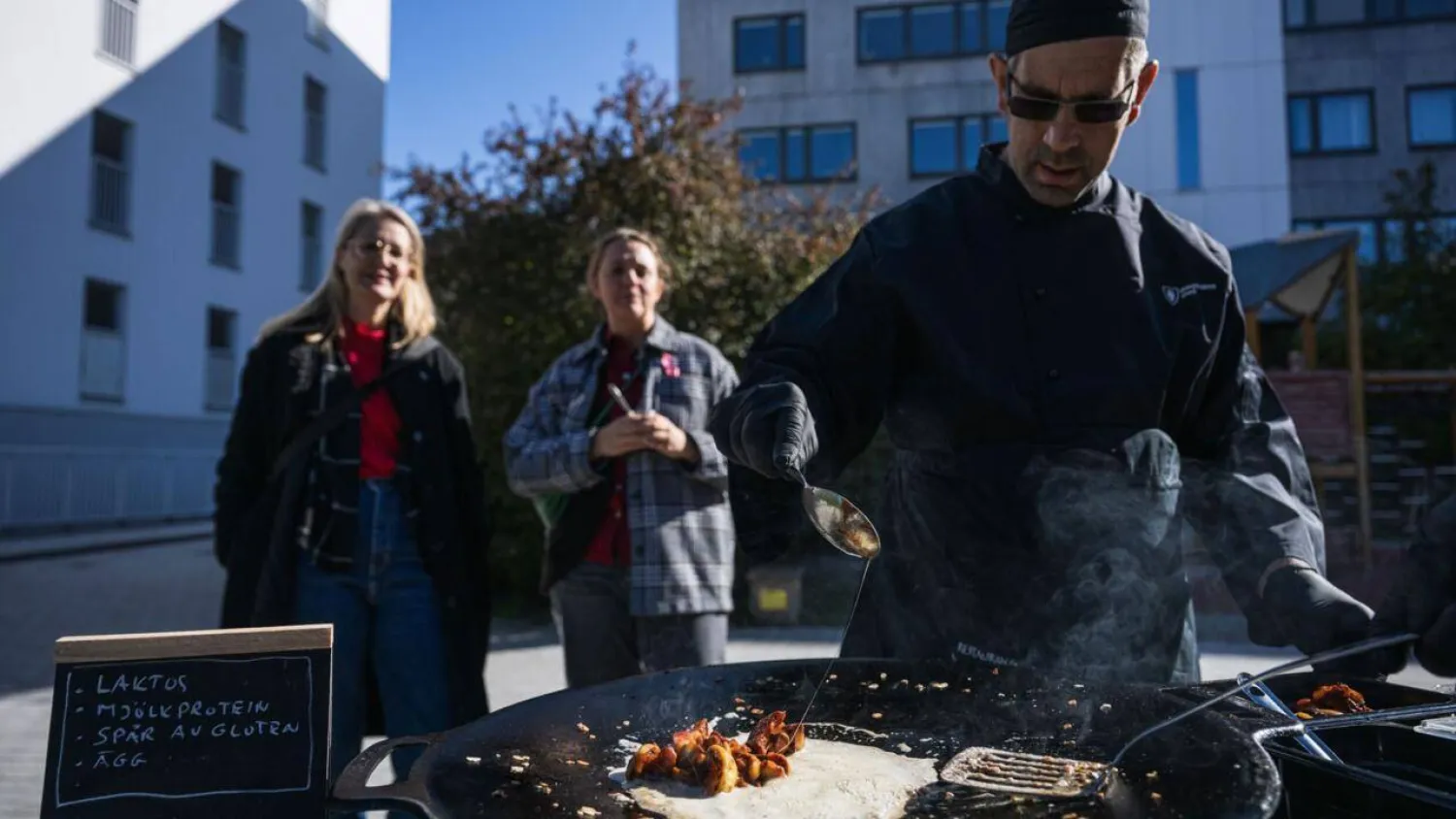
Onlookers watch as workers prepare a dish that can be made under emergency conditions. Jonathan NACKSTRAND / AFP
TT

Swedes Stock Up on Food as Fears of War Deepen

Onlookers watch as workers prepare a dish that can be made under emergency conditions. Jonathan NACKSTRAND / AFP

Swedes are stocking up on food items in case of war, as more conflict in Europe no longer feels like a distant possibility and authorities encourage measures to boost readiness.

At a civil preparedness fair in southwest Stockholm, 71-year-old Sirkka Petrykowska told AFP that she is taking the prospect of hostilities seriously and preparing as much as she can.

"I have bought a camping stove. I have taken a course on preservation in an old-fashioned way, where you can preserve vegetables, meat, and fruit that lasts for 30 years without a refrigerator," Petrykowska said.

"I've set aside blankets for warmth, I bought a gas burner for heating. I've also stocked up at my countryside home," she continued.

In late September, Sweden held its annual Preparedness Week, where authorities seek to raise awareness as part of the country's "total defense" strategy.

The country revived the strategy in 2015 following Russia's annexation of Crimea, and more measures were introduced -- including the appointment of a Minister for Civil Defense -- after Moscow's full-scale invasion of Ukraine in 2022.

The idea is to mobilize all of society, from authorities to citizens and businesses, to collectively resist armed aggression while maintaining essential functions.

Pesto, powdered milk and dried meat

The focus, as it often is in Sweden, is on individual responsibility.

Everyone is encouraged to stockpile enough food to live independently for at least seven days without external aid in the event of a crisis.

That means "resources can initially be directed for instance to elderly and sick people", the Swedish Food Agency writes on its website.

"Meanwhile, society has time re-adjust so that everyone can get help," it continues.

The Swedish Civil Contingencies Agency (MSB) has published a list of recommended foods that are high in fat and protein, and easy to store.

It includes pesto, dried meat or fish, jam, chocolate, mashed potatoes, powdered milk and biscuits.

"In a war scenario, people will be more physically active than under normal circumstances," Oskar Qvarfort, emergency planning officer at the Swedish Food Agency, told AFP, adding that on average the increased need will be about 100 calories.

Martin Svennberg, a business developer from Stockholm, has taken the advice to heart and stockpiled ample food reserves in his basement for his family.

Stacked in boxes in a cramped storage unit are 100 kilograms of flour, dozens of cans of various foods, and an array of freeze-dried meals, enough to last them three months.

For him, the food is not just for sustenance but also for moral support, which is essential in such situations, he stressed to AFP.

"Stocking up on food that you like and that you eat in normal life, I think that is really important," he said.

"I mean when you go to your mum's place or dad's place and you get the food that they made for you as a kid, you get that sense of relief and nostalgia. The same thing goes for food in a crisis," Svennberg said.

'Real challenge'

According to an MSB survey of 2,000 people, 86 percent of Swedes believe the country is worth defending in the event of a military attack, and 76 percent would be willing to defend it as part of Swedish civil defense.

The agency has twice sent out a brochure to all Swedish households informing them of how to act in a crisis, once in 2018 and then in 2024.

The survey, published in March, showed that 39 percent of people felt "worried" when receiving the 2024 edition, compared to 24 percent in 2018.

Sweden also faces logistical challenges owing to its large size, with many areas sparsely populated.

"A large part of food production is concentrated in the south ... and the majority of imports also primarily arrive in these regions," Qvarfort said.

Food transportation would therefore be "a real challenge" in the event of an armed conflict, he said, adding that Ukraine is currently facing the same issue.



Israel President Says at End of Visit Antisemitism in Australia 'Frightening'

Israel's President Isaac Herzog reacts during a Jewish community event in Melbourne on February 12, 2026. (Photo by WILLIAM WEST / AFP)
TT

Israel President Says at End of Visit Antisemitism in Australia 'Frightening'

Israel's President Isaac Herzog reacts during a Jewish community event in Melbourne on February 12, 2026. (Photo by WILLIAM WEST / AFP)

Antisemitism in Australia is "frightening" but most people want good relations, Israel's President Isaac Herzog said on Thursday as he wrapped up a four-day visit and was met by protests in the city of Melbourne.

Herzog's tightly policed visit to Australia this week was meant to offer consolation to the country's Jewish community following the mass shooting on Bondi Beach that killed 15 people in December, said AFP.

However, it sparked demonstrations in major cities, including in Sydney, where police used pepper spray on protesters and members of the media, including an AFP photographer, during scuffles in the central business district on Monday night.

Herzog told Channel Seven's Sunrise ahead of his Melbourne stop that a "wave" of anti-Jewish hatred in Australia had culminated in the December 14 killings at Bondi.

"It is frightening and worrying," he said.

"But there's also a silent majority of Australians who seek peace, who respect the Jewish community and, of course, want a dialogue with Israel."

The Israeli head of state said he had brought a "message of goodwill to the people of Australia".

"I hope there will be a change. I hope things will relax," he said.

Herzog attended a Jewish community event after a meeting with Victoria's governor at Melbourne's Government House.

Protesters waving Palestinian flags and chanting slogans squared off with police outside the event.

More are expected to turn out later at around 5 pm (0600 GMT) on Thursday.

Herzog told the audience at the community event: "We came here to be with you, to look you in the eye, to embrace and remember."

He also said demonstrators outside should instead "go protest in front of the Iranian embassy".

The Australian government accused Iran last year of orchestrating a recent wave of antisemitic attacks and expelled Tehran's ambassador.

Canberra, citing intelligence findings, accused Tehran of directing the torching of a kosher cafe in the Sydney suburb of Bondi in October 2024 and a major arson attack on the Adass Israel Synagogue in Melbourne in December 2024.

- Controversial visit -

Ahead of his arrival, national broadcaster ABC reported that a building at Melbourne University had been graffiti-ed with the phrase: "Death to Herzog".

Many Jewish Australians have welcomed Herzog's trip.

"His visit will lift the spirits of a pained community," said Alex Ryvchin, co-chief executive of the Executive Council of Australian Jewry, the community's peak body.

But some in the community disagreed, with the progressive Jewish Council of Australia saying he was not welcome because of his alleged role in the "ongoing destruction of Gaza".

The UN's Independent International Commission of Inquiry found last year that Herzog was liable for prosecution for inciting genocide after he said all Palestinians -- "an entire nation" -- were responsible for the Hamas attack on Israel in October 2023.

Israel has "categorically" rejected the inquiry's report, describing it as "distorted and false" and has called for the body's abolition.


Türkiye’s Foreign Minister Says the US and Iran Showing Flexibility on Nuclear Deal

FILE PHOTO: Turkish Foreign Minister Hakan Fidan speaks during an interview with Reuters at the 23rd edition of the annual Doha Forum, in Doha, Qatar, December 6, 2025. REUTERS/Ibraheem Abu Mustafa/File Photo
TT

Türkiye’s Foreign Minister Says the US and Iran Showing Flexibility on Nuclear Deal

FILE PHOTO: Turkish Foreign Minister Hakan Fidan speaks during an interview with Reuters at the 23rd edition of the annual Doha Forum, in Doha, Qatar, December 6, 2025. REUTERS/Ibraheem Abu Mustafa/File Photo

The United States and Iran are showing flexibility on a nuclear deal, with Washington appearing "willing" to tolerate some nuclear enrichment, Turkish Foreign Minister Hakan Fidan told the Financial Times in an interview published Thursday.

“It is positive that the Americans appear willing to tolerate Iranian enrichment within clearly set boundaries," Fidan, who has been involved in talks with both Washington and Tehran, told the FT.

“The Iranians now recognize ‌that they ‌need to reach a deal with the ‌Americans, ⁠and the Americans ⁠understand that the Iranians have certain limits. It’s pointless to try to force them.”

Washington has until now demanded Iran relinquish its stockpile of uranium enriched to up to 60% fissile purity, a small step away from the 90% that is considered weapons grade, said Reuters.

Iranian ⁠President Masoud Pezeshkian has said Iran would continue ‌to demand the ‌lifting of financial sanctions and insist on its nuclear rights including ‌enrichment.

Fidan told the FT he believed Tehran “genuinely ‌wants to reach a real agreement” and would accept restrictions on enrichment levels and a strict inspection regime, as it did in the 2015 agreement with the US and others.

US ‌and Iranian diplomats held talks through Omani mediators in Oman last week in ⁠an effort ⁠to revive diplomacy, after President Donald Trump positioned a naval flotilla in the region, raising fears of new military action. Trump on Tuesday said he was considering sending a second aircraft carrier to the Middle East, even as Washington and Tehran prepared to resume negotiations.

The Turkish foreign minister, however, cautioned that broadening the Iran-US talks to ballistic missiles would bring "nothing but another war."

The US State Department and the White House did not respond to a request for comment outside regular business hours.


Russia Strikes Heating in Kyiv, Kills Two in East Ukraine

In this photo provided by the Ukrainian Emergency Service, emergency services personnel work to extinguish a fire at a house following a Russian air attack in Barvinkove, Kharkiv region, Ukraine, Wednesday, Feb. 11, 2026. (Ukrainian Emergency Service via AP)
TT

Russia Strikes Heating in Kyiv, Kills Two in East Ukraine

In this photo provided by the Ukrainian Emergency Service, emergency services personnel work to extinguish a fire at a house following a Russian air attack in Barvinkove, Kharkiv region, Ukraine, Wednesday, Feb. 11, 2026. (Ukrainian Emergency Service via AP)

Russian strikes early Thursday cut heating to nearly 2,600 residential buildings in Kyiv, in a nationwide attack on energy facilities that killed two people in eastern Ukraine.

Russia has stepped up strikes on Ukraine's power and heating infrastructure, plunging entire cities into darkness in the coldest winter of the four-year war.

AFP journalists in Kyiv heard loud blasts and saw explosions light up the night sky, as Ukrainian air defense systems fended off the Russian barrage.

"After last night's massive attack, due to damage to critical infrastructure targeted by the enemy, nearly 2,600 more buildings in the capital have been left without heat," the mayor of Kyiv, Vitaliy Klitschko, said.

He added that two people had been wounded in the capital overnight.

More than 1,000 of the capital's approximately 12,000 apartment blocks were already without heating after massive Russian attacks over the last few weeks.

Russia launched 24 missiles and 219 drones at the war-torn country, Ukraine's air force said, adding that its air defense units had downed 16 missiles and 197 drones.

Two people were killed in the eastern Ukrainian town of Lozova, where the attack cut power to residents and forced authorities to use alternative power sources for critical infrastructure, a local official said.

The attack also wounded four people in the central city of Dnipro, and cut heating to 10,000 customers, Restoration Minister Oleksiy Kuleba said.

"This is yet another attempt to deprive Ukrainians of basic services in the middle of winter. But restoration efforts continue nonstop," Kuleba added.

In the southern Odesa region, the attacks wounded one person, the state emergency services said, while Kuleba said around 300,000 had been left without water supplies.

Russia meanwhile said it repelled a missile attack in the Volgograd region but that debris ignited a fire at a military facility and prompted the evacuation of a nearby village.