


US Senate Unanimously Endorses Repeal of 2002 Iraq War Resolution

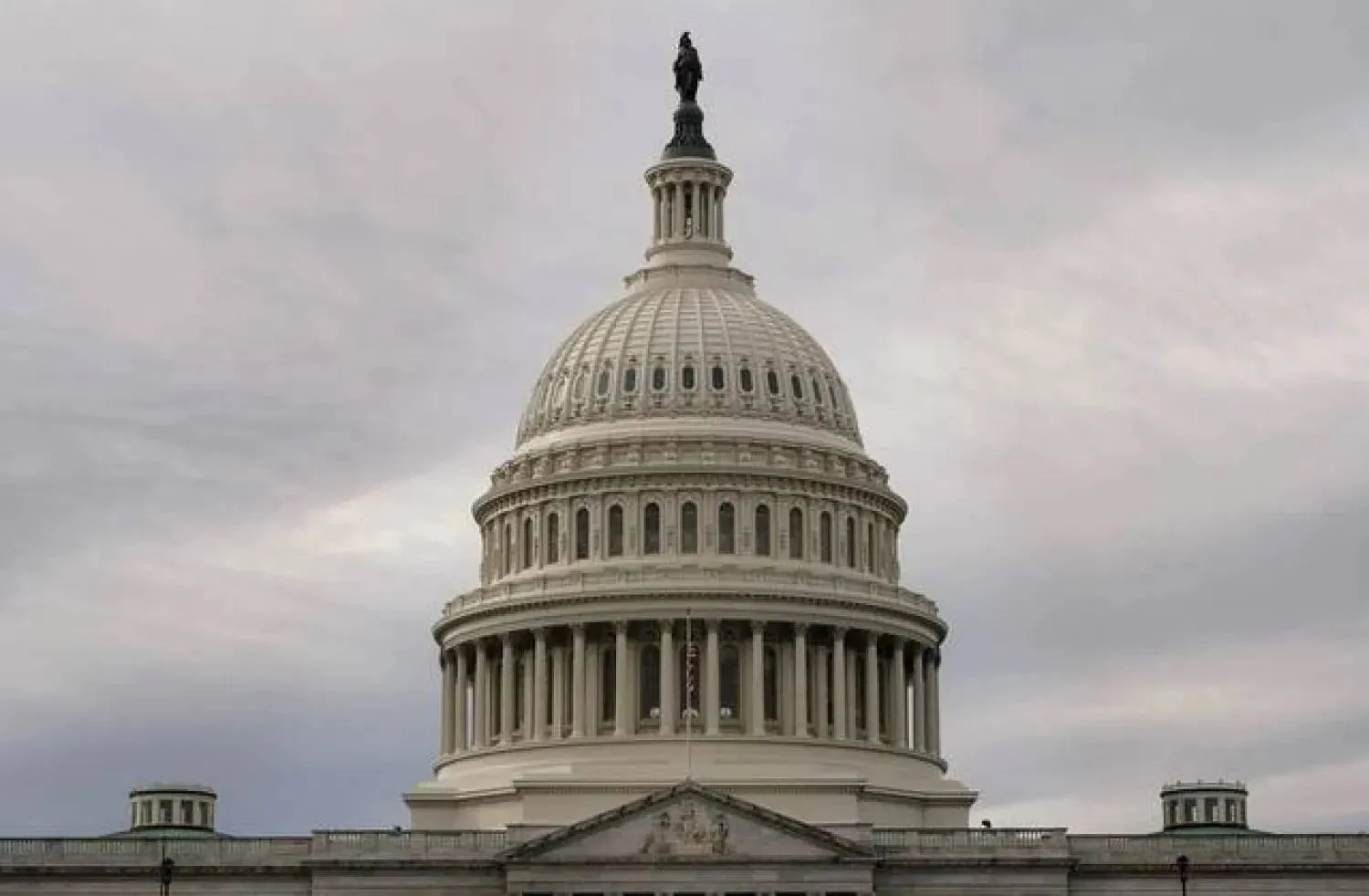
The US Senate. Reuters file photo
TT

US Senate Unanimously Endorses Repeal of 2002 Iraq War Resolution

The US Senate. Reuters file photo

More than two decades later, Congress is on the verge of writing a closing chapter to the war in Iraq.
The Senate voted Thursday to repeal the resolution that authorized the 2003 US invasion, following a House vote last month that would return the basic war power to Congress.
The amendment by Virginia Sen. Tim Kaine, a Democrat, and Indiana Sen. Todd Young, a Republican, was approved by voice vote to an annual defense authorization bill that passed the Senate late Thursday — a unanimous endorsement for ending the war that many now view as a mistake.
Iraqi deaths were estimated in the hundreds of thousands, and nearly 5,000 US troops were killed in the war after President George W. Bush’s administration falsely claimed that then-President Saddam Hussein was stockpiling weapons of mass destruction.
“That’s the way the war ends, not with a bang but a whimper,” Kaine said after the vote, which lasted only a few seconds with no debate and no objections. Still, he said, “America is forever changed by those wars, and the Middle East is too.”
Supporters in both the House and Senate say the repeal is crucial to prevent future abuses and to reinforce that Iraq is now a strategic partner of the United States. The House added a similar amendment to its version of the defense measure in September, meaning the repeal is likely to end up in the final bill once the two chambers reconcile the two pieces of legislation.

While Congress appears poised to pass the repeal, it is unclear whether President Donald Trump will support it. During his first term, his administration cited the 2002 Iraq resolution as part of its legal justification for a 2020 US drone strike that killed Iranian Gen. Qassim Soleimani. It has otherwise been rarely used.
Young said after the vote that he thinks Trump should “take great pride” in signing the bill after campaigning on ending so-called “forever wars,” especially because he would be the first president in recent history to legally end a longstanding war.
He said the vote establishes an important precedent.
“Congress is now very clearly asserting that it is our prerogative and our responsibility not only to authorize but also to bring to an end military conflicts,” Young said.
The bipartisan vote, added to the larger bipartisan defense measure, came amid a bitter partisan standoff over a weeklong government shutdown. Young said the quick vote was an “extraordinary moment” that he hopes “will help some people see that we can still do consequential things in the US Congress.”
The Senate also voted to repeal the 2002 resolution two years ago on a 66-30 vote. While some Republicans privately told Kaine that they were still opposed to the measure, none objected to the unanimous vote on the floor Thursday evening.
A separate 2001 authorization for the global war on terror would remain in place under the bill. While the 2002 and 1991 resolutions are rarely used and focused on just one country, Iraq, the 2001 measure gave President George W. Bush broad authority for the invasion of Afghanistan, approving force “against those nations, organizations, or persons” that planned or aided the Sept. 11, 2001, attacks on the United States.
Passed in September 2001, it has been used in recent years to justify US military action against groups — including al-Qaida and its affiliates, such as the ISIS group and al-Shabab — that are deemed to be a threat against America.



Larijani Calls Trump, Netanyahu ‘Main Killers of People of Iran’ as Russia Slams Threats

Protesters participate in a demonstration supporting protesters in Iran, in front of the US Consulate, Milan, Italy, Tuesday, Jan. 13, 2026. (AP)
TT

Larijani Calls Trump, Netanyahu ‘Main Killers of People of Iran’ as Russia Slams Threats

Protesters participate in a demonstration supporting protesters in Iran, in front of the US Consulate, Milan, Italy, Tuesday, Jan. 13, 2026. (AP)

A senior Iranian official responded Tuesday to US President Donald Trump’s latest threat to intervene in deadly protests, saying that the US and Israel will be the ones responsible for the death of Iranian civilians.

Shortly after Trump’s social media post urging Iranians to “take over” government institutions, Ali Larijani, a former parliament speaker who serves as the secretary of Iran’s Supreme National Security Council, posted on X: “We declare the names of the main killers of the people of Iran: 1- Trump 2- Netanyahu.”

Russia’s Foreign Ministry called Trump's threats “categorically unacceptable.”

The ministry warned in a statement that any such strikes would have “disastrous consequences” for the situation in the Middle East and global security.

It also criticized what it called “brazen attempts to blackmail Iran’s foreign partners by raising trade tariffs.”

The statement noted that the protests in Iran had been triggered by social and economic problems resulting from Western sanctions.

It also denounced “hostile external forces” for trying to “exploit the resulting growing social tension to destabilize and destroy the Iranian state” and charged that “specially trained and armed provocateurs acting on instructions from abroad” sought to provoke violence.

The ministry voiced hope that the situation in Iran will gradually stabilize and advised Russian citizens in the country not to visit crowded places.


Satellite Internet Provider Starlink Now Offering Free Service Inside Iran

Protesters participate in a demonstration supporting protesters in Iran, in front of the US Consulate, Milan, Italy, Tuesday, Jan. 13, 2026. (AP)
TT

Satellite Internet Provider Starlink Now Offering Free Service Inside Iran

Protesters participate in a demonstration supporting protesters in Iran, in front of the US Consulate, Milan, Italy, Tuesday, Jan. 13, 2026. (AP)

The satellite internet provider Starlink now offers free service in Iran, activists said Wednesday.

Mehdi Yahyanejad, a Los Angeles-based activist who has helped get the units into Iran, told The Associated Press that the free service had started. Other activists also confirmed in messages online that the service was free.

Starlink has been the only way for Iranians to communicate with the outside world since authorities shut down the internet Thursday night as nationwide protests swelled and they began a bloody crackdown against demonstrators.

Starlink itself did not immediately acknowledge the decision.


Trump Warns of ‘Very Strong Action’ if Iran Hangs Protesters

 In this photo obtained by The Associated Press, Iranians attend an anti-government protest in Tehran, Iran, Friday, Jan. 9, 2026. (UGC via AP)
In this photo obtained by The Associated Press, Iranians attend an anti-government protest in Tehran, Iran, Friday, Jan. 9, 2026. (UGC via AP)
TT

Trump Warns of ‘Very Strong Action’ if Iran Hangs Protesters

 In this photo obtained by The Associated Press, Iranians attend an anti-government protest in Tehran, Iran, Friday, Jan. 9, 2026. (UGC via AP)
In this photo obtained by The Associated Press, Iranians attend an anti-government protest in Tehran, Iran, Friday, Jan. 9, 2026. (UGC via AP)

US President Donald Trump warned of unspecified "very strong action" if Iranian authorities go ahead with threatened hangings of some protesters, with Tehran calling American warnings a "pretext for military intervention".

International outrage has built over the crackdown that a rights group said has likely killed thousands during protests posing one of the biggest challenges yet to Iran's clerical leadership.

Iran's UN mission posted a statement on X, vowing that Washington's "playbook" would "fail again".

"US fantasies and policy toward Iran are rooted in regime change, with sanctions, threats, engineered unrest, and chaos serving as the modus operandi to manufacture a pretext for military intervention," the post said.

Iranian authorities have insisted they had regained control of the country after successive nights of mass protests nationwide since.

Rights groups accuse the government of fatally shooting protesters and masking the scale of the crackdown with an internet blackout that has now surpassed the five-day mark.

New videos on social media, with locations verified by AFP, showed bodies lined up in the Kahrizak morgue just south of the Iranian capital, with the corpses wrapped in black bags and distraught relatives searching for loved ones.

Trump -- who earlier told the protesters in Iran that "help is on its way" -- said Tuesday in a CBS News interview that the United States would act if Iran began hanging protesters.

Tehran prosecutors have said Iranian authorities would press capital charges of "moharebeh", or "waging war against God", against some suspects arrested over recent demonstrations.

"We will take very strong action if they do such a thing," said the American leader, who has repeatedly threatened Iran with military intervention.

"When they start killing thousands of people -- and now you're telling me about hanging. We'll see how that's going to work out for them," Trump said.

The US State Department on its Farsi language X account said 26-year-old protestor Erfan Soltani had been sentenced to be executed on Wednesday.

"Erfan is the first protester to be sentenced to death, but he won't be the last," the State Department said, adding more than 10,600 Iranians had been arrested.

Rights group Amnesty International called on Iran to immediately halt all executions, including Soltani's.

Trump urged on his Truth Social platform for Iranians to "KEEP PROTESTING", adding: "I have cancelled all meetings with Iranian Officials until the senseless killing of protesters STOPS. HELP IS ON ITS WAY."

It was not immediately clear what meetings he was referring to or what the nature of the help would be.

- 'Rising casualties' -

European nations also signaled their anger over the crackdown, with France, Germany and the United Kingdom among the countries that summoned their Iranian ambassadors, as did the European Union.

"The rising number of casualties in Iran is horrifying," said EU chief Ursula von der Leyen, vowing further sanctions against those responsible.

Norway-based NGO Iran Human Rights said it had confirmed 734 people killed during the protests, including nine minors, but warned the death toll was likely far higher.

"The real number of those killed is likely in the thousands," IHR's director Mahmood Amiry-Moghaddam said.

Iranian state media has said dozens of members of the security forces have been killed, with their funerals turning into large pro-government rallies.

Authorities in Tehran have announced a mass funeral ceremony in the capital on Wednesday for the "martyrs" of recent days.

Amir, an Iraqi computer scientist, returned to Baghdad on Monday and described dramatic scenes in Tehran.

"On Thursday night, my friends and I saw protesters in Tehran's Sarsabz neighborhood amid a heavy military presence. The police were firing rubber bullets," he told AFP in Iraq.

Reza Pahlavi, the US-based son of Iran's ousted shah, called on the military to stop suppressing protests.

"You are the national military of Iran, not the military of the Islamic Republic," he said in a statement.

- 'Serious challenge -

The government on Monday sought to regain control of the streets with mass nationwide rallies that supreme leader Ali Khamenei hailed as proof that the protest movement was defeated, calling them a "warning" to the United States.

In power since 1989 and now aged 86, Khamenei has faced significant challenges, most recently the 12-day war in June against Israel, which forced him to go into hiding.

Analysts have cautioned that it is premature to predict the immediate demise of the theocratic system, pointing to the repressive levers the leadership controls, including the Revolutionary Guard Corps, which is charged with safeguarding the revolution.

Nicole Grajewski, professor at the Sciences Po Center for International Studies, told AFP the protests represented a "serious challenge" to the country, but it was unclear if they would unseat the leadership, pointing to "the sheer depth and resilience of Iran's repressive apparatus".