


Hungarian Master of Absurdist Excess László Krasznahorkai Wins Nobel Literature Prize

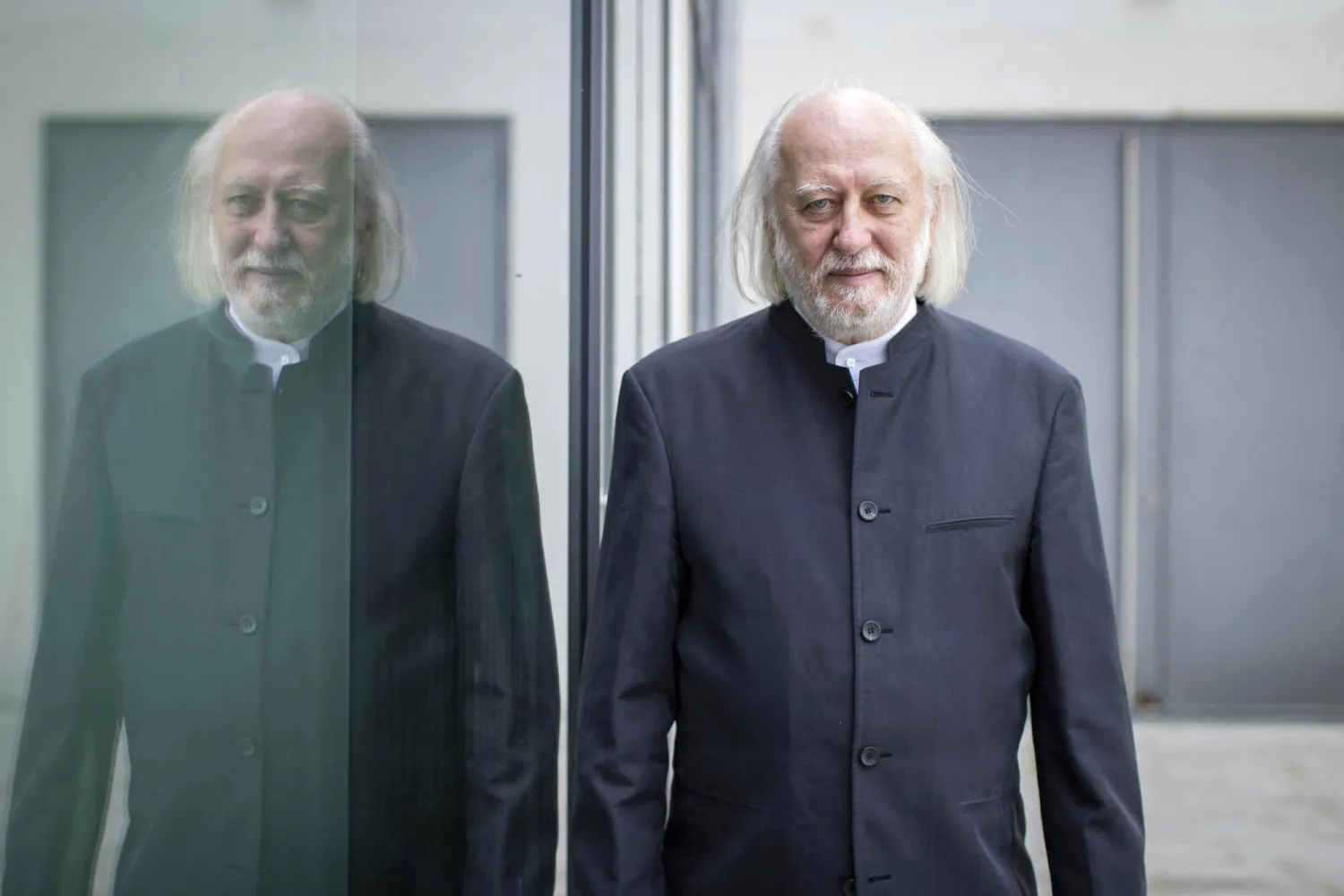
This photo taken on July 26, 2021 shows Hungarian writer Laszlo Krasznahorkai posing for a photo in Salzburg, on the occasion of the presentation of the Austrian State Prize for European Literature 2021. (Photo by Leo NEUMAYR / APA / AFP) / Austria OUT
TT

Hungarian Master of Absurdist Excess László Krasznahorkai Wins Nobel Literature Prize

This photo taken on July 26, 2021 shows Hungarian writer Laszlo Krasznahorkai posing for a photo in Salzburg, on the occasion of the presentation of the Austrian State Prize for European Literature 2021. (Photo by Leo NEUMAYR / APA / AFP) / Austria OUT

Hungarian writer László Krasznahorkai, whose surreal and anarchic novels combine a bleak world view with mordant humor, won the Nobel Prize in literature Thursday for work the judges said upholds the power of art in the midst of “apocalyptic terror.”

The Nobel judges said the 71-year-old author, whose novels sometimes consist of just one long sentence, is “a great epic writer” whose work “is characterized by absurdism and grotesque excess.”

He’s the first Nobel literature winner from Hungary since Imre Kertesz in 2002 and joins a list of laureates that includes Ernest Hemingway, Toni Morrison and Kazuo Ishiguro.

“I am calm and very nervous,” Krasznahorkai told Radio Sweden after getting news of the prize, which comes with an award of more than $1 million. “This is the first day in my life when I got a Nobel Prize. I don't know what's coming in the future.”

The work that won the Nobel Prize in literature The American writer and critic Susan Sontag once described Krasznahorkai as the “contemporary master of the Apocalypse.” His work has echoes of other European writers who explored the absurd tragicomedy of existence, including Franz Kafka and Samuel Beckett, The Associated Press said.

Zsuzsanna Varga, a Hungarian literature expert at the University of Glasgow, said Krasznahorkai’s novels probe the “utter hopelessness” of human existence, while also being “incredibly funny.”

Krasznahorkai’s near-endless sentences made his work the “Hotel California” of literature — once readers get into it, “you can never leave,” she said.

Varga suggested readers new to Krasznahorkai’s work start with “Satantango,” his 1985 debut, which centered around the few remaining residents of a dying collective farm and set the tone for what was to follow.

Krasznahorkai has since written more than 20 books, including “The Melancholy of Resistance,” a surreal, disturbing tale involving a traveling circus and a stuffed whale, and “Baron Wenckheim’s Homecoming,” the sprawling saga of a gambling-addicted aristocrat.

“Herscht 07769,” from 2021, is set in a German town riven with unrest. Written as a series of letters to then-German Chancellor Angela Merkel, it has just one period in its 400 pages.

Several works, including “Satantango,” and “The Melancholy of Resistance” were turned into films by Hungarian director Béla Tarr.

Krasznahorkai also wrote several books inspired by his travels to China and Japan, including “A Mountain to the North, a Lake to the South, Paths to the West, a River to the East,” published in Hungarian in 2003.

How Krasznahorkai came to win Krasznahorkai had been on the Nobel radar for some time, committee member Steve Sem-Sandberg said, calling his literary output “almost half a century of pure excellence.”

The writer was born in the southeastern Hungarian city of Gyula, near the border with Romania, and studied law at universities in Szeged and Budapest before shifting his focus to literature.

Varga, the academic, said Krasznahorkai developed a cult following among young Hungarians during the twilight of Communism in the 1980s, when “authors were pretty much like pop stars.”

János Szegő, Krasznahorkai’s editor at the Budapest-based Magvető publishing house, said that the author’s works deal with “life on the periphery,” and are interested in “the techniques of power.”

“All the populist tendencies of our time can also be found in his novels — from barbarism to the manipulation of the masses,” Szegő said.

Krasznahorkai has been a critic of autocratic Hungarian Prime Minister Viktor Orbán, especially his government's lack of support for Ukraine after the Russian invasion.

In an interview with Swedish newspaper Svenska Dagbladet earlier this year, Krasznahorkai expressed criticism both of Orbán’s political system and the nationalism present in Hungarian society.

“There is no hope left in Hungary today and it is not only because of the Orbán regime,” he told the paper. “The problem is not only political, but also social.”

Orbán nonetheless congratulated the writer in a Facebook post, saying: “The pride of Hungary, the first Nobel Prize winner from Gyula, László Krasznahorkai.”

How Krasznahorkai and others reacted Krasznahorkai received the 2015 Man Booker International Prize for his body of work and the National Book Award for Translated Literature in the US in 2019 for “Baron Wenckheim’s Homecoming.”

He said none of his career was planned.

“I wanted at first to write only one book. And I didn’t want to be a writer,” he told Swedish radio, but rereading his first novel he discovered it wasn’t perfect.

“I started to write another one because I wanted to correct ‘Satantango,’” he said, and later “I tried to write a new book to correct the first two. ... My life is a permanent correction.”

The literature prize has been awarded by the Nobel committee of the Swedish Academy 117 times to a total of 121 winners. Last year's winner was South Korean author Han Kang. The 2023 winner was Norwegian writer Jon Fosse, whose work includes a seven-book epic made up of a single sentence.

The literature prize is the fourth to be announced this week, following the 2025 Nobels in medicine, physics and chemistry.

The winner of the Nobel Peace Prize will be announced Friday. The final Nobel, the Nobel Memorial Prize in Economic Sciences, will be announced Monday.

Nobel Prize award ceremonies are held on Dec. 10, the anniversary of Alfred Nobel’s death in 1896. Nobel was a wealthy Swedish industrialist and the inventor of dynamite who founded the prizes.

Each prize carries an award of 11 million Swedish kronor (nearly $1.2 million). Winners also receive an 18-carat gold medal and a diploma.

Syrian Culture Minister Applauds Saudi Pavilion at Damascus Book Fair

The 2026 Damascus International Book Fair is held from February 6 to 16 - SPA
TT

Syrian Culture Minister Applauds Saudi Pavilion at Damascus Book Fair

The 2026 Damascus International Book Fair is held from February 6 to 16 - SPA

Syrian Minister of Culture Mohammed Yassin Saleh visited the Kingdom’s pavilion at the 2026 Damascus International Book Fair, held from February 6 to 16, where the Kingdom is serving as the Guest of Honor.

He commended the efforts of the Literature, Publishing and Translation Commission in showcasing the rich diversity of the Saudi cultural and literary scene. The pavilion features exhibitions of manuscripts, a Saudi fashion corner, and archaeological replicas, SPA reported.

The minister reviewed the commission's Tarjim translation initiative and Saudi literature comics.

This participation at the 2026 Damascus International Book Fair showcases Saudi creativity and fosters cultural dialogue, supporting Saudi Vision 2030’s goals of knowledge exchange and cultural leadership.


Saudi Arabia, Syria Underline Depth of their Cultural Ties

Syrian President al-Sharaa receives the Saudi minister of culture and the accompanying delegation at the Conference Palace in Damascus on Thursday. (SPA)
TT

Saudi Arabia, Syria Underline Depth of their Cultural Ties

Syrian President al-Sharaa receives the Saudi minister of culture and the accompanying delegation at the Conference Palace in Damascus on Thursday. (SPA)

Saudi Arabia and Syria underlined the strength of their cultural relationship during high-level meetings held in Damascus on Thursday, on the sidelines of the opening of the Damascus International Book Fair 2026, where the Kingdom is participating as guest of honor.

Syrian President Ahmad al-Sharaa received Saudi Minister of Culture Prince Badr bin Abdullah bin Farhan at the Conference Palace in the capital.

Earlier the same day, Prince Badr met with his Syrian counterpart, Minister of Culture Mohammad Yassin Saleh, during an official visit to attend the fair. T

he Saudi minister congratulated Syria on hosting the exhibition and expressed his wishes for continued prosperity, progress, and stability for the Syrian government and people.

Both meetings highlighted the depth of cultural relations between the two countries, the importance of expanding joint cultural cooperation across various fields, and the alignment of positions on issues of mutual interest in a way that serves both nations.

The Saudi delegation included senior officials and advisers, among them representatives from the Royal Court, the Ministry of Culture, and the King Abdulaziz Public Library, reflecting broad institutional engagement in the visit.

In the evening, Prince Badr attended the opening ceremony of the fair’s special session, held under the patronage and in the presence of al-Sharaa. The event drew wide official and cultural participation, including Arab ministers, political and intellectual figures, and a distinguished group of writers and cultural figures.

In a post on the X platform, Prince Badr thanked “our brothers in Syria for their generous hospitality and their efforts in organizing the Damascus International Book Fair.”

The minister also inaugurated the Kingdom’s pavilion at the fair in the presence of the Syrian minister of culture and the Qatari minister of culture.

Saudi Arabia’s guest-of-honor participation continues until Feb. 16 and reflects its growing prominence and leadership in the Arab and global cultural landscape.

This participation aligns with Saudi Vision 2030, which places culture at the heart of national development, viewing it as a space for dialogue, a bridge for civilizational communication, and a tool for strengthening ties among Arab peoples.

The Saudi Literature, Publishing and Translation Commission is leading the Kingdom’s participation, highlighting the development of the cultural sector and reaffirming the central role of books as carriers of knowledge and awareness.

The Saudi pavilion boasts a comprehensive cultural program featuring intellectual seminars, poetry evenings, a manuscript exhibition, traditional Saudi fashion displays, hospitality corners, archaeological replicas, and performing arts that express the depth of the Kingdom’s cultural heritage.

On the sidelines of the visit, Prince Badr, accompanied by Minister Saleh, toured the National Museum of Damascus, which houses rare artifacts spanning prehistoric eras, ancient Syrian civilizations, classical and Islamic periods, as well as traditional and modern art.


UNESCO Honors Al-Bisht Al-Hasawi as Thousands Flock to Al-Ahsa Festival

Visitors can explore interactive displays, participate in live workshops, and witness the meticulous process of tailoring this iconic symbol of prestige - SPA
TT

UNESCO Honors Al-Bisht Al-Hasawi as Thousands Flock to Al-Ahsa Festival

Visitors can explore interactive displays, participate in live workshops, and witness the meticulous process of tailoring this iconic symbol of prestige - SPA

The third edition of Al-Bisht Al-Hasawi Festival is drawing thousands of regional and international visitors to Ibrahim Palace in historic Al-Hofuf.

Organized by the Heritage Commission, this year’s festival celebrates the inscription of the Bisht on UNESCO’s Representative List of the Intangible Cultural Heritage of Humanity.

The event showcases Al-Ahsa’s centuries-old tradition of hand-weaving and gold embroidery, a craft passed down through generations of local families, SPA reported.

Visitors can explore interactive displays, participate in live workshops, and witness the meticulous process of tailoring this iconic symbol of prestige.

With UNESCO's participation and representatives from six countries, the festival has evolved into a global platform for cultural dialogue, cementing the Bisht’s status as a world-class cultural treasure.