


Study Shows How Solar Eclipse Made Some Birds Sing Like a New Day Dawned

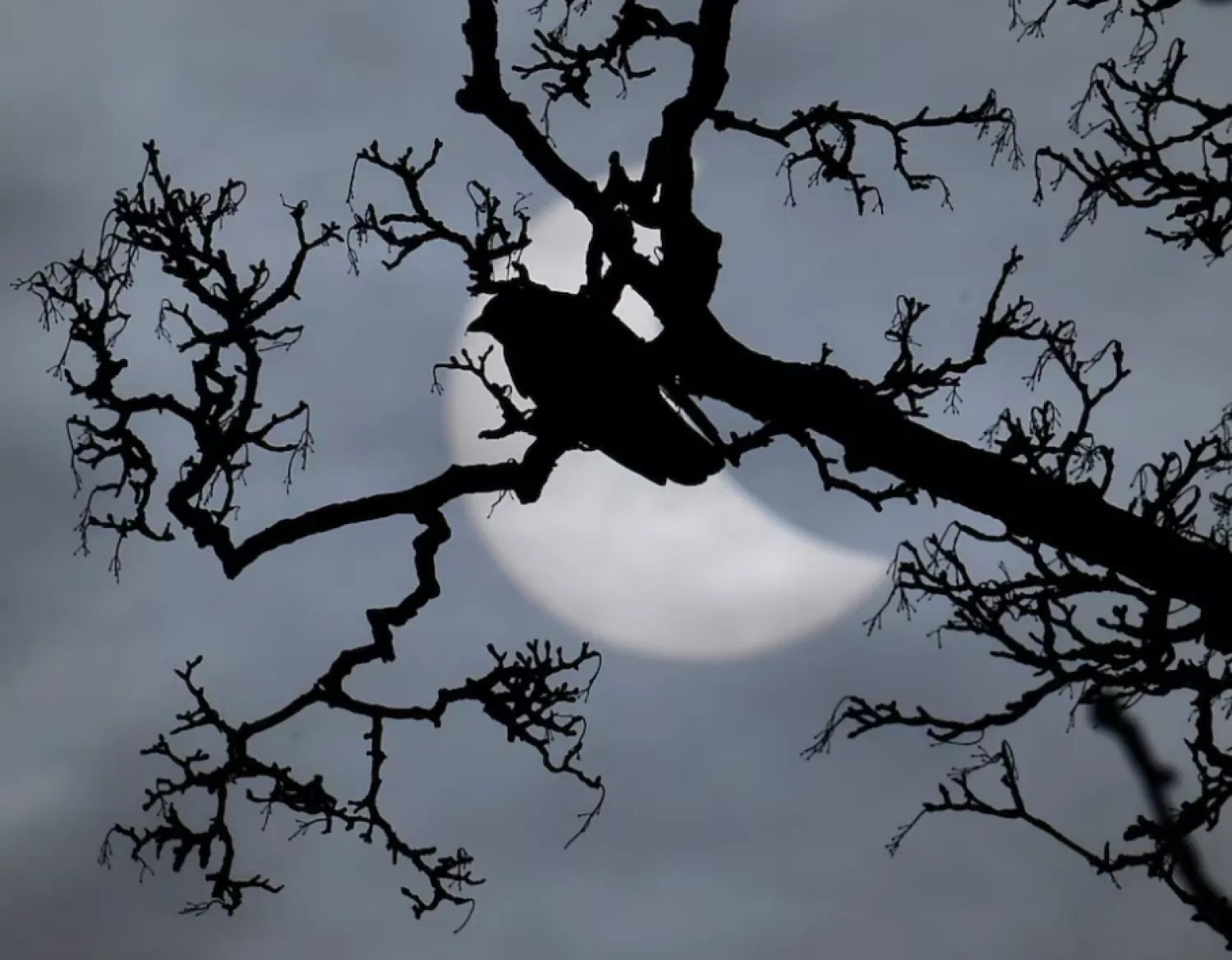
A bird sits on a branch in front of a partial solar eclipse near Bridgwater, in southwestern England, March 20, 2015. REUTERS/Toby Melville/File Photo
TT

Study Shows How Solar Eclipse Made Some Birds Sing Like a New Day Dawned

A bird sits on a branch in front of a partial solar eclipse near Bridgwater, in southwestern England, March 20, 2015. REUTERS/Toby Melville/File Photo

On April 8, 2024, a total solar eclipse traversed a wide swathe of North America stretching 2,500 miles (4,000 km) from Mexico's Pacific Coast through Texas and across 14 other US states into Canada. The period of totality, when the moon covered the face of the sun, lasted about four minutes depending on the location.

While throngs of people gazed skyward to see the celestial show, scientists were studying the effects of the eclipse on birds, whose daily and seasonal rhythms are strongly guided by sunlight. They documented changes in vocal behavior in most - not all - species studied, with birds that naturally make a burst of songs and calls around daybreak the most affected, Reuters reported.

When the sunlight began to return after totality, some species produced their customary "dawn chorus," as if greeting a new day. Some species fell silent, while others did not change their behavior compared to a normal day.

"Light is one of the most powerful forces shaping bird behavior, and even a four-minute 'night' was enough for many species to act as if it were morning again. That tells us just how sensitive some birds are to changes in light," said Liz Aguilar, a doctoral student in evolution, ecology and behavior at Indiana University and lead author of the study published this week in the journal Science.

"Based on previous research, most of which was collected in the lab, we know that changes in light are the most important cues used by living organisms to time their daily rhythms. As day transitions to night and vice versa, hormone levels and gene expression in the body change, and that causes differences in behavior," said study co-author Dustin Reichard, a biology professor at Ohio Wesleyan University.

While there had been anecdotal evidence concerning the behavior of birds during an eclipse and some research involving certain species, this study offered the most comprehensive look yet at the subject, with the findings coming from two datasets.

Fourteen recording units placed around Bloomington, Indiana, captured more than 100,000 bird vocalizations that were analyzed using machine-learning tools to discern the individual species making the songs and calls. In addition, nearly 1,700 people across North America submitted more than 11,000 observations of bird behavior around the eclipse through an app created by the researchers called SolarBird that let anyone in the general public with a smartphone contribute data.

A total of 52 species were documented around Bloomington, 29 of which exhibited significant changes in their vocal behavior as the eclipse occurred compared to a normal April afternoon.

"Different bird species greet the dawn in very different ways. Some have loud, elaborate dawn choruses, while others are much quieter. We found that species known for the most intense dawn choruses were also the ones most likely to react to the eclipse," Aguilar said.

Various species behaved in various ways. For instance, American robins, known for singing very early in the morning while it is still dark, had one of the largest increases in vocalizations during and just after totality - six times higher than a non-eclipse afternoon.

Barred owls vocalized four times as much as a non-eclipse afternoon just after totality ended, when light levels resembled the dawn or dusk periods when their activity normally increases.

Carolina wrens, also known for being particularly vocal including around dawn, were not affected at all by the eclipse.

"It actually makes sense that not all species reacted the same way. Birds differ in how sensitive they are to changes in light. It would have been more surprising if every species responded identically. Each species has its own activity patterns, energetic needs and sensory abilities, so they interpret environmental changes differently," Aguilar said.

"We looked for patterns among closely related species and also compared migratory versus resident birds, but we didn't find any consistent differences," Aguilar said. "That tells us there's still more to learn about what makes certain species more or less sensitive to sudden changes in light, which will be an important direction for future research."



Berlin Drowning in Potatoes… for Free

Sack of fresh raw potatoes (Shutterstock)
TT

Berlin Drowning in Potatoes… for Free

Sack of fresh raw potatoes (Shutterstock)

A vast stockpile of potatoes is being given away for free by a farm in the German state of Saxony, after a bumper national harvest.

Thousands of tasty tubers have been rolling into the country's capital, Berlin, since mid-January, with residents risking icy streets to bag their share, according to BBC.

Dubbed “the great potato rescue” it is part of a plan to stop about 4 million kg of surplus spuds from going to ruin. Food banks, schools and churches are among the beneficiaries, according to organizers.

However, the enterprise was labelled a “disgusting PR stunt” by the Brandenburg Farmers' Association, which lamented the impact on local markets.

Germany is the European Union's potato-producing capital, and last year's harvest has left the market saturated.

Ultimately it is about “putting the potato in the spotlight as a valuable food,” said Berliner Morgenpost editor, Peter Schink who helped spearhead the plan.

The newspaper teamed up with eco-friendly search engine firm, Ecosia, to co-ordinate and fund the distribution of the spuds.

Not wishing to discard its “magnificent tubers” back into the fields, Osterland Agrar says it's set to have bussed around 500,000kg to Berlin, and other parts of Germany and Ukraine.

"We can store them until the middle of this year," said Hans-Joachim von Massow, Managing Director of Osterland Agrar, the agricultural firm that ended up with all the potatoes, after a customer contract was cancelled and settled.

But not everyone is celebrating.

“Food is and will remain valuable, even if thoughtless do-gooders throw around free potatoes at schools and churches,” said Timo Scheib from the Brandenburg Farmers' Association.


Bezos's Blue Origin to 'Pause' Space Tourism to Focus on Moon Efforts

Jeff Bezos arrives to attend Dior Haute Couture Spring/Summer 2026 show in Paris, France, January 26, 2026. REUTERS/Abdul Saboor
TT

Bezos's Blue Origin to 'Pause' Space Tourism to Focus on Moon Efforts

Jeff Bezos arrives to attend Dior Haute Couture Spring/Summer 2026 show in Paris, France, January 26, 2026. REUTERS/Abdul Saboor

Jeff Bezos's space company Blue Origin said Friday it would temporarily pause flights of its space tourism rocket to focus more resources on its lunar ambitions.

According to AFP, the company said in a statement it would "pause New Shepard flights for no less than two years" in order to "further accelerate development of the company's human lunar capabilities."

"The decision reflects Blue Origin's commitment to the nation's goal of returning to the Moon and establishing a permanent, sustained lunar presence," the statement read.

New Shepard is a reusable rocket that has carried dozens of humans across the Karman line, the internationally recognized boundary of space.

But Blue Origin also aims to compete with Elon Musk's SpaceX in the orbital flight market.

Last year, the company founded by Amazon's Jeff Bezos successfully carried out two uncrewed orbital flights using its massive New Glenn rocket, which is significantly more powerful than New Shepard.

Also last year, NASA said it was opening bids for a planned Moon mission, the third phase of the Artemis program, to compete against rival SpaceX, which the then-chief said was "behind."

Blue Origin currently has the contract for the fifth planned mission of the multibillion-dollar Artemis program.

US President Donald Trump's second term in the White House has seen the administration pile pressure on NASA to accelerate its progress to send a crewed mission to the Moon, as China carries out similar efforts.


Cuddly Olympics Mascot Facing Life or Death Struggle in the Wild

The ermine and stoat mascots of the 2026 Olympic Games are everywhere, but their real-life counterparts risk dwindling in the wild. Piero CRUCIATTI / AFP
TT

Cuddly Olympics Mascot Facing Life or Death Struggle in the Wild

The ermine and stoat mascots of the 2026 Olympic Games are everywhere, but their real-life counterparts risk dwindling in the wild. Piero CRUCIATTI / AFP

Tina and Milo, the ermine and stoat mascots of the upcoming 2026 Olympic Games in Italy, are already everywhere -– smiling on stuffed animals, posters, mugs and T-shirts.

But it's another story for their real-life counterparts –- living out of sight and under pressure in the Alps as their snow cover slowly melts away due to climate change.

Ermines and stoats are the same animal -- mustela erminea -- but with the ermine sporting its white winter coat and the stoat its brown one for summer. And while they might be the face of the Olympics, they're disappearing in Italy's Alps, according to the country's only dedicated ermine researcher.

Since 2022, University of Turin doctoral student Marco Granata has been single-handedly monitoring the sinewy, hard-to-spot mammals who inhabit the same mountain peaks where the games will take place, high in the snowy Italian Alps where their winter coats camouflage them from predators.

"The ermine is like a wild ghost. It's a small, elusive animal," Granata told AFP.

"What makes it so interesting to me is the fact that it risks disappearing from entire mountains."

Easy targets

The small mammal's ability to molt -- its brown coat turning to white in November -- is what Granata calls a "super power" that's allowed it to survive for thousands of years.

But now it's a liability.

"The ermine faces a mismatch when it finds itself completely white in a world that should be white but is no longer so," Granata said.

Snow cover in the Italian Alps has decreased by half in the last 100 years, according to a study published in December 2024 in the International Journal of Climatology.

With their snow camouflage gone, the white ermines now stand out starkly against their mountain backdrop, becoming easy targets for predators such as hawks, owls or foxes.

Another problem awaits when the energetic carnivores climb to higher altitudes in search of snow -- a lack of prey.

While the ermines are compelled to ascend, the snow voles and mice they depend upon for food have no need to do so, as they don't change color.

Ski slopes also encroach on ermine habitat because of "competition for the areas where it snows the most," Granata said.

His research predicts ermine habitat in the Italian Alps will decrease by 40 percent by 2100, with ermines forced to climb by an average of 200 meters and the voles staying put.

There is little fuss made in Italy over ermines, which were once heavily hunted for their white pelts to adorn royal ceremonial robes. Scientists have paid them scant attention in recent decades, given the difficulty of gathering data on the fast-moving creatures.

The International Union for Conservation of Nature (IUCN), the world's largest environmental network, last classified the ermine in 2015 as of "least concern" on a list of potentially threatened species.

But that influential list is out of date, argues Granata, who hopes his research will lead to their protection.

"The fact that a doctoral student is the expert on a species shows how little attention has actually been paid to this species," he said.

'Invisible world'

Every fall, Granata hikes Italy's Maritime Alps placing special camera traps -- plastic boxes with a motion-triggered camera inside -- that help him analyse the animal's seasonal patterns.

"You have to think like an ermine," he said, placing the box in areas where the curious mammal might go to find food.

When the snow melts, Granata collects the data from inside the boxes and watches a season's worth of videos and photos.

"It's like unwrapping a gift because you don't know what's inside... you actually see this invisible world," he said.

In one August video, an energetic stoat twists, sniffs and darts around in constant motion as he explores the box.

In October, after learning of the Games' choice of mascot, Granata launched an appeal to the Milano Cortina organizers, asking their sustainability team to help fund university research.

This week they sent a letter declining, which Granata considers a "huge missed opportunity".

The ermine, he said, isn't "just a cute little animal that roams our mountains, but a wild animal at risk of extinction".