

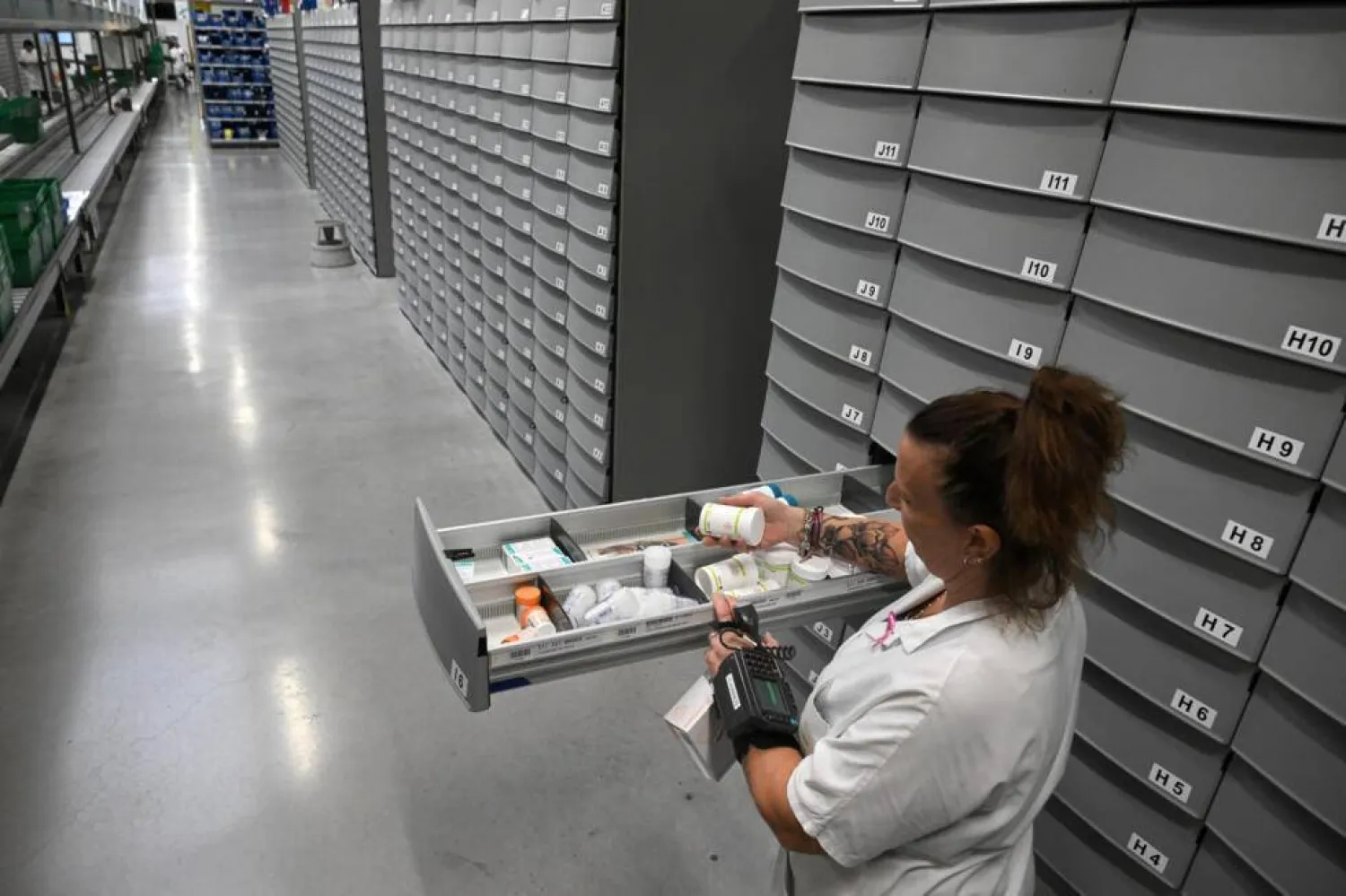

Chronic Drug Shortages Frustrate EU Pharmacists, Patients

Europe depends on Asia for 70 percent of active pharmaceutical ingredients. Nicolas TUCAT / AFP
TT

Chronic Drug Shortages Frustrate EU Pharmacists, Patients

Europe depends on Asia for 70 percent of active pharmaceutical ingredients. Nicolas TUCAT / AFP

At a drug wholesaler warehouse in Belgium, shelves are emptier than they used to be.

Like other EU nations, Belgium has increasingly experienced medicine shortages that vex pharmacists, exasperate patients and risk overloading public health services.

"There are often several dozen medications that are in short supply simultaneously, which makes our lives very difficult," said Didier Ronsyn, a Brussels pharmacist.

An EU audit last month found shortages were a "chronic headache" across the bloc.

Its 27 states reported running critically short of 136 drugs, including antibiotics and medicines used to treat heart attacks, between 2022 and 2024, the European Court of Auditors (ECA) said.

Belgium reported the most cases, with more than a dozen critical instances -- meaning no alternatives are available -- notified to the European Medicines Agency (EMA) in 2024 only.

The cause partially lies in supply chain snags and Europe's over-reliance on Asia for key drug components, the ECA said.

Cheaper prices mean that Asian producers now supply the EU with 70 percent of the active pharmaceutical ingredients it needs, according to a study cited in the ECA report.

The dependency is particularly acute for painkillers, like paracetamol or ibuprofen, and drugs that ran critically low in recent years, including some antibiotics and salbutamol, an asthma drug sold under the brand name Ventolin.

Yet, EU internal market inefficiencies are also to blame.

'Colossal workload'

Drug prices differ within the bloc as national authorities negotiate individually with producers, explained Olivier Delaere, CEO of Febelco, a wholesale distributor that serves about 40 percent of Belgian pharmacies.

As a consequence, manufacturers tend to deliver more to countries that pay more, and just enough to those who drove a harder bargain -- to avoid drugs being re-exported for profit, he said.

Additionally, the ECA said that most medicines are still authorized at national level and packages differ significantly among countries, which makes internal EU trade "more costly and complex".

This causes so-called "local shortages", when a product is not available in one EU country but can be found just across the border in another member state, said Delaere of Febelco.

"It's a growing problem," he said, as a massive automated dispenser stacked with medicine boxes filled green baskets -- each corresponding to a pharmacist's order -- on a conveyor belt in the warehouse behind him.

Some 70 percent of the about one million client calls the firm receives a year "are focused solely on medicine shortages", Delaere said. "It is an absolutely colossal workload and energy drain."

'Complicated', for now

In 2024, EU pharmacists spent on average 11 hours per week managing shortages, according to PGEU, a pharmacists' trade group.

Ronsyn said he often spends an hour a day "making phone calls, checking information, sending patients away, or calling them back to tell them their medication has arrived or in certain cases, that it hasn't" -- something that did not happen in the past.

"It's also tough for the patient, who might panic a little when they don't get their medication on time," he said.

Brussels has been scrambling to find solutions.

In March, the European Commission proposed a "critical medicines act" aimed at boosting manufacturing in the EU by providing incentives and urging member states to move away from price as the key criterion for awarding procurement contracts.

It was followed in July by a "stockpiling strategy" to coordinate stocks and ensure medicines and other goods are available in case of crisis.

A commission spokeswoman said Brussels was confident that these and other recently introduced proposals "will make a substantial difference" and "significantly help tackling the problem".

The bills are currently being negotiated with the European Parliament and member states, a sometimes lengthy process.

"They are trying to find solutions, but it is always very slow," said Ronsyn, whose pharmacy overlooks the commission offices. "We will probably get there someday, but for now it's complicated."



Mummified Cheetahs Found in Saudi Caves Shed Light on Lost Populations

This undated image provided by Communications Earth and Environment shows the mummified remains of a cheetah. (Ahmed Boug/Communications Earth and Environment via AP)
TT

Mummified Cheetahs Found in Saudi Caves Shed Light on Lost Populations

This undated image provided by Communications Earth and Environment shows the mummified remains of a cheetah. (Ahmed Boug/Communications Earth and Environment via AP)

Scientists have uncovered the mummified remains of cheetahs from caves in northern Saudi Arabia.

The remains range from 130 years old to over 1,800 years old. Researchers excavated seven mummies along with the bones of 54 other cheetahs from a site near the city of Arar.

Mummification prevents decay by preserving dead bodies. Egypt's mummies are the most well-known, but the process can also happen naturally in places like glacier ice, desert sands and bog sludge.

The new large cat mummies have cloudy eyes and shriveled limbs, resembling dried-out husks.

“It’s something that I’ve never seen before,” said Joan Madurell-Malapeira with the University of Florence in Italy, who was not involved with the discovery.

Researchers aren’t sure how exactly these new cats got mummified, but the caves’ dry conditions and stable temperature could have played a role, according to the new study published Thursday in the journal Communications Earth and Environment.

They also don't know why so many cheetahs were in the caves. It could have been a denning site where mothers birthed and raised their young.

Scientists have uncovered the rare mummified remains of other large cats, including a saber-toothed cat cub in Russia.

It's uncommon for large mammals to be preserved to this degree. Besides being in the right environment, the carcasses also have to avoid becoming a snack for hungry scavengers like birds and hyenas.

Cheetahs once roamed across most of Africa and parts of Asia, but now live in just 9% of their previous range and haven't been spotted across the Arabian Peninsula for decades. That’s likely due to habitat loss, unregulated hunting and lack of prey, among other factors.

In a first for naturally mummified large cats, scientists were also able to peek at the cheetahs' genes and found that the remains were most similar to modern-day cheetahs from Asia and northwest Africa. That information could help with future efforts to reintroduce the cats to places they no longer live.


Vonn Launches Social Media Search Mission After Ski Pole Goes Missing

 US' Lindsey Vonn crosses the finish line to win the Women's Downhill event of the FIS Alpine Ski World Cup in Altenmarkt Zauchensee, Austria, on January 10, 2026. (AFP)
US' Lindsey Vonn crosses the finish line to win the Women's Downhill event of the FIS Alpine Ski World Cup in Altenmarkt Zauchensee, Austria, on January 10, 2026. (AFP)
TT

Vonn Launches Social Media Search Mission After Ski Pole Goes Missing

 US' Lindsey Vonn crosses the finish line to win the Women's Downhill event of the FIS Alpine Ski World Cup in Altenmarkt Zauchensee, Austria, on January 10, 2026. (AFP)
US' Lindsey Vonn crosses the finish line to win the Women's Downhill event of the FIS Alpine Ski World Cup in Altenmarkt Zauchensee, Austria, on January 10, 2026. (AFP)

Lindsey Vonn may be dominating World Cup downhills at 41, but even the US speed queen is not immune to missing equipment.

Vonn took to social media on Thursday with an unusual plea after losing a ski pole in Tarvisio, Italy, ahead of this weekend's World Cup event.

"Someone took ‌my pole ‌in the parking ‌lot ⁠today in ‌Tarvisio. If you have seen it, please respond to this. Thank you," Vonn wrote on X, posting a photo of the matching pole complete with her initials on the ⁠hand strap.

Vonn, a favorite for the speed events ‌at next month's Milano-Cortina ‍Olympics, retired ‍from the sport in 2019 and ‍had a partial knee replacement in April 2024 but returned to competition later that year and has been enjoying a fairy-tale comeback that has defied age and expectation.

Already the oldest ⁠World Cup winner of all time, Vonn continued her astonishing, age-defying form with a downhill victory in Zauchensee, Austria last week.

That triumph marked Vonn's fourth podium from four downhills this season, cementing her lead in the World Cup standings and her status as the woman to ‌beat at next month's Olympics.


ISS Crew Splashes Down on Earth After Medical Evacuation

FILE - This photo provided by NASA shows the Moon's shadow covering portions of Canada and the US during a total solar eclipse as seen from the International Space Station on Monday, Aug. 8, 2024. (NASA via AP, File)
TT

ISS Crew Splashes Down on Earth After Medical Evacuation

FILE - This photo provided by NASA shows the Moon's shadow covering portions of Canada and the US during a total solar eclipse as seen from the International Space Station on Monday, Aug. 8, 2024. (NASA via AP, File)

Four International Space Station (ISS) crewmembers splashed down in the Pacific Ocean early Thursday, video footage from NASA showed, after a medical issue prompted their mission to be cut short.

American astronauts Mike Fincke and Zena Cardman, Russian cosmonaut Oleg Platonov and Japan's Kimiya Yui landed off the coast of San Diego about 12:41 am (0841 GMT), marking the first-ever medical evacuation from the ISS.