


Scientists Probe Tajik Glacier for Clues to Climate Resistance

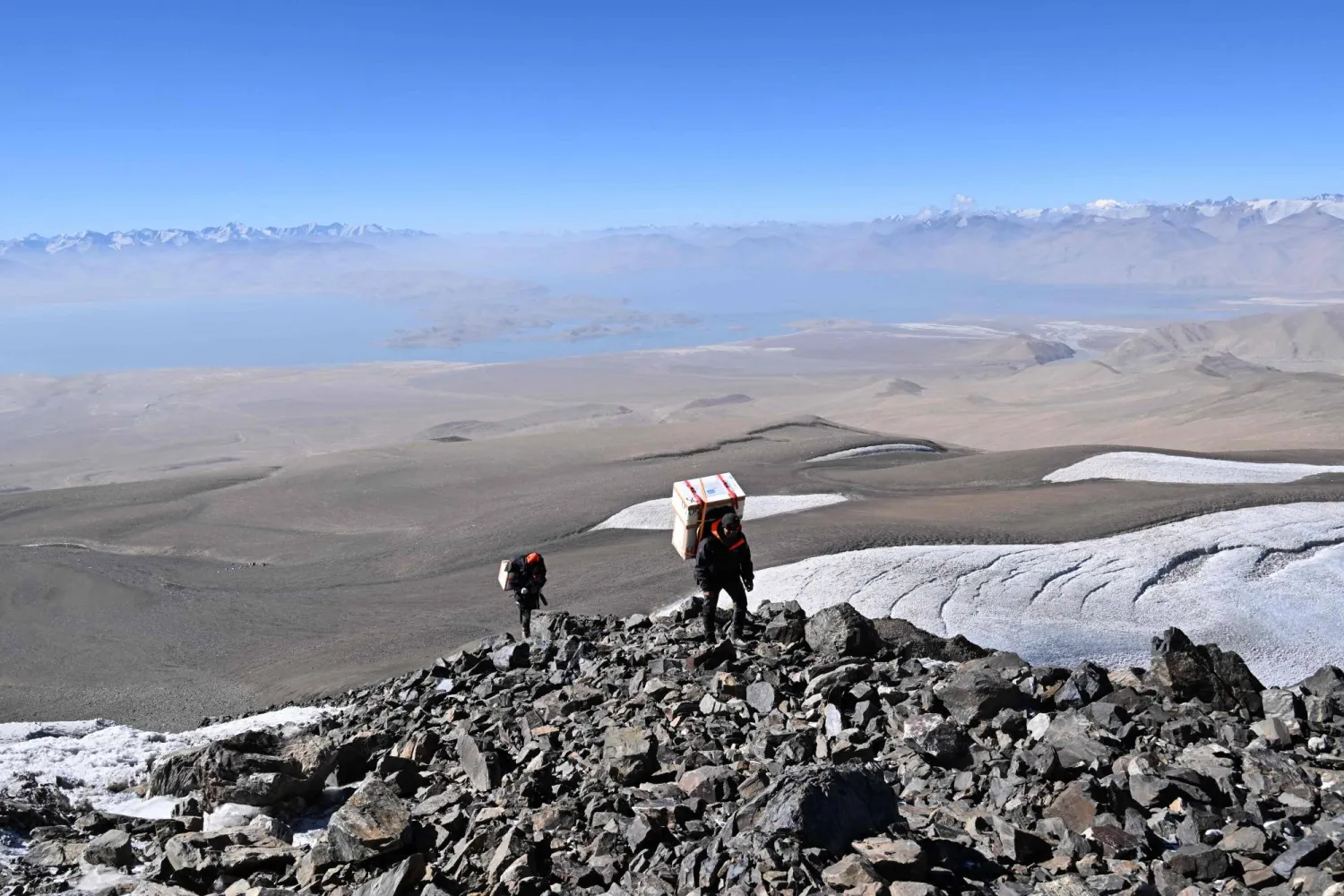
Russia's Ivan Lavrentiev and  Tadjikistan's Jahongir Abdullov, members of the expedition "Pamir-Ice-Memory" climb up at the  base of Pamir Glacier on September 25, 2025 in Kon Chukurbashi, eastern Tadjikistan. (Photo by Prakash MATHEMA / AFP)
Russia's Ivan Lavrentiev and Tadjikistan's Jahongir Abdullov, members of the expedition "Pamir-Ice-Memory" climb up at the base of Pamir Glacier on September 25, 2025 in Kon Chukurbashi, eastern Tadjikistan. (Photo by Prakash MATHEMA / AFP)
TT

Scientists Probe Tajik Glacier for Clues to Climate Resistance

Russia's Ivan Lavrentiev and  Tadjikistan's Jahongir Abdullov, members of the expedition "Pamir-Ice-Memory" climb up at the  base of Pamir Glacier on September 25, 2025 in Kon Chukurbashi, eastern Tadjikistan. (Photo by Prakash MATHEMA / AFP)
Russia's Ivan Lavrentiev and Tadjikistan's Jahongir Abdullov, members of the expedition "Pamir-Ice-Memory" climb up at the base of Pamir Glacier on September 25, 2025 in Kon Chukurbashi, eastern Tadjikistan. (Photo by Prakash MATHEMA / AFP)

Greenland is melting, the Alps are melting and the Himalayas are melting -- yet in one vast mountain region, huge glaciers have remained stable, or even gained mass, in recent decades. Can it last?

To find out, a dozen scientists, accompanied exclusively by an AFP photographer, trekked high over one glacier in eastern Tajikistan to drill for ice cores -- ancient, deep samples that can shed precious light on climate change.

In September and October, they first spent four days crossing the country from west to east in four-wheel drives, then climbed on foot to over 5,800 meters altitude on the Kon-Chukurbashi ice cap, near the Chinese border.

Camping for a week at the summit, in freezing temperatures and despite a day-long blizzard, the scientists from Switzerland, Japan, the United States and Tajikistan drilled the glacier to extract two 105-metre-long ice cores, in sections.

These layers of ice, compacted over centuries, perhaps millennia, form an archive of climate indicators, yielding data on past snowfall, temperatures, atmosphere and dust.

They must now be analyzed in a laboratory to reveal their dates, said the leader of the team, Evan Miles, a glaciologist affiliated with the universities of Fribourg and Zurich.

"We're hopeful for a truly unique core, not just for the region, but for the broader region actually, probably extending back 20 to 25 or 30,000 years."

The apparently resistant glaciers are spread over thousands of kilometers of high mountain ranges in Central Asia, including Karakoram, Tian Shan, Kun Lun and the Pamir mountains of Tajikistan.

By delving back in time in the ice there, researchers hope to find out why these glaciers have resisted the general planetary warming of recent decades -- and whether this so-called "Karakoram anomaly" could be ending.

"This whole region is globally unique because over the last 25 years, these glaciers have shown very, very limited mass loss and even mass gain," said Miles.

The glaciers have shown some limited signs of loss in recent years, but scientists want to determine whether this is a natural variation or the beginning of a real decline.

"In order to understand that, we really, really need to have a longer time period of records of both temperature and precipitation at the glacier sites," said Miles.

"That's the type of information that an ice core can tell us."

One core will be sent to Japan for analysis and another stored in an underground sanctuary in Antarctica at minus 50C.

That naturally cold storage site is a project of the Ice Memory Foundation, which supported the Tajikistan expedition along with main funder, the Swiss Polar Institute.

The foundation, created in 2021 by French, Italian and Swiss universities and research centers, has already collected several cores in the Alps, Greenland, the Andes and elsewhere.

Future scientists will "be able to analyze (them) with their most modern analytical tools in 50, 100, 200 years and extract new information", said Ice Memory's president Thomas Stocker.

"We will probably lose 90 percent of our glacier mass on the Earth," Stocker told AFP. "So we are trying to help preserve a thing that is threatened by human action."

The scientists were scheduled to review their mission during a news conference in the Tajik capital Dushanbe on Monday.



ISS Crew Splashes Down on Earth After Medical Evacuation

FILE - This photo provided by NASA shows the Moon's shadow covering portions of Canada and the US during a total solar eclipse as seen from the International Space Station on Monday, Aug. 8, 2024. (NASA via AP, File)
TT

ISS Crew Splashes Down on Earth After Medical Evacuation

FILE - This photo provided by NASA shows the Moon's shadow covering portions of Canada and the US during a total solar eclipse as seen from the International Space Station on Monday, Aug. 8, 2024. (NASA via AP, File)

Four International Space Station (ISS) crewmembers splashed down in the Pacific Ocean early Thursday, video footage from NASA showed, after a medical issue prompted their mission to be cut short.

American astronauts Mike Fincke and Zena Cardman, Russian cosmonaut Oleg Platonov and Japan's Kimiya Yui landed off the coast of San Diego about 12:41 am (0841 GMT), marking the first-ever medical evacuation from the ISS.


Lonely Tree in Wales Is an Instagram Star, but its Fate Is Inevitable

The Lonely Tree, often pictured submerged in water, was first planted in 2010. (Getty Images)
TT

Lonely Tree in Wales Is an Instagram Star, but its Fate Is Inevitable

The Lonely Tree, often pictured submerged in water, was first planted in 2010. (Getty Images)

It is one of Wales' most-loved beauty spots - but the time of the so-called Lonely Tree being an Instagram star could be slowly coming to an end.

The birch tree's striking setting at Llyn Padarn in Eryri, also known as Snowdonia, draws photographers to capture the sight through the seasons, according to BBC.

But the local authority Cyngor Gwynedd has raised the prospect of the tree, which was planted around 2010, disappearing within the next decade or so.

A lack of nutrients in the soil means birch trees have “a relatively short lifespan” in the area, typically living for around 30 years, but the fact that The Lonely Tree is sometimes submerged in water means its time could be even shorter.

Thousands of walkers and photographers make their way there each year and the tree has many social media sites dedicated to it, including one with 3,500 members on Facebook.

Marc Lock from Bangor, Gwynedd, said: “The Lonely Tree holds a special place in my heart and that of my family.”

He added: “Nestled down by the Lonely Tree, it's a perfect spot for us to sit, reflect and soak in the breath-taking scenery. We often go paddleboarding there in the summer months.”

However, Lock said the area really became his sanctuary after his wife bought him a camera for Christmas and he took up photography.

It was the place he headed to straight away, and he returns regularly at various times of the day and throughout the seasons.

“It's my go-to spot whenever I have some free time and my camera in hand,” he added. “I can't imagine what I would do if anything devastating happened to it like that at the Sycamore Gap tree at Hadrian's Wall. It's simply unthinkable.”

The Sycamore Gap was a much-loved landmark beside Hadrian's Wall in Northumberland that also drew hikers and photographers from far and wide.

It was more than 100 years old and had been the scene of many proposals, with people making the trip there from around the world.

But it was cut down by vandals in September 2023, causing uproar, with thousands of people leaving tributes and posting messages about their love for the beauty spot.

Two men were jailed for four years and three months after admitting the illegal felling.

While maybe not quite as famous as the Sycamore Gap was, The Lonely Tree is every bit as special to those that hold it dear to their heart.


Four Signs You're Self-Sabotaging Your Joy

Threat or uncertainty can reduce cognitive regulation and increase avoidance behaviors. (Indiana University)
TT

Four Signs You're Self-Sabotaging Your Joy

Threat or uncertainty can reduce cognitive regulation and increase avoidance behaviors. (Indiana University)

Most of us, at some point in our lives, have stood in the way of our own growth.

We make progress on a project, start to feel hopeful about a relationship, or finally get on track with a goal, and then we do something that undermines it.

We fall into a procrastination spiral, pick a fight, or simply quit; in doing so, we talk ourselves out of something that could potentially bring us happiness.

There’s a name for this kind of behavior: self-sabotage.

Dr. Mark Travers, an American psychologist with degrees from Cornell University and the University of Colorado Boulder, wrote an essay at Psychology Today about four well-studied reasons why people sabotage good things, based on research in psychology.

Avoiding blame

According to Travers, one of the most consistently researched patterns in self-sabotage comes from what psychologists call self-handicapping.

He said this is a behavior in which people create obstacles to their own success so that if they fail, they can blame external factors instead of internal ability.

A prime example comes from classic research in which researchers observed students who procrastinated studying for an important test. The ones who failed mostly attributed it to a lack of preparation rather than a lack of organization or discipline.

Self-handicapping is not simply laziness or whimsy. Rather, it is a strategy people use to protect their self-worth in situations where they might perform “poorly” or where they might be perceived as inadequate.

Fear of failure or success

People often think of the fear of failure as the main emotional driver behind self-sabotage.

But research points to the fear of success as an equal, yet less-talked-about engine of the phenomenon. Both fears can push people to undermine opportunities that are actually aligned with their long-term goals.

He said people who worry that failure will confirm their negative self-beliefs are more likely to adopt defensive avoidance tactics, like procrastination or quitting early.

Fear of success, though less widely discussed, operates in a similar fashion. What motivates this fear is the anxiety that comes with the consequences of success.

So, self-sabotaging success can be a way to stay within a comfort zone where expectations are familiar, even if that zone is unsatisfying.

Negative self-beliefs

Self-sabotage is tightly intertwined with how people view themselves. When someone doubts their worth, their ability, or their right to be happy, they may unconsciously act in ways that confirm those negative self-views.

Psychological theories help explain this.

Self-discrepancy theory proposes that people experience emotional discomfort when their actual self does not match their ideal self. This mismatch can lead to negative emotions such as shame, anxiety, or depression.

Coping with stress and anxiety

Self-sabotage often emerges in moments of high stress or emotional threat. When people feel overwhelmed, anxious, or stretched thin, their nervous systems shift into protective modes. Instead of moving forward, they retreat, avoid, or defensively withdraw.

Threat or uncertainty can reduce cognitive regulation and increase avoidance behaviors. In situations of perceived threat, even if the threat is potential success or evaluation, people can default to behaviors that feel safer, even if they undermine long-term goals.