
An Estimated 1 Million Cats Prowl the Streets of Cyprus as Officials Scramble to Check Their Numbers 

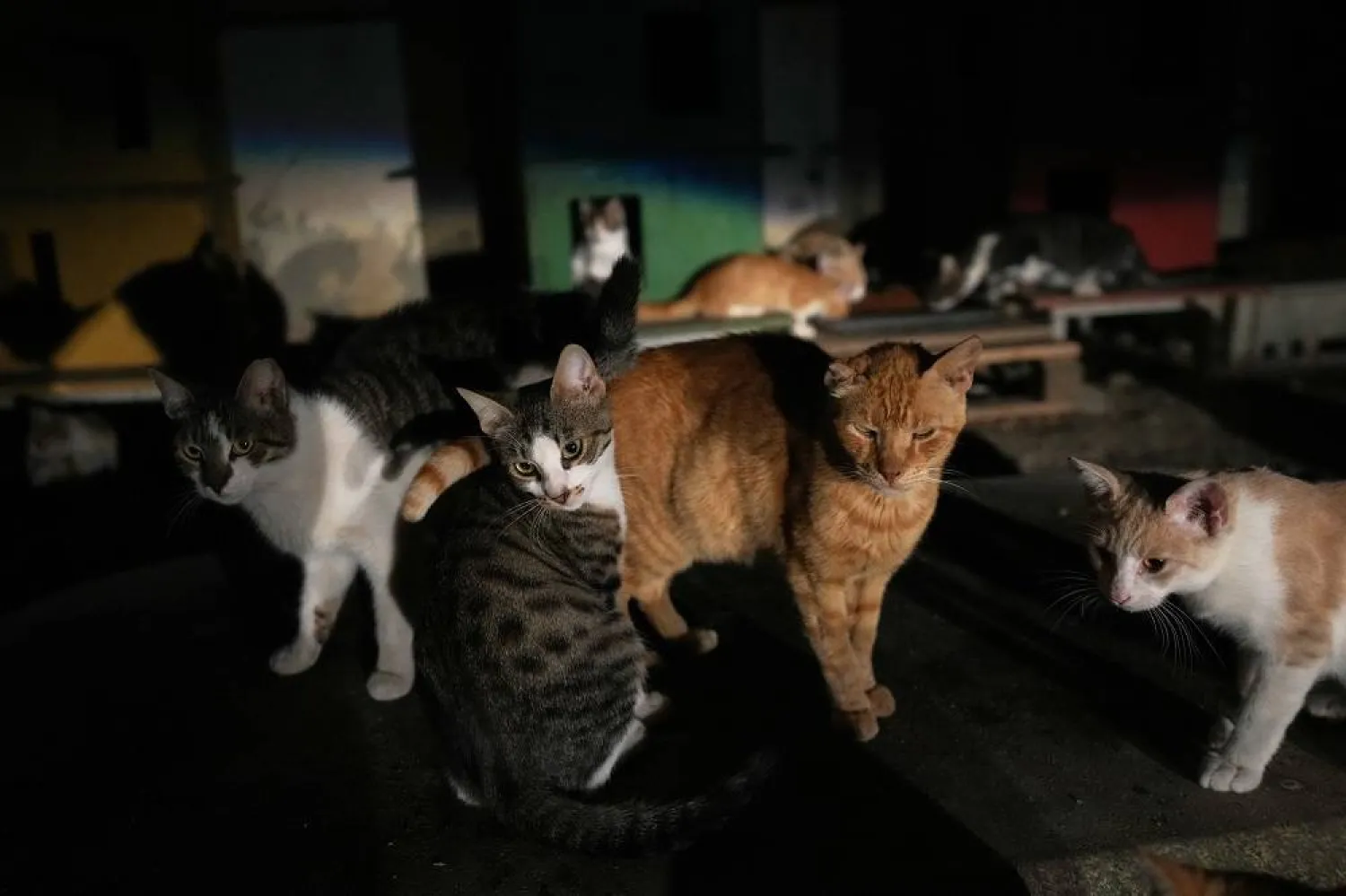
Cats are seen at a park in Lakatamia area, of capital Nicosia, Cyprus, Oct. 4, 2025. (AP)
TT

An Estimated 1 Million Cats Prowl the Streets of Cyprus as Officials Scramble to Check Their Numbers 

Cats are seen at a park in Lakatamia area, of capital Nicosia, Cyprus, Oct. 4, 2025. (AP)

The island of cats has a cat problem.

Officials in Cyprus, the small island nation in the eastern corner of the Mediterranean, estimate there is roughly one feral cat for every one of its 1 million inhabitants — though activists contend the actual population is hundreds of thousands higher.

In late September, the island’s parliamentary committee on the environment was told that an existing sterilization program is too limited to contain the burgeoning cat population.

“It’s a good program, but it needs to expand,” said Environment Commissioner Antonia Theodosiou, noting that the program conducts only about 2,000 sterilizations annually on a budget of just 100,000 euros ($117,000).

While there is no official comparative data, Theodosiou said Cyprus has gained a reputation for having a cat population that is exceptionally large relative to its human inhabitants.

‘There has to be a plan’

Change might be on the way, but funding alone won’t solve Cyprus’s cat problem.

Appearing to heed calls for more funding, Environment Minister Maria Panayiotou announced on Oct. 4 — World Animal Day — that the government would raise cat sterilization funding to 300,000 euros annually. The decision was hailed as a significant step forward.

However, Charalambos Theopemptou, chairman of the Parliamentary Environment Committee, warned against relying on money alone. “There has to be a plan," he said. "We can't just go ahead with sterilizations without having a plan,” he said.

Given cats’ predatory nature, a large population not only has the potential to wreak havoc with the island’s ecosystem, but it could cause undue suffering for feral felines roaming car-choked streets in search of food and shelter.

Cyprus' historic cats

Cyprus has a long history as a cat-loving nation where cat food dispensaries and clusters of tiny houses are a regular sight along popular footpaths.

Two decades ago, French archaeologists unearthed what they believed to be the earliest evidence of a domesticated cat in a 9,500-year-old neolithic village. They found the bones of a cat close to the skeletal remains of a human, suggesting that they were buried together.

Adding to this long history of human-feline connection is the 4th century legend of Saint Helen who, after finding the True Cross in the Holy Lands, brought over a couple of boatloads of cats to deal with a snake infestation. A monastery that serves as a feline safe haven, St. Nicholas of the Cats, still exists today.

With tourism a key economic driver for Cyprus, the island’s cats have become a major attraction for the millions of vacationers who descend on the island every year. The well-fed felines are a common sight, often seen feasting on leftovers provided by visitors at the plethora of restaurants where they like to hang out.

Felines galore

Demetris Epaminondas, president of the Veterinary Association, attributes the exploding population to unchecked breeding, particularly in high-concentration urban areas, and to more kittens surviving birth, thanks to ordinary folks offering care.

The current government-run program disburses its budget to municipalities which, in turn, fund private veterinarians to sterilize cats brought in by animal conservation groups.

Authorities acknowledge the program is ineffective.

The country’s state-run Veterinary Services, which is in charge of sterilizations, conceded that the program’s capabilities are "lesser than the real need.” To reassess where available funding could be redistributed, it has asked local government authorities to submit reports on locations with large feral cat concentrations.

Elias Demetriou who runs the private sanctuary Friends of Larnaca Cats said tripling sterilization funds won't have the desired effect unless conservationist groups who have the know-how are recruited to round up cats for sterilization.

Eleni Loizidou, head of Cat Alert, a volunteer organization caring for strays in Nicosia, said her organization’s recent efforts to round up 397 feral cats from the city center were a mere drop in the ocean and that too few females are being sterilized, partly because of the difficulty in trapping feral cats.

‘There are solutions’

Epaminondas, the Veterinary Association president, said Cyprus' cat population can be brought under control in as few as four years. This would be possible, he said, if authorities cobble together a unified sterilization plan that would put private clinics at the forefront of the effort by offering free-of-charge neutering without all the red tape that complicates the process.

“People will be more motivated to get cats neutered if we make it easier for them to do so,” he said.

His association has proposed a plan that would identify major cat concentration centers where authorities can round them up and take them for sterilization at designated vets. The initiative includes the creation of a smartphone application that would allow anyone to help authorities locate such large cat concentrations.

The state can avoid bearing the full cost of the program by setting up a fund where people and businesses can donate, according to Epaminondas. The minister's announcement about tripling the sterilization budget, he said, could act as a significant incentive for more corporate donations.

The cost of sterilizing a female feral cat in Cyprus is 55 euros ($64), which goes up to 120 euros for domesticated cats brought in by owners, as they receive more specialized care.

Theodosiou, the environment commissioner, said her staff have worked on a long-term strategy that would bring together government, conservationists, and volunteers to establish a precise cat population count and pave the way for a mass sterilization program. The plan would also legalize private cat sanctuaries.

“There are solutions,” Cat Alert's chief Loizidou said.


Saudi Arabia Participates in Drafting the International AI Safety Report 2026

General view of Riyadh, Saudi Arabia. (SPA)
TT

Saudi Arabia Participates in Drafting the International AI Safety Report 2026

General view of Riyadh, Saudi Arabia. (SPA)

The Kingdom of Saudi Arabia, represented by the Saudi Data and Artificial Intelligence Authority (SDAIA), participated for the second consecutive year in the preparation of the International AI Safety Report 2026, reinforcing its international efforts to advance AI safety and support responsible innovation worldwide, the Saudi Press Agency said on Monday.

The report, emerging from the 2023 AI Safety Summit at Bletchley Park, provides a scientific assessment of advances in advanced AI systems, examines associated risks, and outlines practical approaches to strengthening safety standards and global governance, serving as a key reference for policymakers, regulators, and researchers.

The report is a comprehensive global document assessing AI risks and related challenges and serves as a trusted scientific reference to support regulatory policies and the development of governance frameworks for the safe and responsible use of advanced technologies.

The report was developed by a distinguished group of international scientists and experts in AI safety and technology governance, featuring specialists from prestigious universities and research centers, as well as representatives from over 30 countries and major international organizations, including the United Nations, the Organization for Economic Co-operation and Development, and the European Union.

The report highlights several key messages, notably the importance of keeping pace with the rapidly growing capabilities of AI through advanced regulatory and scientific frameworks, the need to invest in safety and technical compliance research to ensure systems remain under effective human oversight, and the promotion of international coordination to establish common standards supporting the safe and responsible use of advanced technologies.

It also emphasizes the need to consider economic and social dimensions to ensure the fair distribution of AI benefits and reduce inequality gaps.

Saudi Arabia’s participation in this international effort aligns with the objectives of Saudi Vision 2030, which aims to establish the Kingdom as a global hub for technological innovation while upholding the highest standards of responsibility and technical security.

It reflects the Kingdom’s commitment to actively shaping the global future of AI, promoting sustainable development, safeguarding community security, and enhancing international cooperation toward a safer, more stable technological future.


US Astronaut to Take her 3-year-old's Cuddly Rabbit Into Space

FILE PHOTO: An evening launch of a SpaceX Falcon 9 rocket carrying 20 Starlink V2 Mini satellites, from Space Launch Complex at Vandenberg Space Force Base is seen over the Pacific Ocean from Encinitas, California, US, June 23, 2024. REUTERS/Mike Blake/File Photo
TT

US Astronaut to Take her 3-year-old's Cuddly Rabbit Into Space

FILE PHOTO: An evening launch of a SpaceX Falcon 9 rocket carrying 20 Starlink V2 Mini satellites, from Space Launch Complex at Vandenberg Space Force Base is seen over the Pacific Ocean from Encinitas, California, US, June 23, 2024. REUTERS/Mike Blake/File Photo

When the next mission to the International Space Station blasts off from Florida next week, a special keepsake will be hitching a ride: a small stuffed rabbit.

American astronaut and mother, Jessica Meir, one of the four-member crew, revealed Sunday that she'll take with her the cuddly toy that belongs to her three-year-old daughter.

It's customary for astronauts to go to the ISS, which orbits 250 miles (400 kilometers) above Earth, to take small personal items to keep close during their months-long stint in space.

"I do have a small stuffed rabbit that belongs to my three-year-old daughter, and she actually has two of these because one was given as a gift," Meir, 48, told an online news conference.

"So one will stay down here with her, and one will be there with us, having adventures all the time, so that we'll keep sending those photos back and forth to my family," AFP quoted her as saying.

US space agency NASA says SpaceX Crew-12 will lift off on a SpaceX Falcon 9 rocket from Cape Canaveral in Florida to the orbiting scientific laboratory early Wednesday.

The mission will be replacing Crew-11, which returned to Earth in January, a month earlier than planned, during the first medical evacuation in the space station's history.

Meir, a marine biologist and physiologist, served as flight engineer on a 2019-2020 expedition to the space station and participated in the first all-female spacewalks.

Since then, she's given birth to her daughter. She reflected Sunday on the challenges of being a parent and what is due to be an eight-month separation from her child.

"It does make it a lot difficult in preparing to leave and thinking about being away from her for that long, especially when she's so young, it's really a large chunk of her life," Meir said.

"But I hope that one day, she will really realize that this absence was a meaningful one, because it was an adventure that she got to share into and that she'll have memories about, and hopefully it will inspire her and other people around the world," Meir added.

When the astronauts finally get on board the ISS, they will be one of the last crews to live on board the football field-sized space station.

Continuously inhabited for the last quarter century, the aging ISS is scheduled to be pushed into Earth's orbit before crashing into an isolated spot in the Pacific Ocean in 2030.

The other Crew-12 astronauts are Jack Hathaway of NASA, European Space Agency astronaut Sophie Adenot, and Russian cosmonaut Andrey Fedyaev.


iRead Marathon Records over 6.5 Million Pages Read

Participants agreed that the number of pages read was not merely a numerical milestone - SPA
TT

iRead Marathon Records over 6.5 Million Pages Read

Participants agreed that the number of pages read was not merely a numerical milestone - SPA

The fifth edition of the iRead Marathon achieved a remarkable milestone, surpassing 6.5 million pages read over three consecutive days, in a cultural setting that reaffirmed reading as a collective practice with impact beyond the moment.

Hosted at the Library of the King Abdulaziz Center for World Culture (Ithra) and held in parallel with 52 libraries across 13 Arab countries, including digital libraries participating for the first time, the marathon reflected the transformation of libraries into open, inclusive spaces that transcend physical boundaries and accommodate diverse readers and formats.

Participants agreed that the number of pages read was not merely a numerical milestone, but a reflection of growing engagement and a deepening belief in reading as a daily, shared activity accessible to all, free from elitism or narrow specialization.

Pages were read in multiple languages and formats, united by a common conviction that reading remains a powerful way to build genuine connections and foster knowledge-based bonds across geographically distant yet intellectually aligned communities, SPA reported.

The marathon also underscored its humanitarian and environmental dimension, as every 100 pages read is linked to the planting of one tree, translating this edition’s outcome into a pledge of more than 65,000 trees. This simple equation connects knowledge with sustainability, turning reading into a tangible, real-world contribution.

The involvement of digital libraries marked a notable development, expanding access, strengthening engagement, and reinforcing the library’s ability to adapt to technological change without compromising its cultural role. Integrating print and digital reading added a contemporary dimension to the marathon while preserving its core spirit of gathering around the book.

With the conclusion of the iRead Marathon, the experience proved to be more than a temporary event, becoming a cultural moment that raised fundamental questions about reading’s role in shaping awareness and the capacity of cultural initiatives to create lasting impact. Three days confirmed that reading, when practiced collectively, can serve as a meeting point and the start of a longer cultural journey.