


IMF Upgrades US Growth Outlook as Trump’s Tariffs Cause Less Disruption, for Now

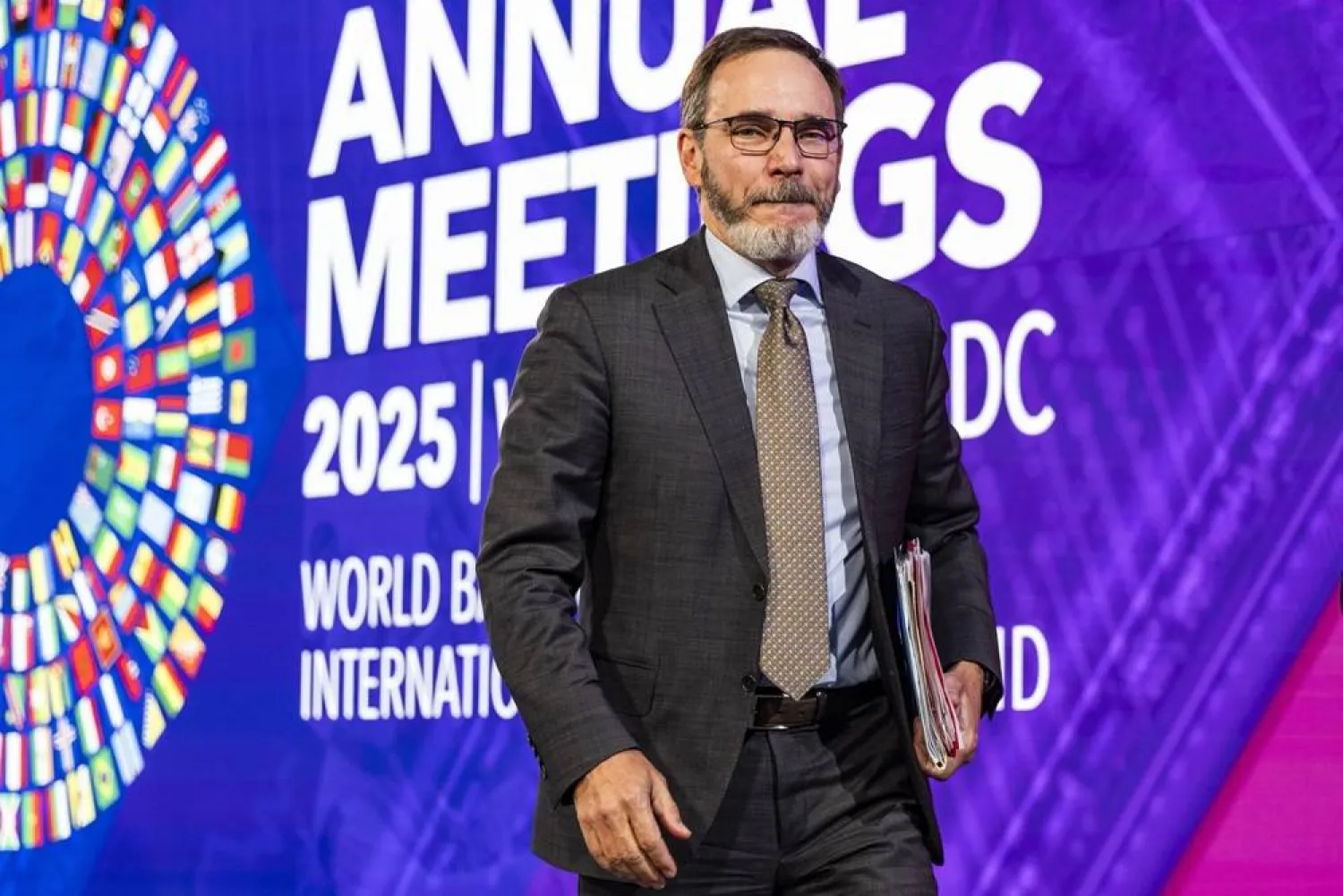
Pierre-Olivier Gourinchas, Economic Counselor of the International Monetary Fund (IMF), departs from a press briefing on the global economic outlook at the 2025 IMF and World Bank Annual Meetings at IMF headquarters in Washington, DC, USA, 14 October 2025. (EPA)
TT

IMF Upgrades US Growth Outlook as Trump’s Tariffs Cause Less Disruption, for Now

Pierre-Olivier Gourinchas, Economic Counselor of the International Monetary Fund (IMF), departs from a press briefing on the global economic outlook at the 2025 IMF and World Bank Annual Meetings at IMF headquarters in Washington, DC, USA, 14 October 2025. (EPA)

The US and global economies will grow a bit more this year than previously forecast as the Trump administration's tariffs have so far proved less disruptive than expected, the International Monetary Fund said Tuesday, though the agency also said the extensive duties still pose risks.

The United States' economy will expand 2% in 2025, the IMF projected in its influential semi-annual forecast, the World Economic Outlook. That is slightly higher than the 1.9% forecast in the IMF's last update in July and 1.8% in April. The US should grow 2.1% next year, also just one-tenth of a percent faster than its previous projection, the IMF said.

The global economy, meanwhile, will grow 3.2% this year, up from a 3% estimate in July, the IMF forecast, and 3.1% in 2026, the same as its previous estimate.

The figures represent a bit of a round-trip for the IMF: In January, before President Donald Trump began imposing tariffs, it had forecast global growth of 3.3%, only slightly higher than its newest estimate. While the US and world economies have fared better than expected, it's too soon to say they are fully in the clear, the IMF said, as Trump has continued to make tariff threats and it can take time for changes in international trade patterns to play out.

On Friday, for example, Trump threatened to slap 100% duties on all imports from China, which caused a sharp fall in the stock market.

IMF chief economist Pierre-Olivier Gourinchas said at a news conference that the import taxes and ongoing threats to impose more duties have created ongoing uncertainty for many businesses and it's weighing on the world economy.

"The tariff shock is here, and it is further dimming already weak growth prospects," he said.

Gourinchas also said that a burst of investment in artificial intelligence, in the form of huge data centers and extensive computing power, has helped offset the drag from trade and boosting the US economy. Yet if a financial market bubble formed and then burst, it could sharply slow business investment and consumer spending, he said.

"There are echoes in the current tech investment surge of the dot-com boom of the late 1990s," he said. "It was the Internet then, it is AI now."

Shares of two companies active in the AI sector, AMD and Oracle, which announced an expanding partnership Tuesday, have seen their shares rise 80% this year.

Gains in AI-related stock values have lifted Americans' wealth and fueled consumer spending, Gourinchas said, just as companies are ramping up their investments in advanced computer chips and building data centers. Hotter spending and investment could push central banks to raise interest rates over time, he said.

Gourinchas also offered several reasons the US and global economies have remained resilient after the widespread imposition of tariffs earlier this year.

"First and foremost, the tariff shock itself is smaller than initially feared, with many trade deals and exemptions," he said. "Most countries also refrained from retaliation, keeping the trading system open. And the private sector also proved agile, front-loading imports and re-routing supply chains."

By front-loading imports, many US companies were able to stock up on goods before the duties took effect, enabling them to avoid or delay price increases.

Yet many of those factors only reflect "temporary relief, rather than underlying strength in economic fundamentals," the IMF's report said.

The IMF also said that import price data in the US shows that so far importers and retailers are paying most of the tariffs, not overseas companies, as many Trump administration officials have predicted. Over time, those firms are likely to pass on more of the price hikes to consumers, the report said.

There are signs that some downsides of the higher tariffs are starting to emerge, the IMF outlook said. Core inflation, which excludes the volatile food and energy categories, has ticked up to 2.9%, according to the Federal Reserve's preferred measure, up from 2.7% a year ago. Hiring has ground to nearly a halt, which could partly reflect a more cautious approach by many firms in the wake of the uncertainty created by the higher tariffs.

The IMF's forecasts are modestly more optimistic than many private-sector economists' expectations. The National Association for Business Economics, a group of academic and business economists, on Monday forecast that the US would grow just 1.8% this year and 1.7% in 2026.

Nearly two-thirds of the economists surveyed by the NABE said they think the administration's duties are nevertheless slowing growth, by up to a half-percentage point.

China, meanwhile, has weathered the hit from US tariffs by sending more of its goods to Europe and Asia, rather than the United States, the IMF said. Its currency has depreciated, which has made its exports cheaper. The IMF is forecasting that China's economy will expand 4.8% this year and 4.2% in 2026, the same as in July.

Gourinchas said that China's economy has grown increasingly dependent on exports, while its real estate sector continues to struggle under heavy debt loads.

"It is increasingly hard to see how this could be sustained," he added.

In Europe, Germany is bolstering growth by increasing government spending to build up its military, Gourinchas said. The IMF now expects the 20 countries that use the euro to grow 1.2% this year, up from a 1% forecast in July, and 1.1% next year, the same as three months ago.

The IMF is a 191-nation lending organization that works to promote economic growth and financial stability and to reduce global poverty.



Qatar Airways Names Hamad Al-Khater Group CEO

A Qatar Airways Airbus A350-900 aircraft takes off in Colomiers near Toulouse, France, October 19, 2017. (Reuters)
TT

Qatar Airways Names Hamad Al-Khater Group CEO

A Qatar Airways Airbus A350-900 aircraft takes off in Colomiers near Toulouse, France, October 19, 2017. (Reuters)

State-owned Qatar Airways has named Hamad al-Khater as the group's chief executive officer, effective December 7, replacing Badr Mohammed Al-Meer, it said on Sunday.

Al-Meer was appointed as the carrier's CEO in October 2023. He replaced Akbar Al Baker, one of the airline industry's most outspoken leaders, who retired after almost three decades of running the airline.

Khater served as the chief operating officer at Hamad International Airport and held other positions at Qatar's state-oil company QatarEnergy.


ECB's Rehn Sees Downside Risks to Inflation, Urges Action on Ukraine Funding

FILE PHOTO: Olli Rehn in Helsinki, Finland, January 28, 2024. Lehtikuva/Heikki Saukkomaa via REUTERS
TT

ECB's Rehn Sees Downside Risks to Inflation, Urges Action on Ukraine Funding

FILE PHOTO: Olli Rehn in Helsinki, Finland, January 28, 2024. Lehtikuva/Heikki Saukkomaa via REUTERS

Inflation in the euro zone faces downside risks in the medium term, even as price growth has returned to the ECB's 2% target, European Central Bank policymaker Olli Rehn said, according to a report in a magazine on Saturday.

The sharp drop from the October 2022 peak of 10.6% to around 2% currently was achieved without triggering mass unemployment or a severe slowdown, he told Italian financial magazine Milano Finanza.

"The good news is that inflation has stabilized around the ECB's symmetric 2% target, supporting real incomes in Europe," Reuters quoted him as saying. "Our latest forecast suggests inflation will remain slightly below 2% over the horizon."

Rehn also urged EU leaders to resolve a stalled plan for a Ukraine "repair loan" funded by Russia's frozen assets, calling it "essential, even existential."

He dismissed speculation about ECB involvement, saying such a move would breach the EU Treaty's ban on monetary financing.

Instead, he backed a European Commission proposal under Article 122, often called the 'EU's emergency clause,' that gives the EU Council the power to adopt measures proposed by the European Commission in exceptional circumstances, bypassing the ordinary legislative process and the European Parliament.

"Every European should support using frozen Russian assets to help Ukraine," he said.

The Finnish policymaker, who has served in senior EU roles for decades, confirmed he would be a strong candidate for ECB vice president when the post opens next year.

"I have received encouragement from various parts of Europe," Rehn added.


World Bank to Partner with Global Vaccine Group Gavi on $2 Billion in Funding

The Vaccine Alliance (GAVI) logo and US flag are seen in this illustration taken April 23, 2025. REUTERS/Dado Ruvic/Illustration/File Photo
TT

World Bank to Partner with Global Vaccine Group Gavi on $2 Billion in Funding

The Vaccine Alliance (GAVI) logo and US flag are seen in this illustration taken April 23, 2025. REUTERS/Dado Ruvic/Illustration/File Photo

The World Bank Group said on Saturday it is working with global vaccine alliance Gavi to strengthen financing for immunization and primary healthcare systems, planning to mobilize at least $2 billion over the next five years in joint financing.

The two organizations will also work together to advance vaccine manufacturing in Africa as part of a World Bank goal to help countries reach 1.5 billion people with quality, affordable health services by 2030, Reuters quoted the World Bank as saying.

Gavi is a public-private partnership that helps vaccinate more than half the world’s poorest children against diseases.

"Our expanded collaboration with the World Bank Group reflects a long-standing joint effort to support countries as they build robust and resilient health systems," said Sania Nishtar, Gavi's chief executive.

US Health Secretary Robert F. Kennedy Jr. said in June the United States would no longer contribute funding to Gavi, alleging that the group ignores safety and calling on it to "justify the $8 billion that America has provided in funding since 2001."

The Trump administration had also indicated in March it planned to cut annual funding of around $300 million for Gavi as part of a wider pullback from international aid.

In June, Gavi had more than $9 billion, less than a target of $11.9 billion, for its work over the next five years helping to immunize children.

Other donors, including Germany, Norway and the Gates Foundation, have pledged money this year for Gavi's future work.