


Astronomers Observe Rings Forming Around Icy Celestial Body Chiron

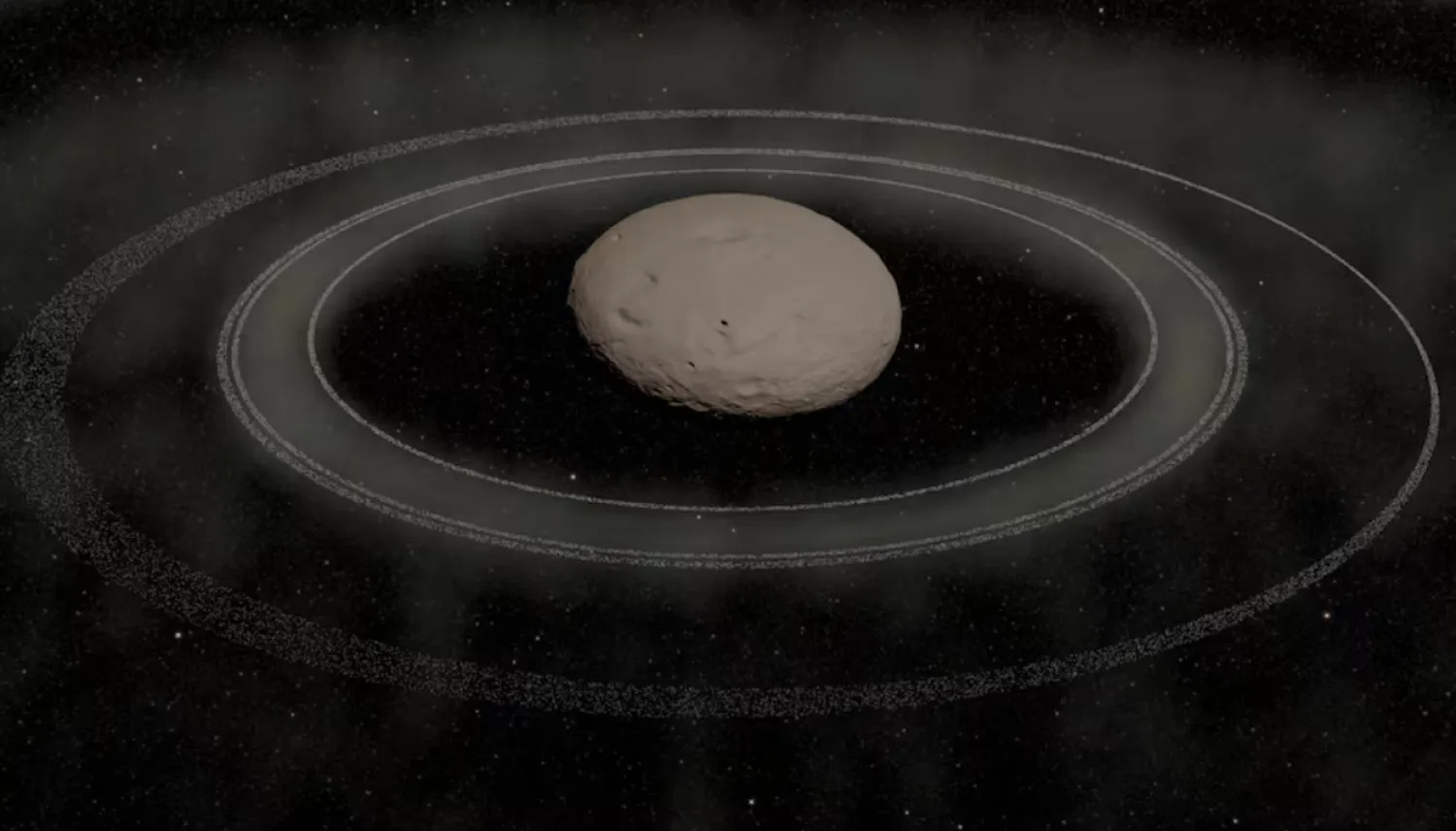
This illustration shows a reconstruction of the centaur object (2060) Chiron, which orbits the sun between the orbits of Saturn and Uranus, and its ring system, in this handout image released on October 14, 2025. UTFPR/Alexandre Crispim/Handout via REUTERS
TT

Astronomers Observe Rings Forming Around Icy Celestial Body Chiron

This illustration shows a reconstruction of the centaur object (2060) Chiron, which orbits the sun between the orbits of Saturn and Uranus, and its ring system, in this handout image released on October 14, 2025. UTFPR/Alexandre Crispim/Handout via REUTERS

The rings of Saturn are among the wonders of our solar system, with a diameter of roughly 175,000 miles (280,000 kilometers) as they encircle the giant planet. But smaller celestial bodies in the solar system also boast ring systems that are impressive in their own right, even if their scale is not as grand.

Scientists said they have observed for the first time a ring system in the process of formation and evolution, consisting of four rings and diffuse material, surrounding a small icy body called Chiron that orbits the sun in the expanse between Saturn and Uranus, according to Reuters.

Chiron is part of a class of objects called centaurs that populate the outer solar system between Jupiter and Neptune, displaying characteristics of both asteroids and comets. Formally called "(2060) Chiron," it has a diameter of about 200 kilometers (125 miles) and takes about 50 years to complete one orbit around the sun. Centaurs are composed mainly of rock, water ice and complex organic compounds.

Since its discovery in 1977, astronomers have observed Chiron off and on, and for years had known it was surrounded by material of some sort. In the new research, scientists obtained their best data on Chiron in 2023 using a telescope at the Pico dos Dias Observatory in Brazil to go along with data from 2011, 2018 and 2022.

The researchers said these observations clearly showed that it is surrounded by well-defined rings - three dense ones about 170 miles (273 km), 202 miles (325 km) and 272 miles (438 km) from Chiron's center, and a fourth one, approximately 870 miles (1,400 km) from its center.

This outer feature, detected for the first time, lies unusually far from Chiron and, they said, requires further observations to confirm its stability as a ring. The three inner rings are embedded within dust swirling around in a disk-like shape.

Comparing data from the various observations of Chiron, the researchers detected significant changes in the ring system, clear evidence that its rings are evolving in real time, according to Chrystian Luciano Pereira, a postdoctoral researcher at the National Observatory in Brazil and lead author of the study published in the Astrophysical Journal Letters.

"This provides a rare glimpse into how such structures originate and change," Pereira said.

Chiron's rings, Pereira added, are likely composed mainly of water ice mixed with small amounts of rocky material, like those of Saturn. Water ice may play a key role in the stability of ring systems because its physical properties allow particles to remain separated instead of coalescing into a moon.

Chiron exhibits occasional comet-like activity - ejecting gas and dust into space. In 1993, Chiron even displayed a small tail of material, as comets do.

The researchers said its rings may be made of leftover material from a possible collision that destroyed a small moon of Chiron or from some other crashes of space debris, or could be from the stuff ejected from Chiron itself - or perhaps some combination of these factors.

"It is an evolving system that will help us understand the dynamical mechanisms governing the creation of rings and satellites around small bodies, with potential implications for various types of disk dynamics in the universe," said astronomer and study co-author Braga Ribas of the Federal University of Technology-Parana and the Interinstitutional Laboratory of e-Astronomy in Brazil.

All four of the solar system's big outer planets - Jupiter, Saturn, Uranus and Neptune - have rings, with Saturn's the largest. But astronomers since 2014 have discovered that some of its smaller bodies have them, too. Chiron brings that number to four, joining fellow centaur Chariklo and two icy worlds beyond Neptune - Haumea and Quaoar.

"This diversity reminds us that ring formation is not exclusive to large planets. It's a universal process that can occur wherever the right physical conditions exist," Pereira said.

A method called stellar occultation was used by a team including Brazilian, French and Spanish researchers to observe the rings. The researchers watched as Chiron passed in front of a distant star, temporarily blocking its light. By measuring how the starlight dims from different locations on Earth, they were able to discern the environment around Chiron.

"We can reconstruct the shape and environment around the object with kilometer-scale precision," Pereira said.



Mummified Cheetahs Found in Saudi Caves Shed Light on Lost Populations

This undated image provided by Communications Earth and Environment shows the mummified remains of a cheetah. (Ahmed Boug/Communications Earth and Environment via AP)
TT

Mummified Cheetahs Found in Saudi Caves Shed Light on Lost Populations

This undated image provided by Communications Earth and Environment shows the mummified remains of a cheetah. (Ahmed Boug/Communications Earth and Environment via AP)

Scientists have uncovered the mummified remains of cheetahs from caves in northern Saudi Arabia.

The remains range from 130 years old to over 1,800 years old. Researchers excavated seven mummies along with the bones of 54 other cheetahs from a site near the city of Arar.

Mummification prevents decay by preserving dead bodies. Egypt's mummies are the most well-known, but the process can also happen naturally in places like glacier ice, desert sands and bog sludge.

The new large cat mummies have cloudy eyes and shriveled limbs, resembling dried-out husks.

“It’s something that I’ve never seen before,” said Joan Madurell-Malapeira with the University of Florence in Italy, who was not involved with the discovery.

Researchers aren’t sure how exactly these new cats got mummified, but the caves’ dry conditions and stable temperature could have played a role, according to the new study published Thursday in the journal Communications Earth and Environment.

They also don't know why so many cheetahs were in the caves. It could have been a denning site where mothers birthed and raised their young.

Scientists have uncovered the rare mummified remains of other large cats, including a saber-toothed cat cub in Russia.

It's uncommon for large mammals to be preserved to this degree. Besides being in the right environment, the carcasses also have to avoid becoming a snack for hungry scavengers like birds and hyenas.

Cheetahs once roamed across most of Africa and parts of Asia, but now live in just 9% of their previous range and haven't been spotted across the Arabian Peninsula for decades. That’s likely due to habitat loss, unregulated hunting and lack of prey, among other factors.

In a first for naturally mummified large cats, scientists were also able to peek at the cheetahs' genes and found that the remains were most similar to modern-day cheetahs from Asia and northwest Africa. That information could help with future efforts to reintroduce the cats to places they no longer live.


Vonn Launches Social Media Search Mission After Ski Pole Goes Missing

 US' Lindsey Vonn crosses the finish line to win the Women's Downhill event of the FIS Alpine Ski World Cup in Altenmarkt Zauchensee, Austria, on January 10, 2026. (AFP)
US' Lindsey Vonn crosses the finish line to win the Women's Downhill event of the FIS Alpine Ski World Cup in Altenmarkt Zauchensee, Austria, on January 10, 2026. (AFP)
TT

Vonn Launches Social Media Search Mission After Ski Pole Goes Missing

 US' Lindsey Vonn crosses the finish line to win the Women's Downhill event of the FIS Alpine Ski World Cup in Altenmarkt Zauchensee, Austria, on January 10, 2026. (AFP)
US' Lindsey Vonn crosses the finish line to win the Women's Downhill event of the FIS Alpine Ski World Cup in Altenmarkt Zauchensee, Austria, on January 10, 2026. (AFP)

Lindsey Vonn may be dominating World Cup downhills at 41, but even the US speed queen is not immune to missing equipment.

Vonn took to social media on Thursday with an unusual plea after losing a ski pole in Tarvisio, Italy, ahead of this weekend's World Cup event.

"Someone took ‌my pole ‌in the parking ‌lot ⁠today in ‌Tarvisio. If you have seen it, please respond to this. Thank you," Vonn wrote on X, posting a photo of the matching pole complete with her initials on the ⁠hand strap.

Vonn, a favorite for the speed events ‌at next month's Milano-Cortina ‍Olympics, retired ‍from the sport in 2019 and ‍had a partial knee replacement in April 2024 but returned to competition later that year and has been enjoying a fairy-tale comeback that has defied age and expectation.

Already the oldest ⁠World Cup winner of all time, Vonn continued her astonishing, age-defying form with a downhill victory in Zauchensee, Austria last week.

That triumph marked Vonn's fourth podium from four downhills this season, cementing her lead in the World Cup standings and her status as the woman to ‌beat at next month's Olympics.


ISS Crew Splashes Down on Earth After Medical Evacuation

FILE - This photo provided by NASA shows the Moon's shadow covering portions of Canada and the US during a total solar eclipse as seen from the International Space Station on Monday, Aug. 8, 2024. (NASA via AP, File)
TT

ISS Crew Splashes Down on Earth After Medical Evacuation

FILE - This photo provided by NASA shows the Moon's shadow covering portions of Canada and the US during a total solar eclipse as seen from the International Space Station on Monday, Aug. 8, 2024. (NASA via AP, File)

Four International Space Station (ISS) crewmembers splashed down in the Pacific Ocean early Thursday, video footage from NASA showed, after a medical issue prompted their mission to be cut short.

American astronauts Mike Fincke and Zena Cardman, Russian cosmonaut Oleg Platonov and Japan's Kimiya Yui landed off the coast of San Diego about 12:41 am (0841 GMT), marking the first-ever medical evacuation from the ISS.