Joint Military Exercises to Bring Together Military Leaders from East, West Libya for the 1st Timehttps://english.aawsat.com/arab-world/5197853-joint-military-exercises-bring-together-military-leaders-east-west-libya-1st
Joint Military Exercises to Bring Together Military Leaders from East, West Libya for the 1st Time
US Africa Command Deputy Commander Lt. Gen. John Brennan meets with LNA deputy commander Gen. Saddam Haftar. Photo: US embassy on X
For the first time since the fall of the late Colonel Muammar Gaddafi's regime in 2011, military leaders from Libya’s east and west are gearing up for joint military exercises sponsored by the United States, seen as an effort to unify the military institution that has been divided for more than a decade.
In Sirte, US Africa Command Deputy Commander Lt. Gen. John Brennan announced that Flintlock 2026, AFRICOM’s premier annual Special Forces exercise, will have a key location in Libya, with the participation of security forces from all regions of the country, as well as Italy and other key partners, the US embassy said in a statement.
“We are honored that a spoke of this important event will take place in Sirte, Libya, a city that has previously witnessed strong US-Libya security collaboration in countering terrorism, and will continue to support our joint professional training efforts, strengthening our shared commitment to regional stability, peace, and prosperity,” said Brennan.
He thanked security forces from east and west of Libya, as well as the Italian government, for facilitating the preparations for the joint exercise.
“We look forward to continued cooperation with our Libyan partners from throughout the country to achieve our shared goals for regional peace and mutual prosperity,” the statement quoted Brennan as saying.
According to the embassy, Brennan and Chargé d’Affaires Jeremy Berndt, met with Libyan National Army (LNA) deputy commander Gen. Saddam Haftar in Sirte on Tuesday night to discuss ways to strengthen US-Libya defense ties and US support for Libyan efforts to unify military institutions.
US Embassy Says Security Ramped up in Jordan after Deadly Church Attackhttps://english.aawsat.com/arab-world/5333104-us-embassy-says-security-ramped-jordan-after-deadly-church-attack
Security personnel stand outside Saint George’s Greek Orthodox Church, where gunmen opened fire during a funeral the previous day, in the village of Hamoud, Karak, Jordan, October 24, 2026. REUTERS/Alaa Al Sukhni
US Embassy Says Security Ramped up in Jordan after Deadly Church Attack
Security personnel stand outside Saint George’s Greek Orthodox Church, where gunmen opened fire during a funeral the previous day, in the village of Hamoud, Karak, Jordan, October 24, 2026. REUTERS/Alaa Al Sukhni
The US embassy in Amman said security had been stepped up at malls, foreign embassies and other locations across Jordan after Friday's attack on a church in Jordan that authorities described as a terrorist act by extremists.
Seven people were killed and dozens were injured when gunmen opened fire during a funeral at a Greek Orthodox church in Karak governorate, the head of Jordan's Public Security Directorate said.
There was no immediate claim of responsibility.
Such attacks are extremely rare in Jordan, though authorities in the US ally say that in recent years they have repeatedly foiled attempted attacks by extremist militants.
Authorities said they are still searching for the attackers, adding it was too early to determine whether they had links to known groups inside or outside Jordan.
"This is a result of a terrorist ideology and blind extremism and we will not allow society to go down this path," Prime Minister Jafar Hassan said in a post on X hours after the violence.
Jordan's King Abdullah visited Karak hours after the attack and said the perpetrators would be punished "with an iron fist".
Christians make up a minority of Jordan's population. The country is home to several biblical sites that attract Christian pilgrims from around the world.
Netanyahu Says Palestinian Authority in for 'Big Surprise'https://english.aawsat.com/arab-world/5333022-netanyahu-says-palestinian-authority-big-surprise
Netanyahu Says Palestinian Authority in for 'Big Surprise'
Israeli troops patrol in the West Bank city of Nablus, 24 October 2026. EPA/ALAA BADARNEH
Israeli Prime Minister Benjamin Netanyahu said that the Palestinian Authority (PA) was in for a "big surprise" after he ordered a major military operation in response to an attack on soldiers in the West Bank.
Netanyahu, days ahead of elections, declined to answer directly when he was asked if he would dismantle the Palestinian Authority but said he favored "ruse and surprise.”
"We transformed the Middle East. I said that we would change things and we have," Netanyahu told i24News in an interview conducted late Friday.
"There is a very big surprise for the Palestinian Authority as well."
Netanyahu on Friday promised a massive military response after Palestinian militants killed two Israeli soldiers near Hebron in the occupied West Bank.
One of his far-right allies called after the attack for Israel to bring down the Palestinian Authority, the semi-autonomous body that governs parts of the West Bank in cooperation with Israel as part of peace accords in the 1990s.
No evidence suggests that the PA was connected to Friday's attack.
700 Square Kilometers Under Israeli Occupation in Lebanon: What Does the ‘Security Belt’ Mean?https://english.aawsat.com/arab-world/5333006-700-square-kilometers-under-israeli-occupation-lebanon-what-does-%E2%80%98security-belt%E2%80%99
700 Square Kilometers Under Israeli Occupation in Lebanon: What Does the ‘Security Belt’ Mean?
Israel’s expanding operations in southern Lebanon are raising questions about how much territory its forces actually occupy, and how much they control through surveillance, firepower and the ability to launch attacks from forward positions.
Israeli Defense Minister Israel Katz has repeatedly cited an area of roughly 700 square kilometers. But developments on the ground paint a more complex picture: Israeli control varies from troops stationed at fixed positions to mobile incursions and firepower dominance over much wider areas.
Military assessments suggest the area is far from a uniform security belt stretching from the Mediterranean coast to Mount Hermon. Its depth varies sharply across sectors, shaped by terrain, commanding heights and routes of movement.
Israeli troops and military vehicles are stationed in some areas. Others have no permanent Israeli military presence but remain under aerial surveillance or within striking range, allowing forces to operate there without maintaining troops on the ground.
Single Front
Defense and security expert Riad Kahwaji told Asharq Al-Awsat that Israel views Lebanon and the Golan Heights as "a single front" stretching from Mount Hermon to the Mediterranean coast at Naqoura and Bayada, despite crossing two countries.
"From its perspective, Israel is establishing a security belt along its northern border," Kahwaji said, adding that the belt is "no longer confined to areas south of the Litani River but has extended north of it in some locations."
Geography helps explain why.
"The geographical scope has effectively expanded beyond the area south of the Litani, particularly from the direction of Metula, where the river is only about seven kilometers away, compared with roughly 30 kilometers between Naqoura and the Litani," he said.
That difference, Kahwaji explained, means the security belt can extend north of the Litani in some areas without maintaining the same depth across the entire border.
The river, therefore, is not a uniform dividing line between northern and southern operational zones. Distances vary, and geography dictates how far Israeli troops or firepower can reach.
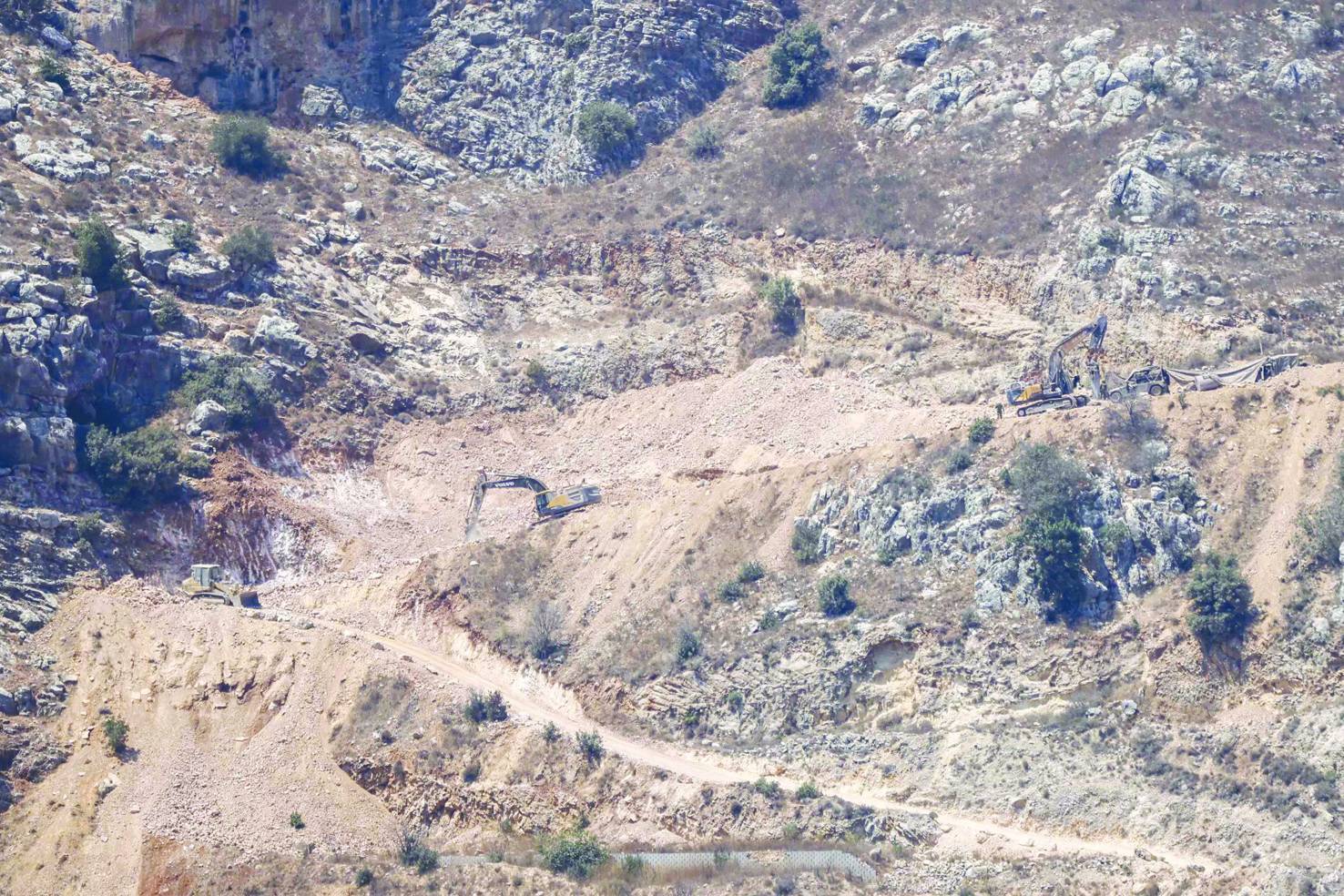
Israeli bulldozers carve roads through the mountainous al-Shaqif region in southern Lebanon (AFP)
Firepower
Kahwaji drew a distinction between occupying territory and controlling it through surveillance and firepower.
He said Israel relies on about 20 military positions, each capable of accommodating a small force, while drones continuously monitor movements deeper inside the area.
"Each position could accommodate a company-sized force, while drones operate continuously farther behind these positions to monitor movements," he said.
"When drones detect movement, it is targeted by artillery or an airstrike. Alternatively, a patrol can be dispatched from one of these positions toward the location where the movement was detected within what is known as the yellow belt."
That, he said, is what control through firepower means.
"It does not require an extensive military presence throughout the entire belt. Instead, it relies on specific military positions, continuous surveillance through drones and firepower, and the ability to target any movement or dispatch a patrol."
The result is a military footprint that extends well beyond the positions troops physically occupy.
From elevated or fortified positions, forces can monitor surrounding roads and towns, strike targets or send patrols without establishing permanent bases in every location.
From the Coast to Beaufort Castle
The pattern is visible across southern Lebanon.
In the west, Israeli operations extend from Naqoura and the coastal sector into areas that have recently faced incursions, demolitions and repeated shelling, including Mansouri and its surroundings.
Farther east, central-sector towns such as Beit Yahoun, Hadatha, Haris and Aita al-Jabal have experienced varying degrees of Israeli military activity or attacks, though the level of troop presence differs.
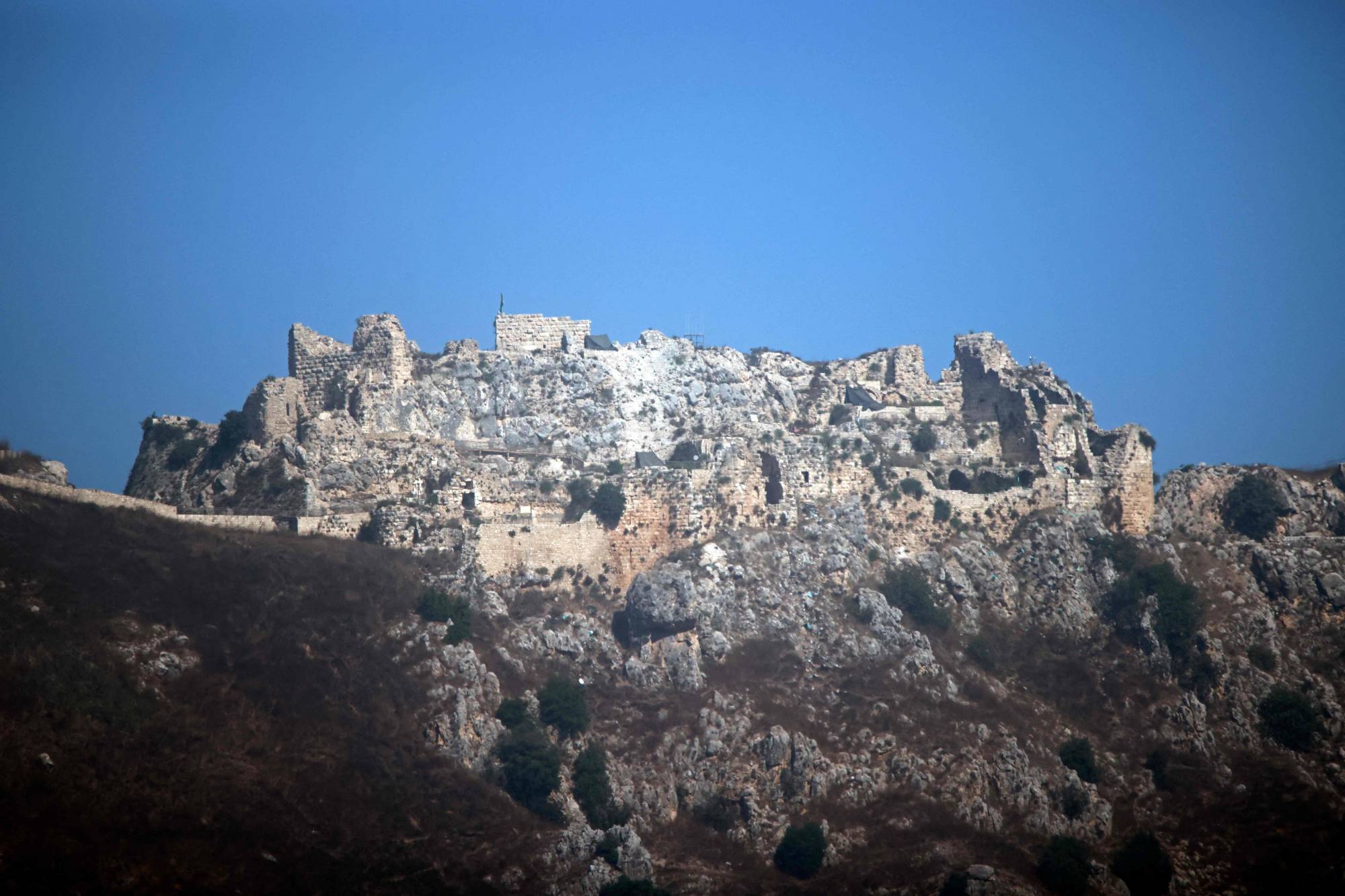
The reach of operations extends farther inland toward Beaufort Castle and the Ali al-Taher heights.
There, elevated terrain offers commanding views over wider areas toward Nabatieh, Iqlim al-Tuffah and surrounding movement routes.
The result is a zone of control shaped less by a continuous border strip than by strategic elevations and the areas they overlook.
Could Israeli Operations Reach the Awali River?
Retired Brigadier General Fadi Daoud offered a broader assessment of where Israeli operations could extend, arguing that control of high ground may determine the limits of any advance.
"What is clear in southern Lebanon is that the expansion could reach the Awali River. Even if it does not, forces will remain positioned on the heights overlooking the river," Daoud told Asharq Al-Awsat.
He said such a deployment could also encompass Rihan and areas around Jezzine, particularly Kfarhouna.
"The western boundary will be the Awali River," he said, identifying geographical control, especially over commanding heights, as the key factor shaping military movements.
Holding elevated positions, he argued, would allow Israeli forces to dominate lower-lying areas with firepower without maintaining troops throughout them.
"Geographical control will enable Israel to control the western Bekaa from the right flank because it is already present on Mount Hermon. The western Bekaa has effectively become a pocket between Mount Hermon and Rihan," Daoud said.
"Israel will establish positions there to control the Bekaa."
Dense clouds of dust cover the hills of Arnoun and al-Shaqif surrounding Beaufort Castle, as seen from Marjayoun in southern Lebanon (AFP)
The Strategic Heights of Rihan and Iqlim al-Tuffah
Daoud said the potential advance could stretch from Mount Rihan toward the heights of Iqlim al-Tuffah, including Mount Safi.
"It will move from Mount Rihan to the heights of Iqlim al-Tuffah, including Mount Safi, where it will establish control over Hezbollah's stronghold in Iqlim al-Tuffah, as well as Sidon, eastern Sidon and the Awali River," he said.
For Daoud, terrain is the determining factor.
"Geography is fixed, and Israel will follow it," he said, stressing that forces positioned on high ground can control areas below through firepower without deploying throughout them.
He argued that Israeli control of Mount Hermon would leave the western Bekaa militarily exposed as far as Qaraoun.
"Its control of Mount Hermon makes the western Bekaa militarily vulnerable as far as Qaraoun," he said.
Mount Hermon, he explained, overlooks two major areas: the western Bekaa to the west and Daraa in Syria to the east.
Both, he said, "will form pockets" on either side of the mountain.
The two military assessments point to a central distinction in the debate over the 700-square-kilometer area: the territory Israel can monitor, strike or enter is not necessarily territory it physically occupies.
Commanding heights, observation posts, fields of fire and the ability to deploy patrols can extend military control far beyond fixed positions, even as the scale of Israel's actual troop presence varies from one sector to another.
Israeli Drone Strike, Demolitions Hit Southern Lebanon
Meanwhile, Israeli military operations continued across southern Lebanon on Friday.
An Israeli drone struck a roundabout in Kfar Tebnit, in the Nabatieh district, with preliminary reports indicating casualties.
At the same time, Israeli troops carried out two demolitions, one on the outskirts of Kfar Tebnit and another in Mansouri in the Tyre district.
Israeli forces also set fire to wooded areas in Qantara and swept Wadi al-Hujeir with machine-gun fire.
An Israeli drone dropped a stun grenade near Kfarshouba, while low-flying drones were reported over Beirut's southern suburbs, Tyre and surrounding areas.
لم تشترك بعد
انشئ حساباً خاصاً بك لتحصل على أخبار مخصصة لك ولتتمتع بخاصية حفظ المقالات وتتلقى نشراتنا البريدية المتنوعة