
John Bolton, Former Trump Adviser, Charged with Sharing Classified Information 

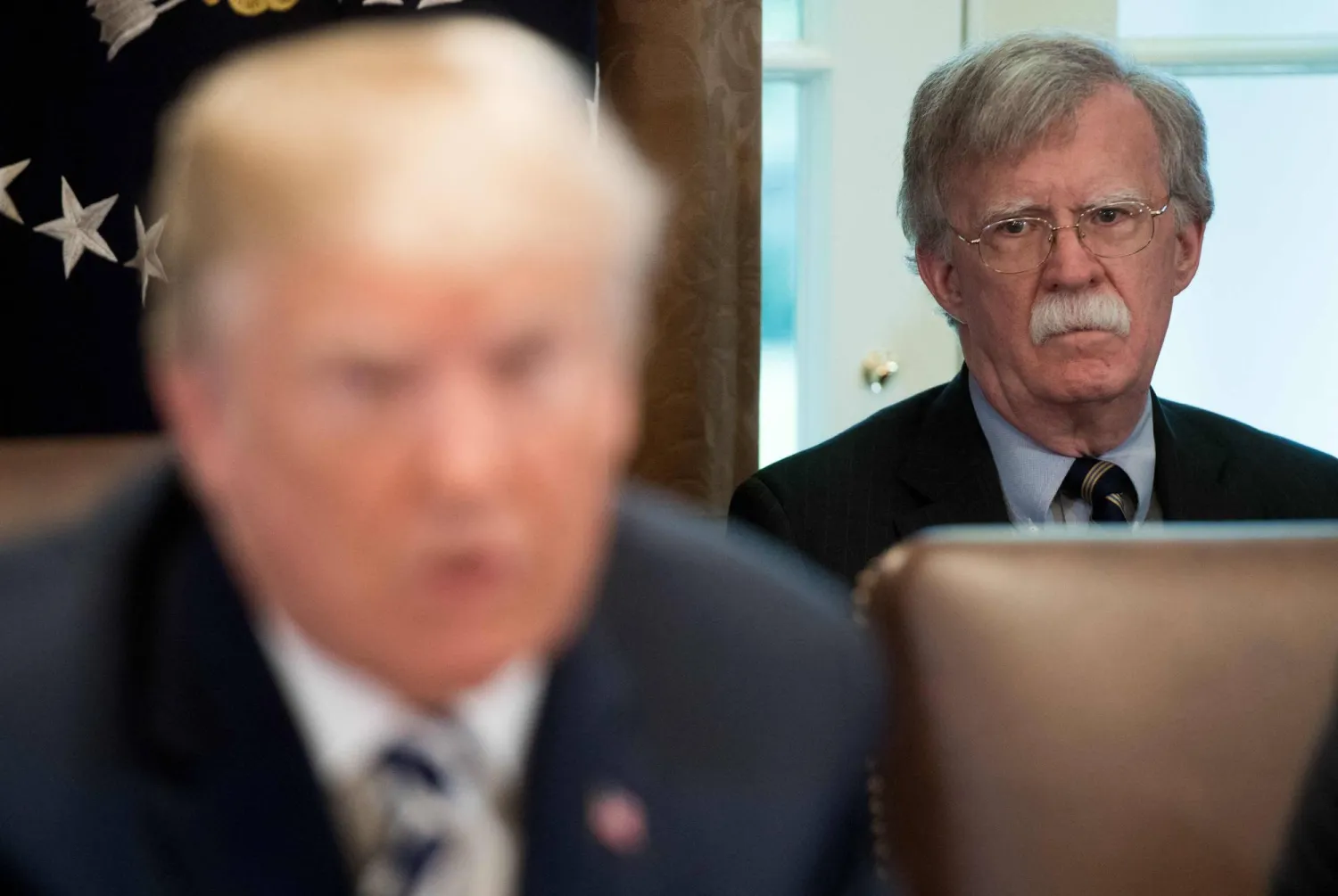
US President Donald Trump speaks alongside National Security Adviser John Bolton (R) during a Cabinet Meeting in the Cabinet Room of the White House in Washington, DC, May 9, 2018. (AFP)
TT

John Bolton, Former Trump Adviser, Charged with Sharing Classified Information 

US President Donald Trump speaks alongside National Security Adviser John Bolton (R) during a Cabinet Meeting in the Cabinet Room of the White House in Washington, DC, May 9, 2018. (AFP)

John Bolton, President Donald Trump's former national security adviser, was charged on Thursday in a sweeping indictment that accuses him of sharing sensitive government information with two of his relatives for possible use in a book he was writing.

The indictment marked the third time in recent weeks the Justice Department has secured criminal charges against one of Trump's critics.

The indictment says the notes Bolton shared with his two relatives in electronic messages included information he gleaned from meetings with senior government officials, discussions with foreign leaders, and intelligence briefings.

In some of the chats, Bolton and his relatives - whom the indictment does not identify - discussed using some of the material for a book. Bolton referred to the two people with whom he shared his daily notes as his "editors," the indictment said.

"Talking with [book publisher] because they have a right of first refusal!" Bolton wrote in one message, according to the indictment.

The two relatives referred to in the indictment are Bolton's wife and daughter, two people familiar with the matter said, reported Reuters.

In a statement, Bolton said, "I look forward to the fight to defend my lawful conduct and to expose his abuse of power."

Bolton's lawyer, Abbe Lowell, said Bolton did not unlawfully share or store any information.

Trump, a Republican who campaigned for the presidency on a vow of retribution after facing a slew of legal woes once his first term in the White House ended in 2021, has dispensed with decades-long norms designed to insulate federal law enforcement from political pressures.

In recent months, he has actively pushed Attorney General Pam Bondi's Justice Department to bring charges against his perceived adversaries including former FBI Director James Comey and New York Attorney General Letitia James, even driving out a prosecutor he deemed to be moving too slowly in doing so.

The investigation of Bolton was opened in 2022, predating the Trump administration. Inside the Justice Department, the case is viewed as stronger than the prosecutions of Comey and James, according to a person familiar with the matter.

The indictment of Bolton, filed in federal court in Maryland, charges him with eight counts of transmission of national defense information and 10 counts of retention of national defense information, all in violation of the Espionage Act.

No court appearance date was listed for Bolton as of Thursday evening.

Each count is punishable by up to 10 years in prison if Bolton is convicted, but any sentence would be determined by a judge based on a range of factors.

Asked by reporters at the White House about the Bolton indictment on Thursday, Trump said: "He's a bad guy."

BOLTON'S EMAIL ALLEGEDLY HACKED

Bolton served as White House national security adviser during Trump's first term before emerging as one of the president's most vocal critics. Bolton, also a former US ambassador to the United Nations, described Trump as unfit to be president in a memoir he released last year.

In the indictment, prosecutors said Bolton shared more than a thousand pages of information about his day-to-day activities as national security adviser, including top-secret information, with the two unauthorized people from April 2018 to August 2025.

The indictment said a "cyber actor" tied to the Iranian government hacked Bolton's personal email after he left government service and accessed classified information. Prosecutors said a representative for Bolton told the government about the hack but did not report that he stored classified information in the email account.

Trump himself was previously indicted on Espionage Act violations for allegedly transporting classified records to his Florida home after departing the White House in 2021 and refusing repeated requests by the government to return them. Trump had pleaded not guilty and that case was dropped after he won reelection in November 2024.

OTHER TRUMP FOES CHARGED

The Justice Department has already indicted Comey, who investigated Trump's 2016 presidential campaign, and James, who previously brought a civil fraud case against Trump and his family real estate company.

Comey, whom Trump fired in 2017, is facing charges of making false statements to Congress and obstruction of Congress. He has pleaded not guilty.

James is facing charges of bank fraud and making false statements to a financial institution. She has denied wrongdoing and is slated to appear in federal court later this month.

In those two cases, the indictments were secured solely by Lindsey Halligan, a Trump loyalist who was appointed US Attorney after her predecessor, Erik Siebert, was ousted for failing to pursue both matters due to a lack of evidence.

The indictment of Bolton was signed by Maryland US Attorney Kelly Hayes, who has been a federal prosecutor since 2013 and has held multiple leadership roles. The indictment also bore the names of several career prosecutors, including Thomas Sullivan, who leads the Maryland office's national security division.

Nevertheless, the Justice Department still runs the risk of being viewed as unfairly selective in its decision to prosecute Bolton for Espionage Act violations.

Earlier this year, US Defense Secretary Pete Hegseth drew scrutiny for sharing details about the imminent attack against Yemen's Iran-aligned Houthis in a Signal message group that included his wife, brother, personal lawyer, as well as a journalist from the Atlantic magazine.

Legal experts suggested that sharing these sensitive details of the Yemen attack appeared to violate the Espionage Act, but the case was quickly closed and the Justice Department took no apparent steps to criminally investigate the incident.

Trump administration officials denied that any classified information was shared.


Back From Iran, Pakistani Students Say They Heard Gunshots While Confined to Campus

 A Pakistani medical student Arslan Haider waits at the airport after arriving from Tehran on a commercial flight amid the ongoing nationwide protests in Iran, in Islamabad, Pakistan, January 15, 2026. (Reuters)
A Pakistani medical student Arslan Haider waits at the airport after arriving from Tehran on a commercial flight amid the ongoing nationwide protests in Iran, in Islamabad, Pakistan, January 15, 2026. (Reuters)
TT

Back From Iran, Pakistani Students Say They Heard Gunshots While Confined to Campus

 A Pakistani medical student Arslan Haider waits at the airport after arriving from Tehran on a commercial flight amid the ongoing nationwide protests in Iran, in Islamabad, Pakistan, January 15, 2026. (Reuters)
A Pakistani medical student Arslan Haider waits at the airport after arriving from Tehran on a commercial flight amid the ongoing nationwide protests in Iran, in Islamabad, Pakistan, January 15, 2026. (Reuters)

Pakistani students returning from Iran on Thursday said they heard gunshots and stories of rioting and violence while being confined to campus and not allowed out of their dormitories in the evening.

Iran's leadership is trying to quell the worst domestic unrest since its 1979 revolution, with a rights group putting the death toll over 2,600.

As the protests swell, Tehran is seeking to deter US President Donald Trump's repeated threats to intervene on behalf of anti-government protesters.

"During ‌nighttime, we would ‌sit inside and we would hear gunshots," Shahanshah ‌Abbas, ⁠a fourth-year ‌student at Isfahan University of Medical Sciences, said at the Islamabad airport.

"The situation down there is that riots have been happening everywhere. People are dying. Force is being used."

Abbas said students at the university were not allowed to leave campus and told to stay in their dormitories after 4 p.m.

"There was nothing happening on campus," Abbas said, but in his interactions with Iranians, he ⁠heard stories of violence and chaos.

"The surrounding areas, like banks, mosques, they were damaged, set on fire ... ‌so things were really bad."

Trump has repeatedly ‍threatened to intervene in support of protesters ‍in Iran but adopted a wait-and-see posture on Thursday after protests appeared ‍to have abated. Information flows have been hampered by an internet blackout for a week.

"We were not allowed to go out of the university," said Arslan Haider, a student in his final year. "The riots would mostly start later in the day."

Haider said he was unable to contact his family due to the blackout but "now that they opened international calls, the students are ⁠getting back because their parents were concerned".

A Pakistani diplomat in Tehran said the embassy was getting calls from many of the 3,500 students in Iran to send messages to their families back home.

"Since they don't have internet connections to make WhatsApp and other social network calls, what they do is they contact the embassy from local phone numbers and tell us to inform their families."

Rimsha Akbar, who was in the middle of her final year exams at Isfahan, said international students were kept safe.

"Iranians would tell us if we are talking on Snapchat or if we were riding in a cab ... ‌that shelling had happened, tear gas had happened, and that a lot of people were killed."


Bomb Hoax Forces Turkish Airlines to Make Emergency Landing in Barcelona

A Turkish Airlines aircraft after landing at El Prat airport, in Barcelona, northeastern Spain, 15 January 2026, after Spanish security forces where alerted due to a bomb threat on board the aircraft. (EPA)
TT

Bomb Hoax Forces Turkish Airlines to Make Emergency Landing in Barcelona

A Turkish Airlines aircraft after landing at El Prat airport, in Barcelona, northeastern Spain, 15 January 2026, after Spanish security forces where alerted due to a bomb threat on board the aircraft. (EPA)

A false bomb threat delivered via an onboard mobile connection caused a Turkish Airlines flight from Istanbul to make an emergency landing at Barcelona's El Prat Airport on Thursday, Spanish police and the airline ‌said.

A Turkish ‌Airlines spokesperson ‌said ⁠earlier that ‌the plane had landed after crew detected that a passenger had created an in-flight internet hotspot which was named to include a bomb threat as the aircraft approached ⁠Barcelona.

Spain's Guardia Civil police force said ‌in a statement ‍that following a ‍thorough inspection of the aircraft ‍after its passengers had disembarked, the alert had been deactivated and no explosives had been found. Spanish airport operator AENA said El Prat was operating normally.

Police have launched ⁠an investigation to determine who was behind the hoax, the statement added.

Türkiye's flag carrier has faced previous incidents of hoax threats, usually made via written messages, that led to emergency landings over the years.


US Sanctions Iranian Officials Over Protest Crackdown

 Treasury Secretary Scott Bessent watches as President Donald Trump speaks to reporters on the South Lawn at the White House, Tuesday, Jan. 13, 2026, in Washington. (AP)
Treasury Secretary Scott Bessent watches as President Donald Trump speaks to reporters on the South Lawn at the White House, Tuesday, Jan. 13, 2026, in Washington. (AP)
TT

US Sanctions Iranian Officials Over Protest Crackdown

 Treasury Secretary Scott Bessent watches as President Donald Trump speaks to reporters on the South Lawn at the White House, Tuesday, Jan. 13, 2026, in Washington. (AP)
Treasury Secretary Scott Bessent watches as President Donald Trump speaks to reporters on the South Lawn at the White House, Tuesday, Jan. 13, 2026, in Washington. (AP)

The United States imposed sanctions Thursday on Iranian security officials and financial networks, accusing them of orchestrating a violent crackdown on peaceful protests and laundering billions in oil revenues.

Treasury Secretary Scott Bessent announced the measures in the wake of the biggest anti-government protests in the history of the republic, although the demonstrations appear to have diminished over the last few days in the face of repression and an almost week-long internet blackout.

"The United States stands firmly behind the Iranian people in their call for freedom and justice," Bessent said in a statement, adding that the action was taken at President Donald Trump's direction.

Among those sanctioned is Ali Larijani, secretary of Iran's Supreme Council for National Security, whom Washington accused of coordinating the crackdown and calling for force against protesters.

Four regional commanders of Iran's Law Enforcement Forces and Revolutionary Guard were also sanctioned for their roles in the crackdown in Lorestan and Fars provinces.

Security forces in Fars "have killed countless peaceful demonstrators" with hospitals "so inundated with gunshot wound patients that no other types of patients can be admitted," the Treasury said.

The Treasury additionally designated 18 individuals and entities accused of operating "shadow banking" networks that launder proceeds from Iranian oil sales through front companies in the UAE, Singapore and Britain.

These networks funnel billions of dollars annually using cover companies and exchange houses, as Iranian citizens face economic hardship, according to the Treasury.

The sanctions freeze any US assets of those designated and prohibit Americans from doing business with them. Foreign financial institutions risk secondary sanctions for transactions with the designated entities.

The action builds on the Trump administration's "maximum pressure" campaign against Iran. In 2025, the Treasury sanctioned more than 875 persons, vessels and aircraft as part of this effort, it said.