


Big Tech is Paying Millions to Train Teachers on AI, in Push to Bring Chatbots Into Classrooms

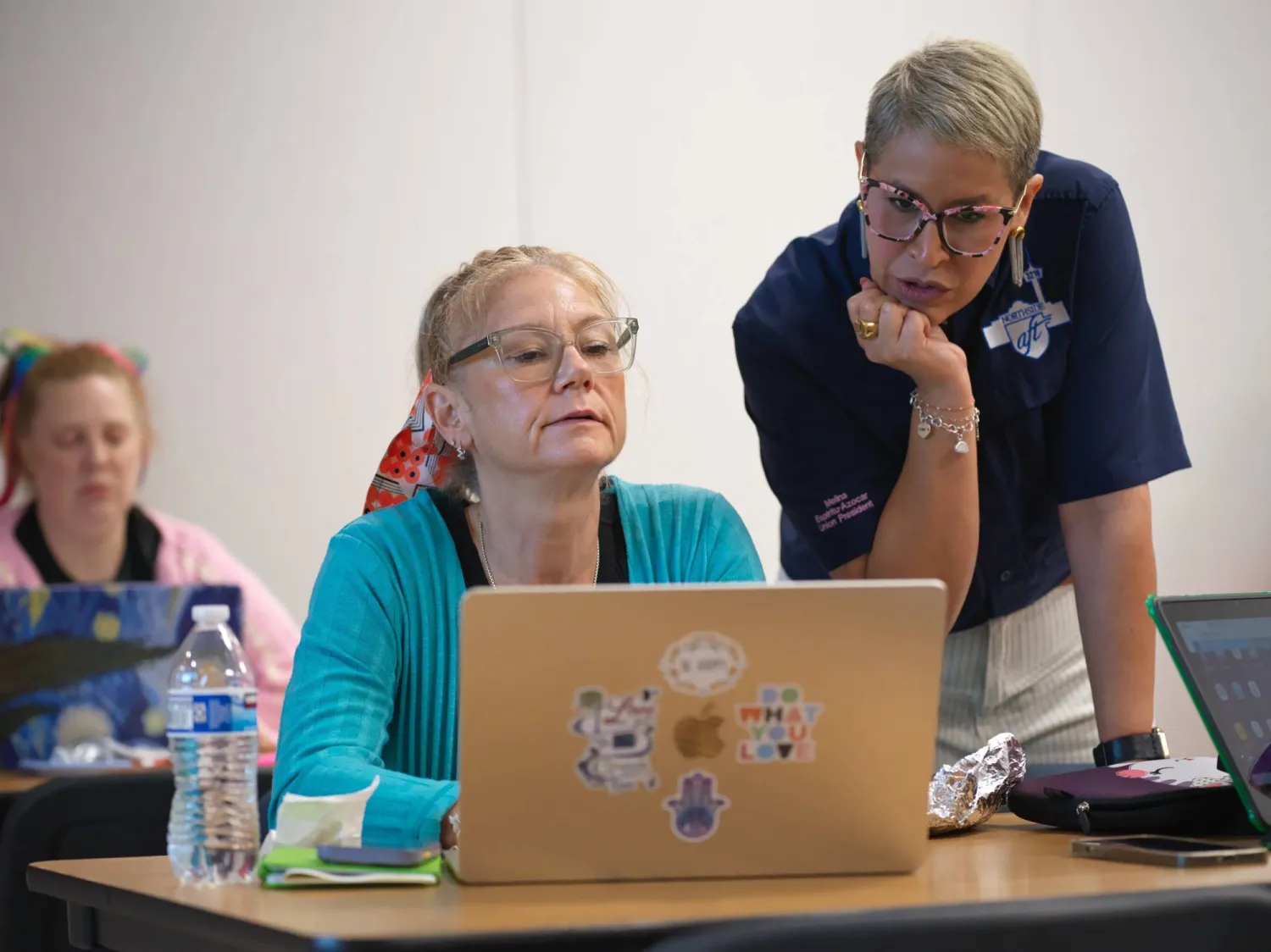
Northside American Federation of Teachers President Melina Espiritu-Azocar, right, speaks with middle school teacher Celeste Simone during a Microsoft AI skilling event, Saturday, Sept. 27, 2025, in San Antonio. (AP Photo/Darren Abate)
TT

Big Tech is Paying Millions to Train Teachers on AI, in Push to Bring Chatbots Into Classrooms

Northside American Federation of Teachers President Melina Espiritu-Azocar, right, speaks with middle school teacher Celeste Simone during a Microsoft AI skilling event, Saturday, Sept. 27, 2025, in San Antonio. (AP Photo/Darren Abate)

On a scorching hot Saturday in San Antonio, dozens of teachers traded a day off for a glimpse of the future. The topic of the day’s workshop: enhancing instruction with artificial intelligence.

After marveling as AI graded classwork instantly and turned lesson plans into podcasts or online storybooks, one high school English teacher raised a concern that was on the minds of many: “Are we going to be replaced with AI?”

That remains to be seen. But for the nation’s 4 million teachers to stay relevant and help students use the technology wisely, teachers unions have forged an unlikely partnership with the world’s largest technology companies. The two groups don’t always see eye to eye but say they share a common goal: training the future workforce of America.

Microsoft, OpenAI and Anthropic are providing millions of dollars for AI training to the American Federation of Teachers, the country’s second-largest teachers union, The Associated Press reported. In exchange, the tech companies have an opportunity to make inroads into schools and win over students in the race for AI dominance.

AFT President Randi Weingarten said skepticism guided her negotiations, but the tech industry has something schools lack: deep pockets.

“There is no one else who is helping us with this. That’s why we felt we needed to work with the largest corporations in the world,” Weingarten said. “We went to them — they didn’t come to us.”

Weingarten first met with Microsoft CEO Brad Smith in 2023 to discuss a partnership. She later reached out to OpenAI to pursue an “agnostic” approach that means any company's AI tools could be used in a training session.

Under the arrangement announced in July, Microsoft is contributing $12.5 million to AFT over five years. OpenAI is providing $8 million in funding and $2 million in technical resources, and Anthropic has offered $500,000.

Tech money will build an AI training hub for teachers With the money, AFT is planning to build an AI training hub in New York City that will offer virtual and in-person workshops for teachers. The goal is to open at least two more hubs and train 400,000 teachers over the next five years.

The National Education Association, the country’s largest teachers union, announced its own partnership with Microsoft last month. The company has provided a $325,000 grant to help the NEA develop AI trainings in the form of “microcredentials” — online trainings open to the union’s 3 million members, said Daaiyah Bilal, NEA’s senior director of education policy. The goal is to train at least 10,000 members this school year.

“We tailored our partnership very surgically,” Bilal said. “We are very mindful of what a technology company stands to gain by spreading information about the products they develop.”

Both unions set similar terms: Educators, not the private funders, would design and lead trainings that include AI tools from multiple companies. The unions own the intellectual property for the trainings, which cover safety and privacy concerns alongside AI skills.

The Trump administration has encouraged the private investment, recently creating an AI Education Task Force as part of an effort to achieve "global dominance in artificial intelligence.” The federal government urged tech companies and other organizations to foot the bill. So far, more than 100 companies have signed up.

Tech companies see opportunities in education beyond training teachers. Microsoft unveiled a $4 billion initiative for AI training, research and the gifting of its AI tools to teachers and students. It includes the AFT grant and a program that will give all school districts and community colleges in Washington, Microsoft’s home state, free access to Microsoft CoPilot tools. Google says it will commit $1 billion for AI education and job training programs, including free access to its Gemini for Education platform for US high schools.

Several recent studies have found that AI use in schools is rapidly increasing but training and guidance are lagging.

The industry offers resources that can help scale AI literacy efforts quickly. But educators should ensure any partnership focuses on what’s best for teachers and students, said Robin Lake, director of the Center on Reinventing Public Education.

“These are private initiatives, and they are run by companies that have a stake,” Lake said.

Microsoft CEO Brad Smith agrees that teachers should have a “healthy dose of skepticism” about the role of tech companies.

“While it’s easy to see the benefits right now, we should always be mindful of the potential for unintended consequences,” Smith said in an interview, pointing to concerns such as AI’s possible impact on critical thinking. “We have to be careful. It’s early days.”

Teachers see new possibilities At the San Antonio AFT training, about 50 educators turned up for the three-hour workshop for teachers in the Northside Independent School District. It is the city's largest, employing about 7,000 teachers.

The day started with a pep talk.

“We all know, when we talk about AI, teachers say, ‘Nah, I’m not doing that,’” trainer Kathleen Torregrossa told the room. “But we are preparing kids for the future. That is our primary job. And AI, like it or not, is part of our world.”

Attendees generated lesson plans using ChatGPT, Google’s Gemini, Microsoft CoPilot and two AI tools designed for schools, Khanmingo and Colorín Colorado.

Gabriela Aguirre, a 1st grade dual language teacher, repeatedly used the word “amazing” to describe what she saw.

“It can save you so much time,” she said, and add visual flair to lessons. She walked away with a plan to use AI tools to make illustrated flashcards in English and Spanish to teach vocabulary.

“With all the video games, the cellphones you have to compete against, the kids are always saying, ‘I’m bored.’ Everything is boring,” Aguirre said. “If you can find ways to engage them with new technology, you’ve just got to do that.”

Middle school teacher Celeste Simone said there is no turning back to how she taught before.

As a teacher for English language learners, Simone can now ask AI tools to generate pictures alongside vocabulary words and create illustrated storybooks that use students' names as characters. She can take a difficult reading passage and ask a chatbot to translate it into Spanish, Pashto or other languages. And she can ask AI to rewrite difficult passages at any grade level to match her students' reading levels. All in a matter of seconds.

“I can give my students access to things that never existed before,” Simone said. “As a teacher, once you’ve used it and see how helpful it is, I don’t think I could go back to the way I did things before.”


Meta Reportedly Delays Release of Phoenix Mixed-reality Glasses to 2027

FILE PHOTO: The logo of Meta is seen at Porte de Versailles exhibition center in Paris, France, June 11, 2025. REUTERS/Gonzalo Fuentes/File Photo
TT

Meta Reportedly Delays Release of Phoenix Mixed-reality Glasses to 2027

FILE PHOTO: The logo of Meta is seen at Porte de Versailles exhibition center in Paris, France, June 11, 2025. REUTERS/Gonzalo Fuentes/File Photo

Meta is delaying the release of its Phoenix mixed-reality glasses until 2027, aiming to get the details right, Business Insider reported on Friday, citing an internal memo.

The delay from an initially planned release in the second half of 2026 is because the company wants a fully polished device, the report said.

Meta did not immediately respond to a Reuters request for comment on the report.

Meta executives Gabriel Aul and Ryan Cairns said moving the release date back is "going to give us a lot more breathing room to get the details right," the report added.

The goggles, previously code-named Puffin, weigh around 100 grams (3.5 ounces) and have lower-resolution displays and weaker computing performance than high-end headsets like Apple’s Vision Pro, the Information reported in July.

Mixed reality merges augmented and virtual reality and allows real-world and digital objects to interact.

Meta is expected to make budget cuts of up to 30% for its metaverse initiative, Bloomberg News reported on Thursday.

The metaverse group sits within Reality Labs, which produces the company's Quest mixed-reality headsets, smart glasses made with EssilorLuxottica's Ray-Ban and upcoming augmented-reality glasses.


Apple, Google Send New Round of Cyber Threat Notifications to Users Around World

The Apple logo is seen in this illustration taken September 24, 2025. (Reuters)
TT

Apple, Google Send New Round of Cyber Threat Notifications to Users Around World

The Apple logo is seen in this illustration taken September 24, 2025. (Reuters)

Apple and Google have sent a new round of cyber threat notifications to users around the world, the companies said this week, announcing their latest effort to insulate customers against surveillance threats.

Apple and the Alphabet-owned Google are two of several tech companies that regularly issue warnings to users when they determine they may have been targeted by state-backed hackers.

Apple said the warnings were issued on Dec. 2 but gave few further details about the alleged hacking activity and did not address questions about the number of users targeted or say who was thought to be conducting the surveillance.

Apple said that "to date we have notified users in over 150 countries in total."

Apple's statement follows Google's Dec. 3 announcement that it was warning all known users targeted using Intellexa spyware, which it said spanned "several hundred accounts across various countries, including Pakistan, Kazakhstan, Angola, Egypt, Uzbekistan, Saudi Arabia, and Tajikistan."

Google said in its announcement that Intellexa, a cyber intelligence company that is sanctioned by the US government, was "evading restrictions and thriving."

Executives tied to Intellexa did not immediately return messages.

Previous waves of warnings have triggered headlines and prompted investigations by government bodies, including the European Union, whose senior officials have previously been targeted using spyware.

Threat notifications impose costs on cyber spies by alerting victims, said John Scott-Railton, a researcher with the Canadian digital watchdog group Citizen Lab.

He said they were "also often the first step in a string of investigations and discoveries that can lead to real accountability around spyware abuses."


AI Bubble to Be Short-lived, Rebound Stronger, NTT DATA Chief Says

FILE PHOTO: Figurines with computers and smartphones are seen in front of the words "Artificial Intelligence AI" in this illustration taken, February 19, 2024. REUTERS/Dado Ruvic/Illustration/File Photo
TT

AI Bubble to Be Short-lived, Rebound Stronger, NTT DATA Chief Says

FILE PHOTO: Figurines with computers and smartphones are seen in front of the words "Artificial Intelligence AI" in this illustration taken, February 19, 2024. REUTERS/Dado Ruvic/Illustration/File Photo

A potential artificial intelligence bubble will deflate faster than past tech cycles but give way to an even stronger rebound as corporate adoption catches up with infrastructure spending, the head of Japanese IT company NTT DATA Inc. said.

Despite worries around supply chains, the direction of travel is clear, CEO Abhijit Dubey said in an interview with the Reuters Global Markets Forum.

"There is absolutely no doubt that in the medium- to long-term, AI is a massive secular trend," he said.

"Over the next 12 months, I think we're going to have a bit of a normalization ... It'll be a short-lived bubble, and (AI) will come out of it stronger."

With demand for compute still running ahead of supply, "supply chains are almost spoken for" over the next two to three years, he said. Pricing power is already tilting toward chipmakers and hyperscalers, mirroring their stretched valuations in public markets, he added.

AI has triggered the biggest technological shake-up since the advent of the internet, fueling trillions of dollars of investment and eye-watering equity gains. But it has caused shortages of memory chips, drawn regulatory scrutiny, and created growing unease over the future of work.

Dubey, who is also the firm's chief AI officer, said his company has begun rethinking recruitment strategies as AI reshapes labor markets.

"There will clearly be an impact ... Over a five- to 25-year horizon, there will likely be dislocation," he said. However, he added that NTT DATA continues to hire across locations.

Speakers at the Reuters NEXT conference in New York discussed how AI may upend work and job growth.

AI startup Writer Inc.'s CEO May Habib said customers are focused on slowing headcount growth.

"You close a customer, you get on the phone with the CEO to kick off the project, and it's like, 'Great, how soon can I whack 30% of my team?'," she said.

Still, a PwC survey of the global workforce released in November suggests the reality of generative AI usage has yet to match boardroom expectations.

Daily use of GenAI remains "significantly lower" than widely touted by executives, PwC said, even as workers with AI skills commanded an average wage premium of 56% — more than double last year's figure.

PwC also flagged a widening skills gap, with about half of non-managers reporting access to training resources, compared with roughly three-quarters of senior executives.
