


Afghans Return Home to Rubble, Hoping Truce Holds with Pakistan

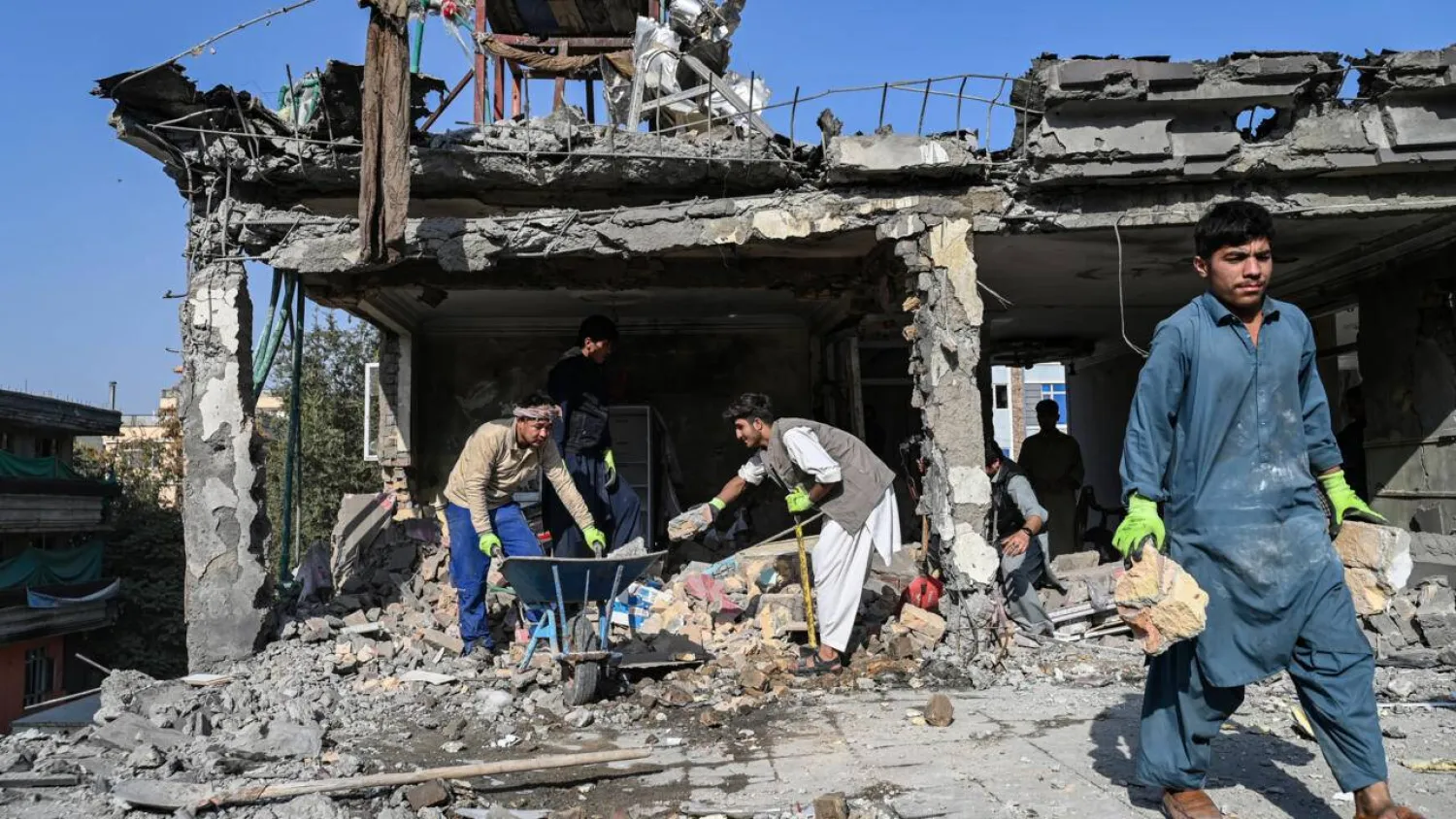
Several buildings in the Afghan capital were completely destroyed by explosions this week. Wakil KOHSAR / AFP
TT

Afghans Return Home to Rubble, Hoping Truce Holds with Pakistan

Several buildings in the Afghan capital were completely destroyed by explosions this week. Wakil KOHSAR / AFP

Abdul Rahim surveys the rubble that was his home in Kabul, where he lived with six family members.

A gaping hole in the living room reveals only charred belongings and debris, while blackened teddy bears and makeup lie in what once was a bedroom.

The explosion at his home was one of four that hit the Afghan capital within a week, as unusually intense violence broke out with Pakistan -- then suddenly halted under a temporary truce, said AFP.

The fighting -- which has left dozens of troops and civilians dead on both sides, mostly in border regions -- represents the worst clashes between the neighbors since the Taliban returned to power in 2021.

"We were attending a graduation ceremony when I learned that an explosion had struck my house around 4:00 pm," Rahim, a motorcycle vendor, tells AFP.

Two explosions occurred Wednesday afternoon following aerial bombardments, according to Kabul police spokesman Khalid Zadran. The strikes plunged central Kabul into terror.

Pakistani security sources meanwhile said they carried out "precision strikes" against an armed group.

Stunned residents have been clearing the rubble, hoping the ceasefire will hold.

"When I returned, I saw shattered windows, injured people lying on the road, and several dead," says Rahim, now forced to live with relatives.

"War is not a solution -- we hope for dialogue," he pleads.

Next door, a yellow-walled school has also been gutted.

'Not a solution'

At least five dead and 35 injured were transported to a Kabul hospital Wednesday afternoon, according to Italian NGO EMERGENCY, which runs the facility.

No official death toll has been released.

Passersby stop to stare at the devastation, kept at a distance by security cordons and numerous personnel.

Three hundred meters away, a market in a residential area was also hit, with videos shared by local media showing a fireball engulfing the neighborhood.

Next to a tall building where at least seven stories can be seen charred, Safiullah Hamidi, a 21-year-old student says his uncle's apartment was among those impacted.

"Pakistan should fight with our army if they want a confrontation, but not by bombing civilians," he says.

Nearby, Samir Ousmani gathers up metal bars littering his car wash station, almost entirely destroyed.

"One of my employees was killed, and two others, along with my uncle, were injured," reports the 22-year-old.

Holding their breath

At the border, where the clashes have been concentrated, residents who had fled are returning home.

"Stores have reopened, and everyone is going about their business, but the border is still closed," says Naqibullah, a 35-year-old merchant in Spin Boldak, Kandahar province.

The death toll continues to mount.

In the border town, 40 civilians were killed Wednesday in exchanges of fire with the Pakistani army, according to local health authorities.

The UN recorded 37 civilians killed and 425 injured in recent days on the Afghan side.

"Yesterday, the situation was terrible because of the war. I hope it doesn't resume because there have already been too many victims," says Aminullah, 22.

Islamabad said the temporary truce would last 48 hours, which ends on Friday evening.

"We are waiting to see what happens tomorrow," says Shamsullah, 36, a biryani vendor.

Pakistan's Prime Minister Shehbaz Sharif said Thursday that for the truce to endure, the ball was "in the court" of the Taliban government.

Kabul has not immediately commented.


Back From Iran, Pakistani Students Say They Heard Gunshots While Confined to Campus

 A Pakistani medical student Arslan Haider waits at the airport after arriving from Tehran on a commercial flight amid the ongoing nationwide protests in Iran, in Islamabad, Pakistan, January 15, 2026. (Reuters)
A Pakistani medical student Arslan Haider waits at the airport after arriving from Tehran on a commercial flight amid the ongoing nationwide protests in Iran, in Islamabad, Pakistan, January 15, 2026. (Reuters)
TT

Back From Iran, Pakistani Students Say They Heard Gunshots While Confined to Campus

 A Pakistani medical student Arslan Haider waits at the airport after arriving from Tehran on a commercial flight amid the ongoing nationwide protests in Iran, in Islamabad, Pakistan, January 15, 2026. (Reuters)
A Pakistani medical student Arslan Haider waits at the airport after arriving from Tehran on a commercial flight amid the ongoing nationwide protests in Iran, in Islamabad, Pakistan, January 15, 2026. (Reuters)

Pakistani students returning from Iran on Thursday said they heard gunshots and stories of rioting and violence while being confined to campus and not allowed out of their dormitories in the evening.

Iran's leadership is trying to quell the worst domestic unrest since its 1979 revolution, with a rights group putting the death toll over 2,600.

As the protests swell, Tehran is seeking to deter US President Donald Trump's repeated threats to intervene on behalf of anti-government protesters.

"During ‌nighttime, we would ‌sit inside and we would hear gunshots," Shahanshah ‌Abbas, ⁠a fourth-year ‌student at Isfahan University of Medical Sciences, said at the Islamabad airport.

"The situation down there is that riots have been happening everywhere. People are dying. Force is being used."

Abbas said students at the university were not allowed to leave campus and told to stay in their dormitories after 4 p.m.

"There was nothing happening on campus," Abbas said, but in his interactions with Iranians, he ⁠heard stories of violence and chaos.

"The surrounding areas, like banks, mosques, they were damaged, set on fire ... ‌so things were really bad."

Trump has repeatedly ‍threatened to intervene in support of protesters ‍in Iran but adopted a wait-and-see posture on Thursday after protests appeared ‍to have abated. Information flows have been hampered by an internet blackout for a week.

"We were not allowed to go out of the university," said Arslan Haider, a student in his final year. "The riots would mostly start later in the day."

Haider said he was unable to contact his family due to the blackout but "now that they opened international calls, the students are ⁠getting back because their parents were concerned".

A Pakistani diplomat in Tehran said the embassy was getting calls from many of the 3,500 students in Iran to send messages to their families back home.

"Since they don't have internet connections to make WhatsApp and other social network calls, what they do is they contact the embassy from local phone numbers and tell us to inform their families."

Rimsha Akbar, who was in the middle of her final year exams at Isfahan, said international students were kept safe.

"Iranians would tell us if we are talking on Snapchat or if we were riding in a cab ... ‌that shelling had happened, tear gas had happened, and that a lot of people were killed."


Bomb Hoax Forces Turkish Airlines to Make Emergency Landing in Barcelona

A Turkish Airlines aircraft after landing at El Prat airport, in Barcelona, northeastern Spain, 15 January 2026, after Spanish security forces where alerted due to a bomb threat on board the aircraft. (EPA)
TT

Bomb Hoax Forces Turkish Airlines to Make Emergency Landing in Barcelona

A Turkish Airlines aircraft after landing at El Prat airport, in Barcelona, northeastern Spain, 15 January 2026, after Spanish security forces where alerted due to a bomb threat on board the aircraft. (EPA)

A false bomb threat delivered via an onboard mobile connection caused a Turkish Airlines flight from Istanbul to make an emergency landing at Barcelona's El Prat Airport on Thursday, Spanish police and the airline ‌said.

A Turkish ‌Airlines spokesperson ‌said ⁠earlier that ‌the plane had landed after crew detected that a passenger had created an in-flight internet hotspot which was named to include a bomb threat as the aircraft approached ⁠Barcelona.

Spain's Guardia Civil police force said ‌in a statement ‍that following a ‍thorough inspection of the aircraft ‍after its passengers had disembarked, the alert had been deactivated and no explosives had been found. Spanish airport operator AENA said El Prat was operating normally.

Police have launched ⁠an investigation to determine who was behind the hoax, the statement added.

Türkiye's flag carrier has faced previous incidents of hoax threats, usually made via written messages, that led to emergency landings over the years.


US Sanctions Iranian Officials Over Protest Crackdown

 Treasury Secretary Scott Bessent watches as President Donald Trump speaks to reporters on the South Lawn at the White House, Tuesday, Jan. 13, 2026, in Washington. (AP)
Treasury Secretary Scott Bessent watches as President Donald Trump speaks to reporters on the South Lawn at the White House, Tuesday, Jan. 13, 2026, in Washington. (AP)
TT

US Sanctions Iranian Officials Over Protest Crackdown

 Treasury Secretary Scott Bessent watches as President Donald Trump speaks to reporters on the South Lawn at the White House, Tuesday, Jan. 13, 2026, in Washington. (AP)
Treasury Secretary Scott Bessent watches as President Donald Trump speaks to reporters on the South Lawn at the White House, Tuesday, Jan. 13, 2026, in Washington. (AP)

The United States imposed sanctions Thursday on Iranian security officials and financial networks, accusing them of orchestrating a violent crackdown on peaceful protests and laundering billions in oil revenues.

Treasury Secretary Scott Bessent announced the measures in the wake of the biggest anti-government protests in the history of the republic, although the demonstrations appear to have diminished over the last few days in the face of repression and an almost week-long internet blackout.

"The United States stands firmly behind the Iranian people in their call for freedom and justice," Bessent said in a statement, adding that the action was taken at President Donald Trump's direction.

Among those sanctioned is Ali Larijani, secretary of Iran's Supreme Council for National Security, whom Washington accused of coordinating the crackdown and calling for force against protesters.

Four regional commanders of Iran's Law Enforcement Forces and Revolutionary Guard were also sanctioned for their roles in the crackdown in Lorestan and Fars provinces.

Security forces in Fars "have killed countless peaceful demonstrators" with hospitals "so inundated with gunshot wound patients that no other types of patients can be admitted," the Treasury said.

The Treasury additionally designated 18 individuals and entities accused of operating "shadow banking" networks that launder proceeds from Iranian oil sales through front companies in the UAE, Singapore and Britain.

These networks funnel billions of dollars annually using cover companies and exchange houses, as Iranian citizens face economic hardship, according to the Treasury.

The sanctions freeze any US assets of those designated and prohibit Americans from doing business with them. Foreign financial institutions risk secondary sanctions for transactions with the designated entities.

The action builds on the Trump administration's "maximum pressure" campaign against Iran. In 2025, the Treasury sanctioned more than 875 persons, vessels and aircraft as part of this effort, it said.
