



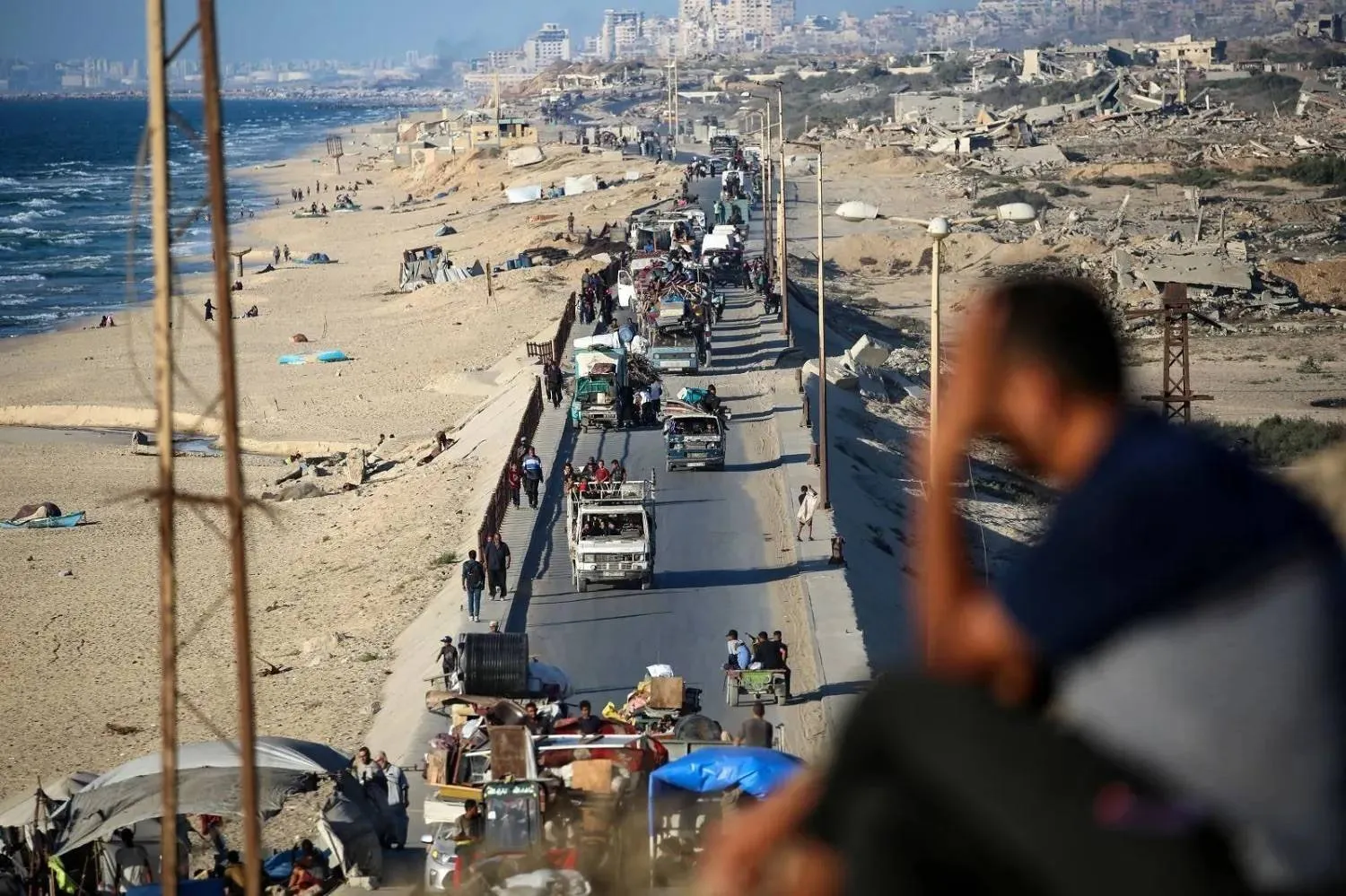

Although the ceasefire agreement in Gaza has come into effect, concerns persist in Egypt that the issue of displacement could resurface at a later stage. These fears stem from the complex realities on the ground and the uncertainty surrounding the agreement’s long-term implementation.
An informed Egyptian source told Asharq Al-Awsat that Cairo’s stance against the forced displacement of Palestinians “was firm from the outset.” According to the source, the Sharm El-Sheikh Agreement effectively ended any immediate plans to expel Gazans, making forced relocation “very difficult at this stage.”
Yet he also warned of what he called a “soft displacement plan” being quietly discussed with several countries, under the guise of humanitarian assistance and family reunification, with the ultimate aim of emptying Gaza.
The source emphasized that the steadfastness shown by the Palestinian people, particularly their return from the south to the north of the Strip, proves that displacing them will not be easy. He stressed Egypt’s unwavering commitment to supporting reconstruction efforts while ensuring that Palestinians remain on their land.
Egypt is scheduled to host an international conference in the second half of November focusing on early recovery, reconstruction, and development in Gaza.
The Egyptian Foreign Ministry announced that preparations are underway for the Cairo International Conference on Gaza Reconstruction, in coordination with the United States, regional partners, donor countries, international organizations, financial institutions, the private sector, and civil society. The conference will be based on the Arab-Islamic plan and the proposals previously put forward by the American administration.
According to the comprehensive plan published by the White House, “no one will be forced to leave Gaza. Those who wish to leave may do so freely and return, but the priority will be to encourage people to stay and build a better future.”
Despite these assurances, former Arab League Secretary-General Amr Moussa said in a televised interview on Wednesday that “the danger of forced displacement has not disappeared.”
He warned against complacency, noting that although recent developments have created more favorable conditions in Gaza for moving toward a broader peace, “the reality is different when dealing with an extremely hardline Israeli government.”
Former Egyptian Foreign Minister Mohamed El Orabi expressed a similar view. He said that while the danger of displacement is not imminent, continued instability could bring the issue back at any time.
“Everything remains possible in the second phase of the ceasefire, which is often the most difficult,” he said, pointing to the challenges following the release of prisoners and hostages.
He added that Egypt remains cautious and realistic about the potential for violations and provocations.
He noted that voluntary migration remains possible, but the Palestinian people, despite their suffering during the war, have demonstrated a strong attachment to their land, with only a few exceptions.
On Wednesday, Reuters quoted a senior American official as saying that Washington is working on forming a stabilization force for Gaza without forcing anyone to leave. Two senior American advisers confirmed that there is no hidden agenda involving displacement.
Since the beginning of the war, Egypt has repeatedly rejected the idea of relocating Palestinians from Gaza and has emphasized its readiness to lead reconstruction efforts. It previously rejected proposals to move Gazans into Sinai.
Major General Adel Al-Omda, an adviser at the Military Academy for Advanced Studies, said that Israeli pressure on Gazans to head toward the Egyptian border has stopped, and that Israel is gradually withdrawing from the Strip while releasing hostages and ensuring that Hamas has no role in Gaza’s future administration.
At the same time, he cautioned against ruling out the risk entirely if the Sharm El-Sheikh peace agreement suffers a setback. He said Egypt is relying on American guarantees and on the more than 20 countries that signed the agreement to ensure its implementation.
