
Hamas Aims to Keep Grip on Gaza Security and Can’t Commit to Disarm, Senior Official Says

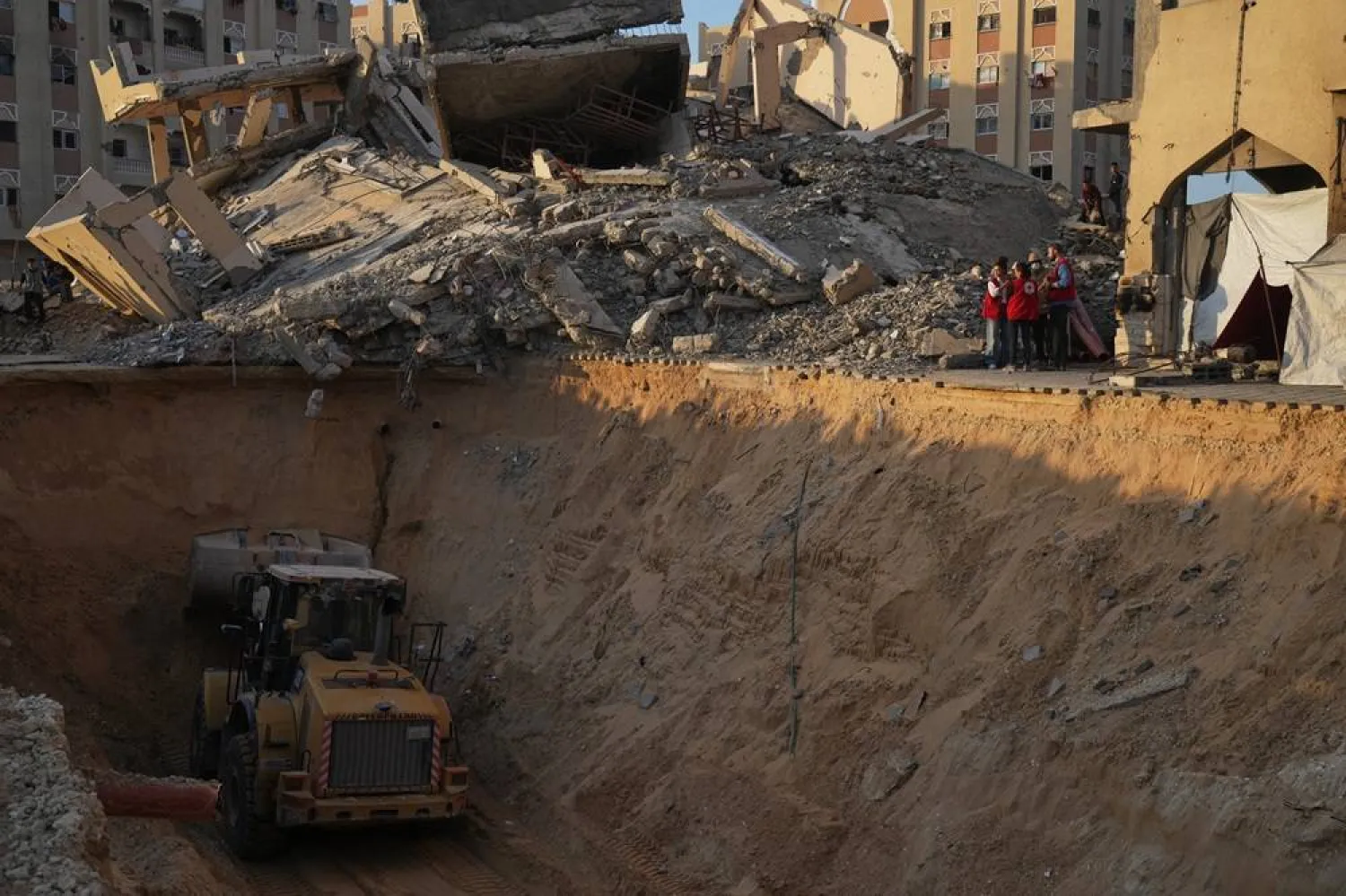
Red Cross workers check the site where members of the Hamas militant group work on searching for bodies of the hostages in an area in Hamad City, Khan Younis, in the southern Gaza Strip, Friday, Oct. 17, 2025. (AP)
TT

Hamas Aims to Keep Grip on Gaza Security and Can’t Commit to Disarm, Senior Official Says

Red Cross workers check the site where members of the Hamas militant group work on searching for bodies of the hostages in an area in Hamad City, Khan Younis, in the southern Gaza Strip, Friday, Oct. 17, 2025. (AP)

Hamas intends to maintain security control in Gaza during an interim period, a senior Hamas official told Reuters, adding he could not commit to the group disarming - positions that reflect the difficulties facing US plans to secure an end to the war.

Hamas politburo member Mohammed Nazzal also said the group was ready for a ceasefire of up to five years to rebuild devastated Gaza, with guarantees for what happens afterwards depending on Palestinians being given "horizons and hope" for statehood.

Speaking to Reuters in an interview from Doha, where Hamas politicians have long resided, Nazzal defended the group's crackdown in Gaza, where it carried out public executions on Monday.

There were always "exceptional measures" during war and those executed were criminals guilty of killing, he said.

PRESSURE TO DISARM

While Hamas has broadly expressed these views before, the timing of Nazzal's comments demonstrates the major obstacles obstructing efforts to cement a full end to the war in Gaza, days after the first phase of the ceasefire was agreed.

They point to big gaps between Hamas' positions and US President Donald Trump's plan for Gaza, ahead of negotiations expected to address Hamas' weapons and how Gaza is governed.

Asked for comment on Nazzal's remarks, the Israeli prime minister's office said Israel was committed to the ceasefire agreement and continued to uphold and fulfil its side of the plan.

"Hamas is supposed to release all hostages in stage 1. It has not. Hamas knows where the bodies of our hostages are. Hamas are to be disarmed under this agreement. No ifs, no buts. They have not. Hamas need to adhere to the 20-point plan. They are running out of time," it said in a statement to Reuters.

Trump's September 29 plan called for Hamas to immediately return all hostages before committing to disarmament and ceding governance of Gaza to a technocratic committee overseen by an international transitional body.

Israeli Prime Minister Benjamin Netanyahu supported the plan, saying it would dismantle Hamas' military capabilities, end its political rule, and ensure that Gaza would never again pose a threat to Israel.

Hamas-led fighters killed 1,200 people and abducted another 251 during the October 7 attacks on Israel that triggered the war, according to Israeli tallies. Israel's military response killed nearly 68,000 people in Gaza, according to local authorities.

Pummeled by Israel in the war, the Palestinian group is under intense pressure to disarm and surrender control of Gaza or risk a resumption of the conflict.

Asked if Hamas would give up its arms, Nazzal, speaking on Wednesday, said: "I can't answer with a yes or no. Frankly, it depends on the nature of the project. The disarmament project you're talking about, what does it mean? To whom will the weapons be handed over?"

He added that issues to be discussed in the next phase of negotiations, including weapons, concerned not only Hamas but other armed Palestinian groups, and would require Palestinians more broadly to reach a position.

Asked for its response to Nazzal's remarks, the White House directed Reuters to comments by Trump on Thursday.

"We have a commitment from them and I assume they're going to honor their commitment," Trump said, noting that Hamas had returned more bodies but without elaborating on the issue of it disarming or its interim presence on the ground.

Nazzal also said the group had no interest in keeping the remaining bodies of deceased hostages seized in the October 7, 2023 attacks.

Hamas has handed over at least nine out of 28 bodies. It was encountering technical problems recovering more, he said, adding that international parties such as Türkiye or the US would help search if needed.

A senior Turkish official said last week that Türkiye would take part in a joint task force along with Israel, the US, Qatar and Egypt to locate the bodies.

Hamas agreed on October 4 to release the hostages and hand over governance to a technocratic committee, but said other matters needed to be addressed within a wider Palestinian framework. It released all living hostages on Monday.

Nazzal said phase two of negotiations would begin soon.

GOALS OF ELECTIONS, 'HOPE' FOR PALESTINIANS

On Tuesday, Trump said he had communicated to Hamas that it must disarm or it would be forced to. Trump has also suggested Hamas was given temporary approval for internal security operations in Gaza and has endorsed Hamas killing members of gangs.

Noting Trump's remarks, Nazzal said there was an understanding regarding Hamas' presence on the ground, without specifying among whom, indicating it was necessary to protect aid trucks from thieves and armed gangs.

"This is a transitional phase. Civilly, there will be a technocratic administration as I said. On the ground, Hamas will be present," he said. After the transitional phase, there should be elections, he said.

Nazzal said mediators had not discussed with the group an international stabilization force for Gaza, which was proposed in Trump's ceasefire plan.

Hamas' founding charter called for the destruction of Israel, although the group's leaders have at times offered a long-term truce with Israel in return for a viable Palestinian state on all Palestinian territory occupied by Israel in the 1967 war.

Israel regards this position as a ruse.

Nazzal said Hamas had suggested a long-term truce in meetings with US officials, and wanted a truce of at least three to five years to rebuild the Gaza Strip. "The goal isn't to prepare for a future war."

Beyond that period, guarantees for the future would require states to "provide horizons and hope for the Palestinian people," he said.

"The Palestinian people want an independent Palestinian state," he added.


Rescue Teams Search for Survivors in Building Collapse that Killed at Least 2 in Northern Lebanon

A Lebanese flag is pictured, in the aftermath of a massive explosion, in Beirut's damaged port area, Lebanon August 17, 2020. REUTERS/Hannah McKay
TT

Rescue Teams Search for Survivors in Building Collapse that Killed at Least 2 in Northern Lebanon

A Lebanese flag is pictured, in the aftermath of a massive explosion, in Beirut's damaged port area, Lebanon August 17, 2020. REUTERS/Hannah McKay

At least two people were killed and four rescued from the rubble of a multistory apartment building that collapsed Sunday in the city of Tripoli in northern Lebanon, state media reported.

Rescue teams were continuing to dig through the rubble. It was not immediately clear how many people were in the building when it fell.

The bodies pulled out were of a child and a woman, the state-run National News Agency reported.

Dozens of people crowded around the site of the crater left by the collapsed building, with some shooting in the air.

The building was in the neighborhood of Bab Tabbaneh, one of the poorest areas in Lebanon’s second largest city, where residents have long complained of government neglect and shoddy infrastructure. Building collapses are not uncommon in Tripoli due to poor building standards, according to The AP news.

Lebanon’s Health Ministry announced that those injured in the collapse would receive treatment at the state’s expense.

The national syndicate for property owners in a statement called the collapse the result of “blatant negligence and shortcomings of the Lebanese state toward the safety of citizens and their housing security,” and said it is “not an isolated incident.”

The syndicate called for the government to launch a comprehensive national survey of buildings at risk of collapse.


Israel to Take More West Bank Powers and Relax Settler Land Buys

A view of Israeli settlement of Maale Adumim, in the West Bank, Sunday, June 18, 2023. (AP)
TT

Israel to Take More West Bank Powers and Relax Settler Land Buys

A view of Israeli settlement of Maale Adumim, in the West Bank, Sunday, June 18, 2023. (AP)

Israel's security cabinet approved a series of steps on Sunday that would make it easier for settlers in the occupied West Bank to buy land while granting Israeli authorities more enforcement powers over Palestinians, Israeli media reported.

The West Bank is among the territories that the Palestinians seek for a future independent state. Much of it is under Israeli military control, with limited Palestinian self-rule in some areas run by the Western-backed Palestinian Authority (PA).

Citing statements by Finance Minister Bezalel Smotrich and Defense Minister Israel Katz, Israeli news sites Ynet and Haaretz said the measures included scrapping decades-old regulations that prevent Jewish private citizens buying land in the West Bank, The AP news reported.

They were also reported to include allowing Israeli authorities to administer some religious sites, and expand supervision and enforcement in areas under PA administration in matters of environmental hazards, water offences and damage to archaeological sites.

Palestinian President Mahmoud Abbas said the new measures were dangerous, illegal and tantamount to de-facto annexation.

The Israeli ministers did not immediately respond to requests for comment.

The new measures come three days before Prime Minister Benjamin Netanyahu is scheduled to meet in Washington with US President Donald Trump.

Trump has ruled out Israeli annexation of the West Bank but his administration has not sought to curb Israel's accelerated settlement building, which the Palestinians say denies them a potential state by eating away at its territory.

Netanyahu, who is facing an election later this year, deems the establishment of any Palestinian state a security threat.

His ruling coalition includes many pro-settler members who want Israel to annex the West Bank, land captured in the 1967 Middle East war to which Israel cites biblical and historical ties.

The United Nations' highest court said in a non-binding advisory opinion in 2024 that Israel's occupation of Palestinian territories and settlements there is illegal and should be ended as soon as possible. Israel disputes this view.


Arab League Condemns Attack on Aid Convoys in Sudan

A general view shows the opening session of the meeting of Arab foreign ministers at the Arab League Headquarters (Reuters)
TT

Arab League Condemns Attack on Aid Convoys in Sudan

A general view shows the opening session of the meeting of Arab foreign ministers at the Arab League Headquarters (Reuters)

Arab League Secretary-General Ahmed Aboul Gheit strongly condemned the attack by the Rapid Support Forces on humanitarian aid convoys and relief workers in North Kordofan State, Sudan.

In a statement reported by SPA, secretary-general's spokesperson Jamal Rushdi quoted Aboul Gheit as saying the attack constitutes a war crime under international humanitarian law, which prohibits the deliberate targeting of civilians and depriving them of their means of survival.

Aboul Gheit stressed the need to hold those responsible accountable, end impunity, and ensure the full protection of civilians, humanitarian workers, and relief facilities in Sudan.