
Explosion and Fire Hit Oil Tanker in Gulf of Aden, Houthis Deny Role

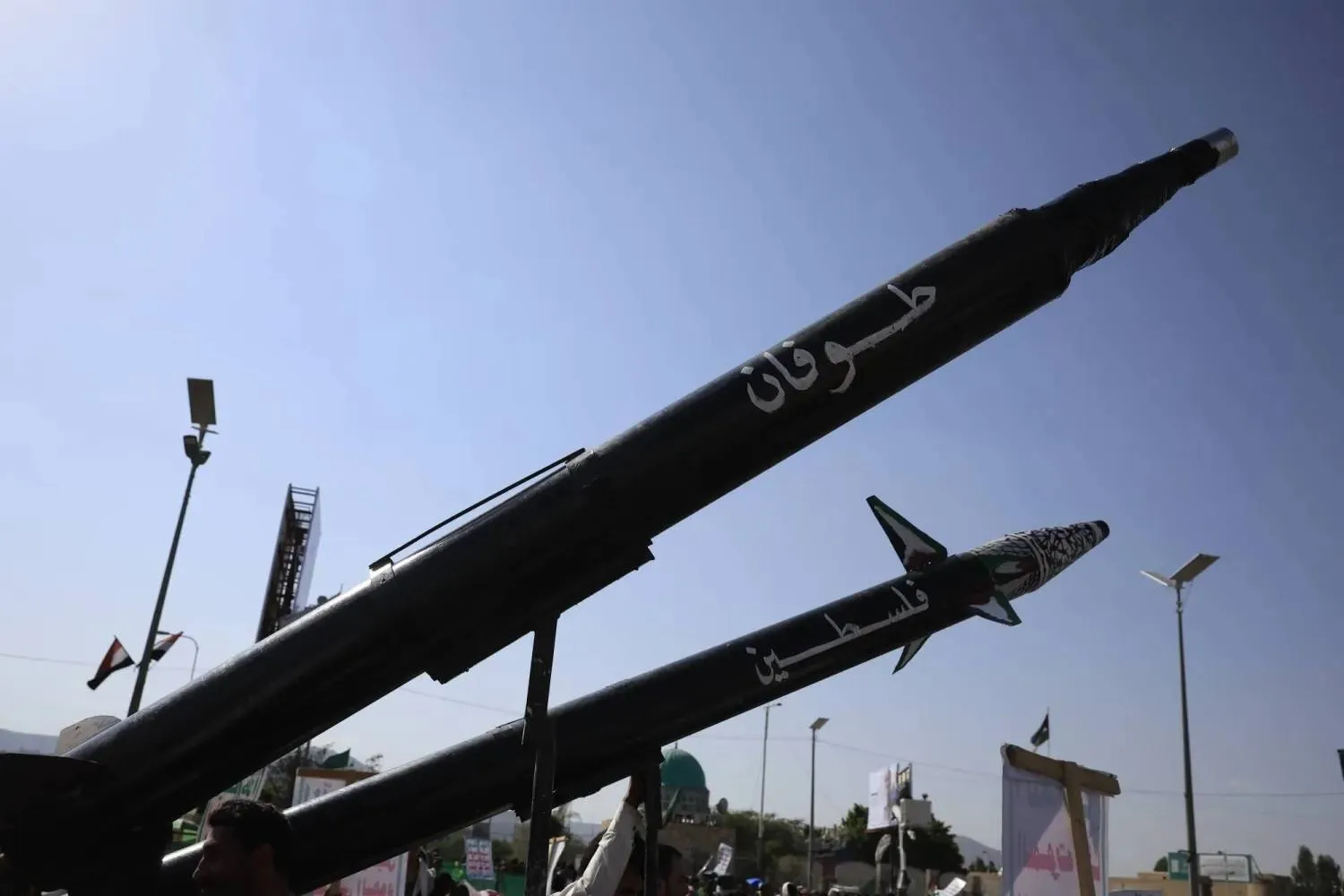
Houthis erect mock missile displays on a street in Sanaa (EPA)
TT

Explosion and Fire Hit Oil Tanker in Gulf of Aden, Houthis Deny Role

Houthis erect mock missile displays on a street in Sanaa (EPA)

In a development that initially bore the hallmarks of a Houthi attack, two British maritime security agencies reported on Saturday that a Cameroon-flagged oil tanker named Falcon was hit by an explosion in the Gulf of Aden, igniting a fire on board.

Two sailors were reported missing, while the remaining 24 crew members were evacuated to Djibouti.

Al-Masirah TV, the media arm of Yemen’s Houthi movement, cited a source at the Ministry of Defense in the group’s self-styled government denying reports that Houthi forces had targeted a ship in the Gulf of Aden, insisting they had “no connection” to the incident.

The denial marked the second signal from the Houthis that they may be halting maritime attacks, coming two days after the group’s leader, Abdul Malik al-Houthi, declared in a televised speech the phrase “If you return, we will return” - an implicit indication of a pause in hostilities following calm in Gaza.

The Houthi denial aligned with data from the oil tanker tracking service TankerTrackers, which said the MV FALCON, sailing under the Cameroon flag and carrying Iranian liquefied gas, was likely bound for the Houthi-controlled port of Ras Issa in Hodeidah, western Yemen, to supply the group.

The European naval mission, EUNAVFOR Aspides, said two of the tanker’s 26 crew members were missing. All were Indian nationals except one Ukrainian.

The United Kingdom Maritime Trade Operations (UKMTO) agency said it had received a report of a projectile attack on a vessel 116 nautical miles east of Aden, sparking a fire on board. It said maritime authorities were “verifying details of the incident” and urged ships in the area to exercise caution and report any suspicious activity.

Separately, the British maritime security firm Ambrey said the tanker had issued a distress call after an onboard explosion about 60 nautical miles south of Ahwar, a district in Yemen’s Abyan governorate.

Ambrey said the blast was caused by a projectile fired from an unknown source off the Yemeni coast in the Gulf of Aden. No injuries were reported among the crew, and there was no immediate comment from the Houthis.

The incident came less than three weeks after a Houthi attack on Sept. 29 killed a Filipino sailor when a Dutch-flagged merchant vessel was struck in the Gulf of Aden.

The European naval mission said it successfully carried out a rescue operation for the ship’s 19 crew members.

Human and Material Losses

Western data show that Houthi attacks in the Red Sea and the Gulf of Aden since November have sunk four ships, seized one, and killed at least nine sailors, while 12 crew members remain in Houthi custody.

The attacks have forced several global shipping companies to reroute vessels around the Cape of Good Hope, driving up transport and insurance costs and delaying supply chains.

Yemen’s internationally recognized government says the ongoing assaults reflect the Houthis’ attempt to evade any political settlement, warning that the operations have directly affected the interests of more than 55 countries and threaten freedom of global trade in the Red Sea, one of the world’s key maritime arteries.

Houthi leader Abdul Malik al-Houthi has previously claimed responsibility for more than 228 naval operations over the past two years, describing them as part of what he called “support for the Palestinian people.”

In his recent speeches, al-Houthi voiced concern about the post-Gaza ceasefire phase between Israel and Hamas, saying his group was “closely monitoring” whether the agreement would lead to a permanent truce and warning that it could be “a deception.”

He urged his followers to continue mobilization and military preparedness, stressing the need to “enhance defensive capabilities against any potential Israeli or American aggression,” as he put it.

In May, the Houthis stopped attacking US vessels under a deal brokered by Oman, which led to the suspension of a large-scale military campaign ordered by President Donald Trump against the group.

However, the agreement did not cover Israeli-linked ships or vessels the Houthis claim are associated with Tel Aviv.



EU Proposes Full Resumption of Syria Cooperation Accord

Members of the Syrian security forces (AFP – file photo)
TT

EU Proposes Full Resumption of Syria Cooperation Accord

Members of the Syrian security forces (AFP – file photo)

Brussels on Monday proposed EU states fully restart the bloc's cooperation agreement with Syria, in the latest step to help bolster the country after the ouster of Bashar al-Assad.

The deal -- which abolishes customs duties on imports of most industrial products from Syria -- was partially suspended in 2011 when Assad's regime ruthlessly cracked down on protests at the start of the civil war.

The 27-nation EU has launched a new chapter with Syria since Assad's ouster from power in December 2024 after over a decade of fighting that devastated the country and sent millions of refugees abroad.

European Commission chief Ursula von der Leyen announced a 620-million-euro ($730 million) two-year financial support package during a visit to Damascus in January.

The bloc has also dropped economic sanctions as it looks to help the authorities under President Ahmed al-Sharaa to rebuild the country and reintegrate internationally.

EU diplomats said that the push to resume the cooperation deal -- which needs approval from member states -- comes ahead of the launch of a new "high-level political dialogue" with Syria next month.

The EU could also look to strike a more ambitious deal to deepen ties with Damascus, the diplomats said.

Some European countries have expressed interest in seeing refugees who came from Syria during the civil war return to their homeland.


Berri to Asharq Al-Awsat: US Working to Extend Lebanon-Israel Ceasefire

Parliament speaker meets with US ambassador to Lebanon Michel Issa (Lebanese Presidency)
TT

Berri to Asharq Al-Awsat: US Working to Extend Lebanon-Israel Ceasefire

Parliament speaker meets with US ambassador to Lebanon Michel Issa (Lebanese Presidency)

Lebanese Parliament Speaker Nabih Berri said the US is working to extend the ceasefire between Lebanon and Israel, while President Joseph Aoun confirmed that “bilateral negotiations will be handled by Lebanon through a delegation headed by Ambassador Simon Karam, and no one will take part on Lebanon’s behalf or replace it in this mission.”

US Ambassador to Lebanon Michel Issa visited Aoun and Berri after returning to Beirut for the first time since the announcement of a 10-day temporary truce, without making any media statements.

Berri told Asharq Al-Awsat that Washington is pursuing efforts to extend the ceasefire, declining to disclose his position on the direct negotiations with Israel that the president is planning.

In remarks distributed by the Lebanese presidency’s media office, Aoun said negotiations aim to halt hostilities, end the Israeli occupation of areas in the south, and deploy the army along the internationally recognized southern border.

Aoun added: “US President Donald Trump showed full understanding and responsiveness during our call regarding Lebanon’s demands, and intervened with Israel to halt hostilities and prepare to launch a negotiating track that would end the abnormal situation and restore the authority of the Lebanese state and its sovereignty over all its territory, foremost the south.”

He said contacts would continue to preserve the ceasefire and begin negotiations, which should be backed by the broadest national support so the negotiating team can achieve its objectives.

He continued: “The upcoming negotiations are separate from any other talks, because Lebanon faces two options: either the continuation of war with its humanitarian, social, economic and sovereignty-related consequences, or negotiations to put an end to this war and achieve sustainable stability. I have chosen negotiations, and I remain hopeful that we can save Lebanon.”


Lebanon President Says Israel Talks Aim to End Hostilities, Occupation

FILED - 16 February 2026, Lebanon, Beirut: Lebanese President Joseph Aoun speaks during a joint press conference with German President Steinmeier (not pictrued) at the presidential palace. Photo: Markus Lenhardt/dpa
TT

Lebanon President Says Israel Talks Aim to End Hostilities, Occupation

FILED - 16 February 2026, Lebanon, Beirut: Lebanese President Joseph Aoun speaks during a joint press conference with German President Steinmeier (not pictrued) at the presidential palace. Photo: Markus Lenhardt/dpa

Lebanese President Joseph Aoun said Monday that planned talks with Israel aim to end hostilities and the Israeli occupation in the south, as he named an ex-ambassador to the United States to lead the delegation.

"The choice to negotiate aims to stop hostilities, end the Israeli occupation of southern regions and deploy the (Lebanese) army all the way to the internationally recognized southern borders" with Israel, Aoun said in a statement.

A 10-day ceasefire pausing more than six weeks of war between Hezbollah and Israel started on Friday after being announced by US President Donald Trump.

More than 2,300 people have been killed in Israeli attacks and over a million displaced since Hezbollah dragged Lebanon into the Middle East conflict last month.

Aoun named former Lebanese ambassador to Washington Simon Karam to head the negotiations with Israel, and said "no one will share this task with Lebanon or take its place".

Iran-backed Hezbollah is not part of the talks and its supporters strongly oppose bilateral Lebanon-Israel negotiations.

Senior Hezbollah official Mahmud Qamati blasted Aoun on Saturday, saying "defeated, you go to the Israelis and Americans, let's see what you will get out of it".

The truce in Lebanon was one of Iran's conditions for resuming talks with Washington to extend their separate ceasefire and work out the terms of a lasting peace.

But Aoun said Monday that the Israel-Lebanon talks will be "separate from any other negotiations", in an implicit reference to the US-Iran diplomacy.

"Lebanon is facing two options: either the continuation of the war, with all its humanitarian, social, economic, and sovereign repercussions, or negotiations to put an end to this war and achieve lasting stability," he said.

"I have chosen negotiations, and I am full of hope that we will be able to save Lebanon."