


Civilians in Sudan's al-Fasher Cower from Drones as Siege Worsens Hunger

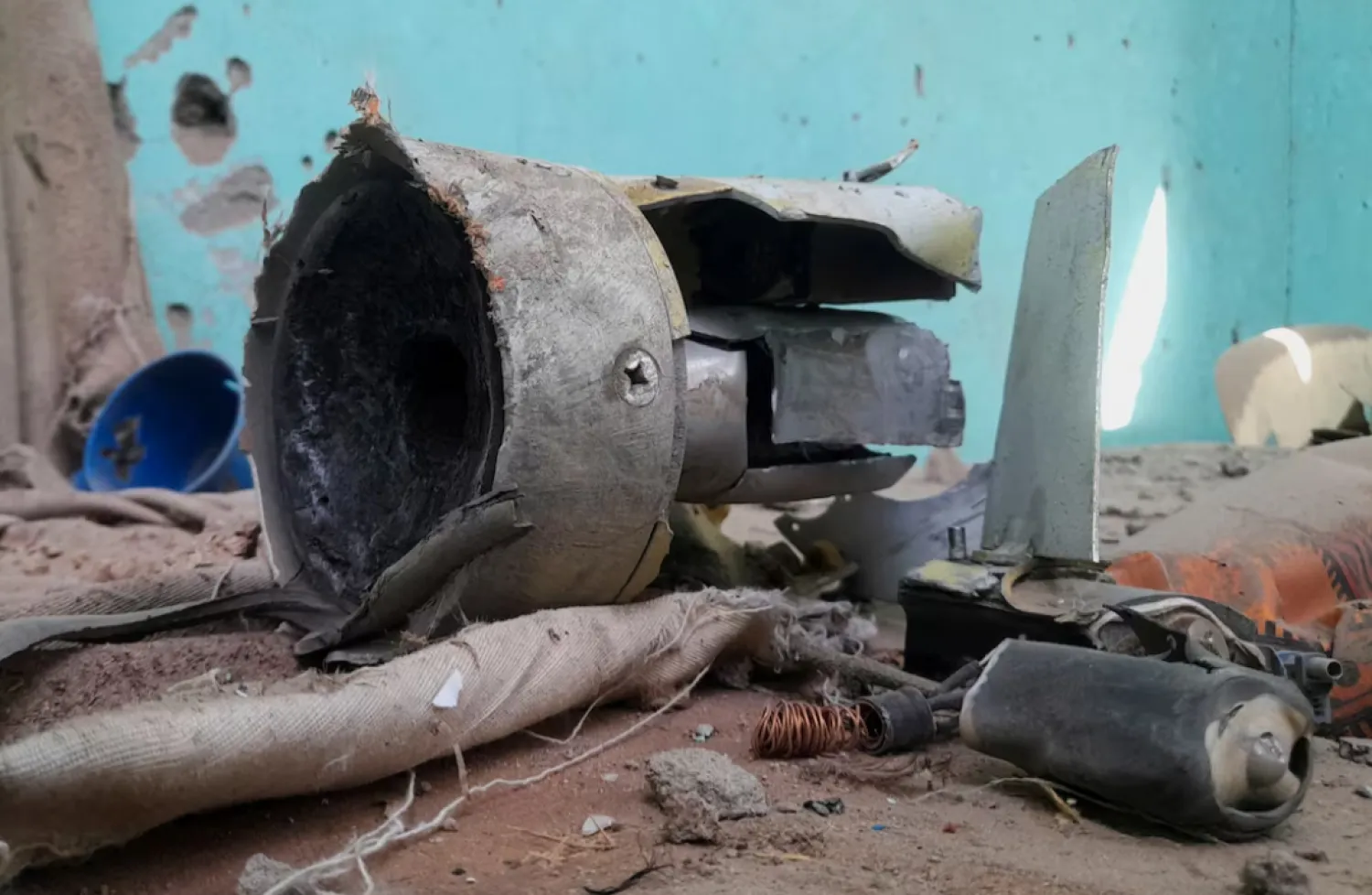
Remnants of a shell that targeted the refugee center, in El Fasher, Sudan, October 7, 2025. REUTERS/Mohyaldeen M Abdallah
TT

Civilians in Sudan's al-Fasher Cower from Drones as Siege Worsens Hunger

Remnants of a shell that targeted the refugee center, in El Fasher, Sudan, October 7, 2025. REUTERS/Mohyaldeen M Abdallah

Residents of Sudan's besieged city of al-Fasher have been taking refuge in underground bunkers to try to protect themselves from drones and shells after intensifying attacks on displacement shelters, clinics and mosques.

Famine-stricken al-Fasher is the Sudanese army's last holdout in the vast, western region of Darfur as it battles the Rapid Support Forces (RSF) in a civil war that has raged for two-and-a-half years, Reuters reported.

The conflict, which erupted from an internal power struggle, has triggered ethnic killings, drawn in foreign powers and created a massive humanitarian crisis.

The army has been gaining ground elsewhere in Sudan, but Darfur is the RSF's stronghold where it aims to base a parallel government, potentially cementing a geographical splintering of the country.

More than one million have fled al-Fasher during an 18-month siege by the RSF, according to the UN, but it has become dangerous and expensive to leave. An estimated quarter of a million civilians remain, and there are fears of mass reprisals if the city falls.

STRUGGLE TO AVOID DRONE STRIKES

Many of those still in the city have dug bunkers for protection after repeated strikes on civilians, according to more than a dozen residents reached by phone as well as footage obtained and verified by Reuters.

The residents described avoiding drones by limiting movements and large gatherings during daytime, and not using lights after dark.

"We can only bury people at night, or very early in the morning," said Mohyaldeen Abdallah, a local journalist. "It's become normal for us."

Five residents said drones have followed civilians into areas where they gather, such as clinics. "When you're walking around you stick to the wall like a gecko so the drone won't see you go inside," said Dr. Ezzeldin Asow, head of al-Fasher's now-abandoned Southern Hospital.

At one shelter in al-Fasher's Abu Taleb school at least 18 people were killed in the week from September 30 by bombardment, a drone attack and an RSF raid, said Abdallah, who visited the site before and after the attacks.

Footage verified by Reuters showed the school's shattered ceilings and scarred walls. On the school grounds, it showed a dead body lying outside a shipping container buried in the ground to create a shelter, with sandbags around the entrance.

Neither the army nor the RSF responded to written requests or calls seeking comment on the incidents at Abu Taleb school and elsewhere in al-Fasher.

Residents captured in the footage blamed the RSF for attacks. Reuters could not independently verify who was responsible.

"They don't distinguish between civilians and soldiers, if you're human they fire at you," Khadiga Musa, head of the North Darfur health ministry, told Reuters by phone from al-Fasher.

The RSF and its allies have been blamed for waves of ethnically driven violence in Darfur during the war, with the US determining last year that they had committed genocide. Its leadership denies ordering such attacks and says rogue soldiers will face justice.

In a statement on October 12, the RSF said al-Fasher was "devoid of civilians". The army and allied self-defense fighters and former rebels had "turned hospitals and mosques into military barracks and rocket launchers," the RSF said.

The Sudanese army, which has denied responsibility for civilian deaths, has also used drones in al-Fasher.

REPEATED ATTACKS ON SECOND SHELTER

On October 10-11 another displacement shelter, Dar al-Arqam, located on university grounds that also house a mosque, suffered repeated strikes. The center's manager, Hashim Bosh, recorded 57 dead including 17 children, among them three babies.

"They were aiming at the mosque. They attacked right after Friday prayer," he said in a voice note to Reuters, describing the first strike. A second strike, he said, came from a drone that followed people running to another shipping container used as a shelter.

The next morning four more shells hit during dawn prayers, Bosh said. Residents interviewed in footage taken by local activists and verified by Reuters confirmed the attacks.

The footage also showed what appear to be 10 bodies covered in sheets at the site, a child-sized body covered by a small prayer rug, and several bodies, mangled and uncovered, inside the container.

Satellite imagery published by the Yale Humanitarian Research Lab (HRL) on October 16 showed six impact points on Dar al-Arqam's buildings.

BODIES SCATTERED IN THE STREETS

According to HRL, as of October 4 the RSF had extended earthen barriers to almost fully encircle al-Fasher.

As a result, activists warned last week that even ambaz, an animal feed people had resorted to eating, had become unavailable.

Activists from a local network, the al-Fasher Resistance Committee, say on average 30 people a day are dying from violence, hunger, and disease.

So many bodies were scattered in the streets that it was a health risk, according to the Abu Shouk Emergency Response Room, a volunteer network.

Those who spoke to Reuters said they feared being kidnapped, robbed, or killed if they left.

"Al-Fasher is basically lifeless," said a member of the Abu Shouk Emergency Response Room who only gave his first name, Mohamed. "But leaving is even more dangerous than staying."


‘Shockingly High’ Number of Gaza Children Still Acutely Malnourished After Truce, UN Says 

Displaced Palestinian students attend class at a tent school in the Tal Al-Hawa neighborhood in Gaza City, Gaza Strip, 09 December 2025. (EPA)
TT

‘Shockingly High’ Number of Gaza Children Still Acutely Malnourished After Truce, UN Says 

Displaced Palestinian students attend class at a tent school in the Tal Al-Hawa neighborhood in Gaza City, Gaza Strip, 09 December 2025. (EPA)

Thousands of children have been admitted for treatment for acute malnutrition in Gaza since an October ceasefire that was supposed to enable a major increase in humanitarian aid, the UN children's agency said on Tuesday.

UNICEF, the biggest provider of malnutrition treatment in Gaza, said that 9,300 children were treated for severe acute malnutrition in October, when the first phase of an agreement to end the two-year Israel-Hamas war came into effect.

While this is down from a peak of over 14,000 in August, the number is still significantly higher than during a brief February-March ceasefire and indicates that aid flows remain insufficient, UNICEF spokesperson Tess Ingram told a Geneva press briefing by video link from Gaza.

"It's still a shockingly high number," she said. "The number of children admitted is five times higher than in February, so we need to see the numbers come down further."

Ingram described meeting underweight babies weighing less than 1 kilogram born in hospitals "their tiny chests heaving with the effort of staying alive."

UNICEF is able to import considerably more aid into the enclave than it was before the October 10 agreement, but obstacles remain, she said, citing delays and denials of cargoes at crossings, route closures and ongoing security challenges.

"We have seen some improvement, but we continue to call for all of the available crossings into the Gaza Strip to be open," she added.

There are not enough commercial supplies entering Gaza, she added, saying that meat was still prohibitively expensive at around $20 a kilogram.

"Most families can't access this, and that's why we're still seeing high rates of malnutrition," she said.

In August, a UN-backed hunger monitor determined that famine conditions were affecting about half a million people - or a quarter of Gaza's population.

Children were severely affected by hunger as the war progressed, with experts warning that the effects could cause lasting damage.


Sudan’s RSF Advances Could Trigger New Refugee Exodus, UNHCR Chief Warns 

Women displaced from el-Fasher stand in line to receive food aid at the newly established El-Afadh camp in al-Dabba, in Sudan's Northern State, Nov. 16, 2025. (AP)
TT

Sudan’s RSF Advances Could Trigger New Refugee Exodus, UNHCR Chief Warns 

Women displaced from el-Fasher stand in line to receive food aid at the newly established El-Afadh camp in al-Dabba, in Sudan's Northern State, Nov. 16, 2025. (AP)

Advances by paramilitary Rapid Support Forces in Sudan could trigger another exodus across the country's borders, UN High Commissioner for Refugees, Filippo Grandi, told Reuters.

The RSF took over Darfur's city of el-Fasher in late October in one of its biggest gains of the 2-1/2-year war with Sudan's army. This month, advances have continued eastward into the Kordofan region and they seized the country's biggest oil field.

Most of the estimated 40,000 people that the United Nations says have been displaced by the latest violence in Kordofan - a region comprised of three states in central and southern Sudan - have sought refuge within the country, Grandi said, but that could change if violence spreads to a large city like El Obeid.

"If that were to be - not necessarily taken - but engulfed by the war, I am pretty sure we would see more exodus," said Grandi in an interview from Port Sudan late on Monday.

"We have to remain...very alert in neighboring countries in case this happens," he said.

MILLIONS HOMELESS

Already, the war has uprooted nearly 12 million people, including 4.3 million who have fled across borders to Chad, South Sudan and elsewhere, in the world's biggest displacement crisis. However, some have returned to the capital Khartoum, which is now back in Sudanese army control.

Humanitarian workers lack resources to help those fleeing, many of whom have been raped, robbed or bereaved by the violence, said Grandi, who met with survivors who fled mass killings in el-Fasher.

"We are barely responding," said Grandi, referring to a Sudan response plan, which is just a third funded largely due to Western donor cuts. UNHCR lacks resources to relocate Sudanese refugees from an unstable area along Chad's border, he said.

FAMILIES TORN APART BY CONFLICT

Most of those who trekked hundreds of kilometers from el-Fasher and Kordofan to Sudan’s al-Dabba camp on the banks of the Nile north of Khartoum, which Grandi visited last week, are women and children. Their husbands and sons were killed or conscripted along the way.

Some mothers said they disguised their sons as girls to protect them from being abducted by fighters, Grandi said.

"Even fleeing is difficult because people are continuously stopped by the militias," he said.

Grandi began his UNHCR career in Khartoum in the 1980s, when Sudan sheltered refugees from other African wars. He is on his last trip as UNHCR chief before his term ends this month. A successor has yet to be named from over a dozen candidates.


International Court Sentences Sudanese Militia Leader to 20 Years in Prison for Darfur Atrocities

Ali Muhammad Ali Abd al-Rahman, a leader of the Sudanese Janjaweed militia, at the International Criminal Court, ICC, in The Hague, Netherlands, Tuesday, Dec. 9, 2025. (AP Photo/Peter Dejong, Pool)
TT

International Court Sentences Sudanese Militia Leader to 20 Years in Prison for Darfur Atrocities

Ali Muhammad Ali Abd al-Rahman, a leader of the Sudanese Janjaweed militia, at the International Criminal Court, ICC, in The Hague, Netherlands, Tuesday, Dec. 9, 2025. (AP Photo/Peter Dejong, Pool)

Judges at the International Criminal Court sentenced a leader of the feared Sudanese Janjaweed militia to 20 years imprisonment Tuesday for war crimes and crimes against humanity committed in the catastrophic conflict in Darfur more than 20 years ago.

At a hearing last month, prosecutors sought a life sentence for Ali Muhammad Ali Abd–Al-Rahman who was convicted in October of 27 counts of war crimes and crimes against humanity that included ordering mass executions and bludgeoning two prisoners to death with an ax in 2003-2004, The Associated Press said.

“He committed these crimes knowingly, wilfully, and with, the evidence shows, enthusiasm and vigor,” prosecutor Julian Nicholls told judges at the sentencing hearing in November.

Abd-Al-Rahman, 76, stood and listened, but showed no reaction as Presiding Judge Joanna Korner passed the sentence.
