



Arm Expands AI Licensing Program to Boost on-device AI Market Share

ARM CEO Rene Haas makes a speech at COMPUTEX forum in Taipei, Taiwan June 3, 2024. REUTERS/Ann Wang
TT

Arm Expands AI Licensing Program to Boost on-device AI Market Share

ARM CEO Rene Haas makes a speech at COMPUTEX forum in Taipei, Taiwan June 3, 2024. REUTERS/Ann Wang

Arm Holdings said on Monday it is expanding its Flexible Access licensing program to cover its Armv9 edge AI platform, aiming to attract startups and device makers developing on-device AI by lowering entry barriers and accelerating design cycles.

The Flexible Access program allows companies to use its chip design tools and training for little or no cost, enabling them to build and test new chip concepts, Reuters reported.

Companies including hardware firms Raspberry Pi, Hailo and SiMa.ai have participated in the program, Arm said.

WHY IT'S IMPORTANT

Opening up the licensing program strengthens Arm's ties with AI startups and on-device AI providers that might otherwise be priced out by costly licenses, positioning Arm to embed its technology across emerging AI devices.

CONTEXT

Arm is expanding to fortify its position in the burgeoning edge AI market, where it faces growing competition from rivals such as Nvidia, Intel, as well as newer players.

Companies from self-driving vehicle makers to retail inventory software developers are adopting edge AI, which runs artificial-intelligence models on devices such as smartphones and laptops to process data on the spot rather than sending it to the cloud.

BY THE NUMBERS Arm said more than 300 companies have joined the program, with 400 chip designs completed and ready for manufacturing. Earlier this month, Qualcomm shifted its flagship chips to Arm's v9 architecture, sources exclusively told Reuters.

MARKET REACTION

Arm's shares rose 4% to $172.23 after the news. Up to last close, the stock had gained 34.2% this year.
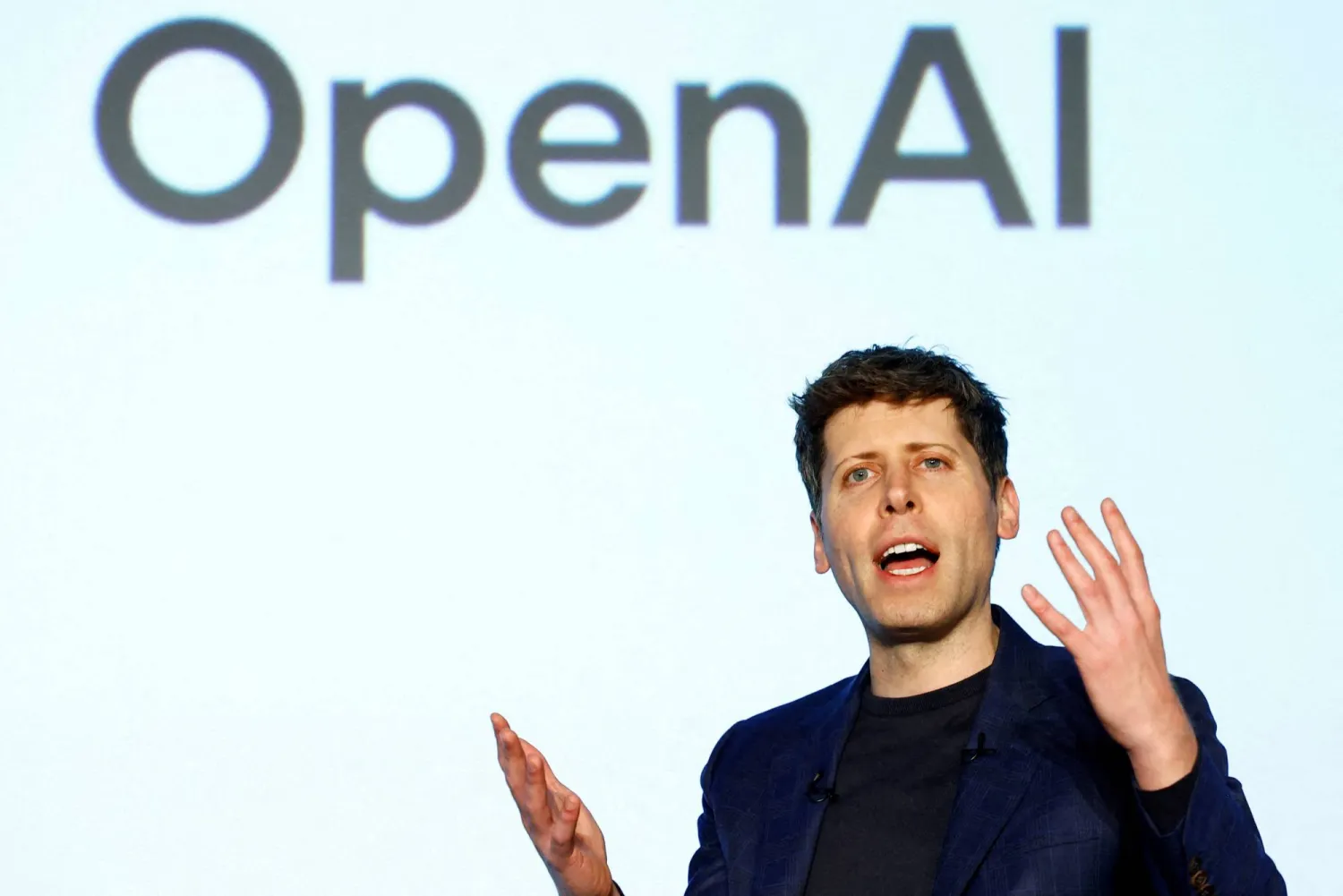



OpenAI's Altman Says AI Unlikely to Lead to 'Jobs Apocalypse'

FILE PHOTO: OpenAI CEO Sam Altman attends an event in Tokyo, Japan February 3, 2025. REUTERS/Kim Kyung-Hoon/File Photo
TT

OpenAI's Altman Says AI Unlikely to Lead to 'Jobs Apocalypse'

FILE PHOTO: OpenAI CEO Sam Altman attends an event in Tokyo, Japan February 3, 2025. REUTERS/Kim Kyung-Hoon/File Photo

OpenAI CEO Sam Altman said on Tuesday the rapid development and adoption of AI would not lead to a global "jobs apocalypse" and the technology had not claimed as many white-collar jobs as he had feared.

Speaking virtually at a Commonwealth Bank of Australia (CBA) conference in Sydney, Altman said he was initially concerned about the impact AI would have on global employment levels.

He said he and his executives had been "roughly right" on the technological predictions made by OpenAI when it launched ChatGPT in 2022. But he said they were "pretty wrong" on the social and economic implications.

"I'm delighted to be wrong about this, I ⁠thought there would have ⁠been more impact on entry-level white-collar jobs being eliminated by now than has actually happened," Altman told CBA Chief Executive Matt Comyn in an interview.

"I now think I understand more about why it hasn't, and I'm obviously grateful but that is an area where my intuitions were just off.

"People are like 'oh you could have saved the world a lot of fear mongering and a lot of doom and gloom' but at the time I was like 'I see this is a ⁠real risk we should probably talk about it' and it still may."

According to Reuters, Altman did not cite any jobs numbers on Tuesday but has previously talked about potential industry-wide job cuts due to AI's advancement.

A growing number of global companies, including HSBC, Amazon, Standard Chartered and CBA have announced some jobs within their companies were being replaced by AI.

OpenAI is preparing to confidentially file for a US initial public offering in the coming weeks, Reuters reported last week, citing a source familiar with the matter. The company could be aiming for a $1 trillion valuation and raising at least $60 billion, Reuters reported in October.

Altman said he had realized that even though AI was taking on an increasingly active role in many industries ⁠and jobs, there was still ⁠a 'human part' of employment that could not be replaced.

He said he had been using AI to respond to Slack and email messages but had reverted to answering some himself.

"I had it reply to messages, saying 'this is Sam's AI' and it was an amazing example to me of we really do care about people," he said.

"We really do care about our interactions with people and this thing, which is a huge amount of my time, is not something that I can imagine myself outsourcing to an AI anytime soon."

That realization, he said, had made him believe the human interaction required in many jobs would not be replaced by AI.

"It really, in both positive and negative ways, updated me to thinking that the jobs picture is likely to be very different than we thought," he said.

"I don't think we're going to have the kind of jobs apocalypse that some of the companies in our space advocate or talk about."


Huawei Touts New Chipmaking Technology to Sidestep US Restrictions

The Huawei logo is seen at the Porte de Versailles exhibition center in Paris, France, June 12, 2025. (Reuters)
TT

Huawei Touts New Chipmaking Technology to Sidestep US Restrictions

The Huawei logo is seen at the Porte de Versailles exhibition center in Paris, France, June 12, 2025. (Reuters)

Chinese tech giant Huawei said on Monday it had developed a new way of making semiconductors that could get around its US-enforced lack of access to the most advanced chipmaking equipment.

Huawei has in recent years been at the center of a geopolitical standoff after Washington warned its equipment could be used for espionage by the Chinese government, an allegation the firm denies.

Sanctions since 2019 have cut Huawei's access to components and technologies made by the United States and some of its allies -- including the lithography machines used to make the world's most advanced chips.

But on Monday the head of Huawei's semiconductor division He Tingbo said that the company will be able to produce next-generation 1.4-nanometre (1.4nm) chips by 2031.

Taiwan's TSMC, the industry leader, has projected it will be able to do the same by 2028.

Cutting-edge chips that can train and power artificial intelligence systems are a crucial and highly sensitive element of the technology rivalry between the United States and China.

The computing power of chips has increased dramatically over the decades as makers cram them with more microscopic electronic components.

Huawei's announcement suggests it might have sidestepped the need for extreme ultraviolet lithography (EUV) machines, which have been considered crucial for mass manufacturing chips of 5nm or under.

"Over the past six years, I have often been asked... how did you survive and come back on top?" He said in a presentation to the International Symposium on Circuits and Systems (ISCAS) in Shanghai.

She said the new technique came about through a shift in how chipmaking has historically been conceptualized.

"Moore's Law" is a principle developed by Intel co-founder Gordon Moore which states the number of transistors -- devices regulating the flow of electricity -- on a chip doubles every two years.

A higher density of transistors results in a smaller chip or one the same size with faster processing power.

He on Monday proposed "the Tau Scaling Law", or "Her's Law", by which instead of optimizing for space, designers optimize for the time taken for the various elements making up a chip to communicate.

This overcomes a key challenge facing Moore's Law that Intel sums up as: "You can make something smaller and smaller and smaller... until you can't".

US sanctions have meant that "these challenges arrived earlier and are tougher" for Huawei, He said.

"Our solution is feasible and affordable. The performance of the new chip can fully compete with that of the other path," she said.

Huawei's next iteration of its Kirin chip, set to launch in the autumn, will be the first ever to fully adopt an architecture called "LogicFolding" based on the new principle, the company said.

The Tau Scaling Law "underscores the company's ambition to lead rather than follow in the global chip race", said George Chen, Partner and Chair of Digital Practice at The Asia Group.

"Even without a new product launch today, Huawei's intent is clear - and its trajectory will likely heighten US concerns."


More and More Plastic Surgeons Are Being Asked to Create an ‘AI Face’

Surgeons have noticed consistencies in the aesthetics of “AI face”. (Shutterstock)
TT

More and More Plastic Surgeons Are Being Asked to Create an ‘AI Face’

Surgeons have noticed consistencies in the aesthetics of “AI face”. (Shutterstock)

Plastic surgeons are increasingly concerned about the rise of “AI face”, as more and more clients arrive in their offices with unrealistic AI-generated visions of what they want to look like, according to The Guardian.

People using AI chatbots to generate their ideal faces are increasingly arriving at surgeons’ offices with briefs demanding flawless skin, sharply sculpted cheekbones, refined noses and near-perfect symmetry – standards that are too time consuming, prohibitively expensive and, in many cases, physically unattainable.

While AI can control every single pixel, “surgery certainly doesn’t work on that microscopic detailed level,” said Dr. Alex Karidis, a surgeon based in west London.

For many clients, however, those expectations are shaped long before they ever meet a surgeon. Karidis and Nugent describe how psychologically effective AI-generated images can be in defining – and reinforcing – clients’ aesthetic ideals.

Dr. Nora Nugent, a cosmetic surgeon from Tunbridge Wells, said: “Once you see an image, it’s wired into you.” Karidis agreed, describing AI images as being “seared” into patients’ minds, and said colleagues had recently been inundated with them.

Surgeons are also keen to emphasize that cosmetic surgery outcomes are far from guaranteed.

“The patient has to understand that there is human variation in how they heal, how they age and what can be done,” said Nugent. “I say to patients beforehand: it’s not limitless what I can do in surgery. Neither of us control everything.”

Surgeons have also noticed consistencies in the aesthetics of “AI face”, particularly hyper-symmetry – something AI can generate effortlessly, but which is often impossible to recreate in real life.

If one of your eyes is a few millimeters higher than the other, AI can alter that in seconds, according to Dr. Julian de Silva, a Harley Street cosmetic surgeon. But rearranging pixels is not the same as rearranging anatomy.

“It’s impossible to change [eye level] because that’s actually set in bone, and your brain sits behind the orbits. You cannot safely change the position of the orbits,” he said.

De Silva added that when AI edits a client’s photo, it frequently defaults to widely accepted beauty ideals: for women, a V-shaped jawline, a sweeping “ogee curve” along the cheekbones and a heart-shaped face; for men, broader jawlines, lower eyebrows and fuller upper eyelids.

But De Silva is also concerned about another growing trend: clinicians sharing surgery results on social media that appear astonishingly effective, but which he suspects may themselves be AI-generated.

“I remember looking at one of these last week and I looked at it over and over,” he said, recalling a video in which a patient appeared to have been made to look 30 years younger. “And then the third time I watched it, I could see ... the hands had six fingers.”