


Body of Slain Nepali Hostage Held in Gaza Repatriated After Release by Hamas 

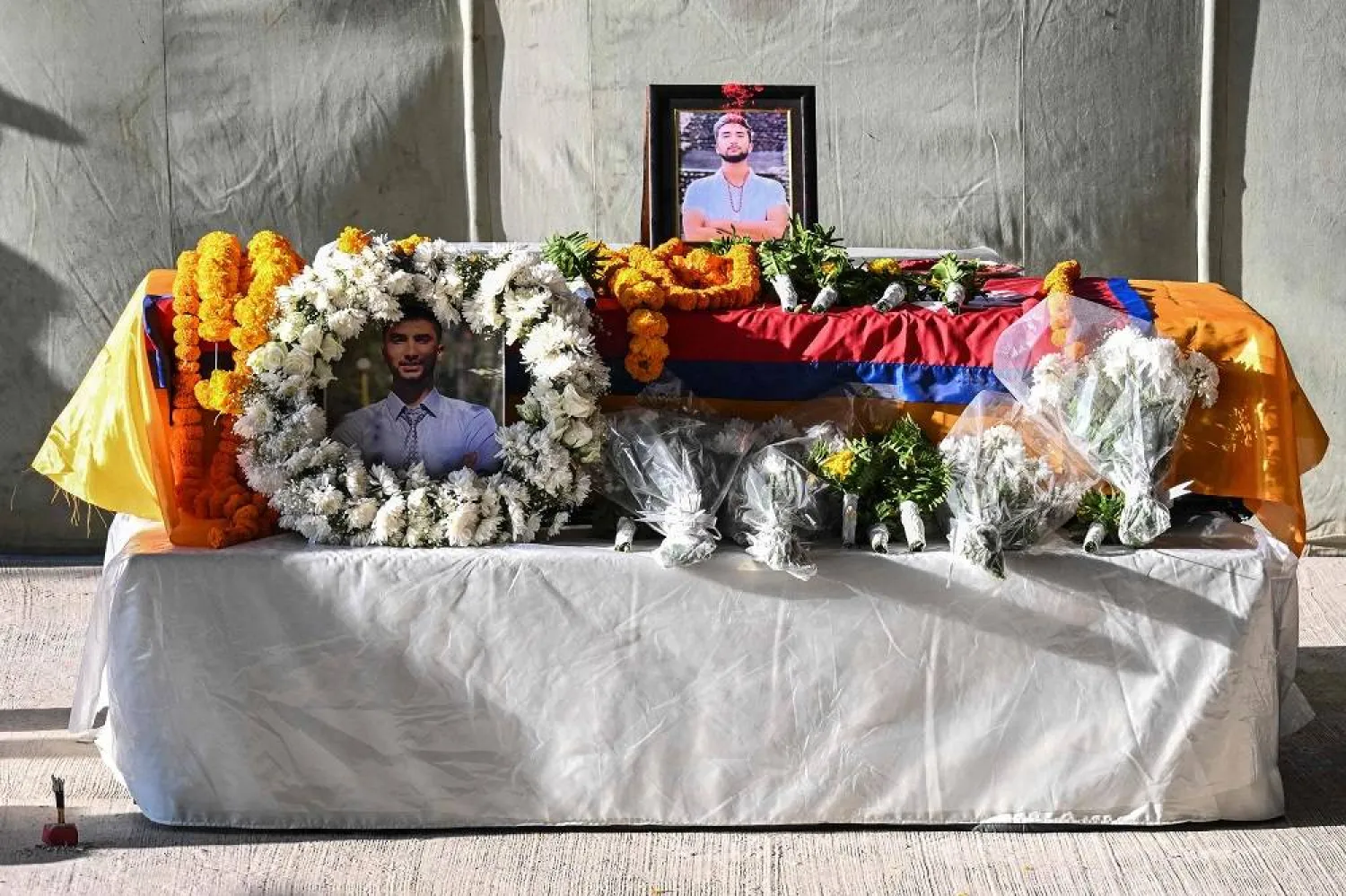
Flowers are placed over the coffin of Bipin Joshi, a deceased Nepali student who was killed while being held hostage in Gaza, at the Tribhuvan International Airport in Kathmandu on October 20, 2025. (AFP) 
TT

Body of Slain Nepali Hostage Held in Gaza Repatriated After Release by Hamas 

Flowers are placed over the coffin of Bipin Joshi, a deceased Nepali student who was killed while being held hostage in Gaza, at the Tribhuvan International Airport in Kathmandu on October 20, 2025. (AFP) 

The body of a Nepali student who was among the hostages being held in Gaza arrived in Kathmandu on Monday after being repatriated, authorities said.

The remains of Bipin Joshi were flown from Israel’s Ben Gurion International Airport in Tel Aviv and arrived at Tribhuvan International Airport. Nepal’s Foreign Ministry said Joshi's body would be taken to his hometown of Bhimdattanagar later Monday evening.

“The Nepal government made various attempts at different levels, to the extent possible, for Joshi’s release while he was in captivity,” the ministry said in a statement.

Joshi was among 17 Nepali students studying agriculture in southern Israel when Hamas launched its Oct. 7, 2023, attack that ignited the war in Gaza. He had arrived in Israel a month earlier on a student exchange program to work and study at Kibbutz Alumim, near the Gaza border.

The Hamas attack left 10 Nepali students dead and injured six others before Joshi, then 22, was kidnapped.

The Israel army said on Oct. 14 that Joshi was killed in captivity during the first months of the war. His death was declared while his mother and sister were in the United States lobbying the international community, including the United Nations, for his release.

Nepal's Prime Minister Sushila Karki paid tribute to Joshi during a ceremony at Kathmandu’s airport, where she draped the national flag over his coffin.

“Bipin’s courage and bravery are a matter of pride for every Nepali,” Karki said. “He is a son of Nepal, a son of every mother. We will never forget him. He lives in our hearts.”



Iran Ready to Fight Back if US or Israel Attacks again, Says Foreign Minister

The Iranian flag waves in front of the International Atomic Energy Agency (IAEA) headquarters, before the beginning of a board of governors meeting, amid the coronavirus disease (COVID-19) outbreak in Vienna, Austria, March 1, 2021. (Reuters)
TT

Iran Ready to Fight Back if US or Israel Attacks again, Says Foreign Minister

The Iranian flag waves in front of the International Atomic Energy Agency (IAEA) headquarters, before the beginning of a board of governors meeting, amid the coronavirus disease (COVID-19) outbreak in Vienna, Austria, March 1, 2021. (Reuters)

Iran does not want war with Israel or the United States, but is ready to fight back if attacked again, the country’s foreign minister said Thursday.

Speaking upon arrival in Beirut, Abbas Araghchi told reporters that Iran is also ready for negotiations with the US over its nuclear program as long as the talks are based on mutual respect rather than “dictation” by Washington.

Araghchi’s comments came as many fear that close US ally Israel will target Iran again as it did during the 12-day war it launched against Tehran in June. Israel killed a slew of top military officials and nuclear scientists, and the US bombed Iranian nuclear enrichment sites.

“America and Israel have tested their attack on Iran and this attack and strategy faced extreme failure,” the Iranian official said in Beirut at the start of a two-day visit to Lebanon. “If they repeat it, they will face the same results.”

“We are ready for any choice. We don’t desire a war but we are ready for it,” Araghchi said.

In February, US President Donald Trump reimposed a “maximum pressure” campaign on Iran in an effort to block its development of nuclear weapons. The campaign included US led strikes on three critical Iranian enrichment facilities in June.

Araghchi said Tehran is ready for “negotiations but I say that the negotiations should be based on mutual respect and mutual interests.”

“We believe that once the Americans reach the outcome that constructive and positive negotiations rather than ordering dictation are the framework, then at that time the results of the these negotiations become fruitful,” he said.

Iran had been enriching uranium up to 60% purity — a short, technical step from weapons-grade levels — after Trump unilaterally withdrew the United States from Tehran’s 2015 nuclear deal with world powers in 2018. Tehran long has maintained its atomic program is peaceful, though the West and the IAEA, the UN's nuclear watchdog, say Iran had an organized nuclear weapons program until 2003.

In late December, Trump warned Iran that the US could carry out further military strikes if the country attempts to reconstitute its nuclear program as he held talks with Israeli Prime Minister Benjamin Netanyahu in Florida.


Russia Says Foreign Troops in Ukraine Would be Targets after UK, France Pledge Post-ceasefire Deployment

Cars move along a dark street during a power blackout after critical civil infrastructure was hit by today's Russian drone strikes, amid Russia's attack on Ukraine, in Zaporizhzhia, Ukraine January 7, 2026. REUTERS/Stringer
TT

Russia Says Foreign Troops in Ukraine Would be Targets after UK, France Pledge Post-ceasefire Deployment

Cars move along a dark street during a power blackout after critical civil infrastructure was hit by today's Russian drone strikes, amid Russia's attack on Ukraine, in Zaporizhzhia, Ukraine January 7, 2026. REUTERS/Stringer

Russia said on Thursday that any troops sent to Ukraine by Western governments would be "legitimate combat targets", after Britain and France announced plans to ​deploy a multinational force there in the event of a ceasefire.

A Russian Foreign Ministry statement said "militaristic declarations" by a coalition of pro-Ukraine Western governments were becoming increasingly dangerous.

Russia was responding for the first time to a meeting of the "coalition of the willing" in Paris on Tuesday at which Britain and France signed a declaration of intent on the future deployment.

French President Emmanuel Macron said it could involve sending ‌thousands of French ‌troops. British Prime Minister Keir Starmer said ‌it ⁠paved ​the way ‌for a legal framework whereby "British, French and partner forces could operate on Ukrainian soil, securing Ukraine's skies and seas and regenerating Ukraine's armed forces for the future", Reuters reported.

Russia "warns that the deployment of Western military units, military facilities, depots and other infrastructure on Ukrainian territory will be classified as foreign intervention, posing a direct threat to the security of not only Russia but also ⁠other European countries," the statement from Moscow said.

"All such units and facilities will be ‌considered legitimate combat targets of the Russian ‍Armed Forces."

It added: "The fresh militaristic ‍declarations of the so-called coalition of the willing and the Kyiv regime constitute ‍a veritable 'axis of war'.

"The plans of these participants are becoming increasingly dangerous and destructive for the future of the European continent and its inhabitants, who are also being forced by Western politicians to finance these aspirations out of ​their own pockets."

Russia, which staged a full-scale invasion of Ukraine in February 2022, says it was forced to intervene in ⁠order to prevent Ukraine from being absorbed into NATO and used as a launchpad to threaten Russia. It has consistently said it will never accept the stationing of Western forces there.

Ukraine and its allies accuse Moscow of waging an imperial-style war aimed at seizing the territory of its neighbour, of which it now holds nearly 20%. They say Ukraine needs firm security guarantees as part of any peace settlement in order to prevent another Russian invasion in future.

The United States has ruled out sending its own troops to Ukraine, but its special envoy Steve Witkoff said ‌at Tuesday's meeting in Paris that President Donald Trump "strongly stands behind" security protocols aimed at deterring future attacks on Ukraine.


Iran: Divisions Deepen as Bazaar Protests Expand

 A protester in the city of Abdanan, which saw the largest demonstrations on Tuesday (Telegram)
A protester in the city of Abdanan, which saw the largest demonstrations on Tuesday (Telegram)
TT

Iran: Divisions Deepen as Bazaar Protests Expand

 A protester in the city of Abdanan, which saw the largest demonstrations on Tuesday (Telegram)
A protester in the city of Abdanan, which saw the largest demonstrations on Tuesday (Telegram)

Iranian authorities are showing clear internal divisions as protests widen across the country, with strikes spreading through Tehran’s historic Grand Bazaar and demonstrations flaring in dozens of cities.

President Masoud Pezeshkian has instructed officials to avoid a heavy-handed security response to protesters, stressing that confrontational tactics could undermine national security.

His position contrasts sharply with the escalating rhetoric of Judiciary Chief Gholam-Hossein Mohseni-Ejei, who has warned against any tolerance toward what he calls “rioters” and those “assisting the enemy,” accusing the United States and Israel of seeking to destabilize Iran.

In Tehran, protests intensified in and around the Grand Bazaar as merchants continued a strike for a second consecutive day. In a notable move, Tehran Metro announced that the capital’s main subway line would remain closed “until further notice” at the 15 Khordad station near the bazaar, a decision widely interpreted as an attempt to curb the flow of people into the area.

Reports also described scattered gatherings and sporadic clashes in central and southern parts of the capital.

Beyond Tehran, the protest movement has expanded to include market strikes and intermittent nighttime demonstrations in multiple cities. On Tuesday night, protests were reported in several provinces.

In Ilam, demonstrators took to the streets in different neighborhoods chanting anti-government slogans. In Torbat-e Heydarieh, solidarity gatherings were held alongside a heavy deployment of special security units. Videos circulated from Alvand, in Qazvin province, showing crowds amid the sound of gunfire, while security forces fired tear gas at protesters in Neyriz, in Fars province.

As strikes spread through commercial centers, currency markets hit record levels. The US dollar approached 1.48 million rials on Tehran’s informal market, while exchange shops quoted selling prices around 1.47 million rials. Analysts said the surge reflected the sharp decline in the rial’s value and the erosion of purchasing power, factors widely seen as key drivers of the unrest.

Official Divide

Vice President for Executive Affairs Mohammad-Jafar Qaempanah said Pezeshkian emphasized during a cabinet meeting the need to avoid a security-first approach to protests “so as not to harm national security,” while distinguishing peaceful demonstrations from acts of violence.

“Anyone carrying a weapon or knife and attacking police or military centers is a rioter and must be separated from protesters,” he said, according to a state news agency.

Government spokeswoman Fatemeh Mohajerani also quoted the president as saying that dialogue with citizens and protesters would not allow “other parties to hijack the people’s protests.”

Former reformist lawmaker Mahmoud Sadeghi criticized the judiciary chief’s threats, saying they played into the hands of hardliners, and urged security forces to respect protesters and show greater tolerance, even toward harsh slogans or angry behavior.

By contrast, Mohseni-Ejei struck a far tougher tone, labeling demonstrators as troublemakers and arguing that those taking to the streets were serving the objectives of Iran’s enemies. He said there would be no room for leniency and promised that prosecutions and punishments would be “swift,” while remaining “precise and in accordance with legal standards.”

Speaking to a group of traders and business owners, he added that “bazaar protests do not mean confronting the system.”

Casualties, Arrests, and Hospitals

Human rights organizations reported dozens of deaths and thousands of arrests in the early days of the unrest.

The Kurdish rights group Hengaw said at least 27 people were killed and more than 1,500 arrested over a 10-day period.

The Human Rights Activists News Agency (HRANA) put the death toll at no fewer than 36, with at least 2,076 arrests.

The Oslo-based Iran Human Rights organization said detainees exceeded 1,000, as protests spread to 28 of Iran’s 31 provinces and around 80 cities.

Tehran Governor Mohammad Sadegh Motamedian said no deaths had been recorded in Tehran province, adding that when events turn into vandalism and clashes, “they are no longer protests.”

Authorities confirmed that at least two members of the security forces were killed and more than 10 wounded, without releasing figures for protester fatalities.

Amid allegations that security forces entered hospitals in Tehran and Ilam, Health Minister Mohammad-Reza Zafarghandi denied that injured protesters had been removed from medical facilities. He said no tear gas had been fired inside Sina Hospital, while noting that investigations were ongoing.

International Pressure

Iran is also facing mounting international pressure. US President Donald Trump warned he would intervene to “save protesters” if security forces opened fire, months after Israeli and US strikes on Iranian nuclear sites during a 12-day conflict.

Iran’s Supreme Leader Ali Khamenei responded by vowing not to “bow to the enemy.”

Foreign Minister Abbas Araghchi said Iran’s internal affairs “have nothing to do with any foreign country,” describing Trump’s comments as “interference,” while expressing hope that tensions between the government and protesting citizens could be resolved through dialogue.

The Foreign Ministry reaffirmed Iran’s recognition of the right to peaceful protest, while condemning what it called “interventionist and misleading” US statements.

In an effort to contain public anger, the government has begun distributing monthly cash assistance of about $7 per citizen to help cover basic food costs.

A Persian-language account run by the US State Department described the payment of one million tomans per person as “humiliating,” contrasting it with Iran’s financial support for regional allies.