Semi-Transparent Crab, Tiny Lantern Shark Discovered in Australia

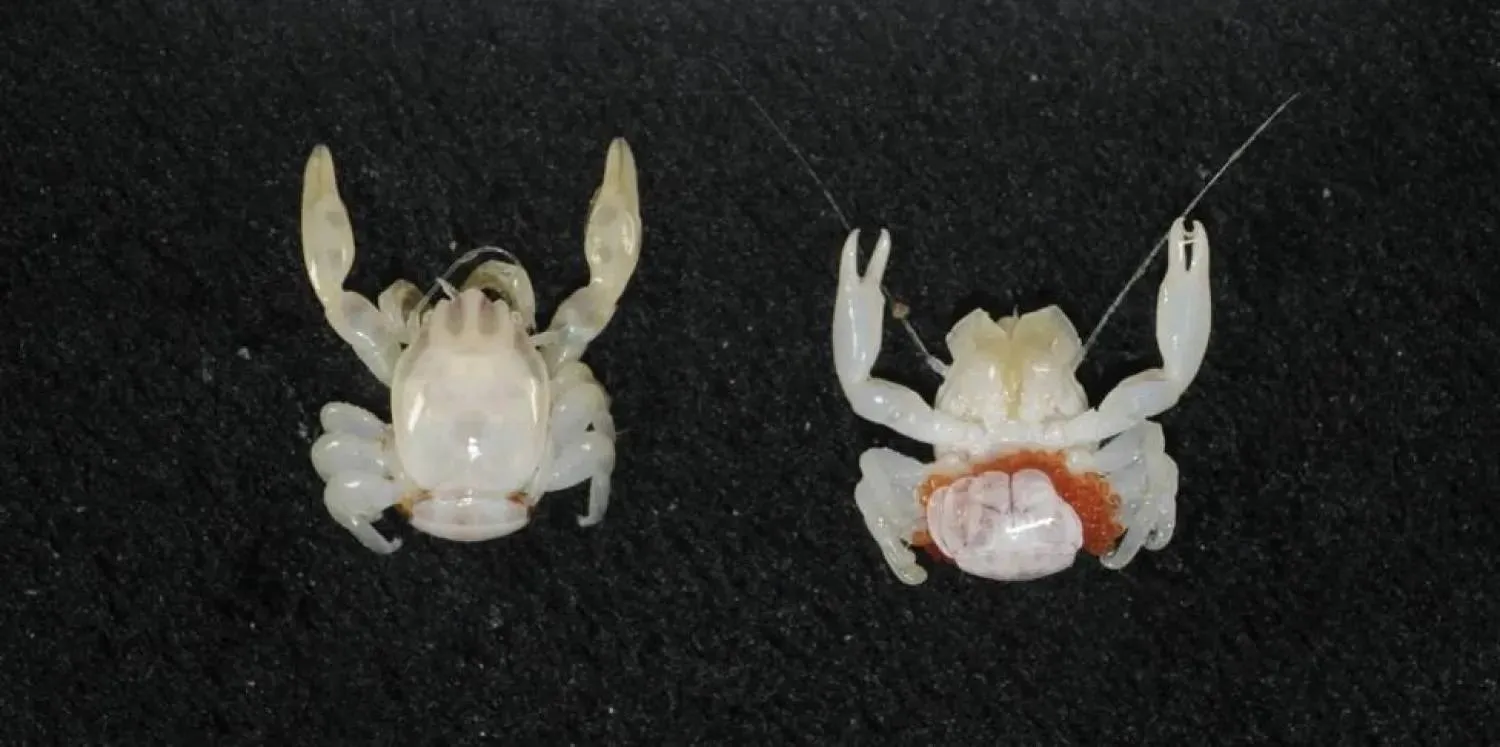
The new species of porcelain crab was found more than 100m below the ocean's surface. (CSIRO/Cindy Bessey)
TT

Semi-Transparent Crab, Tiny Lantern Shark Discovered in Australia

The new species of porcelain crab was found more than 100m below the ocean's surface. (CSIRO/Cindy Bessey)

A semi-transparent crab about the size of an almond and a tiny, glowing lantern shark are among two new species discovered by Australian scientists exploring the deep sea.

In late 2022, scientists from Australia's science agency CSIRO embarked on a research voyage in the Gascoyne Marine Park, about 20km off the coast of Western Australia.

According to BBC, Australia is one of the world's biggest biodiversity hotspots, home to more than a million different species, many of which are not found anywhere else on earth.

But - like much of the globe - large swathes of its water remain unexplored, and the animal and plant life within them unknown to science.

Among the hundreds of specimens collected during the 2022 voyage was the newly described West Australian Lantern Shark. Growing up to 40cm, it has large eyes and a glowing belly, and was found more than 600m below the ocean's surface.

“Lantern sharks are bioluminescent, with light produced by photophores located on their belly and flanks, which is where their common name comes from,” Dr Will White, a fish scientist, said.

They also discovered a new type of porcelain crab, about 1.5cm in length and found about 122m below sea level. They use hairs to catch food, instead of their claws.

“Porcelain crabs are known as filter feeders, feeding on plankton by using modified mouthparts with long hairs to sweep the water for small pieces of food such as plankton, rather than the typical crab method of grabbing and pinching food with their claws,” said Dr. Andrew Hosie, curator of aquatic zoology from the Western Australian Museum.

About 20 new species have been unearthed as a result of the voyage so far, including the Carnavon Flapjack Octopus, a rusty red creature around 4cm big.

Researchers estimate about 600 more are yet to be described and named, as it can take years for scientists to gather the information to prove they are unique.


French Pair Propose New Term to Define 'Environment'

(FILES) In this photo taken on August 5, 2025, a DFCI wildfire defense vehicle from the National Forestry Office (ONF) is seen after the start of the Corbieres wildfire in Ribaute, southwest France. (Photo by Idriss Bigou-Gilles / AFP)
TT

French Pair Propose New Term to Define 'Environment'

(FILES) In this photo taken on August 5, 2025, a DFCI wildfire defense vehicle from the National Forestry Office (ONF) is seen after the start of the Corbieres wildfire in Ribaute, southwest France. (Photo by Idriss Bigou-Gilles / AFP)

Environmental causes face an uphill battle. Overshadowed in politics, overlooked in budgets and defeated in courts, nature is often treated as a niche concern, second to more pressing matters.

Two Frenchmen -- one a philosopher, the other a legal scholar -- think language is part of the problem and argue that protection of the living world should be discussed in entirely different legal terms.

In their new book, Baptiste Morizot and Laurent Neyret make the case that "habitability" -- the conditions that support human life on Earth -- should be treated as a fundamental right like dignity and liberty.

"Habitability is the condition of all our rights and freedoms," Morizot, a researcher at Aix-Marseille University, told AFP.

Even in France where the environment holds constitutional status, Morizot said the defense of nature as a basic right is often relegated below other core values even if people do not realize it.

"No one has said we should talk about the environment as if it were secondary," the philosopher said. But "it is marginalized; it is not in the realm of importance".

Morizot and Neyret searched for a term that elevated the environment to a fundamental condition of humanity's existence rather than a backdrop to be protected when convenient.

"This word exists. It is habitability," they wrote in "Liberté, Dignité, Habitabilité", the French title of their book published in April which is yet to be translated into English.

The framework of environmental law, the authors write, dates from a time when humans did not yet have the technological capacity to drastically alter Earth's habitability or its climate.

Morizot says "the environment" has become more broadly associated with nature and "people who like flowers and little birds."

"But security is more important, health is more important, growth is more important," he said of the prevailing attitude.

If judges regarded habitability in the same way as liberty then "restrictions on applying pesticides near groundwater would no longer be seen as an arbitrary burden, but as the result of a value recognized by all", the authors wrote.

The concept "prohibits the law from continuing to speak as if the world were an unchanging environment."

Even as environmental protection has slipped down the policy priority list in the United States and Europe, climate activists have scored major courtroom wins recently from the International Court of Justice to national tribunals.

"We are facing a movement where habitability is on the verge of being taken seriously in courtrooms, and where even those who don't want to play along can't opt out," co-author Neyret told AFP.

"By naming habitability, we hope to surface this underground movement, accelerate and amplify it," said the former chief of staff to French Constitutional Council president Laurent Fabius.

The authors acknowledge the widespread adoption of such a term could take years or decades. When will we know that habitability is considered a core value?

"When it is cited in court rulings by judges, when it is enshrined in the constitution... in France or elsewhere, when it appears in the preambles of international declarations," said Morizot.

And above all: "When it enables a judge to tip a case one way or the other," he said.


Denmark Performs Autopsy on 'Timmy' the Whale

FILE - Beluga whales swim in a tank at Marineland amusement park in Niagara Falls, Ontario, Canada, June 9, 2023. (Chris Young/The Canadian Press via AP, File)
TT

Denmark Performs Autopsy on 'Timmy' the Whale

FILE - Beluga whales swim in a tank at Marineland amusement park in Niagara Falls, Ontario, Canada, June 9, 2023. (Chris Young/The Canadian Press via AP, File)

Scientists will on Thursday conduct an autopsy on "Timmy", the humpback whale whose ordeal to return to the open seas captured Germany's hearts and sparked a media frenzy, Danish officials said.

The whale, which had struggled since beaching near the German coast, died after being transported into the North Sea off Denmark aboard a barge and released on May 2 in a last-ditch rescue operation.

"The necropsy is expected to take place this afternoon as planned," the Danish Environmental Protection Agency told AFP in an email.

The results of the examination are to be released later, it added.

"Timmy", as he was dubbed in Germany, was moved on Saturday to the shore of the island of Anholt, near where the animal had been found.

After Timmy was first spotted stricken on a sandbank on March 23, the marine mammal's travails gripped Germany for weeks, with media flocking to the Baltic coast to follow the various attempts to get the whale swimming again.

But after several failed attempts, some experts criticized the continued rescues -- privately financed by wealthy entrepreneurs -- as pointless.


Genome Study Shows What Made the Extinct Ice Age Cave Lion Unique

The remains of a frozen female cave lion cub named Sparta, about 32,000 years old and recovered in northeastern Siberia, are pictured in Yakutsk, Russia, in this photograph from 2018, obtained on June 3, 2026. Love Dalen/Handout via REUTERS
TT

Genome Study Shows What Made the Extinct Ice Age Cave Lion Unique

The remains of a frozen female cave lion cub named Sparta, about 32,000 years old and recovered in northeastern Siberia, are pictured in Yakutsk, Russia, in this photograph from 2018, obtained on June 3, 2026. Love Dalen/Handout via REUTERS

The cave lion was one of the biggest cats to ever live, prowling a huge swathe of territory from Western Europe across Siberia and into North America and hunting large prey - and perhaps even people - before going extinct around the end of the Ice Age.

New genome research reveals what made this big cat unique and how it differed from the modern lion, its smaller cousin, though the two species did sporadically interbreed. The cave lion, whose scientific name is Panthera spelaea, died out roughly 14,000 years ago.

The researchers compared the genomes of 12 cave lions that lived from 17,000 to 148,000 years ago in places such as Russia, Austria and Canada's Yukon territory with the genomes of 20 modern lions. Cave lion DNA was extracted mostly from bones and teeth, but also from soft tissue in well-preserved frozen cubs from Siberia, where cold conditions helped preserve ancient genetic material. One of these, a female called Sparta, is among the best Ice Age specimens ever found.

"We show that cave lions were not simply Ice Age versions of modern ⁠lions, but ⁠instead represented a highly distinct evolutionary lineage," said evolutionary geneticist Love Dalén of the Centre for Palaeogenetics, a collaboration between Stockholm University and the Swedish Museum of Natural History, senior author of the study published in the journal Cell.

According to Reuters, the study showed that the evolutionary lineages of the two species diverged probably around 1.7 million years ago during the Pleistocene Epoch. Each species possessed unique genetic variants that likely adapted them to their different habitats and behaviors. These genetic differences related to growth, vision, brain function and circulatory development.

The cave lion, which despite its name did not actually live in caves, was significantly larger and built more robustly than the modern lion. It dwelled in colder ⁠climes, favoring the open grasslands and tundras of northern Eurasia and northwestern North America. This vanished ecosystem, called the mammoth steppe in a nod to its most prominent inhabitant, resembled today's African savanna but with frigid temperatures.

"The cave lion was absolutely an apex predator, and as such filled an incredibly important and impactful ecological role," said evolutionary geneticist and study lead author David Stanton of Cardiff University in Wales. "They were one of the most widespread carnivores to ever live."

Among its probable prey were woolly mammoths - most likely young or elderly individuals - as well as woolly rhinoceroses, antelope, reindeer, horses and bison. Humans also dwelled in these regions in the Ice Age's later stages.

"While there is no clear evidence that cave lions preyed on humans, it seems highly likely that they occasionally did so. Cave paintings show that Ice Age people were highly familiar with these animals. They are often depicted with remarkable accuracy, and are usually shown without the large mane characteristic of modern male lions," Dalén said.

Other predators sharing the landscape included wolves, cave hyenas, ⁠brown bears, cave bears and ⁠the scimitar-toothed cat Homotherium. The powerful saber-toothed cat Smilodon was a more southern species, but may have come into contact with cave lions in the Yukon and Alaska regions during brief periods of Pleistocene climate warming.

The modern lion did not venture as far north as the cave lion's usual domain. But the study showed that the two species came into contact at particularly cold stretches of the Ice Age when growing continental ice sheets and expansion of the steppe tundra brought cave lions southward, causing their ranges to overlap.

"Climate appears to dictate the level of interbreeding that we see between these species," Stanton said.

The researchers said this interbreeding may have occurred in places like modern-day Iran. That region once was home to a sizable population of modern lions, though they are now largely restricted to Africa.

The warming at the end of the Ice Age contributed to the extinctions of many of the large Pleistocene animals, or megafauna, with human hunting presenting another destabilizing factor.

"Cave lions, like the rest of the megafauna at the end of the Pleistocene, were under a huge amount of pressure due to rapid changes in climate combined with increasing human population densities. The extinction of cave lions falls into the general pattern that we see of mass extinction of megafauna at this time, but for reasons that we don't completely understand," Stanton said.