Fierce Winds Stoke Fires, Send Temperatures Soaring in Australia and New Zealand https://english.aawsat.com/varieties/5200077-fierce-winds-stoke-fires-send-temperatures-soaring-australia-and-new-zealand%C2%A0
Fierce Winds Stoke Fires, Send Temperatures Soaring in Australia and New Zealand
People stand near a jetty amid a stormy weather in Melbourne on October 22, 2025. (AFP)
TT
TT
Fierce Winds Stoke Fires, Send Temperatures Soaring in Australia and New Zealand
People stand near a jetty amid a stormy weather in Melbourne on October 22, 2025. (AFP)
Wild, hot winds swept across Australia and New Zealand on Wednesday, fueling wildfires and sending spring temperatures soaring past 40 degrees Celsius (104 degrees Fahrenheit) in parts of Sydney.
Australia's weather bureau said a powerful mass of hot air that built up over the country’s outback on Tuesday was now moving across the southeast of the country and bringing an early heatwave.
Wind gusts of up to 100 kph (62 mph) raised bushfire threats and forced authorities to issue several total fire bans across New South Wales, the most populous state.
A total of 36 fires are burning, with nine yet to be contained, authorities said.
Temperatures in Sydney’s central business district soared past 37 C by the afternoon, while the western suburbs of Penrith and Bankstown reached 40 C.
“It is still spring and we are seeing these incredibly warm temperatures,” Bureau of Meteorology forecaster Angus Hines.
The fire season usually runs from November through February, the late southern hemisphere spring through summer.
Across the Tasman Sea in New Zealand, authorities issued rare “red” level wind warnings, reserved for only the most extreme weather events, for central and southern parts of the country.
Firefighters battled to contain wildfires near Kaikoura on the South Island and in Hawke's Bay on the North Island, fanned by the winds.
The fires have so far destroyed several properties, including five homes.
Ingka, the parent company of the Swedish furniture giant IKEA, confirmed that fire had burnt some pine trees that were intended for furniture but that it would not impact the company’s global supply chain.
The government also declared a state of emergency in the Canterbury region on Wednesday afternoon to assist in the response to the severe weather conditions.
Forecaster MetService said it expects gusts could reach 150 kph along the South Island's east coast and up to 140 kph around Wellington, the capital, on Thursday. Heavy rain is also forecast for parts of the country.
Authorities said people should stay indoors, avoid travel and prepare for possible power and communications outages.
The warnings follow strong winds and heavy rain on Tuesday that left thousands without power and killed a man in a Wellington park when a tree branch fell on him.
Myanmar's Rebuild Stutters Year after Deadly Quake
Myanmar's ancient capital Mandalay bore the brunt of damage in the 7.7-magnitude quake. Sai Aung MAIN / AFP
The gaping holes torn in a road to Mandalay by last year's devastating earthquake have been filled in, and the route in northern Myanmar partly resurfaced.
But only a few of the broken spans of the historic Ava Bridge have been removed, while the others still droop into the river where hundreds of newly homeless people bathed in the aftermath of the disaster.
More than 3,800 people in Myanmar -- and around 90 more in neighboring Thailand -- were killed when the 7.7-magnitude tremor struck on March 28, 2025.
AFP was the only international news agency on the ground in Myanmar's capital Naypyidaw when the quake hit, with its team the first international journalists to reach the city of Mandalay.
A year on, reporters returning to the affected areas found a mixed picture of reconstruction work.
In Naypyidaw, the collapsed concrete awning of the main hospital's emergency department -- which crushed a car when it came down -- has been replaced with a new, lighter structure, with a plastic roof.
A rare unguarded photo of junta chief Min Aung Hlaing, looking flustered as he sought to direct rescue efforts at the hospital, was one of many by AFP that captured the destruction after the quake, which came during a years-long civil war.
Mandalay, an ancient royal capital hemmed by jungle-clad mountains and the snaking Irrawaddy river, bore the brunt of the damage.
At a pagoda in the suburb of Amarapura, a statue of a reclining Buddha emerges from a carefully arranged pile of brick rubble, its face respectfully cleaned.
"Some are rebuilding their houses, while others are just now getting the support they need to work and live," said board secretary Hsan Tun, 70.
Four people died at the pagoda, he added, including a girl who was meditating. "It's only by the Buddha's protection that we survived."
Almost all of Mandalay's flattened or toppled residential buildings have been cleared away, some of them already rebuilt and others remaining as fenced-off empty lots dotting the city.
The tilted-over towers overlooking the palace moat have all been brought back upright, and workers are building new brick castellations for their supporting ramparts.
After the quake, thousands of people whose homes had been made uninhabitable or who feared aftershocks slept out for weeks by the moat, but it is once again the preserve of morning joggers and sightseers.
- 'When the sky falls' -
Some of the buildings at the Thahtay Kyaung monastery, where saffron-clad monks cleared rubble from the wreckage by hand in the days after the quake, have been razed.
"People are facing many economic hardships," said the abbot, U Thudassa. "Like the saying, 'When the sky falls, it falls on everyone'."
"We build as much as we can with what we have," added the 70-year-old. "We cannot just stand still; natural disasters will always be a part of life."
At Amarapura's Nagayon Pagoda, a Buddha statue reduced to just two legs and hands on a pedestal has been fully restored, looking out with a serene gaze.
In nearby Bon Oe village, the quake caused a mosque to collapse onto worshippers gathered for the noon prayer on the last Friday of Ramadan, killing many.
A permanent replacement has yet to be erected -- government approval is needed for religious buildings, and it has not yet been granted.
Instead, men gather for evening prayers in a temporary structure covered in green tarpaulins and with palm leaves for a roof.
"Yesterday marked one year" since disaster struck, said mosque leader Khin Maung Naing, counting by the Islamic calendar.
"Everyone still trembles at any loud noise," he added.
"Even after a year, the tremor, the scenes and the feelings from that earthquake feel as if they happened only yesterday or the day before. To this day, it remains in my heart."
3-limbed Sea Turtle Being Tracked at Sea by Satellitehttps://english.aawsat.com/varieties/5255369-3-limbed-sea-turtle-being-tracked-sea-satellite
An adult female Kemp's ridley sea turtle is seen swimming in a tank at Loggerhead Marinelife Center after a satellite tracking device was attached to its shell in Juno Beach, Fla. on Tuesday, March 24, 2026. (AP Photo/Cody Jackson)
3-limbed Sea Turtle Being Tracked at Sea by Satellite
An adult female Kemp's ridley sea turtle is seen swimming in a tank at Loggerhead Marinelife Center after a satellite tracking device was attached to its shell in Juno Beach, Fla. on Tuesday, March 24, 2026. (AP Photo/Cody Jackson)
The veterinary staff at a Florida sea turtle hospital is getting help from space to monitor the animals they have rehabilitated. They're particularly interested in amputees.
Using satellite tracking devices in a collaboration between the Loggerhead Marinelife Center and the Smithsonian Conservation Biology Institute, scientists are learning how well sea turtles can survive in the wild after losing a limb.
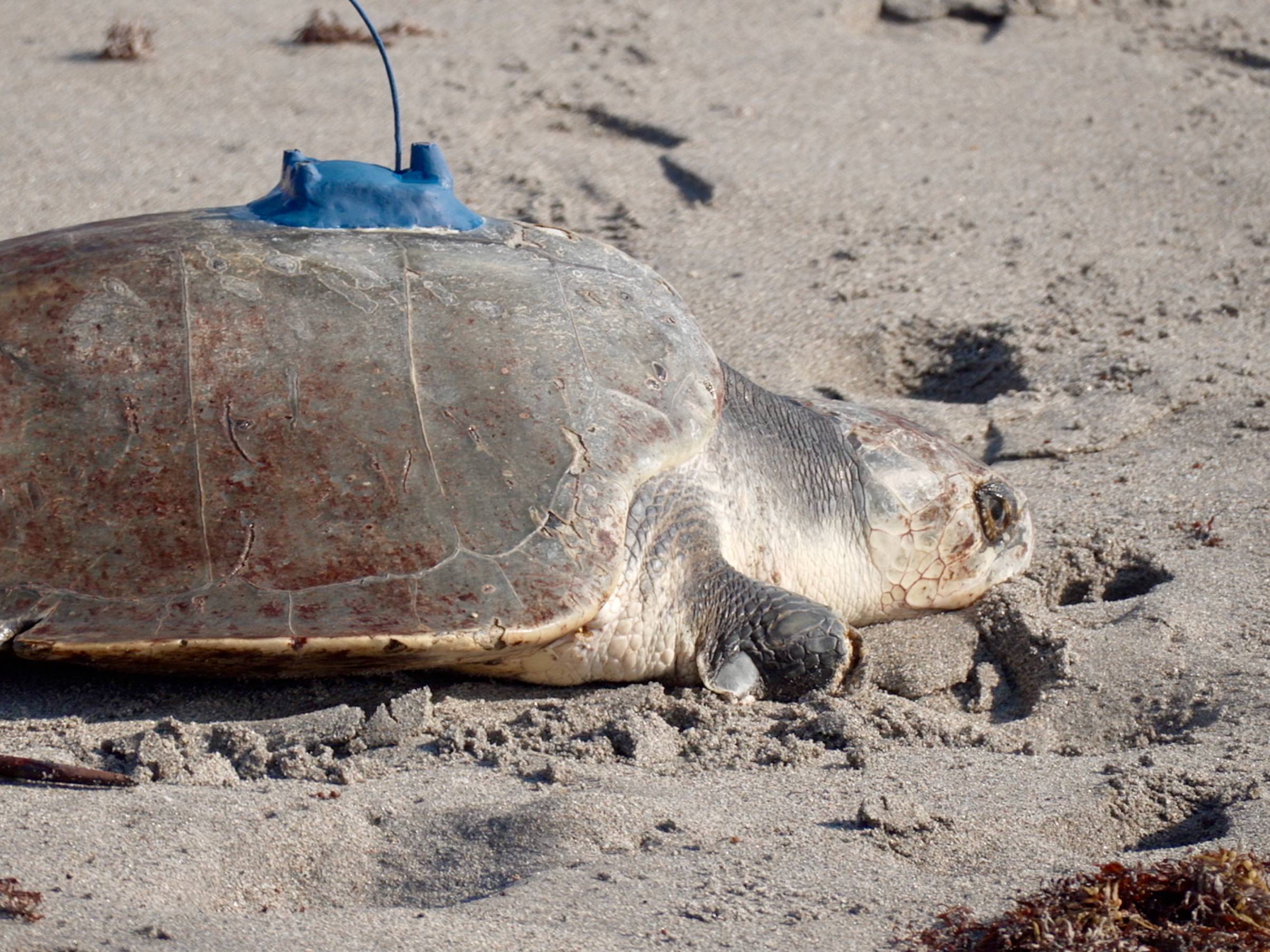
Amelie, a Kemp's ridley sea turtle who lost her right forelimb to a predator — most likely a shark, the center said — was taken to the beach on Wednesday for her highly anticipated release. The turtle paused for about 30 seconds, then slowly made her way into the Atlantic Ocean as onlookers cheered.
Amelie had been rescued and brought to the center by the Inwater Research Group in Port St. Lucie, Florida, seven weeks earlier after a traumatic amputation. She underwent surgery to clean and close the wound, and was treated for pneumonia while in a tank at the center.
When veterinarians deemed her healthy enough to return to the sea, they glued a tracking device to her shell.
A rehabilitated adult female Kemp's ridley sea turtle crawls toward the ocean during a release in Juno Beach, Fla. on Wednesday, March 25, 2026. (AP Photo/Cody Jackson)
An ultrasound confirmed that Amelie is developing eggs, giving researchers another reason to track her movements.
Kemp's ridley turtles, the rarest of sea turtle species, are more typically found on Florida's Gulf Coast, so treating Amelie was especially significant, said Andy Dehart, the center's president and CEO.
Amelie is actually the fourth amputee sea turtle being tracked by the enter, Loggerhead research director Sarah Hirsch said. They include a three-limbed turtle named Pyari who has traveled nearly 700 miles since her release in January, her tracker shows.
“We do know that they can be successful in the wild because we have seen them on our nesting beaches, but we really want to understand their dive behaviors, how they’re migrating once they’re back in the wild," The Associated Press quoted Hirsch as saying.
The satellite tags have a saltwater switch that detects when the turtle comes up to the surface to breathe, triggering the transmission of data to the satellites. Their location appears online after a 24-hour delay. To view Amelie and other turtles tracked for various research projects, visit the Loggerhead website.
“They’ve been through a lot," Hirsch said. "They’ve gotten a lot of medical care here, and to see them be able to go back out and contribute to the population is really rewarding.”
Genetic Study Identifies Earliest-known Dog, Dating to 15,800 Years Agohttps://english.aawsat.com/varieties/5255367-genetic-study-identifies-earliest-known-dog-dating-15800-years-ago
FILE PHOTO: A woman gives her dog a kiss as they watch the sunset at Anchor Bay outside Mellieha, Malta, January 26, 2018. REUTERS/Darrin Zammit Lupi/File Photo
Genetic Study Identifies Earliest-known Dog, Dating to 15,800 Years Ago
FILE PHOTO: A woman gives her dog a kiss as they watch the sunset at Anchor Bay outside Mellieha, Malta, January 26, 2018. REUTERS/Darrin Zammit Lupi/File Photo
Dogs have been loyal companions to people since we made them our first domesticated animals, descending long ago from gray wolves - though precisely when, where and why have remained unanswered. New genetic research now is offering valuable insight, including identifying the earliest-known dog, dating to 15,800 years ago, Reuters reported.
This dog, known from bones found at the Pinarbasi rock shelter site in Türkiye used by ancient human hunter-gatherers, is about 5,000 years older than the previous earliest-known, genetically confirmed canine, the researchers said.
The date of the Pinarbasi dog and several others almost as old identified at other sites in Europe shows that dogs already were widely distributed and an integral part of human culture millennia before the advent of agriculture, they said.
The new findings were presented in two scientific papers published on Wednesday in the journal Nature.
William Marsh, a postdoctoral researcher in the Ancient Genomics Laboratory at the Francis Crick Institute in London who was co-lead author of one of the studies, said the DNA evidence suggests dogs were present in various locales in western Eurasia by 18,000 years ago and already were quite different genetically from wolves.
"We putatively predict that dog and wolf populations diverged a lot earlier, likely before the last glacial maximum (of the Ice Age), so before 24,000 years ago. Although saying that, there is still a great degree of uncertainty," Marsh said.
The dog, descended from an ancient wolf population separate from modern wolves, was the first animal domesticated by people, with animals such as goats, sheep, cattle and cats coming later.
"Dogs have been by our side as humans underwent major lifestyle transitions and complex societies emerged," said geneticist Anders Bergström of the University of East Anglia in England, lead author of the other study.
"I think it's also interesting that, unlike most other domesticated animals, dogs do not always have very clearly defined roles or purposes for humans. Perhaps their primary role is often just to provide companionship," Bergström said.
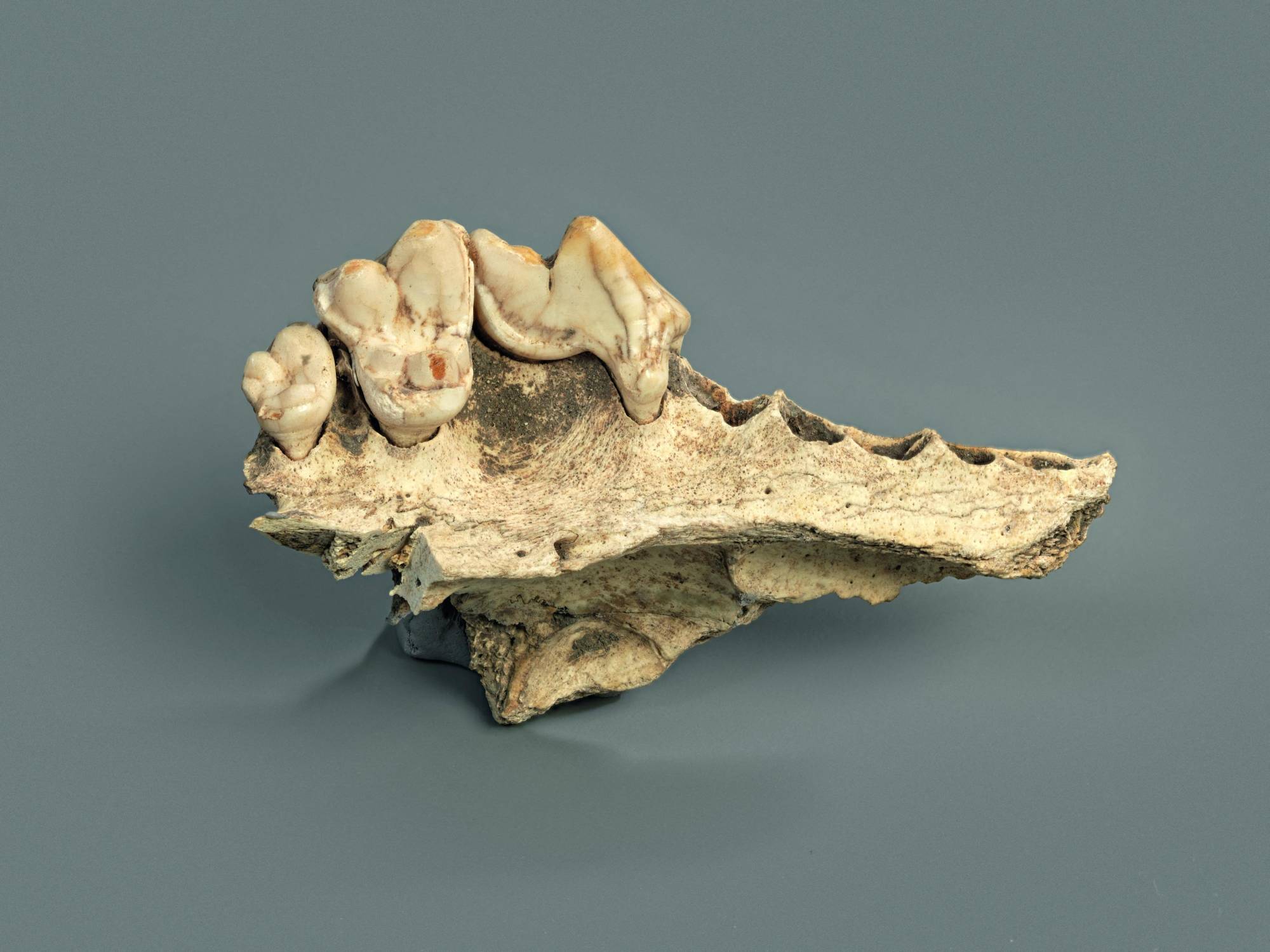
The upper jaw of a domesticated dog from the Kesslerloch cave in Thayngen, Switzerland, dating to about 14,000 years ago, is seen in this photograph from July 2019. Cantonal Archaeological Service of Schaffhausen/Ivan Ivic/Handout via REUTERS
Bergström and his team performed a large-scale search for the early dogs of Europe, using a new method to differentiate genetically between wolves and dogs among 216 ancient remains ranging from 46,000 to 2,000 years old from Belgium, Denmark, France, Germany, the Netherlands, Scotland, Sweden, Switzerland and Türkiye. This was the largest study of such remains to date.
The researchers managed to identify 46 dogs and 95 wolves. Because the skeletons of dogs and wolves were so similar in the early stages of canine domestication, genetic studies are needed to distinguish between them in ancient remains.
The oldest of the dogs identified by Bergström's team was one dating to 14,200 years ago from Switzerland's Kesslerloch Cave site. The oldest of the European dogs identified in this study were found to have shared an origin with dogs in Asia and the rest of the world, showing that these various canine populations did not arise from separate domestication events.
The Pinarbasi dog, identified in the study Marsh worked on, showed how much dogs were valued by the hunter-gatherers who kept them.
"At Pinarbasi, we have both human and dog burials, with dogs buried alongside humans," Marsh said.
There also was evidence that the people at Pinarbasi fed their dogs fish.
This study identified five dogs dating to between 15,800 and 14,300 years ago, including canine remains from Gough's Cave near Cheddar in England.
"At Gough's Cave, we have butchering and processing of humans after death that included cannibalism, as a funerary behavior akin to burial. Similar post-mortem modification, albeit not definitively for consumption, was found on the dog remains," Marsh said.
The Pinarbasi and Gough's Cave dogs were found to be more closely related to the ancestors of present-day European and Middle Eastern breeds such as boxers and salukis than to Arctic breeds like Siberian huskies.
Beyond companionship, the ancient dogs may have helped people hunt or perhaps served as watchdogs, sort of Ice Age alarm systems, according to the researchers. Unlike the many exotic dog breeds around today, these early dogs still likely closely resembled the wolves from which they descended, they said.
"The questions of when, where and why people domesticated dogs still remain largely unanswered," Bergström said. "We think it probably happened somewhere in Asia, but more precisely remains to be determined."
لم تشترك بعد
انشئ حساباً خاصاً بك لتحصل على أخبار مخصصة لك ولتتمتع بخاصية حفظ المقالات وتتلقى نشراتنا البريدية المتنوعة