
Louvre Director Acknowledges Failure After Jewel Heist and Says She Offered to Resign

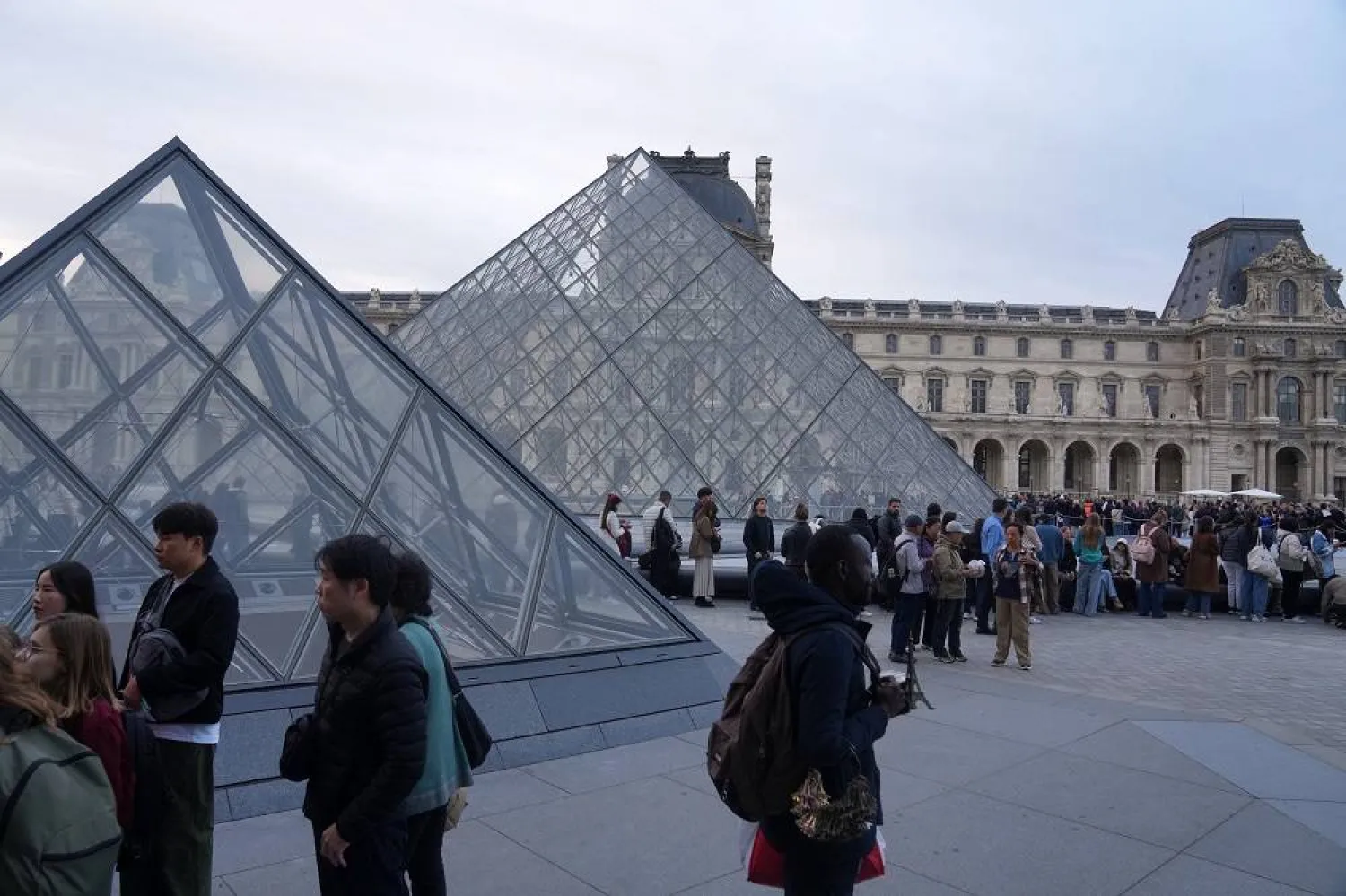
Visitors queue to enter the Louvre museum three days after historic jewels were stolen in a daring daylight heist, Wednesday, Oct. 22, 2025 in Paris. (AP)
TT

Louvre Director Acknowledges Failure After Jewel Heist and Says She Offered to Resign

Visitors queue to enter the Louvre museum three days after historic jewels were stolen in a daring daylight heist, Wednesday, Oct. 22, 2025 in Paris. (AP)

The director of the Louvre Museum on Wednesday acknowledged a ″terrible failure″ at the Paris monument after a stunning daylight crown jewel heist at the world's most-visited museum, and said she offered to resign, but it was refused. 

The Louvre reopened earlier in the day to long lines beneath its landmark Paris glass pyramid for the first time since one of the highest-profile museum thefts of the century stunned the world with its audacity and scale. 

In testimony to the French Senate, Louvre director Laurence des Cars said the museum had a damaging shortage of security cameras outside the monument and other ″weaknesses″ exposed by Sunday’s theft. 

Under heavy pressure over a theft that stained France’s global image, she testified to a Senate committee that she submitted her resignation but that the culture minister refused to accept it. 

″Today we are experiencing a terrible failure at the Louvre, which I take my share of responsibility in,″ she said. 

The thieves slipped in and out, making off with eight pieces from France’s Crown Jewels at the world’s most-visited museum — a cultural wound that some compared to the burning of Notre-Dame cathedral in 2019. 

The Sunday raid — steps from the Mona Lisa and valued at over $100 million — has put embattled President Emmanuel Macron, Des Cars and others under fresh scrutiny. It comes just months after employees went on strike, warning of chronic understaffing and under-resourced protections, with too few eyes on too many rooms. 

Crowds bunched at the barriers as they were being removed Wednesday, a coda to frantic forensic work and staff briefings that had taken place. Inside, the scene of the crime — the Apollo Gallery housing the Crown Diamonds — stayed sealed, a folding screen obscuring the doorway at the gallery’s rotunda entrance. 

Disbelief among visitors  

Three days on, the jewels remain missing and the thieves are still at large and reactions are divided. 

"For a place like the Louvre, it’s unfathomable,” said Amanda Lee, 36, an art teacher from Chicago. “I heard it took under four minutes. How is that possible here, with no police in sight?” 

Others were unperturbed. 

“We told the kids it’s a history lesson. The Apollo Room is shut, but we saw the masterpieces,” said Claire Martin, 41, a French lawyer from Versailles visiting with her two children during a school holiday. 

“We came for the art," she said. "The police can deal with the thieves.” 

France acknowledges failings  

Authorities say the thieves spent less than four minutes inside the Louvre on Sunday morning: a freight lift was wheeled to the Seine-facing façade, a window was forced open and two vitrines were smashed. 

Then came the getaway on motorbikes through central Paris. Alarms had gone off, drawing agents to the gallery and forcing the intruders to bolt. 

As it reopened, the Louvre declined questions from The Associated Press to detail any reinforced protocols. It said no uniformed police were posted in the corridors. With school holidays swelling demand, the day was fully booked and access limited. 

“I didn’t notice extra security — guards as always, and no police inside. It felt like a normal day,” said Tomás Álvarez, 29, a software engineer from Madrid. 

The loot  

The thieves made away with a total of eight objects, including a sapphire diadem, necklace and single earring from a set linked to 19th-century queens Marie-Amélie and Hortense. 

They also made off with an emerald necklace and earrings tied to Empress Marie-Louise, Napoleon Bonaparte’s second wife, as well as a reliquary brooch. Empress Eugénie’s diamond diadem and her large corsage-bow brooch — an imperial ensemble of rare craftsmanship — were also part of the loot. 

One piece — Eugénie's emerald-set imperial crown, with more than 1,300 diamonds — was later found outside the museum, damaged but recoverable. 

Fears the jewels will be destroyed  

Prosecutor Laure Beccuau valued the haul at about €88 million ($102 million), a “spectacular” figure that still fails to capture the works’ historical weight. She warned the thieves would be unlikely to realize anything close to that sum if they pry out stones or melt the metals — a fate curators fear would pulverize centuries of meaning into anonymous gems for the black market. 

Beccuau said expert analyses are underway; four people have been identified as present at the scene, and roughly 100 investigators are mapping the crew and any accomplices. 

The heist has intensified scrutiny of the Louvre’s security. 

Culture Minister Rachida Dati drew fire Tuesday after telling lawmakers there had been no security failings. 

Questions about Louvre’s security overhaul 

All this comes after Macron announced new measures in January for the Louvre — complete with a new command post and expanded camera grid that the culture ministry says is being rolled out. 

It also raises hard questions, including whether Sunday’s breach is tied to staffing levels, and how uniformly the upgrades in the overhaul are being applied. 

“It’s a scandal of planning,” said Luca Romano, 52, a civil engineer from Milan visiting Paris with his wife. “If you can plant a freight lift at a palace and no one stops you, that’s a system failure.” 

Protection for headline works is airtight — the Mona Lisa is behind bulletproof glass in a climate-controlled case — yet the break-in exposed seams elsewhere in a 33,000-object labyrinth. For many French, the contrast is a public embarrassment at the landmark. 

It touches a raw nerve: the issue of swelling crowds and overstretched staff. 

In June, a staff walkout over overcrowding and chronic understaffing delayed opening. Unions argue that mass tourism leaves too few eyes on too many rooms and creates pressure points where construction zones, freight access and visitor flows intersect. 

On Wednesday, the Louvre’s other star attractions — from the Venus de Milo to the Winged Victory of Samothrace — were open again. But the cordoned-off vitrines in the Apollo Room, guarded and empty, told a different story: one of a breach measured not just in minutes and euros, but in the fragility of a nation’s patrimony. 


Saudi Heritage Commission Announces Discovery of 20 Rock Engravings in Soudah Peaks Project

The newly identified sites feature inscriptions and rock carvings estimated to be between 4,000 and 5,000 years old. (SPA)
TT

Saudi Heritage Commission Announces Discovery of 20 Rock Engravings in Soudah Peaks Project

The newly identified sites feature inscriptions and rock carvings estimated to be between 4,000 and 5,000 years old. (SPA)

Saudi Arabia’s Heritage Commission, in collaboration with Soudah Development, a Public Investment Fund company, announced on Tuesday the discovery of 20 ancient rock art sites within the Soudah Peaks area.

Spanning more than 636.5 square kilometers across Soudah and parts of Rijal Almaa, the project area is now recognized as home to some of the region’s oldest cultural landmarks. The newly identified sites feature inscriptions and rock carvings estimated to be between 4,000 and 5,000 years old, offering valuable insights into the region’s rich history.

The findings include Thamudic inscriptions, along with vivid depictions of ibex, hyenas, and ostriches, as well as scenes of hunters, dancers, palm trees, and weapons, reflecting the environmental and social practices of the ancient communities that once inhabited the area.

The survey forms part of a memorandum of understanding signed between the Heritage Commission and Soudah Development. Conducted in four scientific phases, the initiative began with data collection and site analysis, concluding with the documentation and classification of high-value archaeological sites in preparation for future development and preservation efforts.

Soudah Development remains committed to protecting and promoting the natural and cultural heritage of the project area. The company continues to work towards creating an integrated cultural and tourism experience that reflects the authenticity and historical richness of the region, in line with its vision to transform Soudah Peaks into a premier luxury mountain destination rooted in heritage.


Ancient Rome Meets Modern Technology as Tourists Visit Restored, Frescoed Home via Livestream Tours

 Colosseum Archeological Park guide Valentina uses a head-mounted device to livestream a guided tour for the press of the newly-restored underground House of Griffins, dated between the II and I century B.C., on the Palatine Hill next to the Colosseum, in Rome, Tuesday, Jan. 13, 2026. (AP)
Colosseum Archeological Park guide Valentina uses a head-mounted device to livestream a guided tour for the press of the newly-restored underground House of Griffins, dated between the II and I century B.C., on the Palatine Hill next to the Colosseum, in Rome, Tuesday, Jan. 13, 2026. (AP)
TT

Ancient Rome Meets Modern Technology as Tourists Visit Restored, Frescoed Home via Livestream Tours

 Colosseum Archeological Park guide Valentina uses a head-mounted device to livestream a guided tour for the press of the newly-restored underground House of Griffins, dated between the II and I century B.C., on the Palatine Hill next to the Colosseum, in Rome, Tuesday, Jan. 13, 2026. (AP)
Colosseum Archeological Park guide Valentina uses a head-mounted device to livestream a guided tour for the press of the newly-restored underground House of Griffins, dated between the II and I century B.C., on the Palatine Hill next to the Colosseum, in Rome, Tuesday, Jan. 13, 2026. (AP)

One of the best-preserved ancient Roman homes on the Palatine Hill is opening to the public for the first time, albeit via a livestreamed tour of its hard-to-reach underground frescoes and mosaics.

The House of the Griffins was first discovered during the excavations in the early 20th century of the Palatine Hill, the verdant hill that rises up from the Roman Forum and dominates views of central Rome today with its striking red brick ruins.

The hill, located just off the Colosseum, was the site of temples and homes of leading citizens during Rome’s Republican era, which is traditionally dated from 509 B.C. to 27 B.C. It became the aristocratic quarter during the Roman Empire that followed, when new palaces were built on top of the older homes.

The House of the Griffins is one of those earlier Republican-era homes, and was hidden to the world underground after the Emperor Domitian built his palace on top of it in the first century A.D.

Now for the first time, the general public can virtually visit the House of the Griffins and its newly restored frescoes, including the decoration that gives the home its name: An arched lunette fresco featuring two griffins — the half-eagle, half-lion mythological creatures.

Visitors won’t actually walk through the home’s intimate rooms, which are only accessible via a perilously steep staircase underground. Rather, visitors above ground will watch as a tour guide wearing a head-mounted smartphone descends into the domus and walks through its rooms, livestreaming the visit and narration.

The live, virtual tour serves multiple purposes: It allows visitors to “see” a domus that, because of its underground location, would otherwise be off-limits. And by limiting the number of people in its rooms, the livestreaming protects the delicate frescoes from too much humidity and carbon dioxide.

Project chief Federica Rinaldi said archaeologists don’t know much about the family who lived there, but said they were clearly well-off. The level of decoration recalls some of the elegant homes of the era in Pompeii: The frescoes feature richly colored faux marble designs, and floor mosaics of three-dimensional cubes.

“Its location at the highest point of the hill, its distribution over several levels that take advantage of the slopes of the Palatine Hill itself, and its preservation make it today an almost textbook reference," she said. “It was certainly a domus of the highest standard.”

Starting on March 3, the livestreamed tours will be held weekly, on Tuesdays, with one in Italian and one in English, though more are foreseen. Groups are limited to a dozen people and require reservations, as well as an additional ticket beyond the typical Colosseum-Palatine Hill entrance fee.

The restoration of the House of the Griffins is one of 10 projects funded by the European Union in the archaeological park and is part of an effort to spread tourists out beyond the must-see Colosseum and Forum, which often get overwhelmed with visitors.

“It’s a great occasion to value the full territory of the park,” said the head of the park, Simone Quilici.


Sudan Recovers 570 Artifacts Looted During War

Artifacts that were recovered after being looted from the National Museum in Khartoum during the country's long-running war, are displayed during an official ceremony in Port Sudan on January 13, 2026. (AFP)
TT

Sudan Recovers 570 Artifacts Looted During War

Artifacts that were recovered after being looted from the National Museum in Khartoum during the country's long-running war, are displayed during an official ceremony in Port Sudan on January 13, 2026. (AFP)

Sudanese authorities displayed ancient figurines, ornate vases and scarab-shaped amulets at a ceremony Tuesday in Port Sudan celebrating the recovery of more than 570 antiquities stolen from the national museum during the country's long-running war.

The artifacts, arranged on large tables under heavy security, were recovered after months of investigation and brought to the wartime capital of Port Sudan.

The National Museum in Khartoum, which housed some of Sudan's most important archaeological collections, was looted and badly damaged after the paramilitary Rapid Support Forces (RSF) seized the capital in the early days of its war with the army, its former ally.

At the time, satellite images showed trucks carrying artifacts west, towards the vast region of Darfur -- now completely under RSF control.

Since then, Sudanese authorities have worked with UNESCO and Interpol to track down the stolen items.

Authorities did not detail on Tuesday exactly how the artifacts were recovered.

"Sudan heritage is not only of national importance, it is a treasure of humanity," said UNESCO's representative in Sudan, Ahmed Junaid, referring to international efforts to combat illicit trafficking of cultural property.

"Many people do not know the value of the objects displayed on the tables, but they reflect the identity of the nation and its history," said Sudan's finance minister Gibril Ibrahim.

Khalid Aleisir, minister of information and culture, announced a "financial reward" for anyone returning antiquities to the authorities, without specifying an amount.

Officials estimate that the recovered items account for about 30 percent of the objects looted from the museum.

Still missing are the contents of the so-called "gold room", the museum's most valuable collection, which included ancient jewellery and 24-carat gold pieces, some nearly 8,000 years old.