


Kermit Aims to Ease French Nerves at Art Basel Paris 

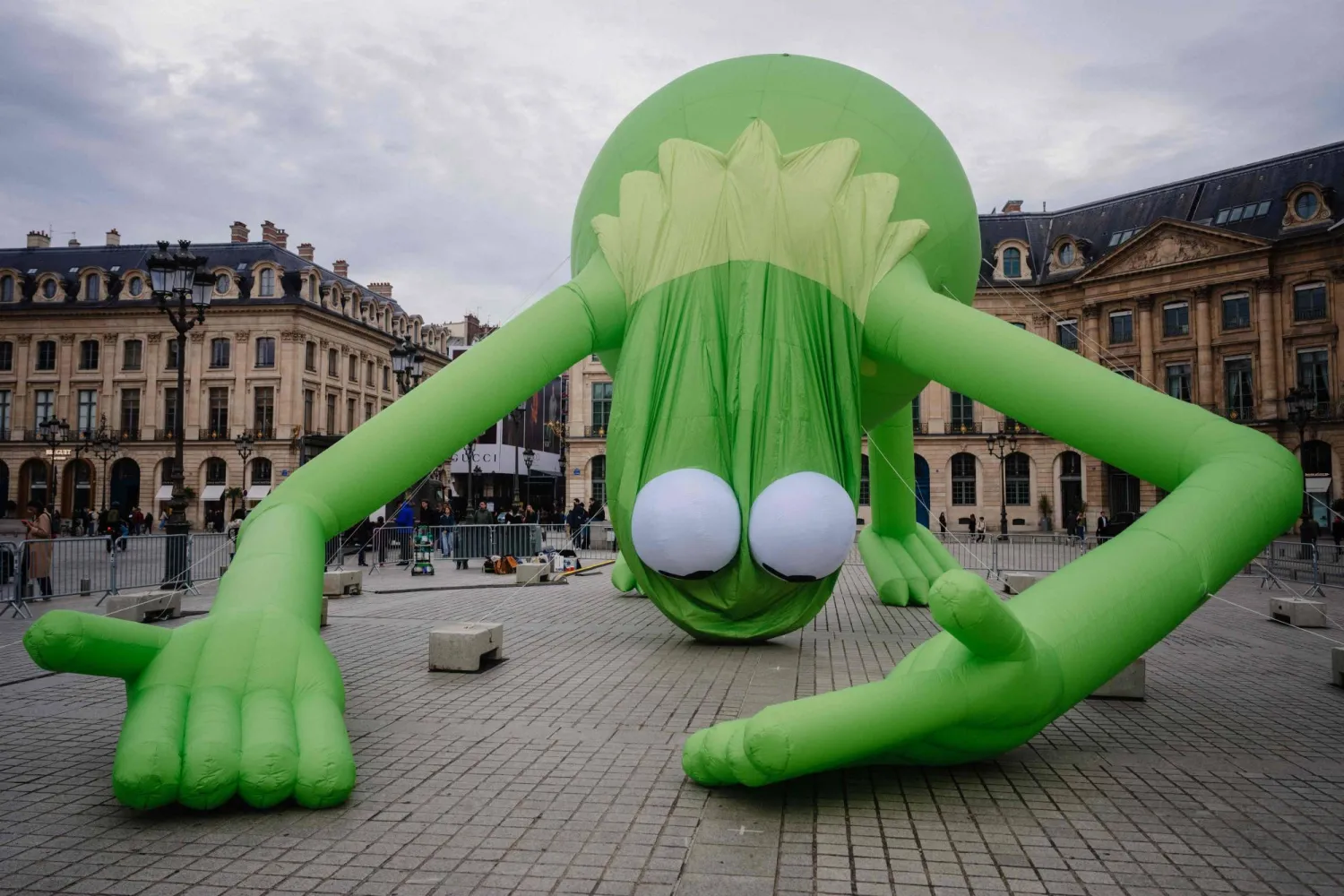
This photograph shows installing of the artwork of Venezuelan-US artist Alex Da Corte titled "Kermit the Frog, Even" at Place Vendome in Paris, on October 19, 2025, ahead of the official opening of the Art Basel contemporary and modern art market. (AFP)
TT

Kermit Aims to Ease French Nerves at Art Basel Paris 

This photograph shows installing of the artwork of Venezuelan-US artist Alex Da Corte titled "Kermit the Frog, Even" at Place Vendome in Paris, on October 19, 2025, ahead of the official opening of the Art Basel contemporary and modern art market. (AFP)

A huge inflatable Kermit the frog will be the star of the Art Basel Paris contemporary art fair this week in the French capital, unnerved by a daring heist at the Louvre.

"Kermit the Frog, Even" is a 20-meter (66-foot) blow-up figure by Venezuelan-US artist Alex Da Corte -- with its head deflated at the artist's request.

The beloved Muppet Show puppet has already been on display for several days in the Place Vendome, where the world's top jewellers showcase their most valuable and extravagant pieces.

Kermit succeeds last year's giant mushroom by German artist Carsten Hoeller and the Wave by Switzerland's Urs Fischer in 2023.

Its head is deflated as "a way of paying tribute to US public broadcaster PBS", which aired the Muppet Show in the 1970s and is now "facing drastic budget cuts", explained Art Basel Paris director Clement Delepine.

This is the fourth fair in Paris organized by Switzerland's Art Basel, which organizes a series of contemporary art fairs around the world.

More than 200 galleries from around 40 countries are expected to take part in the main event from Friday to Sunday under the huge glass dome roof of the Grand Palais in Paris.

Coming just days after thieves made off in broad daylight with eight pieces of priceless royal jewellery from the Louvre museum, organizers are at pains to reassure participants.

"The safety and protection of our exhibitors, visitors and teams is an absolute priority," Art Basel Paris told AFP, pointing to "comprehensive security measures".

In addition to the central event in the Grand Palais, monumental works have been installed across central Paris as part of a free public program.

These include huge sculptures by contemporary artists Wang Keping (China), Stefan Rinck (Germany), Leiko Ikemura (Japan) and Thomas Houseago (UK).

Visitors can also explore a jungle wall of wild grasses made of nylon, plastic and polyester by Madagascan artist Joel Andrianomearisoa.

The Petit Palais, meanwhile, is currently home to Julius von Bismarck's mesmerizing "The Elephant in the Room".

This features a life-sized giraffe and a replica of an equestrian statue of Otto von Bismarck, the first chancellor of the German Empire, both constantly change shape in slow motion.

According to the UBS 2025 annual survey, published by Art Basel, global sales of modern and contemporary art fell by 12 percent in 2024 to $57.5 billion -- the second straight annual fall.




Ukraine's 'Origami Deer' Sculpture Rescued from Frontline Tours Europe

Ukrainian artist Zhanna Kadyrova (R) and Ukrainian curator of the 'Security Guarantees' project Leonid Marushchak pose in front of the 'Origami Deer' sculpture in Prague on March 12, 2026. (Photo by Michal Cizek / AFP)
TT

Ukraine's 'Origami Deer' Sculpture Rescued from Frontline Tours Europe

Ukrainian artist Zhanna Kadyrova (R) and Ukrainian curator of the 'Security Guarantees' project Leonid Marushchak pose in front of the 'Origami Deer' sculpture in Prague on March 12, 2026. (Photo by Michal Cizek / AFP)

An "Origami Deer" statue rescued from a Ukrainian city destroyed and occupied by Moscow's army is touring six European countries before featuring at the 61st Venice Biennale, which has sparked outrage over the inclusion of Russian artists.

Ukrainian artist Zhanna Kadyrova created the concrete work with her colleague Denys Ruban in 2019 for a park in the eastern city of Pokrovsk to replace a Soviet-era military plane displayed there.

In 2024, Kadyrova and historian Leonid Marushchak removed the deer, shaped like a paper origami, as Russian troops closed in and then occupied Pokrovsk.

The sculpture will be the main feature of the Ukrainian pavilion, named Security Guarantees, at the Venice Biennale.

It will feature alongside Russian exhibits at the event that started in 1895 and comprises festivals, art and architecture exhibitions running from May 9 to November 22.

The decision to invite Russian artists, banned from the 2022 and 2024 editions after Moscow's full-scale invasion of Ukraine, has sparked international uproar with the European Union threatening to cut funding for the Biennale.

"It's very important for us to see how the entire world reacts to the situation, supporting us and opposing Russia's participation," Marushchak told AFP.

"If the Russians want to show their culture, they might as well organize a biennale in Pokrovsk which they have destroyed," he added.

En route to Venice, the deer has been exhibited in Warsaw, Vienna and Prague and will continue on to Berlin, Brussels and Paris.

Displaced from its pedestal, the deer symbolizes "millions of Ukrainians who have lost their home" and moved abroad, Kadyrova told AFP during a stopover in Prague.

The resemblance to paper origami refers to the Budapest Memorandum of 1994 which saw Ukraine yielding its nuclear arsenal to Russia in exchange for security guarantees that did not materialize.

"So it's no more than paper," Kadyrova said.

Marushchak has been evacuating works of art from eastern Ukraine since the war started.

He has saved scores of objects, often taking huge risk with his team, to protect them from looting or theft.

One of the most dramatic rescue operations involved a 700-year-old stone lion statue evacuated from a museum in Bakhmut in 2023, just before the Russian army took the city, as Marushchak's car was hit by a shell on the way out.

"Other evacuations were difficult in that we didn't succeed as much as we wanted because the front line was too close and the danger was too big," Marushchak told AFP.

The Venice Biennale typically attracts more than 600,000 visitors to pavilions set up by participating countries.

Kadyrova said the Ukrainian team was not planning any protest over Russia's participation as "it's up to politicians".

"But I hope that some community will gather to pressure the Biennale, pressure Italy, and I hope that it will not happen."


'Talking Drum' Looted by France in 1916 Back in Ivory Coast

A crate containing the Djidji Ayokwe drum, at the airport in Abidjan, Ivory Coast. (Photo by Issouf SANOGO / AFP)
TT

'Talking Drum' Looted by France in 1916 Back in Ivory Coast

A crate containing the Djidji Ayokwe drum, at the airport in Abidjan, Ivory Coast. (Photo by Issouf SANOGO / AFP)

The Djidji Ayokwe "talking drum", which was looted by French colonial troops in 1916 and taken to France, arrived back in Ivory Coast Friday, in the latest repatriation of stolen artifacts.

The wooden drum, more than three meters (10 feet) long and weighing 430 kilos (950 pounds), was used by the Ebrie tribe to transmit messages.

It was officially handed over on February 20 after France's parliament approved removing the artifact from the national museum collections to enable its return.

Ivory Coast had asked in late 2018 for the return of the Djidji Ayokwe among 148 works of art taken during the colonial period.

It arrived aboard a specially chartered plane at Ivory Coast's main city Abidjan and remained inside a huge wooden crate stamped "fragile", AFP journalists saw.

"It's an historic day and I feel deep emotion," Culture Minister Francoise Remarck said, welcoming its arrival at the airport, where the Ebrie community also sang and played drums.

"We are living a moment of justice and remembrance," the minister added.

French President Emmanuel Macron promised in 2021 to send the drum and other artifacts back home to the west African country.

It is one of hundreds of objects France is preparing to send back to Africa, with the efforts set to be accelerated by the passing of a new law to authorize mass repatriations.

"We are happy and relieved to know that this sacred piece of our culture is back on its native land," Aboussou Guy Georges Mobio, an Ebrie village chief, told AFP.

The drum will initially be held in a "safe space" to allow it to acclimatize, the culture minister said.

It is due to go on display at the Museum of Civilizations in Abidjan which has been specially renovated.

The "talking drum" was used by the Ebrie community to warn of danger, mobilize for war or call villagers to ceremonies.

It was seized by colonial authorities in 1916 before being shipped to France in 1929 and exhibited in Paris.

Senegal and Benin have also asked for the repatriation of their treasures.

In late 2020, the French parliament adopted a law providing for the permanent return to Benin of 26 artifacts from the royal treasures of Dahomey.

The return of cultural artifacts taken from ex-colonies in Africa and elsewhere has become a sensitive issue, with museums, institutions and collectors in Europe and the United States facing pressure to give them back.


Red Sea Fund Launches Second Round to Support Film Projects in Production Stage

File photo of the fifth day of the Red Sea International Film Festival - SPA
TT

Red Sea Fund Launches Second Round to Support Film Projects in Production Stage

File photo of the fifth day of the Red Sea International Film Festival - SPA

The Red Sea Fund, affiliated with the Red Sea Film Foundation, announced the opening of applications to support film projects in the production stage within the second round of this year’s support program, which will continue until March 21, as part of its efforts to enhance the cinema industry and empower innovators in the region, SPA reported.

The round aims to support promising cinematic voices from the Kingdom and the Arab world, as well as filmmakers from Africa and Asia, through financial grants that help complete film projects and present their creative narratives globally, with a special focus on projects ready to enter production and begin filming.