Saudi Culture Minister Meets French Counterpart as RCU Announces Partnership with Center Pompidou

The commission affirmed that this collaboration with leading international cultural institutions reflects the Kingdom’s commitment to promoting culture and the arts as essential pillars of comprehensive development under Saudi Vision 2030 - SPA
TT

Saudi Culture Minister Meets French Counterpart as RCU Announces Partnership with Center Pompidou

The commission affirmed that this collaboration with leading international cultural institutions reflects the Kingdom’s commitment to promoting culture and the arts as essential pillars of comprehensive development under Saudi Vision 2030 - SPA

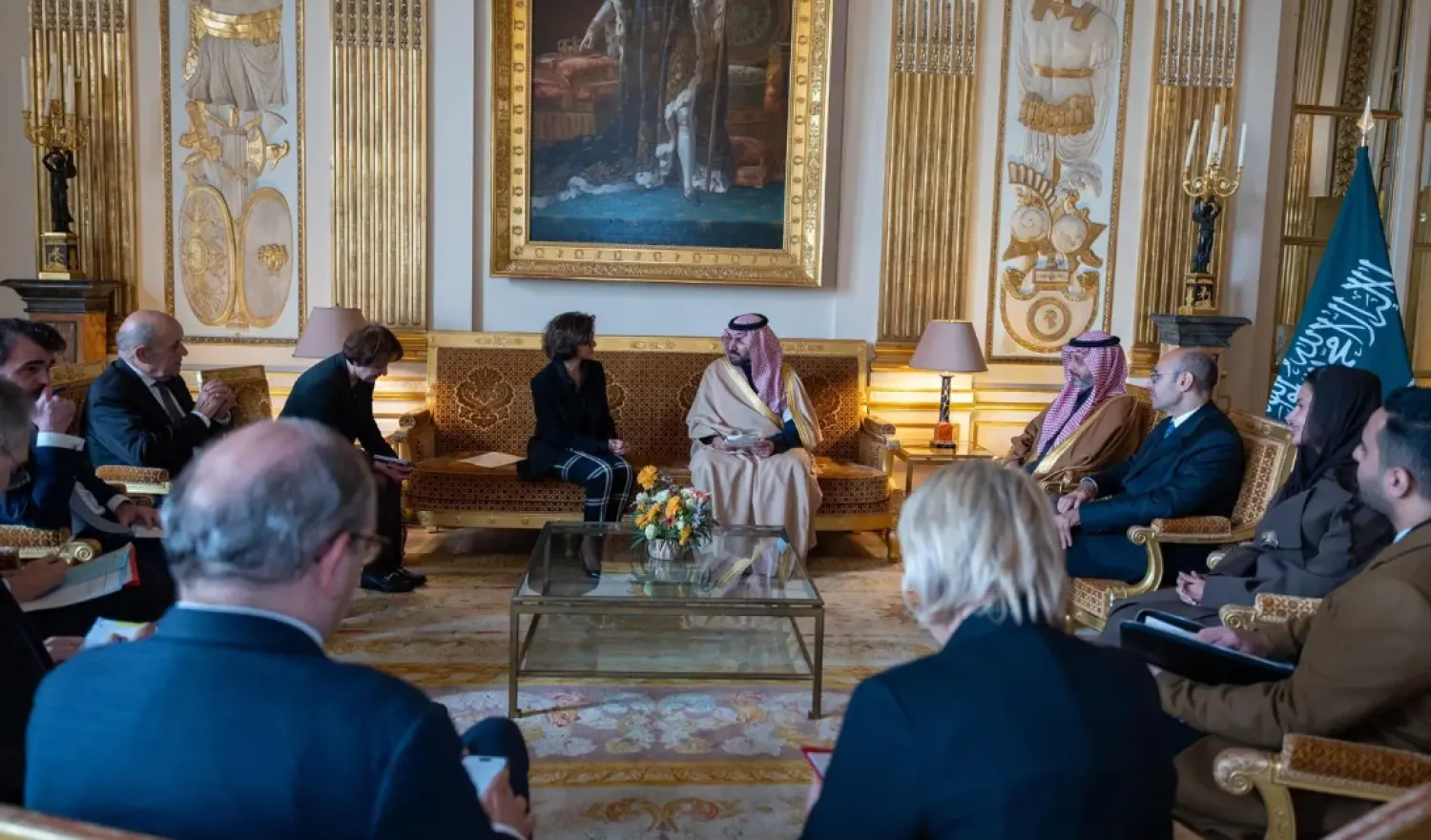
Saudi Minister of Culture and Governor of the Royal Commission for AlUla (RCU) Prince Bader bin Abdullah bin Farhan met with France’s Minister of Culture Rachida Dati during his visit to France.

According to a press release issued by the RCU, the commission announced that upon the reopening of the Center Pompidou, a section of the museum will be named in gratitude to the Kingdom of Saudi Arabia. The specifics will be finalized in alignment with the museum's new layout. In addition, a cultural and artistic program will be implemented from now until 2030.


It will feature the launch of a research program focused on modern and contemporary Saudi artists, drawing on the resources and expertise of the Center Pompidou. This initiative will also include support to familiarize young audiences with art history, as well as a program for the transfer of expertise and exchanges between cultural professionals, SPA reported.

The release added that the RCU stated that the agreement is an extension of the strategic partnership between the two countries in the cultural and creative sectors, established under the leadership of Prince Mohammed bin Salman bin Abdulaziz Al Saud, Crown Prince, Prime Minister, and Chairman of the Board of Directors of RCU, and President Emmanuel Macron of the French Republic. The partnership reflects a shared commitment to strengthening culture as a bridge for international dialogue and advancing sustainable development.

Under the agreement, the RCU will provide 50 million euros to support Center Pompidou 2030, a project to renovate and develop the Center Pompidou. This initiative aims to enhance its facilities and expand its educational and artistic programs, reinforcing its role as a leading global cultural institution.

The partnership is part of the broader Saudi-French collaboration to develop the Museum of Contemporary Art in AlUla, as cultural cooperation between the two nations has been rapidly growing in recent years.

RCU also announced the (Arduna) exhibition, scheduled to take place during AlUla Arts Festival in January 2026. Organized in collaboration with Arts AlUla, the Center Pompidou, and the French Agency for AlUla Development, the exhibition will feature new artworks and foster dialogue among artists from around the world. It will also include workshops and live performances designed to support emerging talent and enrich AlUla’s evolving cultural landscape.

The commission affirmed that this collaboration with leading international cultural institutions reflects the Kingdom’s commitment to promoting culture and the arts as essential pillars of comprehensive development under Saudi Vision 2030. It further strengthens AlUla’s position as a global hub for creativity, where heritage, innovation, and knowledge come together to inspire future generations.


Twice a Year, a Golden Sunbeam Illuminates a 3,000-Year-Old Pharaonic Temple

 Tourists crowd to film the sun as it sends a beam of light into the Great Temple of Ramses II's dark inner chamber in Abu Simbel, 870 kilometers (540 miles) south of Cairo, Egypt, Thursday, Oct. 22, 2026, a rare 3,200-year-old astronomical ceremony that happens twice a year. (AP)
Tourists crowd to film the sun as it sends a beam of light into the Great Temple of Ramses II's dark inner chamber in Abu Simbel, 870 kilometers (540 miles) south of Cairo, Egypt, Thursday, Oct. 22, 2026, a rare 3,200-year-old astronomical ceremony that happens twice a year. (AP)
TT

Twice a Year, a Golden Sunbeam Illuminates a 3,000-Year-Old Pharaonic Temple

 Tourists crowd to film the sun as it sends a beam of light into the Great Temple of Ramses II's dark inner chamber in Abu Simbel, 870 kilometers (540 miles) south of Cairo, Egypt, Thursday, Oct. 22, 2026, a rare 3,200-year-old astronomical ceremony that happens twice a year. (AP)
Tourists crowd to film the sun as it sends a beam of light into the Great Temple of Ramses II's dark inner chamber in Abu Simbel, 870 kilometers (540 miles) south of Cairo, Egypt, Thursday, Oct. 22, 2026, a rare 3,200-year-old astronomical ceremony that happens twice a year. (AP)

Hundreds of tourists from around the world and locals gathered at dawn Thursday at a temple in southern Egypt, with some sleeping outside it overnight to witness a solar phenomenon that has taken place here for millennia.

Twice a year, on Oct. 22 and Feb. 22 — dates believed to mark the ascension of Ramesses II to the throne and his birthday — the sun sends a beam of light into the Great Temple of Ramses II’s dark inner chamber to illuminate the statues of the pharaoh and two gods beside him.

The illumination, a result of the temple's alignment with the sun, lasts about 20 minutes.

“Today is a very special day, as you can see. It’s a celebration and a historic holiday," Hisham Khela, a local tour guide for Italian tourists, told The Associated Press.

Egyptology enthusiasts and other visitors stood in a messy single-file line with phone cameras in hand, some with selfie sticks and most with bags under their eyes from waking up so early. Although huge crowds turned up, they looked tiny beside the giant statues lining the temple, which overlooks the Nile.

To mark the phenomenon, colorfully dressed performers scattered in front of the temple smiled and danced in unison to meditative chimes, the percussion of the tabla and the distinct sound of mizmars, an ancient Egyptian trumpet.

Inside the temple, visitors huddled tightly in near-total darkness in front of the statues of Ramesses II and the gods Amun-Ra and Ra-Horakhty, lit by a beam of sunlight that traveled about 60 meters (200 feet) into the temple, according to the National Research Institute of Astronomy and Geophysics.

For first-timers, ancient history created modern memories.

Janice Souudi, who traveled from Atlanta, Georgia, said it was her first time in Egypt, and she said it won’t be her last.

“I came here today for the huge temple statues and how well preserved they are. But I was most impressed with the colors of the carvings and hieroglyphics and imagery," she said. "Beautiful, stunning, worth it!”

In the 1960s, archaeologists carried out a massive project to dismantle and relocate the temple, moving it out of the path of rising waters created by the Aswan High Dam.

Engineers took care to preserve the temple’s alignment with the sun, so that more than 3,000 years after it was built, the light still finds its way inside.


AlUla's Dadan Excavations Explore Ancient Civilizations in 2026–2027 Archaeology Season

The work aims to study historical sites and uncover evidence that sheds light on the development of ancient civilizations in northwestern Arabia. (SPA)
TT

AlUla's Dadan Excavations Explore Ancient Civilizations in 2026–2027 Archaeology Season

The work aims to study historical sites and uncover evidence that sheds light on the development of ancient civilizations in northwestern Arabia. (SPA)

Archaeological excavations and research are continuing at Dadan in AlUla as part of the 2026–2027 archaeology season, launched by the Royal Commission for AlUla in AlUla and Khaybar.

The work aims to study historical sites and uncover evidence that sheds light on the development of ancient civilizations in northwestern Arabia.

Photographs taken by the Saudi Press Agency (SPA) have documented ongoing excavations at Dadan, focusing on funerary and residential areas as part of the second phase of the archaeological project. Building on five years of research, the work aims to trace the development of the ancient city and provide further insights into patterns of human settlement and daily life.

This season's work includes specialized archaeological studies and digital documentation of historical sites and findings.

Saudi specialists and university students are also participating in fieldwork and research, gaining practical experience and developing their skills in excavation, documentation, and archaeological analysis.

In Khaybar, research projects are exploring the relationship between people and the ancient oasis across different historical periods.

The projects involve studying ancient environments, sediment records, and natural resources, while other studies trace human activity in Khaybar from the Neolithic period through the Islamic eras.

The work is part of the Royal Commission for AlUla's efforts to support scientific research, preserve cultural heritage, and develop national expertise in archaeology and documentation. Together, these efforts aim to expand knowledge of the region's history and successive civilizations.


Saudi Visual Arts Commission Signs MoU with Cité Internationale des Arts in Paris to Strengthen Collaboration in Visual Arts

Saudi Visual Arts Commission Signs MoU with Cité Internationale des Arts in Paris to Strengthen Collaboration in Visual Arts
TT

Saudi Visual Arts Commission Signs MoU with Cité Internationale des Arts in Paris to Strengthen Collaboration in Visual Arts

Saudi Visual Arts Commission Signs MoU with Cité Internationale des Arts in Paris to Strengthen Collaboration in Visual Arts

The Saudi Visual Arts Commission has signed a memorandum of understanding with Cité Internationale des arts in Paris to strengthen collaboration, exchange expertise in the visual arts, and explore areas of cooperation that support artists and practitioners and broaden their access to artistic, cultural, and professional exchange.

Areas of collaboration include developing visual arts-related initiatives and residency programs, exploring opportunities to involve local and international artists and talent in programs organized by both parties, and supporting Saudi artists and expanding their opportunities to connect with the global art scene, SPA reported.

The two parties will also collaborate on organizing joint initiatives and exhibitions, exchanging expertise and knowledge, and engaging experts and professionals in mentorship, professional guidance, and talent development initiatives.

The MoU forms part of the commission’s efforts to support the visual arts ecosystem in Saudi Arabia, strengthen international cultural exchange and collaboration, and expand opportunities for artists and cultural practitioners to engage and develop professionally, in line with the objectives of Saudi Vision 2030 to support the growth of the cultural sector, empower practitioners, and enhance the Kingdom’s cultural presence internationally.