

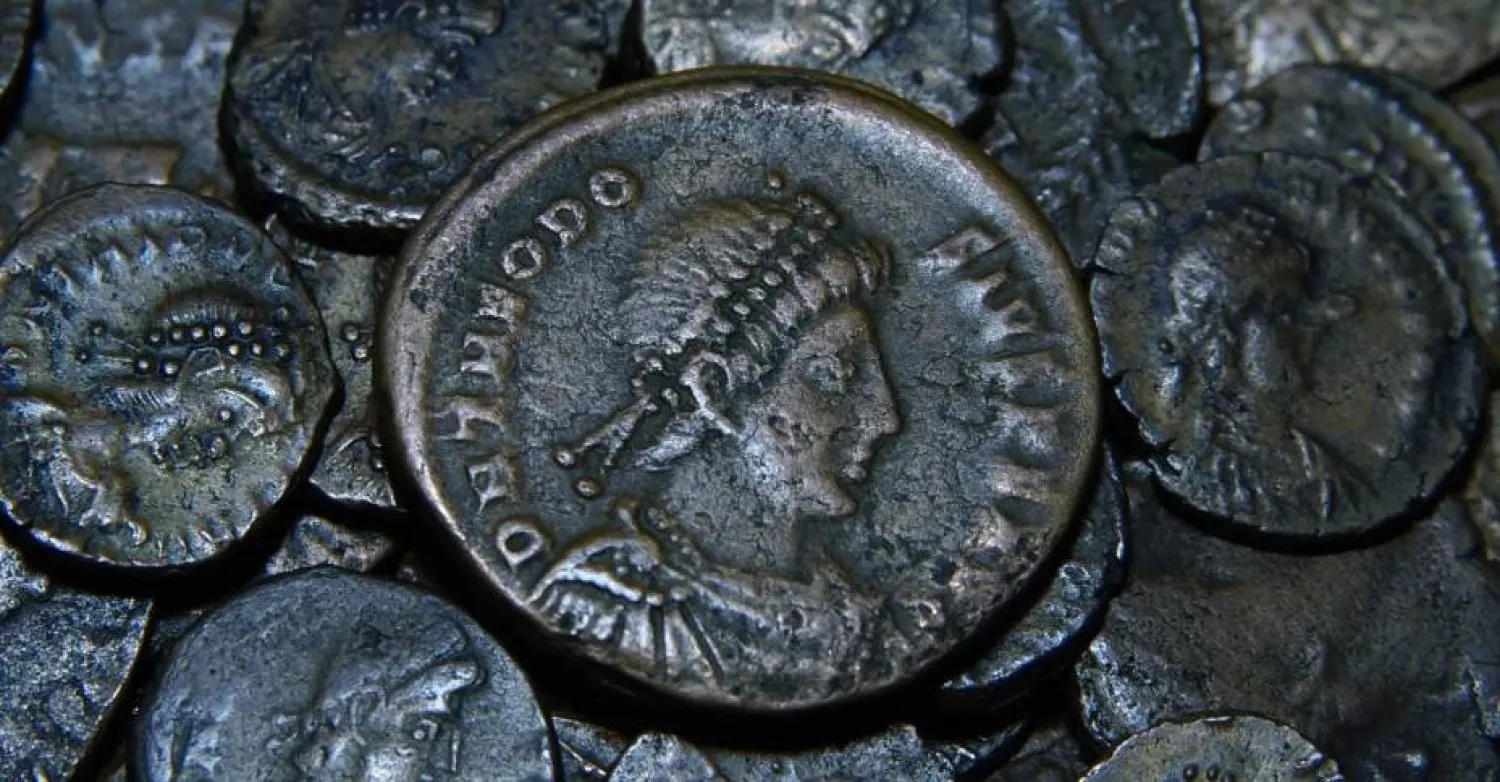

'Biggest Ever' Haul of 15,000 Roman Coins Found in Wales by Metal Detectorist

David Moss found two clay pots in a field in north Wales containing thousands of Roman coins. Shutterstock
TT

'Biggest Ever' Haul of 15,000 Roman Coins Found in Wales by Metal Detectorist

David Moss found two clay pots in a field in north Wales containing thousands of Roman coins. Shutterstock

A metal detectorist has discovered up to 15,000 Roman coins, which could be the biggest hoard ever discovered in Wales, the BBC reported on Thursday.

David Moss, 36, from Cheshire, was left in disbelief and said he had “goosebumps” after digging up two clay pots in north Wales.

But the epic find left him fearing they could be stolen, so he slept with them in his car for three days before taking them to experts.

The coins are now in the safe hands of the National Museum Cardiff where they will be analyzed, BBC said.

While not wanting to give specific details of where he found them, David described the area as a “virtually untouched” area of north Wales.

“You're talking from the times of the druids and the Vikings right through to the Romans,” he said. “I just find it fascinating. It's an area that I'll be interested in for the rest of my life.”

There have been several coin “hoards” found over the years, usually deliberately buried and never recovered, typically during periods of turmoil or as a religious offering to the gods.

National Museum Cardiff said the largest hoard its team was aware of was one of 10,000 coins found near Chepstow in the 1990s.

David has been metal detecting for nearly a decade and so far has uncovered about 2,700 Roman coins.

But he believes the two pots he discovered in August, with his friend Ian Nicholson, contain between 10,000 and 15,000 coins.

“A rainbow appeared minutes before the signal was found,” he said. “I couldn't believe it.”

The pair then spent six-and-a-half hours excavating the coins.

David notified the landowner, who gave him a plastic box to keep them in. He then drove back to his home in Chester, and ended up sleeping with them in his car.

“I just didn't want to leave it out my sight,” he said.

Anthony Halse, chairman of the South Wales and Monmouthshire Numismatic Society, believes the haul could have belonged to a member of the Roman army, or multiple members, who buried the coins for safekeeping.



Sudan Recovers 570 Artifacts Looted During War

Artifacts that were recovered after being looted from the National Museum in Khartoum during the country's long-running war, are displayed during an official ceremony in Port Sudan on January 13, 2026. (AFP)
TT

Sudan Recovers 570 Artifacts Looted During War

Artifacts that were recovered after being looted from the National Museum in Khartoum during the country's long-running war, are displayed during an official ceremony in Port Sudan on January 13, 2026. (AFP)

Sudanese authorities displayed ancient figurines, ornate vases and scarab-shaped amulets at a ceremony Tuesday in Port Sudan celebrating the recovery of more than 570 antiquities stolen from the national museum during the country's long-running war.

The artifacts, arranged on large tables under heavy security, were recovered after months of investigation and brought to the wartime capital of Port Sudan.

The National Museum in Khartoum, which housed some of Sudan's most important archaeological collections, was looted and badly damaged after the paramilitary Rapid Support Forces (RSF) seized the capital in the early days of its war with the army, its former ally.

At the time, satellite images showed trucks carrying artifacts west, towards the vast region of Darfur -- now completely under RSF control.

Since then, Sudanese authorities have worked with UNESCO and Interpol to track down the stolen items.

Authorities did not detail on Tuesday exactly how the artifacts were recovered.

"Sudan heritage is not only of national importance, it is a treasure of humanity," said UNESCO's representative in Sudan, Ahmed Junaid, referring to international efforts to combat illicit trafficking of cultural property.

"Many people do not know the value of the objects displayed on the tables, but they reflect the identity of the nation and its history," said Sudan's finance minister Gibril Ibrahim.

Khalid Aleisir, minister of information and culture, announced a "financial reward" for anyone returning antiquities to the authorities, without specifying an amount.

Officials estimate that the recovered items account for about 30 percent of the objects looted from the museum.

Still missing are the contents of the so-called "gold room", the museum's most valuable collection, which included ancient jewellery and 24-carat gold pieces, some nearly 8,000 years old.


Louvre Museum Says Shutting for the Day Due to Strike

People walk next to the Louvre Museum covered in snow in Paris, France, 07 January 2026. (EPA)
TT

Louvre Museum Says Shutting for the Day Due to Strike

People walk next to the Louvre Museum covered in snow in Paris, France, 07 January 2026. (EPA)

The Louvre Museum was forced to close on Monday due to strike action from staff in the latest disruption at the world's most-visited museum, management said.

"Due to public strikes, the Musee du Louvre is closed today," the museum said in a message posted on its website, informing disappointed tourists and art lovers that their entry tickets would be automatically reimbursed.

The museum closed for a full day last month and has been only partially open on several other days since.

Nearly three months after an embarrassing daylight heist, which has heaped pressure on Louvre bosses, staff are calling for more recruitment and better maintenance of the vast former royal palace.

Questions continue to swirl since the October 19 break-in over whether it was avoidable and why thieves were able to steal crown jewels worth more than $100 million.

Two intruders used a truck-mounted extendable platform to access a gallery containing the jewels, slicing through a glass door with disk-cutters in front of startled visitors before stealing eight priceless items.

As well as the robbery, two other recent incidents have highlighted maintenance problems inside the building, which chief architect Francois Chatillon has described as "not in a good state".

A water leak in November damaged hundreds of books and manuscripts in the Egyptian department, while management had to shut a gallery housing ancient Greek ceramics in October because ceiling beams above it risked giving way.


20-Year-Olds Gathering in Kimonos for Coming of Age Day Ceremony in Japan

Kimono-clad Japanese young women take pictures after attending a Coming-of-Age Day ceremony in Yokohama, near Tokyo, Japan, 12 January 2026. EPA/FRANCK ROBICHON
TT

20-Year-Olds Gathering in Kimonos for Coming of Age Day Ceremony in Japan

Kimono-clad Japanese young women take pictures after attending a Coming-of-Age Day ceremony in Yokohama, near Tokyo, Japan, 12 January 2026. EPA/FRANCK ROBICHON

Young women in brightly colored long-sleeved kimonos and young men in formal suits or traditional hakama and haori gathered Monday at Yokohama Arena to mark Coming-of-Age Day, an annual celebration for those who have turned 20.

The ceremonies, which are a widely observed public rite of passage in Japan, lasted less than an hour. Before and after the events, young adults gathered near the arena entrance, sidewalks and nearby train stations, greeting friends they had not seen for a long time. Smartphones were raised repeatedly as participants took pictures of each other and themselves.

Among the many participants wearing black and navy suits, a large number of young men chose traditional hakama trousers and haori jackets.

Legally, adulthood in Japan now begins at 18, following a revision of the Civil Code in April 2022. Even so, most local governments continue to hold Coming-of-Age ceremonies for 20-year-olds.

Inside Yokohama Arena, participants stood for the national anthem, then sang Yokohama’s city song together. Many then switched on the lights of their mobile phones, illuminating the hall.