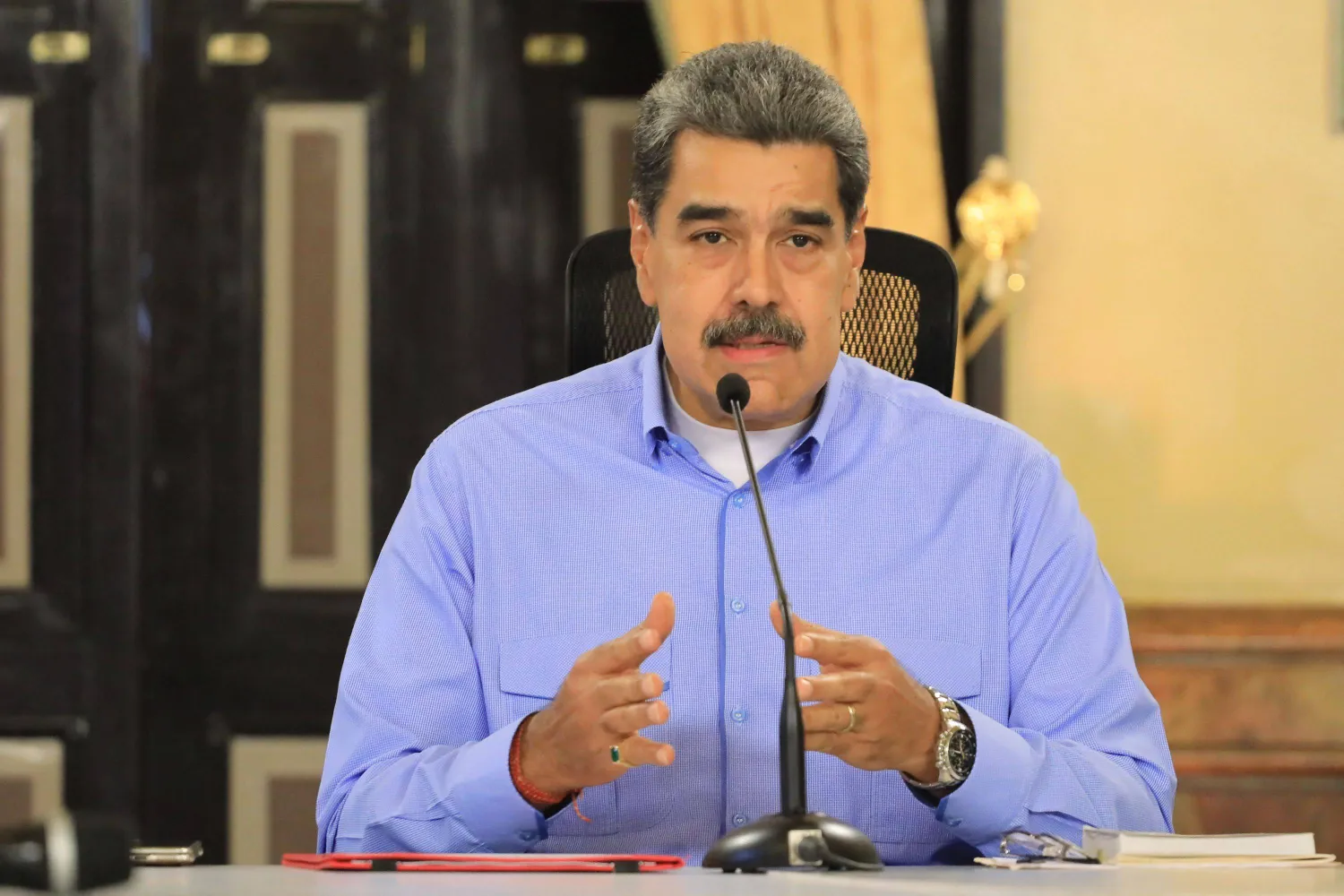
Venezuela's Maduro to US: 'No Crazy War, Please!'

This handout picture released by the Venezuelan Presidency press office on September 23, 2025, shows Venezuela's President Nicolas Maduro speaking during a meeting with the Executive Committee of the State Council of the Nation at the Miraflores Presidential Palace in Caracas. (Photo by ZURIMAR CAMPOS / Venezuelan Presidency / AFP)
TT

Venezuela's Maduro to US: 'No Crazy War, Please!'

This handout picture released by the Venezuelan Presidency press office on September 23, 2025, shows Venezuela's President Nicolas Maduro speaking during a meeting with the Executive Committee of the State Council of the Nation at the Miraflores Presidential Palace in Caracas. (Photo by ZURIMAR CAMPOS / Venezuelan Presidency / AFP)

Venezuelan President Nicolas Maduro pleaded Thursday against a "crazy war" as an escalating US military campaign sent tensions soaring.

Maduro's comment came after US President Donald Trump said he had authorized covert action against the South American nation amid a military campaign targeting what Washington says are drug traffickers in the Caribbean and Pacific, said AFP.

"Yes peace, yes peace forever, peace forever. No crazy war, please!" Maduro said in English in a meeting with unions aligned with the leftist leader.

The United States has deployed stealth warplanes and navy ships as part of what it calls anti-narcotics efforts, but has yet to release evidence that its targets -- eight boats and a semi-submersible -- were smuggling drugs.

Speaking to reporters on Thursday, Trump again denied that he had sent B-1B bombers to Venezuela, but said "we're not happy with them. They've emptied their prisons into our country."

The president said "we're not going to necessarily ask for a declaration of war" from Congress, which has the constitutional power to do so.

"We're just going to kill people who come into our country."

The US strikes, which began on September 2, have killed at least 37 people, according to an AFP tally based on US figures.

Regional tensions have flared as a result of the campaign, with Maduro accusing Washington of seeking regime change.

Late Thursday, the government in Trinidad and Tobago -- located just off Venezuela's coast -- announced that a US warship would dock in its capital from October 26-30.

The Trinidadian foreign ministry said a unit of US Marines would conduct joint exercises with its defense forces.

Two of those killed in the US strikes were from Trinidad and Tobago.

Last week, Trump said he had authorized covert CIA action against Venezuela and was considering strikes against alleged drug cartels on land.

The Republican billionaire president accuses Maduro of heading a drug cartel, a charge the Venezuelan leader denies.

"We know the CIA is present" in Venezuela, the country's defense minister Vladimir Padrino said Thursday.

"They may deploy -- I don't know how many -- CIA-affiliated units in covert operations... and any attempt will fail."

Padrino was overseeing military exercises along Venezuela's coast in response to the US military deployment in the Caribbean.

Experts have questioned the legality of using lethal force in foreign or international waters against suspects who have not been intercepted or questioned.


Trump Moves Deadline for Striking Iran Energy Sites

 Rescue workers and first responders work at a residential building hit in an earlier US-Israeli strike in Tehran, Iran, Monday, March 23, 2026. (AP)
Rescue workers and first responders work at a residential building hit in an earlier US-Israeli strike in Tehran, Iran, Monday, March 23, 2026. (AP)
TT

Trump Moves Deadline for Striking Iran Energy Sites

 Rescue workers and first responders work at a residential building hit in an earlier US-Israeli strike in Tehran, Iran, Monday, March 23, 2026. (AP)
Rescue workers and first responders work at a residential building hit in an earlier US-Israeli strike in Tehran, Iran, Monday, March 23, 2026. (AP)

US President Donald Trump has pushed back his deadline for strikes on Iran's energy assets, saying talks on ending the war were "going very well" as Israel announced fresh strikes on Tehran early Friday.

As the conflict that has roiled energy markets nears its second month, US Secretary of State Marco Rubio said G7 nations should help push for the reopening of the crucial Strait of Hormuz, in remarks before arriving in France on Friday for a meeting of the bloc's foreign ministers.

Last Saturday, Trump had initially given Iran 48 hours to open the strategic strait to oil tankers, threatening to destroy its power plants, but he has now extended the deadline twice.

"As per Iranian Government request... I am pausing the period of Energy Plant destruction by 10 Days to Monday, April 6, 2026, at 8 P.M., Eastern Time," he posted on Thursday.

Around a fifth of global crude oil and liquefied natural gas passes through the Strait of Hormuz in peacetime.

Trump had earlier denied that he was desperate for a deal to end the war, despite Tehran’s cool response to an American peace plan.

"Talks are ongoing and, despite erroneous statements to the contrary by the Fake News Media, and others, they are going very well," Trump posted on his Truth Social platform.

The president's envoy Steve Witkoff told a cabinet meeting earlier of "strong signs" that Tehran was ready to negotiate, confirming publicly for the first time that Washington had passed a 15-point "action list" to Tehran through Pakistani officials.

"We will see where things lead, and if we can convince Iran that this is the inflection point with no good alternatives for them, other than more death and destruction," Witkoff said.

At the meeting, Trump said Iran had allowed 10 oil tankers passage through the Strait of Hormuz to show it was serious about talks.

The Iranian news agency Tasnim said Tehran had replied to Washington's 15 points and was "awaiting the other side's response."

- Energy crunch -

The Tasnim report, citing an unnamed official, said Tehran's reply called for war reparations and respect for Iran's "sovereignty" over the Strait of Hormuz.

Tehran also called for an end to US and Israeli attacks on Iran as well as on groups in the region aligned with it, the report said -- a reference to Lebanon's Hezbollah, among others.

Early on Friday, Israel's military said it carried out "a wide-scale wave of strikes targeting infrastructure of the Iranian terror regime in the heart of Tehran".

In Lebanon, state media reported an airstrike on Beirut's southern suburbs, as AFP correspondents heard several explosions from the Hezbollah stronghold.

Iran's Revolutionary Guards meanwhile claimed a series of missile and drone attacks on Thursday, targeting sites in Israel as well as military facilities in the Gulf used by US forces.

The war began on on February 28 with US-Israeli airstrikes on Iran, and Tehran has responded with retaliatory attacks and a de facto closure of the Strait of Hormuz, sending oil prices soaring and roiling financial markets.

As countries grapple with the energy crunch caused by the war, a Japanese official told AFP on Friday that the government plans to temporarily lift restrictions on coal-fired power plants.

Vietnam meanwhile temporarily waived an environmental tax on fuel to cut soaring petrol prices, the trade ministry said.

The World Bank, in its first statement on the crisis, said it was "ready to respond at scale".

"The longer this lasts, and the more damage there is to critical infrastructure, the more challenging this will be," it said.

- 'They want to make a deal' -

In a televised meeting at the White House, Trump veered between repeated threats to "obliterate" Iran and claims it was already on the verge of capitulating.

"They want to make a deal. The reason they want to make a deal is they have been just beaten," he said.

Trump also said the United States might take control of Iran's oil, comparing it to the deal Washington made with Venezuela after toppling Nicolas Maduro.

Trump's tough talk came as Israeli opposition leader Yair Lapid warned his country's government for the first time that the war was taking too high a toll.

The military "is stretched to the limit and beyond," Lapid said, echoing a warning delivered a day earlier by military chief Lieutenant General Eyal Zamir, according to leaked remarks from a security cabinet meeting.

"The government is sending the army into a multi-front war without a strategy, without the necessary means, and with far too few soldiers," Lapid said.

In a televised briefing, military spokesman Effie Defrin said "more combat soldiers are needed" to establish a "defensive" buffer zone in Lebanon.

Israel said this week that its military would effectively occupy south Lebanon up to the Litani River, around 30 kilometers (20 miles) from the border.

Lebanon -- drawn into the war on March 2 when Hezbollah fired rockets at Israel -- said it would complain to the UN Security Council over Israeli attacks as a threat to its sovereignty.

Hezbollah on Friday said its fighters had launched rockets at northern Israel, where air raid sirens sent residents to shelters.



NATO: Ukraine Still Receiving Arms Despite Mideast War

NATO Secretary General Mark Rutte via Reuters/File
TT

NATO: Ukraine Still Receiving Arms Despite Mideast War

NATO Secretary General Mark Rutte via Reuters/File

Ukraine is still getting essential defense equipment despite the war in the Middle East, which is depleting stockpiles in Europe and the United States, NATO Secretary General Mark Rutte said Thursday.

"The good news is that essential equipment into Ukraine continues to flow," he told reporters. That included American-made Patriot missile interceptors, which Ukraine desperately needs, he added, AFP reported.

The PURL program, launched last year, allows Ukraine to receive US equipment financed by European countries.

Some 75 percent of the missiles used by Patriot batteries in Ukraine have been supplied through the program, and 90 percent of the munitions used by other air-defense systems, Rutte added.

Rutte called on European countries to increase their own production capacity.

"They need to produce more extra production lines, extra shifts, opening new factories. The money is there," he said.


Germany FM Says 'Encouraging' if US Speaking Directly to Iran

German Foreign Minister Johann Wadephul. (Reuters: File Photo)
TT

Germany FM Says 'Encouraging' if US Speaking Directly to Iran

German Foreign Minister Johann Wadephul. (Reuters: File Photo)

Germany's foreign minister Thursday said it was encouraging if the United States was talking directly to Iran to end the war in the Middle East, but Washington should make its intentions clear.

"I hear that there are signs that the US is speaking directly to Iran. I think that this is encouraging and this is welcome," Johann Wadephul told reporters before heading into the meeting of G7 foreign ministers outside Paris, AFP reported.

With US Secretary of State Marco Rubio set to join the discussions from Friday, he added: "For the German government it is of great importance to know precisely what our American partners are intending."