


Erdogan Says US, Others Must Press Israel to Abide by Gaza Ceasefire

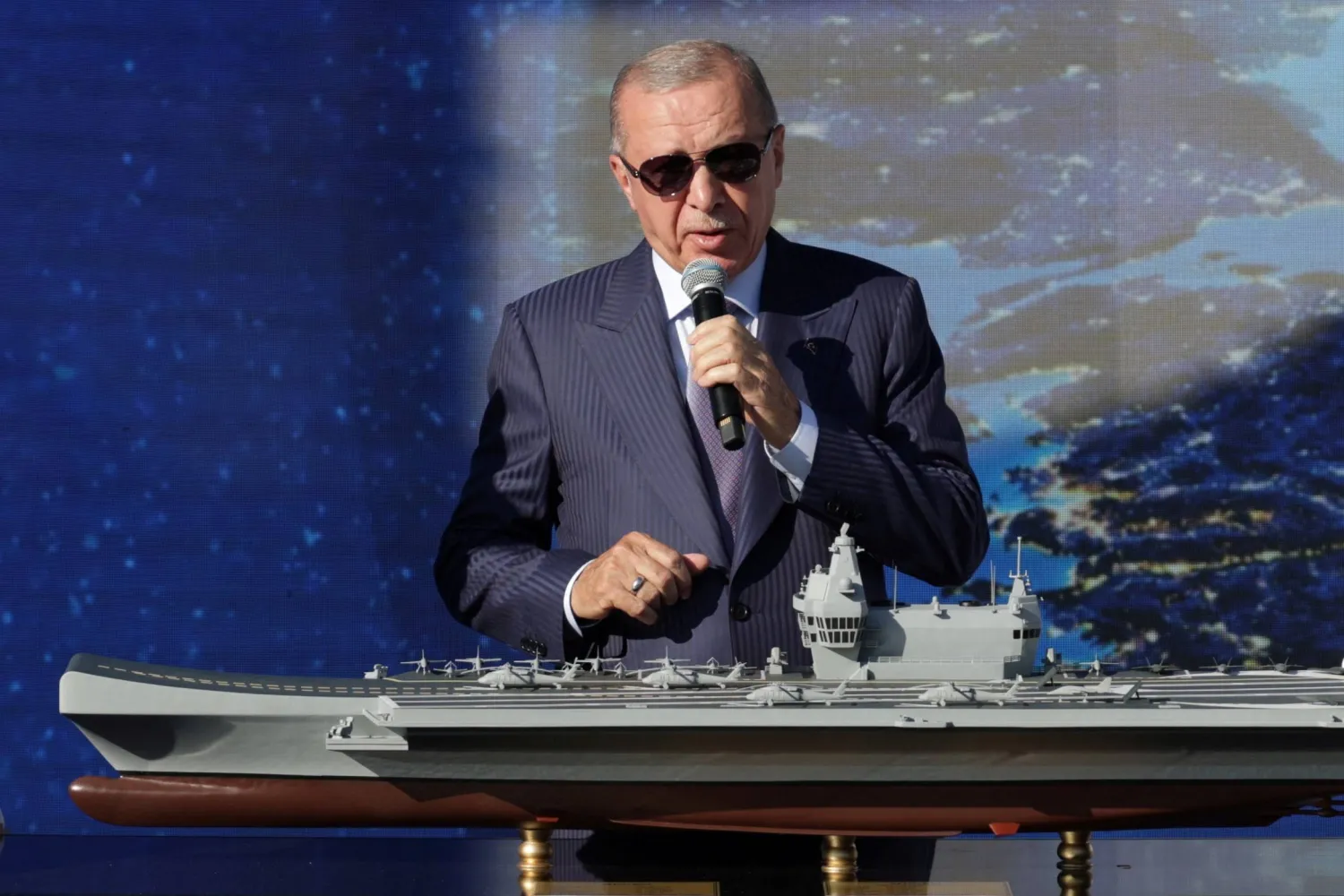
Turkish President Tayyip Erdogan delivers a speech during the Teknofest Blue Homeland event at the Naval Shipyard Command in Istanbul, Türkiye, August 28, 2025. REUTERS/Murad Sezer
TT

Erdogan Says US, Others Must Press Israel to Abide by Gaza Ceasefire

Turkish President Tayyip Erdogan delivers a speech during the Teknofest Blue Homeland event at the Naval Shipyard Command in Istanbul, Türkiye, August 28, 2025. REUTERS/Murad Sezer

Turkish President Tayyip Erdogan said the United States and others must do more to push Israel to stop violating the Gaza ceasefire agreement, including the possible use of sanctions or halting arms sales.

NATO member Türkiye, one of the most vocal critics of Israel's attacks on Gaza, has joined the ceasefire negotiations as a mediator after largely indirect involvement. Its increased role followed a meeting last month between Erdogan and US President Donald Trump at the White House.

"As Türkiye, we are doing our utmost for the ceasefire to be secured. The Hamas side is abiding by the ceasefire. In fact, it is openly stating its commitment to this. Israel, meanwhile, is continuing to violate the ceasefire," Erdogan told reporters on his return flight from a regional Gulf tour.

"The international community, namely the United States, must do more to ensure Israel's full compliance to the ceasefire and agreement," he said, according to a transcript of his comments shared by his office on Friday.

"Israel must be forced to keep its promises via sanctions, halting of arms sales."

Ankara has said that it would join a "task force" to oversee the implementation of the ceasefire, that its armed forces could serve in a military or civilian capacity as needed, and that it will play an active role in the reconstruction of the enclave.

Israeli Prime Minister Benjamin Netanyahu hinted on Wednesday at his opposition to any role for Turkish security forces in the Gaza Strip.

Asked about Netanyahu's comments, Erdogan refrained from his usual criticism of the Israeli leader and appeared to soften his earlier commitment to taking a role on the field in Gaza, saying talks on the issue were still underway.

"Talks are continuing on the task force that will work in Gaza. The modalities of this are not yet clear. As this is a multi-faceted issue, there are comprehensive negotiations. We are ready to provide Gaza any form of support on this issue," he said.

Relations between former allies Israel and Türkiye have hit new lows during the Gaza war, with Ankara accusing Netanyahu's government of committing genocide, an allegation Israel has repeatedly denied.



One Killed in Israeli Strike on South Lebanon

A photograph taken from the southern city of Nabatieh shows smoke rising from the site of an Israeli airstrike on the village of Nabatieh al-Fawqa on July 5, 2026. (AFP)
TT

One Killed in Israeli Strike on South Lebanon

A photograph taken from the southern city of Nabatieh shows smoke rising from the site of an Israeli airstrike on the village of Nabatieh al-Fawqa on July 5, 2026. (AFP)

An Israeli strike on southern Lebanon killed a young motorcyclist on Friday, Lebanese state media reported, the latest attack despite a truce in the Israel-Hezbollah war.

"A young man from the city of Nabatieh was martyred in a raid by an enemy drone that targeted him this afternoon, when he was riding a motorcycle" in Kfar Rumman near the city of Nabatieh, Lebanon's state-run National News Agency said.

It also reported other strikes in the area, wounding at least one person.

The Israeli military meanwhile said it targeted "a Hezbollah terrorist operating near an access shaft of the underground terror infrastructure at the Ali al-Taher Ridge, within the Security Zone where (Israeli) soldiers are operating", referring to a hill that overlooks the area of Nabatieh.

"In an additional strike, the (Israeli army) eliminated a suspect traveling in a vehicle who posed a threat to (Israeli) soldiers operating within the Security Zone."

Hezbollah drew Lebanon into the regional war on March 2 by attacking Israel, claiming it was acting in retaliation for the death of Iran's supreme leader, killed in US-Israeli strikes on Iran on February 28.

Israel responded with a large-scale bombing campaign and a ground offensive, killing more than 4,300 people and occupying territory near the border.

Israel has kept up intermittent strikes on south Lebanon, particularly in the Nabatieh area, despite the truce, usually saying it is targeting Hezbollah sites and operatives.

Lebanon and Israel recently reached a framework agreement that calls for Hezbollah's disarmament and a gradual Israeli withdrawal from occupied Lebanese territory while Lebanon's army deploys into "pilot zones".

However, the agreement -- rejected by Hezbollah -- does not set a timetable for Israel's withdrawal, and Israeli officials have also vowed that their forces will remain in a "security zone" 10 kilometers (six miles) deep as long as Hezbollah remains armed.

Friday's strikes come as Lebanon and Israel are set to meet for a new round of talks in Rome next week, and Lebanese President Joseph Aoun is expected in Washington on June 21, invited by his US counterpart Donald Trump.

In an interview with Asharq al-Awsat, Aoun said that "the United States is the only party capable of exerting pressure on the Israeli government to prevent it from targeting the southern suburbs of Beirut, the infrastructure, or expanding the occupied territories in southern Lebanon".

"We want the American administration to help us regain all of our land."


Iraq’s ‘Oil Network’ Arrests Reach Another Official

Iraqi security personnel patrol a street in Baghdad on June 28. (AFP)
TT

Iraq’s ‘Oil Network’ Arrests Reach Another Official

Iraqi security personnel patrol a street in Baghdad on June 28. (AFP)

An Iraqi security force on Thursday arrested Hussein Talib, director general of the state-run Oil Products Distribution Company, on suspicion of involvement in corruption cases, hours before he was scheduled to take the constitutional oath as a replacement member of parliament, a security source said.

Talib’s detention came as investigations into corruption linked to the oil sector widened. The Central Anti-Corruption Criminal Court announced Thursday that an additional 14 billion Iraqi dinars, or about $10.7 million, had been seized in the case of detained Oil Ministry Undersecretary Adnan al-Jumaili.

Talib, who heads the Oil Ministry-affiliated company, had been named to replace lawmaker Ammar Mousa as a Baghdad representative for the National State Forces Alliance. His arrest prevented him from taking the oath, the source said.

The National Wisdom Movement, led by Ammar al-Hakim and of which Talib is a member, said it supported measures taken by the government, judiciary and Integrity Commission to combat corruption.

Movement spokesman Hossam al-Hassani said it backed legal action aimed at protecting public funds, adding that an official’s compliance with investigative procedures demonstrated respect for constitutional and legal institutions.

He stressed that “the accused is innocent until proven guilty by a final court ruling,” adding that any legal responsibility, if established, was personal and should not extend to any political, social or institutional entity. He urged against prejudging or politically exploiting the case.

Iraqi security forces last week arrested politicians, lawmakers and senior government officials named in al-Jumaili’s confessions. Security and legal sources described the arrests as the beginning of a broader anti-corruption campaign ordered by Prime Minister Ali al-Zaidi.

Al-Zaidi, who took office in May, has pledged to root out corruption, one of Iraq’s most persistent challenges despite repeated accountability promises by successive governments.

An investigating judge said continued inquiries into the waste of public funds in projects led authorities to discover money hidden in a stormwater drainage pit. Investigations were continuing to identify all members of the network.

Parliament also voted Thursday to dismiss National Investment Commission Chairman Haider Makkiya and refer the relevant files to the Integrity Commission after he failed to attend a questioning session.

Al-Zaidi said his government would fight corruption “without exceptions or red lines,” pursue those involved and recover stolen funds.

Local media also reported that Foreign Minister Fuad Hussein discussed in Kuwait efforts to freeze and recover money allegedly deposited in Kuwaiti banks by corruption suspects, as well as cooperation to identify shell companies and return assets to Iraq.


Syrian Authorities Say Captured ISIS-linked Cell Behind Blasts

Syrian security personnel inspect a burned vehicle near the Four Seasons Hotel after two explosions rocked the area earlier in Damascus, Syria, Tuesday, July 7, 2026. (AP Photo/Omar Albam)
TT

Syrian Authorities Say Captured ISIS-linked Cell Behind Blasts

Syrian security personnel inspect a burned vehicle near the Four Seasons Hotel after two explosions rocked the area earlier in Damascus, Syria, Tuesday, July 7, 2026. (AP Photo/Omar Albam)

Syrian officials said late Thursday the country had captured an ISIS-linked cell responsible for two bomb blasts during French President Emmanuel Macron's visit to Damascus earlier this week.

In a joint press conference with his Syrian counterpart, Macron said we must "not let ourselves be destabilized" by such attacks, and the two leaders vowed to boost ties with new ambassadors to be installed in each country.

Syria's Interior Minister Anas Khattab said that "the cell responsible for the terrorist bombings that targeted Damascus two days ago is now in our custody".

"Once the investigations are completed, we will reveal to the public the identities of the cell's members, their roles, and all of their affiliations and connections," he wrote on X.

Ahmad Dalati, head of interior security for the Damascus region, said on Syrian state television that preliminary investigations indicated "the cell was affiliated with the ISIS group".

The interior ministry said in a statement that the cell had been captured following a series of raids "carried out at the same time against the suspects' different locations across Damascus and its countryside".

The statement said the raids occurred in four neighborhoods.

Two blasts hit central Damascus on Tuesday, killing one person and wounding dozens during the French president's first visit to Syria.

The explosives had been planted near the Four Seasons Hotel, where Macron had spent the night, with Syria's interior ministry saying one was placed in a garbage container and the other in a vehicle near the hotel in the heart of the capital.