
Thailand's Queen Mother Sirikit Has Died at Age 93

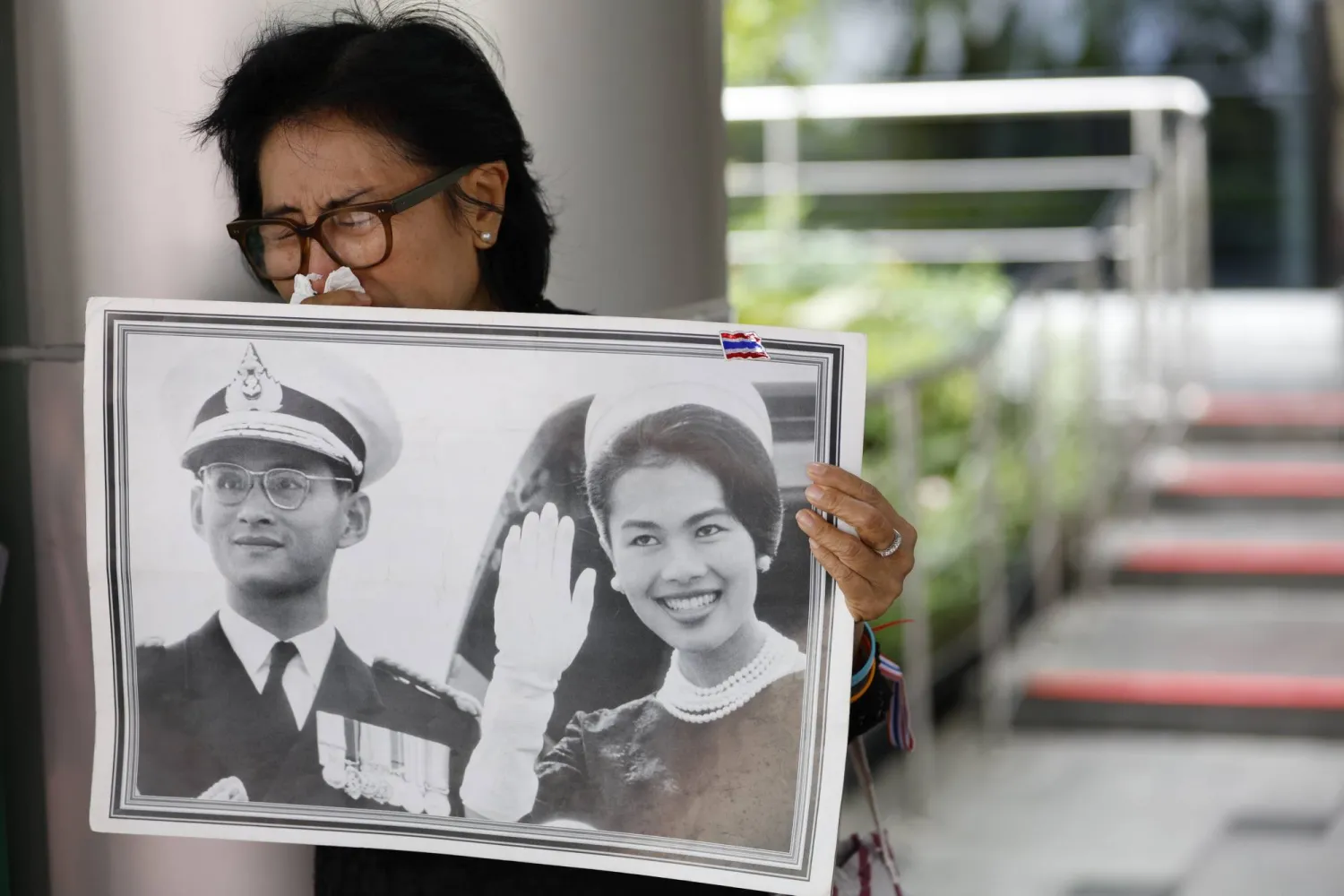
A Thai woman mourns Queen Mother Sirikit after the announcement of her death at King Chulalongkorn Memorial Hospital in Bangkok, Thailand, 25 October 2025. EPA/RUNGROJ YONGRIT
TT

Thailand's Queen Mother Sirikit Has Died at Age 93

A Thai woman mourns Queen Mother Sirikit after the announcement of her death at King Chulalongkorn Memorial Hospital in Bangkok, Thailand, 25 October 2025. EPA/RUNGROJ YONGRIT

Thailand’s Queen Mother Sirikit, who supervised royal projects to help the rural poor, preserve traditional craft-making and protect the environment, died on Friday. She was 93.

The Royal Household Bureau said she died in a hospital in Bangkok, adding that she began suffering from a blood infection on Oct. 17 and despite her medical team’s efforts, her condition did not improve. She suffered a stroke in 2012 and was afterwards largely absent from public life due to declining health. Her husband, King Bhumibol Adulyadej, died in October 2016.

Mourners gathered outside Chulalongkorn Hospital on Saturday morning after hearing the news.

“It is yet again another great loss for the whole nation. I heard about it at 4 a.m. I felt like fainting. The whole world seemed like it had stopped," said 67-year-old Maneerat Laowalert.

Although overshadowed by her late husband and her son, the current king, Sirikit was beloved and influential in her own right. Her portrait was displayed in homes, offices and public spaces across Thailand and her Aug. 12 birthday was celebrated as Mother’s Day. Her activities ranged from helping Cambodian refugees to saving some of the country's once-lush forests from destruction.

The Thai monarchy traditionally has avoided playing an open role in politics, but in recent decades of political upheaval, marked by two military takeovers and several rounds of bloody street protests, speculation grew about Sirikit’s views and her behind the scenes influence. When she publicly attended the 2008 funeral of a protester killed during a clash with police, many saw it as her taking a side in the political schism.

Sirikit met the king while living in Europe Sirikit Kitiyakara was born into a rich, aristocratic family in Bangkok on Aug. 12, 1932, the year absolute monarchy was replaced by a constitutional system. Both of her parents were related to earlier kings of the current Chakri dynasty.

She attended schools in wartime Bangkok, the target of Allied air raids, and after World War II moved with her diplomat father to France where he served as ambassador.

At 16, she met Thailand’s newly crowned king in Paris, where she was studying music and languages. Their friendship blossomed after Bhumibol suffered a near-fatal car accident and she moved to Switzerland, where he was studying, to help care for him. The king courted her with poetry and composed a waltz titled, "I Dream of You."

The pair married in 1950, and at a coronation ceremony later the same year both vowed to "reign with righteousness for the benefit and happiness of the Siamese (Thai) people."

The couple had four children: current King Maha Vajiralongkorn, and princesses Ubolratana, Sirindhorn and Chulabhorn.

During their early married life, the Thai royals crisscrossed the world as goodwill ambassadors and forged personal ties with world leaders.

Malaysian Foreign Minister Mohamad Hasan expressed his “heartfelt condolences” on her death as he opened a meeting with his Southeast Asian counterparts in Kuala Lumpur, Malaysia, The Associated Press reported.

A turn to Thailand's rural areas But by the early 1970s, the king and queen turned most of their energies to Thailand's domestic problems, including rural poverty, opium addiction in hill tribes and a communist insurgency.

Each year, the couple traveled around the countryside while also officiating at more than 500 royal, religious and state ceremonies.

The queen, an impeccable dresser and avid shopper, also relished climbing hills and visiting simple villages where older women called her "daughter."

Thousands raised their problems to her, ranging from marital squabbles to serious diseases, and the queen and her assistants took up many personally.

While some in Bangkok gossiped about her involvement in palace intrigues and her lavish lifestyle, her popularity in the countryside endured.

"Misunderstandings arise between people in rural areas and the rich, so-called civilized people in Bangkok. People in rural Thailand say they are neglected, and we try to fill that gap by staying with them in remote areas," she said in an interview with The Associated Press in 1979.

Royal development projects were set up across Thailand, some of them initiated and directly supervised by the queen.

In 1976, the queen launched a foundation aimed at increasing the income of poor rural families and preserving dying crafts. The foundation, known as SUPPORT, has trained thousands of villagers in silk-weaving, jewelry-making, painting, ceramics and other traditional crafts.

She also set up wildlife breeding centers, "open zoos," and hatcheries to save endangered sea turtles. Her Forest Loves Water and Little House in the Forest projects sought to demonstrate the economic gains of preserving forest cover and water sources.

While royalty elsewhere had only ceremonial or symbolic roles, Queen Sirikit believed the monarchy was a vital institution in Thailand.

"There are some in the universities who think the monarchy is obsolete. But I think Thailand needs an understanding monarch," she said in the 1979 interview. "At the call, ‘The king is coming,’ thousands will gather.

“The mere word king has something magic in it. It is wonderful."


Iranians to Receive Monthly Payment Amid Economic Woes, Protests

A customer shops at a supermarket at a shopping mall in northern Tehran, on Sept. 28, 2025. (AP)
TT

Iranians to Receive Monthly Payment Amid Economic Woes, Protests

A customer shops at a supermarket at a shopping mall in northern Tehran, on Sept. 28, 2025. (AP)

Iranian authorities on Sunday announced they will give a monthly allowance to every citizen in the country to alleviate economic pressure, after a week of protests.

"Individuals can receive an amount equivalent to one million Tomans (approximately $7) per person per month, which is credited to their accounts for four months," government spokeswoman Fatemeh Mohajerani told state TV.

She said the amount will be given to every Iranian for four months in the form of credit that can be used to purchase certain goods and is intended to "reduce the economic pressure on the people."

In Iran, which has a population of more than 85 million people, the minimum wage is roughly $100 (85 euros) and average monthly salaries are around $200.

Iranians mostly use mobile phones and debit cards for their daily purchases instead of cash.

Iran's economy has been grappling with biting US and international sanctions over Tehran's nuclear program for years, and December saw a 52 percent year-on-year inflation rate.

The national currency has lost more than a third of its value against the US dollar over the past year, causing a sharp decrease in people's purchasing power and broad discontent in the country.

Sunday marked the eighth day of sporadic protests in the country over economic uncertainty in the wake of the depreciation.

The protests have touched, to varying degrees, at least 40 different cities, mostly medium-sized and in the country's west, according to an AFP tally based on official announcements and media reports.

At least 12 people have been killed, including members of the security forces, according to a toll based on official reports.


Rubio Says US Won’t Govern Venezuela but Will Press for Changes Through Oil Blockade

US Secretary of State Marco Rubio (C) speaks during a news conference at the Mar-a-Lago Club in Palm Beach, Florida, USA, 03 January 2026. (EPA)
TT

Rubio Says US Won’t Govern Venezuela but Will Press for Changes Through Oil Blockade

US Secretary of State Marco Rubio (C) speaks during a news conference at the Mar-a-Lago Club in Palm Beach, Florida, USA, 03 January 2026. (EPA)

Secretary of State Marco Rubio suggested Sunday that the United States would not take a day-to-day role in governing Venezuela other than enforcing an existing "oil quarantine" on the country, a turnaround after President Donald Trump announced a day earlier that the US would be running Venezuela following its ouster of leader Nicolas Maduro.

Rubio's statements on TV talk shows seemed designed to temper concerns about whether the assertive American action to achieve regime change might again produce a prolonged foreign intervention or failed attempt at nation-building. They stood in contrast to Trump’s broad but vague claims that the US would at least temporarily "run" the oil-rich nation, comments that suggested some sort of governing structure under which Caracas would be controlled by Washington.

But Rubio offered a more nuanced take, saying the US would continue to enforce an oil quarantine that was already in place on sanctioned tankers before Maduro was removed from power early Saturday and using that leverage as a means to press policy changes in Venezuela.

"And so that’s the sort of control the president is pointing to when he says that," Rubio said on CBS’ "Face the Nation.We continue with that quarantine, and we expect to see that there will be changes, not just in the way the oil industry is run for the benefit of the people, but also so that they stop the drug trafficking."

The blockade on sanctioned oil tankers — some of which have been seized by the US — "remains in place, and that’s a tremendous amount of leverage that will continue to be in place until we see changes that not just further the national interest of the United States, which is number one, but also that lead to a better future for the people of Venezuela," he added.

Trump repeated vow US would ‘run’ Venezuela

Trump's vow to "run" Venezuela, repeated more than half a dozen times at a news conference in Florida on Saturday, sparked concerns among some Democrats. It also drew unease from parts of his own Republican coalition, including an "America First" base that is opposed to foreign interventions, and also from observers who recalled past nation-building efforts in Iraq and Afghanistan.

Rubio dismissed such criticism, saying that Trump’s intent had been misunderstood by a "foreign policy establishment" that was fixated on the Middle East.

"The whole foreign policy apparatus thinks everything is Libya, everything is Iraq, everything is Afghanistan," Rubio said. "This is not the Middle East. And our mission here is very different. This is the Western Hemisphere."

Rubio also suggested that the US would give Maduro’s subordinates who are now in charge time to govern, saying, "We’re going to judge everything by what they do, and we’re going to see what they do." And though he did not rule out a US military presence in Venezuela, Rubio said the current US "force posture" was capable of stopping drug boats and sanctioned tankers.

A day earlier, Trump told reporters, "We’re going to run the country until such time as we can do a safe, proper and judicious transition." He later pointed to his national security team with him, including Rubio and Defense Secretary Pete Hegseth, and said it would be done for a period of time by "the people that are standing right behind me. We’re gonna be running it we’re gonna be bringing it back."

The White House declined to comment beyond what Trump said Saturday.

Maduro's arrival

Maduro landed late Saturday afternoon at a small airport in New York City's northern suburbs following the middle-of-the-night operation that extracted him and his wife, Cilia Flores, from their home in a military base in the capital, Caracas — an act that Maduro’s government called "imperialist." The couple faces US charges of participating in a narco-terrorism conspiracy.

The dramatic seizure of the Maduros capped an intensive Trump administration pressure campaign on Venezuela’s autocratic leader and months of secret planning, resulting in the most assertive American action to achieve regime change since the 2003 invasion of Iraq. Legal experts raised questions about the lawfulness of the operation, which was done without congressional approval.

Venezuela’s vice president, Delcy Rodriguez, meanwhile, demanded that the US free Maduro and called him the country’s rightful leader as her nation’s high court named her interim president.

After arriving at the airport, Maduro was flown by helicopter to Manhattan, where a convoy of law enforcement vehicles, including an armored car, was waiting to whisk him to a nearby US Drug Enforcement Administration office. A video posted on social media by a White House account showed Maduro, smiling, as he was escorted through that office by two DEA agents grasping his arms.

He is due to make his first appearance Monday in Manhattan's federal court.

Maduro and other Venezuelan officials were indicted in 2020 on narco-terrorism conspiracy charges, and the Justice Department released a new indictment Saturday of Maduro and his wife that painted his administration as a "corrupt, illegitimate government" fueled by a drug-trafficking operation that flooded the US with cocaine. The US government does not recognize Maduro as the country’s leader.

The Trump administration spent months building up American forces in the region and carrying out attacks on boats in the Caribbean Sea and eastern Pacific Ocean for allegedly ferrying drugs. Last week, the CIA was behind a drone strike at a docking area believed to have been used by Venezuelan drug cartels — the first known direct operation on Venezuelan soil since the US campaign began in September.

Quiet falls in Venezuela after US operation

Venezuela’s capital remained unusually quiet Sunday with few vehicles moving around and convenience stores, gas stations and other businesses closed. A road typically filled with runners, cyclists and other fitness enthusiasts on Sundays only had a handful of people working out the day after Maduro was deposed.

The presidential palace was guarded by armed civilians and members of the military. At a nearby plaza, only a street sweeper and a soldier stood, and across the street, a church remained close for a second day in a row.

Caracas resident David Leal arrived to the lot where he parks vehicles for a living only to quickly realize that he would likely not see any clients for a second day.

"People are still shaken," said Leal, 77.


Venezuela Military Recognizes Maduro’s VP as Acting President

Venezuela's Vice-President and Oil Minister Delcy Rodriguez addresses the media in Caracas, Venezuela, March 10, 2025. (Reuters)
TT

Venezuela Military Recognizes Maduro’s VP as Acting President

Venezuela's Vice-President and Oil Minister Delcy Rodriguez addresses the media in Caracas, Venezuela, March 10, 2025. (Reuters)

Venezuela's military on Sunday recognized Delcy Rodriguez, deputy to ousted President Nicolas Maduro, as the country's acting leader, after US forces extracted the former head of state to face trial.

Amid uncertainty following the leftist president's dramatic capture, Defense Minister Vladimir Padrino Lopez appeared to throw his weight behind Rodriguez, who US President Donald Trump had earlier indicated was a figure Washington could work with.

Padrino read out a statement on television endorsing a Supreme Court ruling that appointed Rodriguez as acting president for 90 days.

He also called on Venezuelans to get back to their daily life, speaking less than two days after the US strikes shook the capital Caracas and special forces seized Maduro and his wife.

Padrino denounced it as a "cowardly kidnapping" and said that some of Maduro's bodyguards were killed "in cold blood," as well as military personnel and civilians on the Venezuelan side.

Venezuelan authorities have not yet given an official toll for people hurt or killed in the US operations.

The streets of Caracas were deserted and quiet on Sunday, with many businesses closed and moderate queues at some markets and pharmacies.

"I call on the people of Venezuela to resume their activities of all kinds, economic, work and education, in the coming days," Padrino said.

"The homeland must follow its constitutional course."