The insistence of about 500 displaced Lebanese to stay along Beirut’s waterfront has raised questions about why they chose to remain in that area despite the lack of basic living conditions.
The displaced say they are staying for security reasons, fearing they could be targeted if they move to larger gatherings, such as the Sports City, and because they want to remain in Beirut rather than in distant areas in the north or the Bekaa.
But Beirut figures and lawmakers say the issue has security dimensions that go beyond the humanitarian aspect, arguing that their continued presence on the waterfront is taking place by a decision from Hezbollah.
The prime minister’s office said, “No infrastructure will be allowed to be built at the newly designated site, nor any additional facilities that could turn this temporary presence into a permanent reality.”
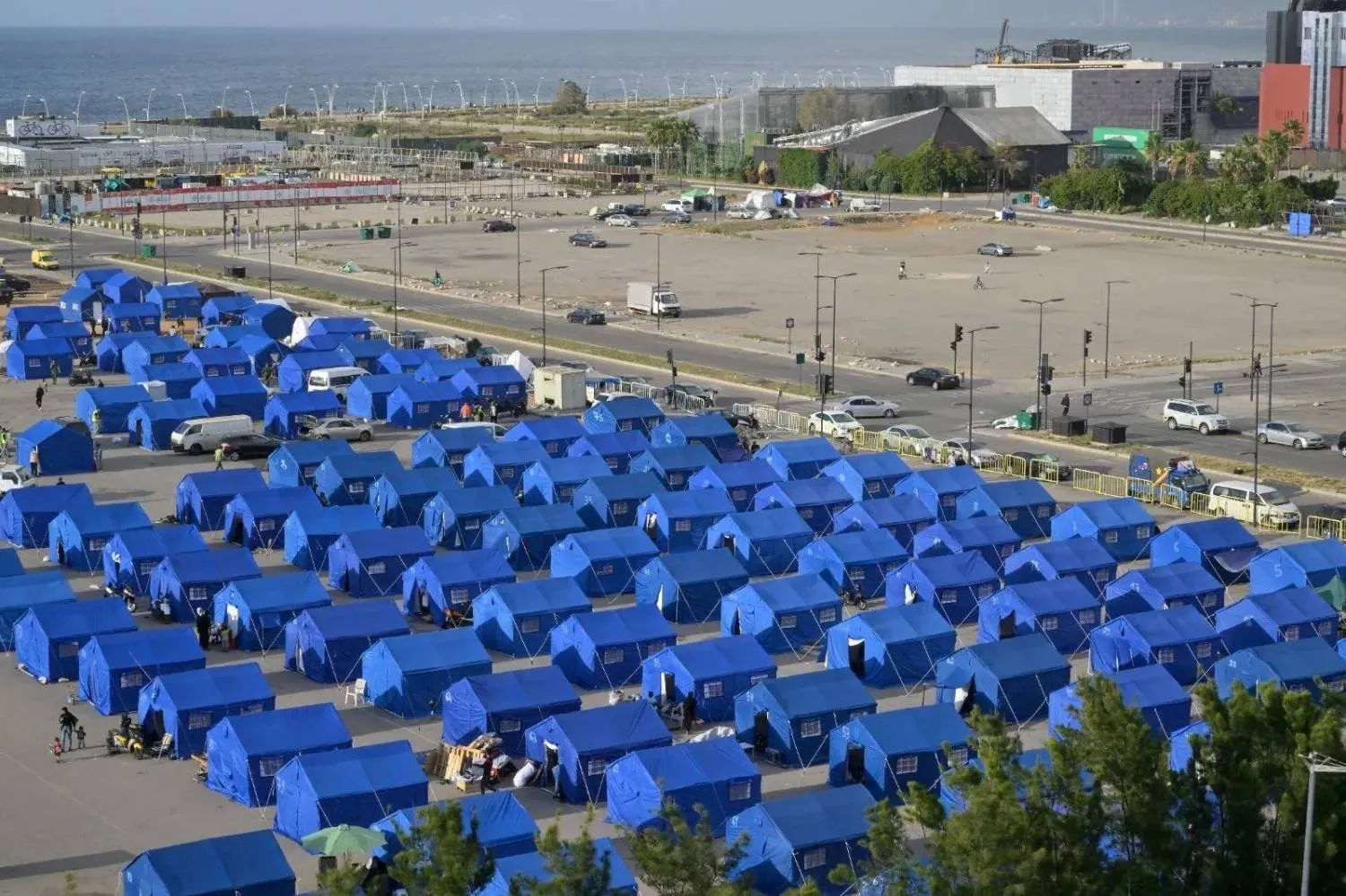
Over the past two days, the displaced were moved only a few meters from privately owned land, where they had been living in inhumane conditions inside random and disorganized tents, to adjacent land owned by the Beirut municipality.
Their presence was organized there, and proper tents were provided, along with security and organizational measures at the new site. But the gathering still lacks bathrooms and basic services.
The official decision to move the tents only a few meters, rather than ending the gathering and distributing the displaced to more suitable shelters, surprised many, especially as it effectively kept the same concentration of people on Beirut’s waterfront, with only limited organizational changes.
Prime minister’s office
The central operations room at the prime minister’s office said in a statement that, “as part of efforts to prevent random gatherings, fixed structures that had been set up on Beirut’s waterfront were removed, especially those made of wood, asbestos and concrete, in a way that prevents any expansion at this site.”
It said the new site, which belongs to the Beirut municipality, accounts for no more than 15% of the area where the tents had previously been set up.
It added that “this measure does not aim to establish a camp or an official shelter, nor to impose a new fait accompli, as some are trying to suggest, but rather to protect public order and security in the capital, and to remove encroachments on private property.”
It stressed that “no infrastructure will be allowed to be built at the newly designated site, nor any additional facilities that could turn this temporary presence into a permanent reality.”
Interior Ministry clarification
Interior Ministry sources said the displaced had been asked to move to Sports City but had refused.
“Because the tents had spread randomly, and under the directives of the prime minister, Beirut Governor Judge Marwan Abboud was tasked with finding a temporary solution to organize the situation. It was decided to confine the tents to land belonging to the Beirut municipality as a temporary measure,” the sources told Asharq Al Awsat.
They said the measure aimed to establish a minimum level of organization, while “the best solution remains for the displaced to move to shelters, in the hope that this crisis ends as soon as possible so they can return to their homes.”
A decision by Hezbollah?
MP Waddah Sadek said the authorities had faced three options, either leave the gathering in the state of chaos it was in on private land, move the displaced within the same area to state owned land in a way that ends the encroachment on private property and allows their presence to be better organized, or remove the tents and gathering by force, which would have led to a security incident given the displaced people’s refusal to leave.
“The officials concerned chose the second option because they considered it the best at this stage,” Sadek told Asharq Al Awsat.
Sadek said, “What is happening is taking place by a clear decision from Hezbollah, because the displaced have no interest in staying in the condition they are in when better alternatives and options exist.”
He warned of “gatherings under the title of displacement at every entrance to Beirut, which reinforces fears over the scenario Hezbollah is preparing.”
Security fears?
One of the displaced people at Beirut’s waterfront said in a television interview that their insistence on staying where they are was “purely” for security reasons.
“We fear being gathered in one large center, such as the Sports City, and then Israel targeting us,” he said.
Although the Social Affairs Ministry had provided buses for weeks to transport them to other areas, where suitable shelters had been prepared, they refused to leave and insisted on staying in the capital.
Deporting Syrians
Beirut municipal council member Mohammad Ballouza said the municipal council had no role in the file and that no council session had been held to take any decision on the matter.
“The decision to move the displaced from private land to land belonging to the Beirut municipality was taken under the directives of Prime Minister Nawaf Salam, under the supervision of the interior minister, and implemented by the Beirut governor. Instead of having tents spread across private property, they were gathered on land owned by the Beirut municipality,” he told Asharq Al Awsat.
Ballouza said, “The displaced do not want to leave the area, so they were only provided with tents. Syrians were deported to Syria or moved to other points.”
He said shelters in Beirut had reached full capacity and that the capital had exceeded its ability to absorb more people. “The Sports City in Beirut can accommodate only about 200 people,” he said.
Fear that the temporary becomes permanent
MP Ghassan Hasbani, a member of the Strong Republic bloc, visited the Grand Serail with MP Fouad Makhzoumi, where they discussed with Prime Minister Nawaf Salam the presence of the displaced on Beirut’s waterfront.
After the meeting, Hasbani stressed the need to move the displaced to other equipped shelters, saying Beirut’s waterfront is not prepared or able to accommodate this population, whether on private or municipal properties.
He also voiced concern that “the temporary could become permanent, especially through public property that must be protected.”