


Historic Libraries Bring Modern Comfort to Book Lovers and History Buffs in New England

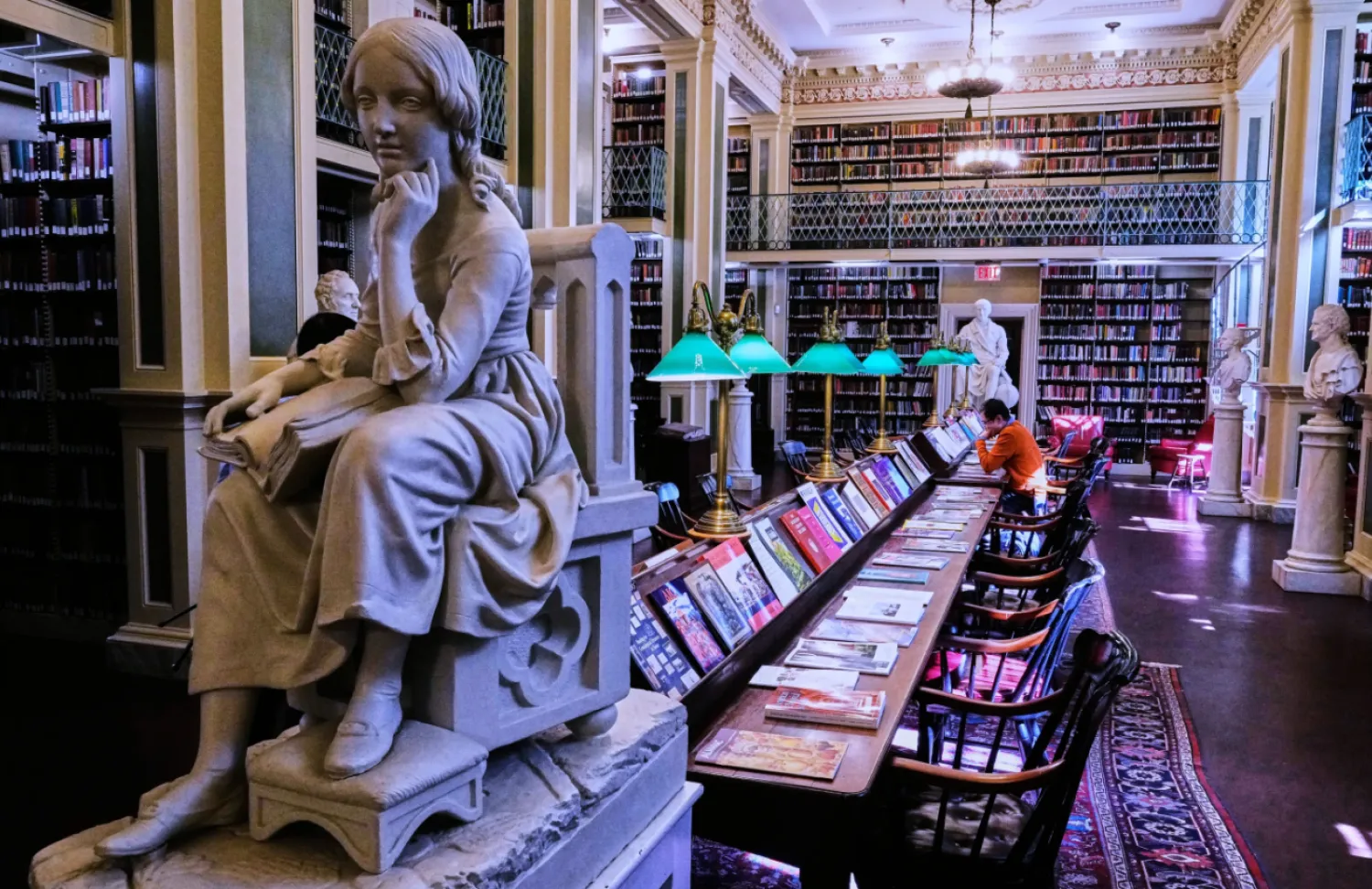
Little Nell, left, a sculpture of the character from Charles Dickens's "The Old Curiosity Shop", is displayed at the Boston Athenaeum, Thursday, Oct. 9, 2025, in Boston. (AP Photo/Charles Krupa)
TT

Historic Libraries Bring Modern Comfort to Book Lovers and History Buffs in New England

Little Nell, left, a sculpture of the character from Charles Dickens's "The Old Curiosity Shop", is displayed at the Boston Athenaeum, Thursday, Oct. 9, 2025, in Boston. (AP Photo/Charles Krupa)

When David Arsenault takes down a worn, leather-bound 19th-century book from the winding shelves of the Boston Athenaeum, he feels a sense of awe — like he’s handling an artifact in a museum.

Many of the half a million books that line the library's seemingly endless maze of reading room shelves and stacks were printed before his great-great-grandparents were born. Among fraying copies of Charles Dickens novels, Civil War-era biographies and town genealogies, everything has a history and a heartbeat, The AP news reported.

“It almost feels like you shouldn’t be able to take the books out of the building, it feels so special,” said Arsenault, who visits the institution adjacent to Boston Common a few times a week. “You do feel like, and in a lot of ways, you are, in a museum — but it’s a museum you get to not feel like you’re a visitor in all the time, but really a part of.”

The more than 200-year-old institution is one of only about 20 member-supported private libraries in the US dating back to the 18th- and 19th-centuries. Called athenaeums, a Greek word meaning “temple of Athena,” the concept predates the traditional public library most Americans recognize today. The institutions were built by merchants, doctors, writers, lawyers and ministers who wanted to not only create institutions for reading — then an expensive and difficult-to-access hobby — but also space to explore culture and debate.

Many of these athenaeums still play a vibrant role in their communities.

Patrons gather to play games, join discussions on James Joyce, or even research family history. Others visit to explore some of the nation’s most prized artifacts, such as the largest collection from George Washington ’s personal library at Mount Vernon at the Boston Athenaeum.

In addition to conservation work, institutions acquire and uplift the work of more modern creatives who may have been overlooked. The Boston Athenaeum recently co-debuted an exhibit by painter Allan Rohan Crite, who died in 2007 and used his canvas to depict the joy of Black life in the city.

One thing binds all athenaeums together: books and people who love them.

“The whole institution is built around housing the books,” said Matt Burriesci, executive director of Providence Athenaeum in Rhode Island. “The people who come to this institution really appreciate just holding a book in their hands and reading it the old-fashioned way.”

Book lover's dream Built to mimic an imposing Greek temple, staffers at the Providence Athenaeum often talk about the joy of watching people enter for the first time.

Visitors must climb a series of cold, granite steps. Only then are they met with a thick wooden door that ushers them into a warm world filled with cozy reading nooks, hidden desks to leave secret messages to fellow patrons, and almost every square inch bursting with books.

“It’s the actual time capsule of people’s reading habits over 200 years,” Burriesci said, while pointing to a first-edition of Little Women, where the pages and spine proudly showcase years of being well read.

Many athenaeums are designed to pay tribute to Greek influence and their namesake, the goddess of wisdom. In Boston, a city once dubbed “the Athens of America,” visitors to the athenaeum are greeted by a nearly 7-foot-tall (2.1-meter-tall) bronze statue of Athena Giustiniani.

The building is as much an art museum as it is a library.

“So many libraries were built to be functional — this library was built to inspire,” said John Buchtel, the Boston Athenaeum’s curator of rare books and head of special collections.

The 12-level building includes five gallery floors where ornate busts of writers and historical figures decorate reading rooms with wooden tables overlooked by book-lined pathways reachable by spiral and hidden staircases.

Natural light shines in from large windows where guests can look down to see one of Boston's most historic cemeteries where figures like Paul Revere, Samuel Adams, and John Hancock are buried.

“We’re able to leave many of these things out for people to peruse, and I think people can often get curious about something and just follow their curiosity into things that they didn’t even know that they were going to be fascinated by,” said Boston Athenaeum executive director Leah Rosovsky.

A safe haven When athenaeums were founded, they were exclusive spaces that only people with education and money could access.

Some are now free. Most are open to the public for day passes and tours. Memberships to the Boston Athenaeum can range from $17 to $42 a month per person, depending on whether the patron is under 40 or is sharing the membership with family members.

Charlie Grantham, a wedding photographer and aspiring novelist, said she first visited during one of the institution’s annual community days, where the public can explore for free. She said she was surprised by how accessible it was and describes the space as “Boston’s best kept secret — an oasis in the middle of the city.”

“It’s just so peaceful. Even if I’m still working... doing things I’m stressed out about at home, when I’m here, there’s like a stillness about it and things feel more manageable, things feel enjoyable here,” she said.

Some people visit every day to work remotely, read or socialize, said Salem Athenaeum executive director Jean Marie Procious.

“We do have a loneliness crisis,” she said. “And we want to encourage people to come and see us as a space to meet up with others and a safe environment that you’re not expected to buy a drink or buy a meal.”



Saudi Heritage Commission Announces Discovery of 20 Rock Engravings in Soudah Peaks Project

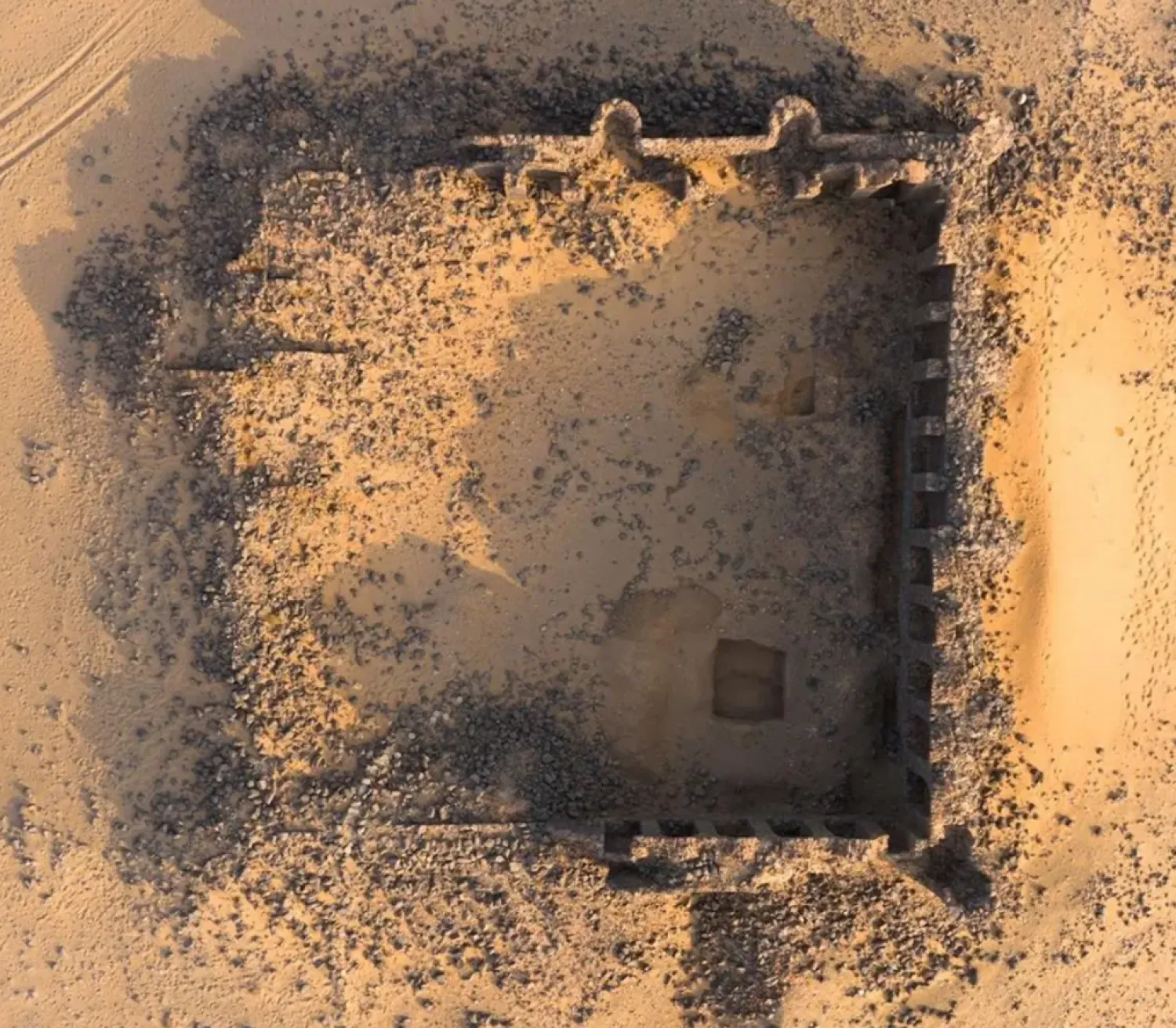
The newly identified sites feature inscriptions and rock carvings estimated to be between 4,000 and 5,000 years old. (SPA)
TT

Saudi Heritage Commission Announces Discovery of 20 Rock Engravings in Soudah Peaks Project

The newly identified sites feature inscriptions and rock carvings estimated to be between 4,000 and 5,000 years old. (SPA)

Saudi Arabia’s Heritage Commission, in collaboration with Soudah Development, a Public Investment Fund company, announced on Tuesday the discovery of 20 ancient rock art sites within the Soudah Peaks area.

Spanning more than 636.5 square kilometers across Soudah and parts of Rijal Almaa, the project area is now recognized as home to some of the region’s oldest cultural landmarks. The newly identified sites feature inscriptions and rock carvings estimated to be between 4,000 and 5,000 years old, offering valuable insights into the region’s rich history.

The findings include Thamudic inscriptions, along with vivid depictions of ibex, hyenas, and ostriches, as well as scenes of hunters, dancers, palm trees, and weapons, reflecting the environmental and social practices of the ancient communities that once inhabited the area.

The survey forms part of a memorandum of understanding signed between the Heritage Commission and Soudah Development. Conducted in four scientific phases, the initiative began with data collection and site analysis, concluding with the documentation and classification of high-value archaeological sites in preparation for future development and preservation efforts.

Soudah Development remains committed to protecting and promoting the natural and cultural heritage of the project area. The company continues to work towards creating an integrated cultural and tourism experience that reflects the authenticity and historical richness of the region, in line with its vision to transform Soudah Peaks into a premier luxury mountain destination rooted in heritage.


Ancient Rome Meets Modern Technology as Tourists Visit Restored, Frescoed Home via Livestream Tours

 Colosseum Archeological Park guide Valentina uses a head-mounted device to livestream a guided tour for the press of the newly-restored underground House of Griffins, dated between the II and I century B.C., on the Palatine Hill next to the Colosseum, in Rome, Tuesday, Jan. 13, 2026. (AP)
Colosseum Archeological Park guide Valentina uses a head-mounted device to livestream a guided tour for the press of the newly-restored underground House of Griffins, dated between the II and I century B.C., on the Palatine Hill next to the Colosseum, in Rome, Tuesday, Jan. 13, 2026. (AP)
TT

Ancient Rome Meets Modern Technology as Tourists Visit Restored, Frescoed Home via Livestream Tours

 Colosseum Archeological Park guide Valentina uses a head-mounted device to livestream a guided tour for the press of the newly-restored underground House of Griffins, dated between the II and I century B.C., on the Palatine Hill next to the Colosseum, in Rome, Tuesday, Jan. 13, 2026. (AP)
Colosseum Archeological Park guide Valentina uses a head-mounted device to livestream a guided tour for the press of the newly-restored underground House of Griffins, dated between the II and I century B.C., on the Palatine Hill next to the Colosseum, in Rome, Tuesday, Jan. 13, 2026. (AP)

One of the best-preserved ancient Roman homes on the Palatine Hill is opening to the public for the first time, albeit via a livestreamed tour of its hard-to-reach underground frescoes and mosaics.

The House of the Griffins was first discovered during the excavations in the early 20th century of the Palatine Hill, the verdant hill that rises up from the Roman Forum and dominates views of central Rome today with its striking red brick ruins.

The hill, located just off the Colosseum, was the site of temples and homes of leading citizens during Rome’s Republican era, which is traditionally dated from 509 B.C. to 27 B.C. It became the aristocratic quarter during the Roman Empire that followed, when new palaces were built on top of the older homes.

The House of the Griffins is one of those earlier Republican-era homes, and was hidden to the world underground after the Emperor Domitian built his palace on top of it in the first century A.D.

Now for the first time, the general public can virtually visit the House of the Griffins and its newly restored frescoes, including the decoration that gives the home its name: An arched lunette fresco featuring two griffins — the half-eagle, half-lion mythological creatures.

Visitors won’t actually walk through the home’s intimate rooms, which are only accessible via a perilously steep staircase underground. Rather, visitors above ground will watch as a tour guide wearing a head-mounted smartphone descends into the domus and walks through its rooms, livestreaming the visit and narration.

The live, virtual tour serves multiple purposes: It allows visitors to “see” a domus that, because of its underground location, would otherwise be off-limits. And by limiting the number of people in its rooms, the livestreaming protects the delicate frescoes from too much humidity and carbon dioxide.

Project chief Federica Rinaldi said archaeologists don’t know much about the family who lived there, but said they were clearly well-off. The level of decoration recalls some of the elegant homes of the era in Pompeii: The frescoes feature richly colored faux marble designs, and floor mosaics of three-dimensional cubes.

“Its location at the highest point of the hill, its distribution over several levels that take advantage of the slopes of the Palatine Hill itself, and its preservation make it today an almost textbook reference," she said. “It was certainly a domus of the highest standard.”

Starting on March 3, the livestreamed tours will be held weekly, on Tuesdays, with one in Italian and one in English, though more are foreseen. Groups are limited to a dozen people and require reservations, as well as an additional ticket beyond the typical Colosseum-Palatine Hill entrance fee.

The restoration of the House of the Griffins is one of 10 projects funded by the European Union in the archaeological park and is part of an effort to spread tourists out beyond the must-see Colosseum and Forum, which often get overwhelmed with visitors.

“It’s a great occasion to value the full territory of the park,” said the head of the park, Simone Quilici.


Sudan Recovers 570 Artifacts Looted During War

Artifacts that were recovered after being looted from the National Museum in Khartoum during the country's long-running war, are displayed during an official ceremony in Port Sudan on January 13, 2026. (AFP)
TT

Sudan Recovers 570 Artifacts Looted During War

Artifacts that were recovered after being looted from the National Museum in Khartoum during the country's long-running war, are displayed during an official ceremony in Port Sudan on January 13, 2026. (AFP)

Sudanese authorities displayed ancient figurines, ornate vases and scarab-shaped amulets at a ceremony Tuesday in Port Sudan celebrating the recovery of more than 570 antiquities stolen from the national museum during the country's long-running war.

The artifacts, arranged on large tables under heavy security, were recovered after months of investigation and brought to the wartime capital of Port Sudan.

The National Museum in Khartoum, which housed some of Sudan's most important archaeological collections, was looted and badly damaged after the paramilitary Rapid Support Forces (RSF) seized the capital in the early days of its war with the army, its former ally.

At the time, satellite images showed trucks carrying artifacts west, towards the vast region of Darfur -- now completely under RSF control.

Since then, Sudanese authorities have worked with UNESCO and Interpol to track down the stolen items.

Authorities did not detail on Tuesday exactly how the artifacts were recovered.

"Sudan heritage is not only of national importance, it is a treasure of humanity," said UNESCO's representative in Sudan, Ahmed Junaid, referring to international efforts to combat illicit trafficking of cultural property.

"Many people do not know the value of the objects displayed on the tables, but they reflect the identity of the nation and its history," said Sudan's finance minister Gibril Ibrahim.

Khalid Aleisir, minister of information and culture, announced a "financial reward" for anyone returning antiquities to the authorities, without specifying an amount.

Officials estimate that the recovered items account for about 30 percent of the objects looted from the museum.

Still missing are the contents of the so-called "gold room", the museum's most valuable collection, which included ancient jewellery and 24-carat gold pieces, some nearly 8,000 years old.