New Batch of Syrian Families to Be Evacuated from Hol Camp

Media reports said arrangements are underway for more evacuations in the future. (Stability Support Unit)
TT

New Batch of Syrian Families to Be Evacuated from Hol Camp

Media reports said arrangements are underway for more evacuations in the future. (Stability Support Unit)

A new batch of Syrian families will be evacuated from the al-Hol camp in Syria’s northeastern al-Hasakeh province.

The camp holds over 37,000 people, including families of ISIS fighters.

This is the third batch to be evacuated since a March 10 agreement between the new Syrian authorities in Damascus and the Kurdish Syrian Democratic Forces (SDF). The camp is under SDF control.

Sunday’s evacuation will mainly cover 15 families whose members suffer from chronic medical conditions, the majority of whom are women and children.

They will be evacuated to the provinces of Damascus, Aleppo and Idlib in coordination with the autonomous Kurdish authorities, Syrian government, UNHCR and other agencies.

The Syrian Center for Studies and Dialogue said the process will kick off on Sunday morning according to a “coordinated plan aimed at bolstering societal stability in the country.”

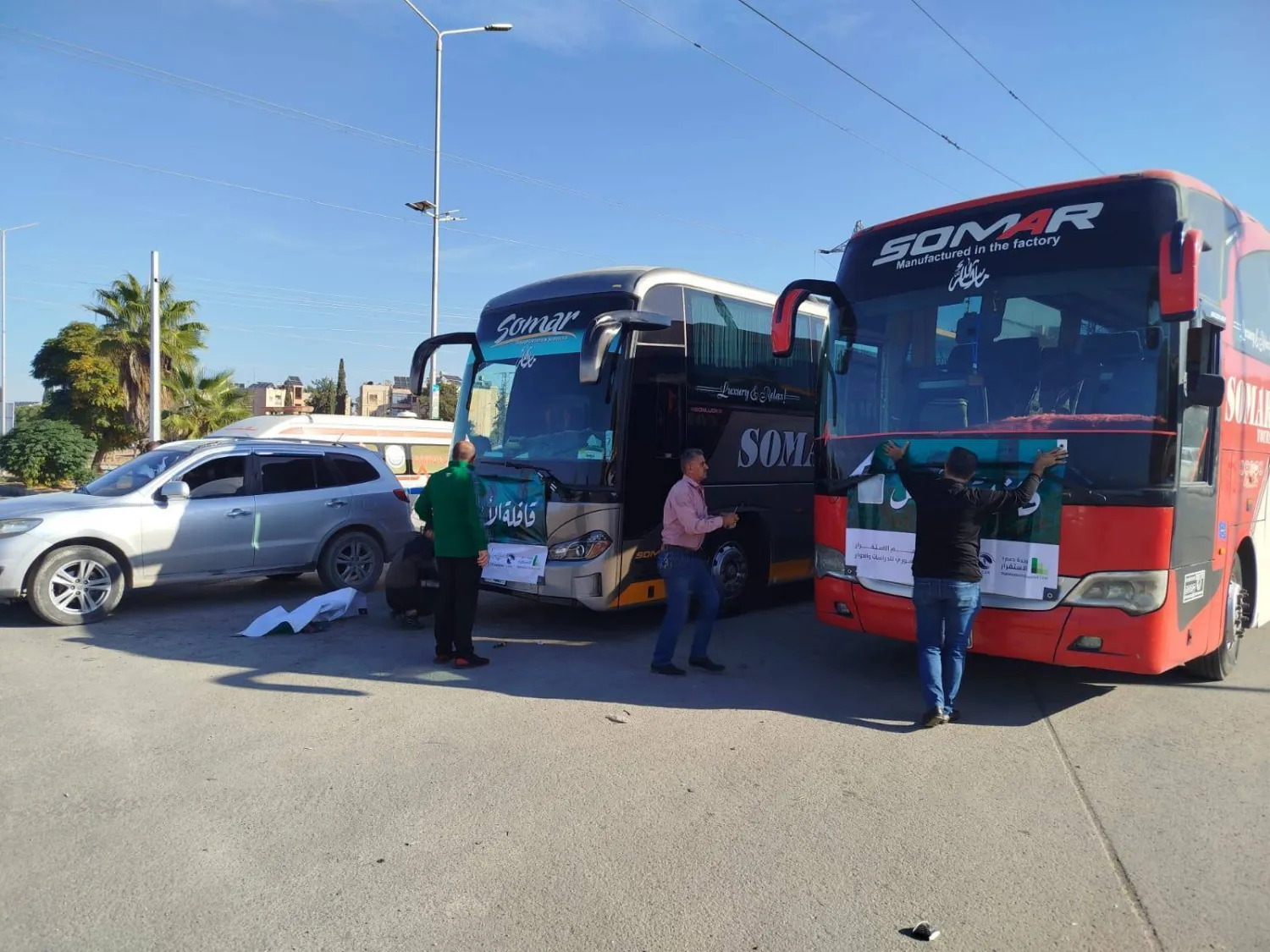
Syrian media broadcast on Saturday images of convoys of buses as they made their way from Aleppo to Hasakeh to transport the families. They were accompanied by medical teams and ambulances from the Syrian Health Ministry.

Media reports said arrangements are underway for more evacuations in the future.

The first batch of families was evacuated in June and included 42 families or 160 people. The second batch was evacuated the following month and included 36 families or around 127 people.

The al-Hol camp is one of the thorniest security and political issues facing Syria given the threat its detainees pose to the region. It is holding the families of ISIS members from around 42 countries, which are refusing their repatriation.

Washington has been pressuring Damascus to resolve this file as it is key to lifting sanctions off of it.

The camp spans over 3 square kms and is located near the Iraq border. The majority of its 37,000 detainees hail from Syria and Iraq, while 6,500 come from various countries around the world; among them are 6,300 women, widows and wives of ISIS fighters. They are held in a dedicated section of the camp with their children.

The Iraqi government has agreed with the Kurdish authorities to repatriate Iraqis from the camp in stages.


Source Reveals to Asharq Al-Awsat Names of Some Members of Gaza Technocrat Committee

Palestinians displaced by the Israeli military offensive shelter in an UNRWA school, in Khan Younis, in the southern Gaza Strip, August 19, 2025. (Reuters)
TT

Source Reveals to Asharq Al-Awsat Names of Some Members of Gaza Technocrat Committee

Palestinians displaced by the Israeli military offensive shelter in an UNRWA school, in Khan Younis, in the southern Gaza Strip, August 19, 2025. (Reuters)

An informed Palestinian sources revealed that an agreement has been reached on the majority of the members of the technocratic committee will run the Gaza Strip.

The source, who is a member of the Palestinian civil society, told Asharq Al-Awsat that the 18-member committee will be comprised of Gaza residents who are businessmen, academics or involved in civil society.

The approved members have been informed to head to Cairo, which they will do on Wednesday.

Asharq Al-Awsat learned that the members include Ali Shaath, who served as secretary at the Palestinian Authority's Transportation Ministry, Abdulkarim Ashour, a civil society activist, Aed Yaghi, Director of the Palestinian Medical Relief Society (PMRS) in Gaza, Ayed Abou Ramadan, Chair of the Gaza Chamber of Commerce, and Jaber al-Daour, President of Palestine University.

Other members include Bashir al-Rayyes, an engineering consultant, Omar Shemali, engineer Ali Barhoum, and lawyer Hana Tarazi.

It remains to be seen if Israel has approved the names of the committee, said the source.

Changes could be introduced if objections are made.

Egypt has been intensifying its efforts with all Palestinian parties, American mediators and Israel to speed up the formation of the committee that will run Gaza temporarily and be affiliated with Palestinian President Mahmoud Abbas' government.

Hamas is gearing up to transfer control to the committee once it is finalized.


Aoun, Hezbollah Ties Cool as Contacts Stay at Minimum

Supporters of Hezbollah hold portraits of its general secretaries on the first anniversary of the assassination of Hassan Nasrallah. (Reuters file)
TT

Aoun, Hezbollah Ties Cool as Contacts Stay at Minimum

Supporters of Hezbollah hold portraits of its general secretaries on the first anniversary of the assassination of Hassan Nasrallah. (Reuters file)

Relations between Lebanese President Joseph Aoun and Hezbollah have grown visibly strained, with contacts confined to what ministerial sources described as “the bare minimum.”

The chill has deepened following Aoun’s recent remarks on Hezbollah’s weapons, which widened the rift between the two sides and triggered pointed criticism from the group at the president.

In a televised interview last week marking the first anniversary of his election, Aoun said that “the role of weapons outside the state has ended with the presence of the army, and their continued existence has become a burden on their own environment and on Lebanon as a whole, with no remaining deterrent role.”

In response, former Hezbollah-aligned minister Mohammed Fneish said in a television interview that the party had “reservations on the president’s recent positions,” adding: “We disagree with him in form and substance in some passages. We are not another party. We are a resistance force that played a major role in liberating Lebanon.”

Cool communication

Ministerial sources familiar with Aoun’s position stressed that “the stances he expressed are not new, but the current circumstances may differ from previous ones.”

Speaking to Asharq Al-Awsat, the sources said the remarks stem from the president’s conviction that weapons outside the framework of the state no longer serve any purpose, that their role has ended, and that they have become a burden on everyone, including the Shiite community and Hezbollah’s own base.

“This is, ultimately, a description of an existing reality,” the sources said.

They added that reactions from Hezbollah’s supporters were expected, but would not prevent communication from continuing, since maintaining contact serves the interests of both sides, particularly Hezbollah.

Aoun and Salam

In recent years, Hezbollah had sought to maintain good relations with Aoun. Its lawmakers voted for him during the presidential election session after months of backing Suleiman Franjieh’s candidacy.

The group’s leadership even opened discreet talks with Aoun on what became known as the “national security strategy,” though these discussions yielded no results. Channels of communication remain open on the issue of weapons north of the Litani River, amid Hezbollah’s refusal to cooperate on this file.

Since the cabinet approved a decision last August restricting weapons to the state, Hezbollah’s leadership and supporters have focused their criticism on the government in which the group is represented.

Ties have worsened between Hezbollah and Prime Minister Nawaf Salam, whom the group did not back during parliamentary consultations that named him as premier last year.

A natural reaction

Political writer Dr. Kassem Kassir, who closely follows Hezbollah’s position, said the reaction of the party's supporters to Aoun’s remarks was “a natural response,” particularly because the president did not take into account what he described as the "role of the resistance in protecting Lebanon."

He added that calls to end the role of weapons were made without offering guarantees for what would follow or proposing alternative options.

Kassir told Asharq Al-Awsat that the stance of Hezbollah’s supporters did not necessarily reflect the position of the leadership. Communication channels remain open, but contacts have failed to produce a unified vision.

He added that Hezbollah has formal reservations about the performance of the government and the state, especially regarding Israeli negotiations and what it views as concessions made without guarantees or tangible results.

Duality in rhetoric

University professor and lawyer Ali Murad said that segments of Hezbollah’s supporters on social media adopt an extreme accusatory tone toward anyone who disagrees with them, leaving no room for nuance.

However, he argued that the problem goes beyond the supporters themselves and lies in the political rhetoric and mobilization Hezbollah has relied on for decades, "which entrenched a culture that recognizes only black and white and promotes accusations of betrayal, either fully with us or fully against us."

Murad told Asharq Al-Awsat that the "real issue lies in Hezbollah’s dual rhetoric."

He said the party "is fully aware that the reality has become extremely difficult following major losses and a military defeat on one hand, and the broader retreat of the Axis of Resistance on the other. As a result, a clear contradiction has emerged between what Hezbollah says and what it actually believes."

This contradiction, Murad said, is evident in the speeches of Hezbollah’s secretary general Sheikh Naim Qassem, which reflect two parallel narratives. "One acknowledges reality to a degree while maintaining rejection of handing over weapons. The other is a mobilizing discourse rooted in an earlier era, before the pager operation and the 'support front' war."

“What Aoun said falls in this direction,” Murad said, arguing that Hezbollah in its former state has ended and has become a burden on Lebanon, the Shiite community, and the residents of the south.

"Persisting with the same rhetoric today amounts to rejecting reality and practicing denial, a form of political arrogance reflected by both supporters and the group’s media circles."

No interest in breaking ties

Murad said what angered Hezbollah’s supporters most was “the truth they do not want to acknowledge,” namely that Hezbollah’s role has ended, that it has exited the deterrence equation, and that it can no longer achieve Lebanon’s objectives on its own.

“The president stated a truth that needed to be said,” he said.

Asked whether the relationship between Hezbollah and Aoun was nearing a breaking point, Murad said it was not in Hezbollah’s interest to sever political ties with the president, or even with the prime minister.

He noted that the group understands that the actions of both officials serve Lebanon’s interests and, in particular, the interests of the south.

In some respects, he added, this approach also spares Hezbollah and its base the risks of "fatal choices that could lead to a bleak outcome if denial or political self-destruction were to prevail."


Palestinian Factions Hold Indirect Talks in Cairo on Second Phase of Gaza Ceasefire

A general view shows destruction in the Bureij camp in the central Gaza Strip on January 9, 2026 following Israeli attacks. Gaza's civil defense agency said Israeli attacks in the Palestinian territory killed at least 13 people, including five children, despite a ceasefire that has largely halted the fighting. (AFP)
TT

Palestinian Factions Hold Indirect Talks in Cairo on Second Phase of Gaza Ceasefire

A general view shows destruction in the Bureij camp in the central Gaza Strip on January 9, 2026 following Israeli attacks. Gaza's civil defense agency said Israeli attacks in the Palestinian territory killed at least 13 people, including five children, despite a ceasefire that has largely halted the fighting. (AFP)

A Palestinian source from the Fatah movement told Asharq Al-Awsat on Tuesday that “indirect” meetings among Palestinian factions have begun in Cairo to discuss advancing the second phase of the Gaza ceasefire agreement, particularly the formation of the committee to run the enclave, ahead of a broader meeting scheduled for Wednesday.

The second phase of the ceasefire, which came into force on Oct. 10, includes key provisions such as the disarmament of Hamas, the formation of a Board of Peace to oversee the peace process in the territory, the establishment of a technocratic committee to run Gaza’s affairs, and the deployment of an international stabilization force.

The Palestinian source stated that eight Palestinian factions are currently in Cairo, including Fatah and Hamas, to explore ways to advance the stalled second phase.

Fatah may skip the factions’ meeting

The source said discussions include the formation of the technocratic committee, the Palestinian police force to be deployed in the enclave, and related structures, noting that differences remain and that Fatah refuses to meet directly with Hamas.

A second informed Fatah source told Asharq Al-Awsat that the movement may not take part in Wednesday’s planned factions’ meeting.

A Palestinian source stated on Monday that consultations in Cairo were expected to finalize the administration committee and present factions with proposed names, particularly following recent developments involving changes to some nominees in response to Israeli objections.

On Tuesday, another informed Palestinian source stated that an agreement had been reached on the names of most members of the technocratic committee.

In televised remarks late on Sunday, Hamas politburo member Mohammed Nazzal said a delegation from the movement would discuss follow-up on the implementation of the ceasefire agreement amid “major difficulties hindering its application and continued Israeli violations.”

Mediators’ contacts

The Gaza administration committee has moved to the forefront of ceasefire mediation efforts, amid anticipation of decisive US decisions on announcing the Board of Peace and the technocratic committee, as well as Wednesday’s factions’ meeting in Cairo.

Those intensive contacts by mediators “require real US pressure and Palestinian consensus to translate them into momentum for the second phase and to overcome Israeli obstacles,” an Egyptian expert told Asharq Al-Awsat.

Qatari Foreign Ministry spokesman Majed Al Ansari said at a press conference on Tuesday that Doha is working with mediators to accelerate progress toward the second phase of the ceasefire, accusing Israel of obstructing the deal.

“Israel must answer one question: why is the Gaza agreement delayed?” Al Ansari said, adding that “the complexities on the table today require moving forward to the second phase of the agreement, and our contacts are continuous and daily to push the deal ahead.”

Qatari Prime Minister Sheikh Mohammed bin Abdulrahman Al Thani and Egyptian Foreign Minister Badr Abdelatty stressed during a phone call the importance of announcing the formation of the temporary Palestinian technocratic committee, in parallel with establishing the international stabilization force, ensuring the flow of humanitarian aid, and creating conditions for early recovery and reconstruction, said a statement by Egypt’s Foreign Ministry on Tuesday.

Abdelatty and Turkish Foreign Minister Hakan Fidan also agreed during a phone call on Tuesday on “the need to intensify regional and international efforts to ensure the consolidation of the ceasefire and to move forward with the transition to the second phase of the US president’s plan.”

In a separate call with Palestinian Vice President Hussein al-Sheikh, Abdelatty reaffirmed Egypt’s support for deploying the international stabilization force and technocratic committee, which would help create the conditions necessary for restoring the Palestinian Authority’s role.

Abdelatty also spoke by phone with German Foreign Minister Johann Wadephul, who is close to Israel, to discuss Gaza.

Mukhtar Ghobashi, Secretary General of the Al-Farabi Center for Strategic Studies, said mediators’ contacts must be followed by genuine and serious US pressure to announce second-phase decisions, whether on forming the administration committee or the Board of Peace.

Ghobashi said Cairo is keen to push the second phase forward, as reflected in the intensive contacts, but that progress hinges on US pressure, Palestinian consensus, and imminent US decisions this week to end the tragedy in the enclave, for which Israel bears full responsibility.