


How a Naples Museum Protects its Treasures with Forensic Mapping

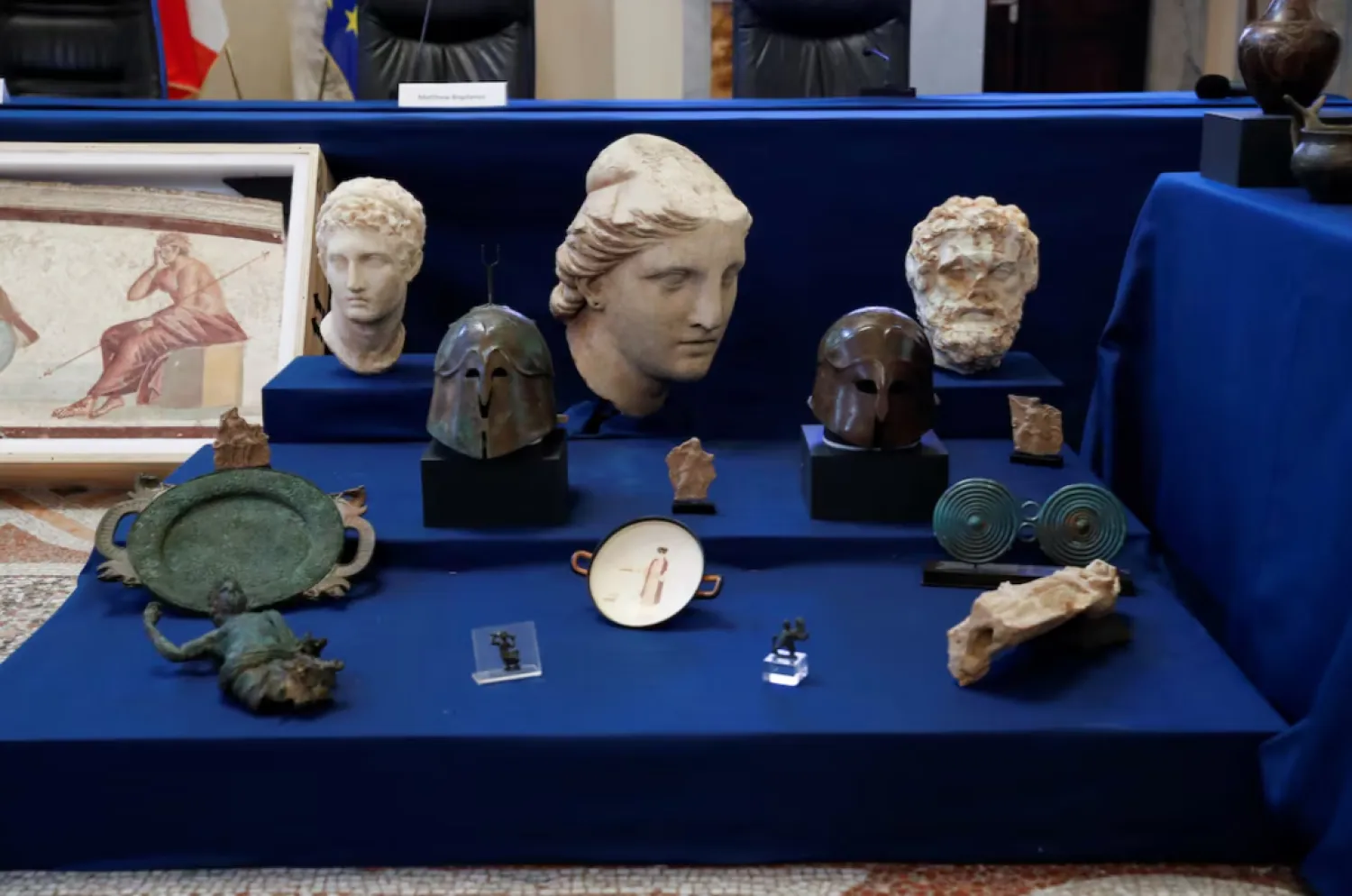
Some of the antiquities worth an estimated $19 million are seen after being returned to Italy by New York City, in Rome, Italy, January 23 2023. REUTERS/Remo Casilli
TT

How a Naples Museum Protects its Treasures with Forensic Mapping

Some of the antiquities worth an estimated $19 million are seen after being returned to Italy by New York City, in Rome, Italy, January 23 2023. REUTERS/Remo Casilli

With the art world on high alert for any sign of the missing Louvre jewels, one Italian collection says its method of creating a photographic fingerprint of its own priceless gems and artefacts could make them harder to break apart and sell on.

A team of gemology experts has spent more than a decade studying the most valuable pieces of the collection at Naples' Tesoro di San Gennaro. Using microscopes and specialised equipment, the team has photographed more than 10,000 stones, Reuters reported.

As well as the armed security and alarmed displays that provide physical protection for the site, the process has allowed them to certify the unique characteristics of the gems to provide a kind of forensic fingerprint that experts liken to DNA.

Major European museums have declined to comment on their security protocols in the wake of the Louvre theft, but the Naples method offers a rare insight into some of the measures used by institutions.

LOUVRE DIRECTOR HAD WARNED ABOUT SECURITY

"If the Louvre had adopted this security system, thieves would not be able to resell the stones from the stolen jewellery," Ciro Paolillo, a former professor of investigative gemology at La Sapienza University in Rome, who led the mapping work, told Reuters.

"The stones would be identified, even if cut, at the first official quality certification by an international body."

Reuters was unable to verify whether the French museum had undertaken a comparable analysis of the stolen stones. The museum did not respond to requests for comment.

Louvre director Laurence des Cars has said she had repeatedly warned that the centuries-old building's security was in a dire state. She said exterior security cameras did not offer full coverage of the facade, adding that the window through which the thieves broke in was not monitored by CCTV.

The Paris prosecutor said on Sunday suspects had been arrested over the robbery, but declined to give further details, saying newspaper reports about the arrests would hinder the search for the stolen jewellery and the perpetrators.

MUSEUM WAS MAFIA TARGET IN 1975

The San Gennaro treasures, a trove of sacred art and jewels, have been assembled over seven centuries from donations from popes, royals and the wealthy. It includes a cross adorned with emeralds and diamonds given by Joseph Bonaparte, the eldest brother of Napoleon, who was king of Naples in the 1800s.

Nestled beside Naples' cathedral, the museum houses over 21,000 pieces, among them a mitre encrusted with nearly 4,000 precious stones and a necklace with over 1,500 gems.

It is named after the fourth-century martyr who is the patron saint of the southern Italian port.

Although no official appraisal of the collection has ever been conducted, Francesca Ummarino, the museum's director, told Reuters that the mitre and the necklace together have an estimated value of around 100 million euros ($116 million).

It also includes 53 silver busts, most dating back to the 17th and 18th centuries, each weighing around 200 kg, she said.

The Italian team led by Paolillo analysed samples of silver and gold to trace their origins to specific workshops in Naples' historic Goldsmiths' Quarter.

However such metallurgical mapping, no longer possible as alloys are now standardized by law, would not help in case of a heist.

"The criminals would melt down the masterpieces, making it impossible to understand the alloy," Paolillo said.

Unlike most religious artefacts in Italy, the collection does not belong to the Vatican or the state. It is owned by the people of Naples and managed by the "Deputazione", a lay institution founded in 1527.

The Treasure of San Gennaro was kept in the vault of the Bank of Naples for nearly 30 years following an aborted robbery attempt orchestrated by the local mafia, the Camorra, in 1975.

It was reopened to the public in 2003, and since then, no robbery has been reported, despite the city's crime index remaining high.

"We have anti-theft security windows, all equipped with alarms. We have a military patrol on duty 24 hours a day at the museum entrance, and if, unfortunately, any objects were to be stolen, the mapping of the stones would allow us to recognise them," said Riccardo Carafa d'Andria, vice president of the Deputation.

"Out of deep devotion to their patron saint, Neapolitans do not touch the Treasure of San Gennaro — and they would never allow anyone else to touch it either."



US Astronaut to Take her 3-year-old's Cuddly Rabbit Into Space

FILE PHOTO: An evening launch of a SpaceX Falcon 9 rocket carrying 20 Starlink V2 Mini satellites, from Space Launch Complex at Vandenberg Space Force Base is seen over the Pacific Ocean from Encinitas, California, US, June 23, 2024. REUTERS/Mike Blake/File Photo
TT

US Astronaut to Take her 3-year-old's Cuddly Rabbit Into Space

FILE PHOTO: An evening launch of a SpaceX Falcon 9 rocket carrying 20 Starlink V2 Mini satellites, from Space Launch Complex at Vandenberg Space Force Base is seen over the Pacific Ocean from Encinitas, California, US, June 23, 2024. REUTERS/Mike Blake/File Photo

When the next mission to the International Space Station blasts off from Florida next week, a special keepsake will be hitching a ride: a small stuffed rabbit.

American astronaut and mother, Jessica Meir, one of the four-member crew, revealed Sunday that she'll take with her the cuddly toy that belongs to her three-year-old daughter.

It's customary for astronauts to go to the ISS, which orbits 250 miles (400 kilometers) above Earth, to take small personal items to keep close during their months-long stint in space.

"I do have a small stuffed rabbit that belongs to my three-year-old daughter, and she actually has two of these because one was given as a gift," Meir, 48, told an online news conference.

"So one will stay down here with her, and one will be there with us, having adventures all the time, so that we'll keep sending those photos back and forth to my family," AFP quoted her as saying.

US space agency NASA says SpaceX Crew-12 will lift off on a SpaceX Falcon 9 rocket from Cape Canaveral in Florida to the orbiting scientific laboratory early Wednesday.

The mission will be replacing Crew-11, which returned to Earth in January, a month earlier than planned, during the first medical evacuation in the space station's history.

Meir, a marine biologist and physiologist, served as flight engineer on a 2019-2020 expedition to the space station and participated in the first all-female spacewalks.

Since then, she's given birth to her daughter. She reflected Sunday on the challenges of being a parent and what is due to be an eight-month separation from her child.

"It does make it a lot difficult in preparing to leave and thinking about being away from her for that long, especially when she's so young, it's really a large chunk of her life," Meir said.

"But I hope that one day, she will really realize that this absence was a meaningful one, because it was an adventure that she got to share into and that she'll have memories about, and hopefully it will inspire her and other people around the world," Meir added.

When the astronauts finally get on board the ISS, they will be one of the last crews to live on board the football field-sized space station.

Continuously inhabited for the last quarter century, the aging ISS is scheduled to be pushed into Earth's orbit before crashing into an isolated spot in the Pacific Ocean in 2030.

The other Crew-12 astronauts are Jack Hathaway of NASA, European Space Agency astronaut Sophie Adenot, and Russian cosmonaut Andrey Fedyaev.


iRead Marathon Records over 6.5 Million Pages Read

Participants agreed that the number of pages read was not merely a numerical milestone - SPA
TT

iRead Marathon Records over 6.5 Million Pages Read

Participants agreed that the number of pages read was not merely a numerical milestone - SPA

The fifth edition of the iRead Marathon achieved a remarkable milestone, surpassing 6.5 million pages read over three consecutive days, in a cultural setting that reaffirmed reading as a collective practice with impact beyond the moment.

Hosted at the Library of the King Abdulaziz Center for World Culture (Ithra) and held in parallel with 52 libraries across 13 Arab countries, including digital libraries participating for the first time, the marathon reflected the transformation of libraries into open, inclusive spaces that transcend physical boundaries and accommodate diverse readers and formats.

Participants agreed that the number of pages read was not merely a numerical milestone, but a reflection of growing engagement and a deepening belief in reading as a daily, shared activity accessible to all, free from elitism or narrow specialization.

Pages were read in multiple languages and formats, united by a common conviction that reading remains a powerful way to build genuine connections and foster knowledge-based bonds across geographically distant yet intellectually aligned communities, SPA reported.

The marathon also underscored its humanitarian and environmental dimension, as every 100 pages read is linked to the planting of one tree, translating this edition’s outcome into a pledge of more than 65,000 trees. This simple equation connects knowledge with sustainability, turning reading into a tangible, real-world contribution.

The involvement of digital libraries marked a notable development, expanding access, strengthening engagement, and reinforcing the library’s ability to adapt to technological change without compromising its cultural role. Integrating print and digital reading added a contemporary dimension to the marathon while preserving its core spirit of gathering around the book.

With the conclusion of the iRead Marathon, the experience proved to be more than a temporary event, becoming a cultural moment that raised fundamental questions about reading’s role in shaping awareness and the capacity of cultural initiatives to create lasting impact. Three days confirmed that reading, when practiced collectively, can serve as a meeting point and the start of a longer cultural journey.


Imam Turki bin Abdullah Royal Reserve Launches Fifth Beekeeping Season

Jazan’s Annual Honey Festival - File Photo/SPA
TT

Imam Turki bin Abdullah Royal Reserve Launches Fifth Beekeeping Season

Jazan’s Annual Honey Festival - File Photo/SPA

The Imam Turki bin Abdullah Royal Nature Reserve Development Authority launched the fifth annual beekeeping season for 2026 as part of its programs to empower the local community and regulate beekeeping activities within the reserve.

The launch aligns with the authority's objectives of biodiversity conservation, the promotion of sustainable environmental practices, and the generation of economic returns for beekeepers, SPA reported.

The authority explained that this year’s beekeeping season comprises three main periods associated with spring flowers, acacia, and Sidr, with the start date of each period serving as the official deadline for submitting participation applications.

The authority encouraged all interested beekeepers to review the season details and attend the scheduled virtual meetings to ensure organized participation in accordance with the approved regulations and the specified dates for each season.
