


FII: The Key to Unlocking a More Inclusive Global Economy

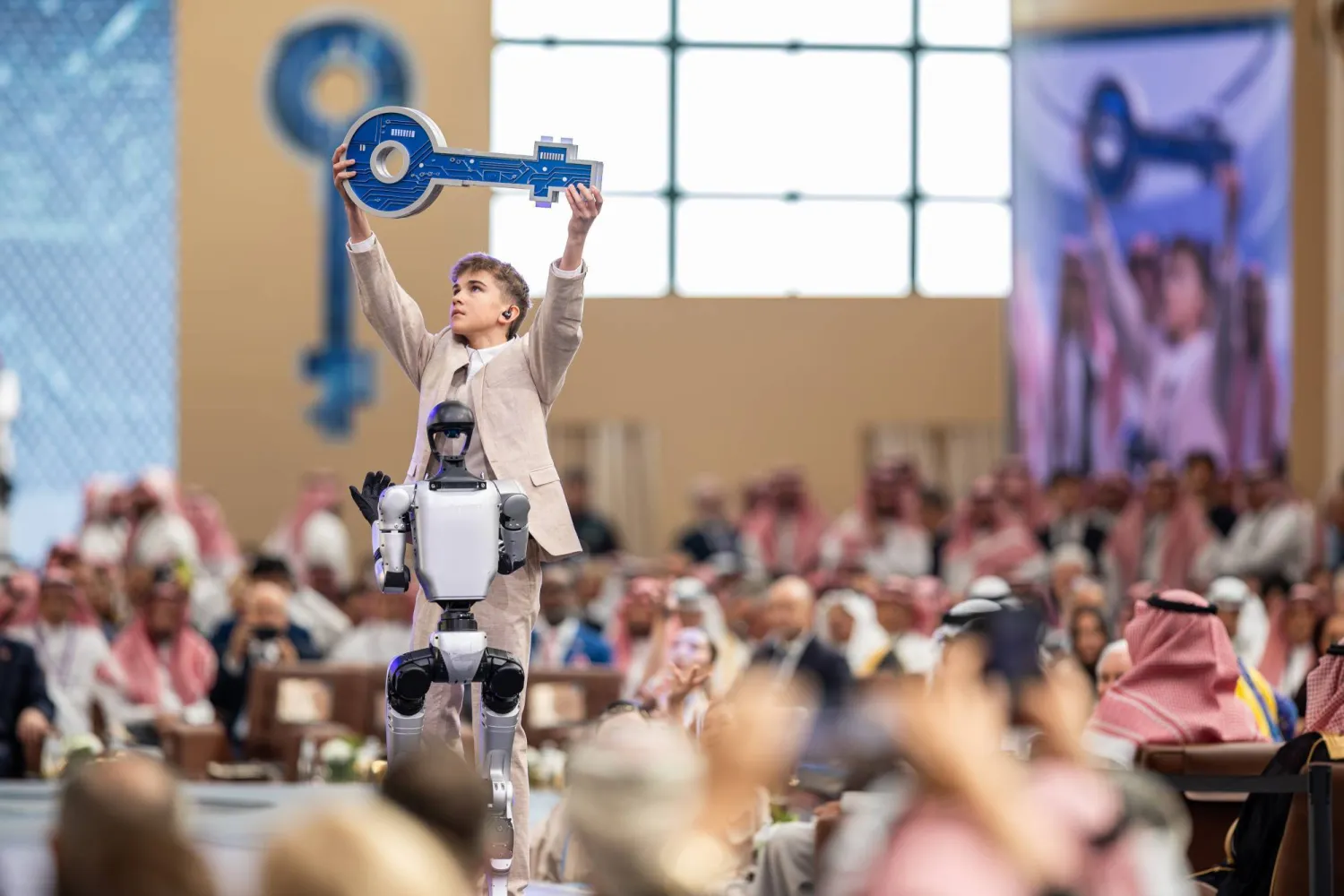
A robot hands “the Key to Prosperity,” the forum’s symbol, to a performer during the opening ceremony. (Asharq Al-Awsat)
TT

FII: The Key to Unlocking a More Inclusive Global Economy

A robot hands “the Key to Prosperity,” the forum’s symbol, to a performer during the opening ceremony. (Asharq Al-Awsat)

A humanoid robot carrying “The Key to Prosperity,” matching this year’s Future Investment Initiative (FII) theme, stole the spotlight as the ninth edition of the global investment forum opened in Riyadh, symbolizing the unlocking of global economic potential through innovation and bold ideas.

Held under the patronage of Custodian of the Two Holy Mosques, King Salman bin Abdulaziz, the three-day event began on Tuesday at the King Abdulaziz International Conference Center, drawing heads of state, ministers, sovereign wealth fund chiefs, senior executives, and global industry leaders.

The opening ceremony featured a symbolic moment as the robot handed the “Key to Prosperity” to the event’s artist, marking the start of panel discussions that brought together some of the world’s most influential decision-makers.

This year’s agenda aims to drive global collaboration and shape the future of the world economy with a focus on health, artificial intelligence, and human development.

Panels covered a broad range of pressing issues, including the impact of AI and robotics on productivity, wealth creation amid rising inequality, the geoeconomic consequences of resource scarcity, demographic shifts reshaping future workforces, and strategies to balance economic growth with environmental sustainability.

Yasir Al-Rumayyan urges elevating global impact

In his opening remarks, Yasir Al-Rumayyan, Governor of the Public Investment Fund (PIF), Chairman of Saudi Aramco, and Chairman of the FII Institute, described the forum as the world’s most influential gathering for those who can turn ideas and investments into tangible global impact.

“It's incredible to see all of these visionary leaders who have truly changed the world in the same room. For those with the vision to turn ideas and investments into global impact, this is the greatest gathering in the world,” said Al-Rumayyan.

“$250 billion worth of deals have been made on this platform since it was born less than a decade ago,” he revealed.

“We have come a long way together, but at this year's FII, we must take our impact to the next level,” urged Al-Rumayyan.

He stressed that the financial power represented by today’s leaders comes with great responsibility and an even greater opportunity to shape the world’s economic future.

“We must act on this responsibility and seize this opportunity without any delay,” he added.

“The old models that brought us to this point are no longer fit for purpose,” he noted, saying that “We need a new model. We need a global collaboration for a new era of global prosperity.”

Highlighting global economic growth, Al-Rumayyan noted that the world’s GDP has surpassed $111 trillion and is expected to expand by 2.8% this year. Yet, he warned of growing social disparities: “66% of people feel positive about their lives. Yet only 37% are optimistic about the world and 69% are concerned their country will lose jobs to foreign competition. This gap between personal hope and global doubt is a warning.”

Technology, he said, could bridge that divide — if it remains accessible.

“Three and four people worry that AI will widen the education gap between societies who have access and those that don't. We can't allow that to happen. We must address inequalities that have held us back for too long,” said Al-Rumayyan.

Vision 2030 and expanding opportunities

Al-Rumayyan said governments and the private sector must work together to harness global capital for security, stability, and opportunity.

“Under the leadership Prince Mohammed bin Salma, Crown Prince and Prime Minister, Saudi Arabia's economic transformation has set a new global benchmark for a national vision,” he said.

“Nine years since the launch of vision 2030, you can see the results everywhere. New cities, new industries, new ecosystems and supply chains. And last year, foreign investment grew 24% reaching 31.7 billion dollars.”

“We have taken Saudi Arabia to the world and now the world is coming to Saudi Arabia, to FII every year, to Expo in 2030, and to the FIFA World Cup in 2034.”

He emphasized that Saudi wealth is measured not in numbers, but in human prosperity.

“In Riyadh, this week we have the opportunity to forge deals across borders that deliver impact and capture the true power of partnerships,” he remarked.

Richard Attias, CEO of the FII Institute and Chairman of its Executive Committee, welcomed global leaders and delegates, expressing pride in how FII has evolved into a passionate community determined to change the world.

Foreign investment and economic transformation

Saudi Investment Minister Khalid Al-Falih said in a panel session that 90% of foreign direct investment (FDI) flowing into the Kingdom now targets non-oil sectors, while only 10% goes to oil-related industries.

According to Al-Falih, the Saudi economy is in a phase of dynamic expansion, driven by emerging sectors such as advanced manufacturing, technology, tourism, entrepreneurship, and deep tech — where investments have grown tenfold.

Al-Falih added that Saudi Arabia’s GDP has doubled over the past decade, mostly fueled by non-oil growth.

As per the minister, the Kingdom is entering a new phase of economic diversification, with $1 billion deployed into startups and 60% of Middle East venture funding now originating in Saudi Arabia.

He added that 40% of the Kingdom’s budget and expenditures are now financed by non-oil revenues, underscoring the strong macroeconomic and fiscal balance achieved.



International Mining Conference Opens in Riyadh on Tuesday 

People attend the fourth edition of the International Mining Conference in Riyadh. (SPA)
TT

International Mining Conference Opens in Riyadh on Tuesday 

People attend the fourth edition of the International Mining Conference in Riyadh. (SPA)

Under the patronage of Custodian of the Two Holy Mosques King Salman bin Abdulaziz Al Saud, the fifth edition of the International Mining Conference will open in Riyadh on Tuesday under the theme “Minerals: Meeting the Challenges of a New Era of Development.”

Around 200 exhibiting and sponsoring entities are expected to participate, paving the way for the signing of approximately 150 memoranda of understanding and strategic agreements.

Organized by the Ministry of Industry and Mineral Resources, the three-day conference aims to bring together governments, mining companies, financial institutions, and governmental and non-governmental organizations to strengthen global dialogue on the future of the minerals sector.

Strategic pillars

This year’s conference is built around three strategic pillars designed to transform challenges into regional and international opportunities. The first focuses on developing innovative financing models for infrastructure, enabling the activation of seven major mineral corridors in Africa and South America, with the potential for expansion to other regions.

The second pillar centers on capacity-building in mineral-producing countries through the establishment of a global network of centers of excellence specializing in geology, innovation, sustainability, workforce development, and regulatory frameworks.

The third pillar aims to boost transparency across manufacturing value chains through the launch of a pilot system for tracking mineral supply chains, which could later be scaled globally.

International ministerial meeting

As in previous editions, the conference will open with an international ministerial meeting for ministers responsible for mining, reinforcing its position as the largest multilateral governmental platform in the sector.

Participation this year is expected from 100 countries, up from 90 in the previous edition, including 16 G20 members and around 50 international organizations, among them the United Nations, the World Bank, the International Council on Mining and Metals, the UN Industrial Development Organization, and the International Organization for Standardization.

Last year’s meeting produced several landmark initiatives, including agreement on an international framework for critical minerals to strengthen global supply chains and the launch of a network of centers of excellence spanning Africa, West Asia, and Central Asia.

Saudi Minister of Industry and Mineral Resources Bandar Alkhorayef said the fifth edition of the conference would further consolidate the Kingdom’s role as a global leader in shaping the future of mining and minerals, attracting investment, and ensuring responsible and secure mineral supplies.

He described the event as a call for collective action and a platform for building new partnerships.

The previous edition witnessed the signing of 126 agreements and memoranda of understanding worth SR107 billion ($28.5 billion), alongside four strategic projects. These included a joint venture between Saudi Aramco and Maaden to explore critical minerals for the energy transition, a potential expansion of the Mansourah–Massarah mine, new discoveries at Wadi al-Jaw and the Shiban deposits, the acquisition of Al Rajhi Steel Industries by Hadeed, and plans to build the first fully integrated steel plant outside China in partnership with Baosteel, Aramco, and the Saudi Public Investment Fund.

Outlook for the minerals sector

Coinciding with the conference, organizers released the Future Minerals Indicators Report, offering a comprehensive assessment of the global minerals sector amid surging demand driven by the energy transition, advanced manufacturing, and mounting supply-chain pressures.

The report stressed that minerals have become a strategic pillar of energy security and long-term industrial development, calling for a shift from diagnosis to implementation through clear policies, targeted investment, and broader international cooperation.


Saudi Arabia’s Maaden Adds 7.8 Million Ounces of Gold to Its Resources

The Mahd Ad Dhahab mine operated by Maaden (SPA). 
TT

Saudi Arabia’s Maaden Adds 7.8 Million Ounces of Gold to Its Resources

The Mahd Ad Dhahab mine operated by Maaden (SPA). 

The Saudi Arabian Mining Company (Maaden) has recorded a major milestone in its drive toward global leadership, announcing the addition of 7.8 million ounces of gold to its mineral resources.

The announcement came on the eve of the International Mining Conference, which opens Tuesday in Riyadh. Saudi Minister of Industry and Mineral Resources Bandar Alkhorayef said the Kingdom’s mining sector is now the fastest growing in the world.

The increase is the result of intensive exploration and resource development programs carried out at four strategic sites across Saudi Arabia. These include the Mansourah–Massarah mine - the Kingdom’s newest and largest - along with Umm al-Salam, Uruq 20/21, a new discovery at Wadi al-Jaw, additional sites within the Central Arabian Gold Region, and the historic Mahd Ad Dhahab mine.

The achievement reinforces Maaden’s strategy of positioning mining as the third pillar of Saudi industry and a key driver of economic diversification under Vision 2030.

In January last year, Maaden announced the discovery of several gold- and copper-bearing sites at Wadi al-Jaw and Jabal Shayban, as well as evidence of strong gold mineralization beneath its main open-pit operations at Mansourah–Massarah, though data at the time was insufficient to estimate scale and grade.

Strategy Bearing Fruit

Commenting on the latest results, Maaden Chief Executive Officer Bob Wilt said in a statement published on the Saudi Exchange (Tadawul) that the discoveries provide clear proof the company’s long-term strategy is delivering tangible results. He added that continued investment in Saudi Arabia’s gold potential would strengthen future cash flows and bolster Maaden’s global financial standing.

Wilt noted that the company is still at an early stage in unlocking the vast potential of the Arabian Shield, stressing that the depth and breadth of Maaden’s resource portfolio - from operating mines to early-stage discoveries - highlight the scale of opportunity. Strong drilling results, he said, demonstrate sustainable growth and the ability to convert geological prospects into high-value mineral assets.

Beyond gold, Wilt pointed to promising early indicators for base metals at sites such as Jabal Shayban and Jabal al-Wakil, including copper, nickel, and platinum, minerals central to advanced global industries.

Mansourah–Massarah Expansion

Updated resource estimates at Mansourah–Massarah underscore the scale of expansion underway. Resources now stand at 116 million tons with an average grade of 2.8 grams of gold per ton, equivalent to 10.4 million ounces. Expansion and conversion drilling identified an additional 4.2 million ounces, translating into a net annual increase of 3 million ounces after technical adjustments.

Integrated Discoveries

At Umm al-Salam and Uruq 20/21, total resources reached 50.6 million tons at an average grade of 2.1 grams per ton, adding 3.41 million ounces. These discoveries directly support plans to expand the Mansourah–Massarah processing hub, improving efficiency and lowering costs.

At Wadi al-Jaw, Maaden announced an initial estimate of 3.08 million ounces of gold from 76.8 million tons, identified in just over a year following extensive drilling across 55 kilometers. Exploration continues in surrounding areas, including Jabal Wa’lah.

In the Central Arabian Gold Region, Maaden also confirmed a new discovery at Al-Rajum North mine, while drilling at Mahd Ad Dhahab has successfully expanded mineralization beyond existing models, extending the mine’s operational life.


Dar Global and Trump Organization Launch $1 Billion Project in Jeddah

The project, called Trump Plaza Jeddah, will include executive and premium residences, home offices, retail outlets and curated dining offerings. (Asharq Al-Awsat) 
TT

Dar Global and Trump Organization Launch $1 Billion Project in Jeddah

The project, called Trump Plaza Jeddah, will include executive and premium residences, home offices, retail outlets and curated dining offerings. (Asharq Al-Awsat) 

Dar Global and the Trump Organization announced on Monday the official launch of Trump Plaza Jeddah, valued at over $1 billion.

Dar Global, a London-listed luxury real estate developer, said the project marks its third collaboration with the Trump Organization in the Kingdom.

This landmark project, strategically located within the expansive Amaya development along King Abdulaziz Road, is poised to redefine luxury urban living in Jeddah's thriving real estate landscape, following the launch of Trump Tower Jeddah in December 2024.

Dar Global described the project as one of the most integrated urban destinations in Jeddah, saying it includes home offices, retail spaces, dining venues and a private club.

Residential offerings include fully furnished 1, 2, and 3-bedroom Trump Executive Residences; premium 2, 3, and 4-bedroom Trump Park Residences; and exclusive 4-bedroom Trump Townhouses.

Together with thoughtfully designed home offices, premium retail, and curated dining, the project redefines modern living by blending convenience and luxury into a single, connected destination.

Optional rental management services further enhance the appeal for international owners seeking a turnkey ownership experience.

“Expanding our presence in Saudi Arabia with Trump Plaza Jeddah underscores our commitment to world-class quality and iconic design,” said Eric Trump, executive vice president of the Trump Organization. “This project reflects the strength of our relationship with Dar Global and our confidence in Jeddah as a dynamic, globally relevant city.”

Trump affirmed that Trump Plaza Jeddah will set a new benchmark for integrated urban destinations.

For his part, Ziad El Chaar, CEO of Dar Global, said the launch of Trump Plaza Jeddah represents a major milestone in the company’s Saudi portfolio.

“This is not a single-use development, but a carefully curated urban ecosystem designed for global residents who want to live, work, and connect within the best address in Jeddah,” he said.

“Anchored by a private park and supported by world-class amenities, Trump Plaza Jeddah introduces a new model for modern city living in the Kingdom,” El Chaar noted.

The project also features an exclusive 4,000-square-meter Vitality Club, with golf simulators, a spa, sports medicine and recovery facilities, swimming pools, dining, and high-performance wellness spaces.

Destination retail and dining, including Trump Grill, Trump Daily, an artisan bakery, and a fitness pro shop, reinforce its positioning as a district day and night.