


Hurricane Melissa Leaves Dozens Dead in Trail of Destruction Across Cuba, Haiti and Jamaica

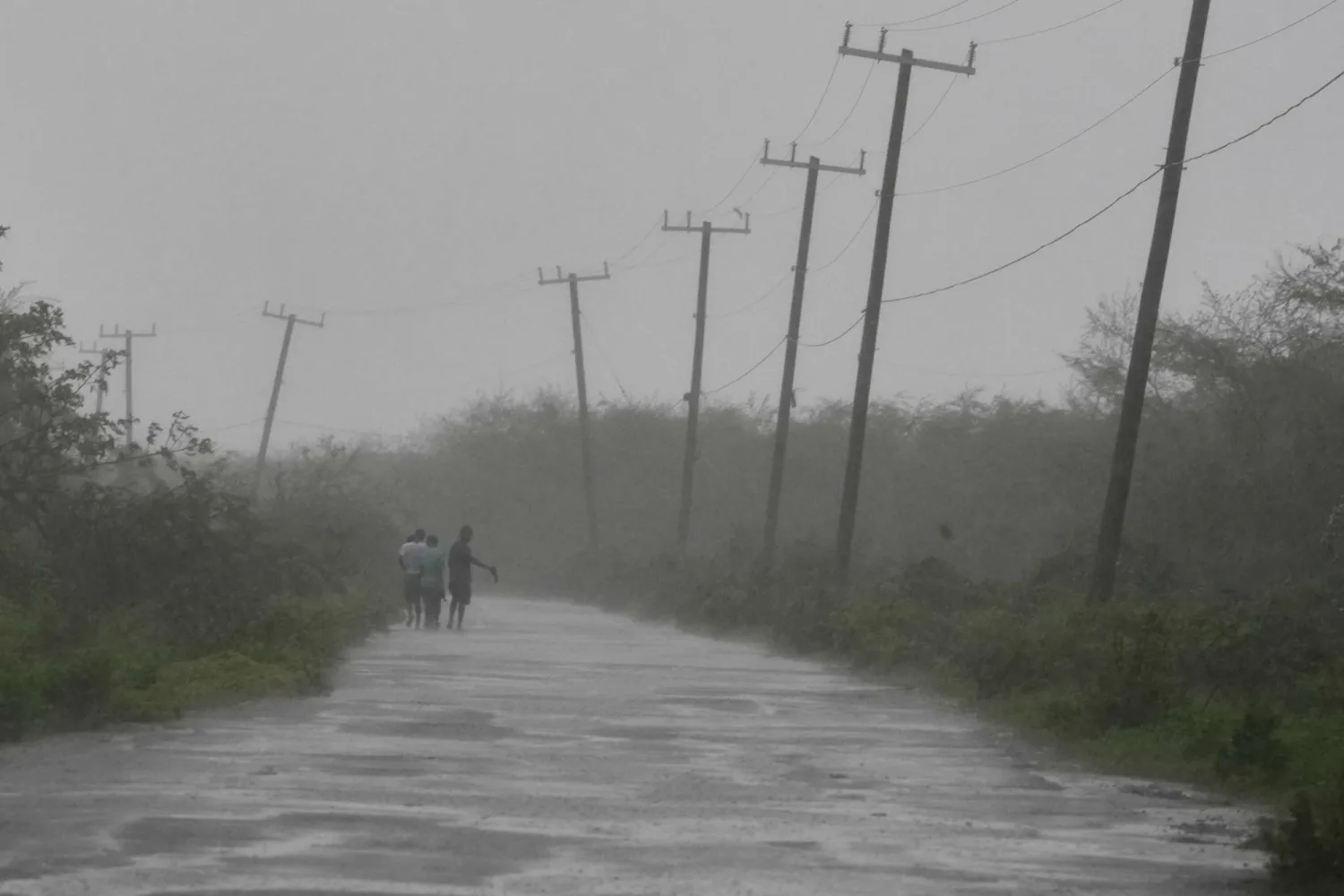
People walk along a road during the passing of Hurricane Melissa in Rocky Point, Jamaica, Tuesday, Oct. 28, 2025. (AP)
TT

Hurricane Melissa Leaves Dozens Dead in Trail of Destruction Across Cuba, Haiti and Jamaica

People walk along a road during the passing of Hurricane Melissa in Rocky Point, Jamaica, Tuesday, Oct. 28, 2025. (AP)

Hurricane Melissa left dozens dead and widespread destruction across Cuba, Haiti and Jamaica, where roofless homes, toppled utility poles and water-logged furniture dominated the landscape Wednesday. 

A landslide blocked the main roads of Santa Cruz in Jamaica's St. Elizabeth parish, where the streets were reduced to mud pits. Residents swept water from homes as they tried to salvage belongings. Winds ripped off part of the roof at a high school, a designated public shelter. 

“I have never seen anything like this before in all my years living here,” resident Jennifer Small said. 

Melissa made landfall Tuesday in Jamaica as a catastrophic Category 5 storm with top winds of 185 mph (295 kph), one of the strongest Atlantic hurricanes on record, before weakening and moving on to Cuba, but even countries outside the direct path of the massive storm felt its devastating effects. 

At least 40 people have died across Haiti, Steven Aristil with Haiti’s Civil Protection Agency told The Associated Press. He said 20 of those deaths were reported in the southern coastal town of Petit-Goâve, where another 10 remain missing. Earlier Wednesday, the mayor of Petit-Goâve told the AP that at least 25 people were killed in that community, where flooding collapsed dozens of homes. The number of dead and missing in Haiti often fluctuate in the early days after major natural disasters. 

In Cuba, officials reported collapsed houses, blocked mountain roads and roofs blown off Wednesday, with the heaviest destruction concentrated in the southwest and northwest. Authorities said about 735,000 people remained in shelters. 

“That was hell. All night long, it was terrible,” said Reinaldo Charon in Santiago de Cuba. The 52-year-old was one of the few people venturing out Wednesday, covered by a plastic sheet in the intermittent rain. 

Jamaica rushes to assess the damage 

In Jamaica, more than 25,000 people were packed into shelters Wednesday and more streamed in throughout the day after the storm ripped roofs off their homes and left them temporarily homeless. 

Dana Morris Dixon, Jamaica’s education minister, said that 77% of the island was without power Wednesday. 

Jamaican officials reported complications in assessing the damage because of outages, noting “a total communication blackout” in areas, Richard Thompson, acting director general of Jamaica’s Office of Disaster Preparedness and Emergency Management, told the Nationwide News Network. 

Prime Minister Andrew Holness said in a statement Wednesday that teams are working to rescue people and bring relief where it’s needed the most. 

“Recovery will take time, but the government is fully mobilized,” he said. “Relief supplies are being prepared, and we are doing everything possible to restore normalcy quickly.” 

Officials in Black River, Jamaica, a coastal town of approximately 5,000 people in the southwestern part of the island, pleaded for aid at a news conference Wednesday. 

“Catastrophic is a mild term based on what we are observing,” Mayor Richard Solomon said. 

Solomon said the local rescue infrastructure had been demolished by the storm. The hospital, police units and emergency services were inundated by floods and unable to conduct emergency operations. The storm also destroyed the facility where relief supplies were being stored. 

In southwest Jamaica, David Muschette, 84, sat among the rubble of his roofless house. He said he lost everything as he pointed to his wet clothes and furniture strewn across the grass while part of his roof partially blocked the road. 

“I need help,” he begged. 

The government said it hopes to reopen Jamaica’s airports as early as Thursday to ensure quick distribution of emergency relief supplies. 

The United States is sending rescue and response teams to assist in recovery efforts in the Caribbean, Secretary of State Marco Rubio announced on X. He said government officials were coordinating with leadership in Jamaica, Haiti, the Dominican Republic and the Bahamas. 

St. Elizabeth Police Superintendent Coleridge Minto told Nationwide News Network radio station Wednesday that authorities have found at least four bodies in southwest Jamaica. Minto said police were investigating other unconfirmed deaths. One death was reported in the west when a tree fell on a baby, state minister Abka Fitz-Henley told Nationwide News Network. 

Before landfall, Melissa had already been blamed for three deaths in Jamaica, three in Haiti and one in the Dominican Republic. 

Cuba rides out the storm  

People in the eastern Cuban province of Santiago de Cuba began clearing debris around the collapsed walls of their homes on Wednesday after Hurricane Melissa made landfall in the region hours earlier. 

“Life is what matters,” said Alexis Ramos, a 54-year-old fisherman as he surveyed his destroyed home and shielded himself from the intermittent rain with a yellow raincoat. “Repairing this costs money, a lot of money.” 

Meanwhile, local media showed images of the Juan Bruno Zayas Clinical Hospital with severe damage: glass scattered across the floor, waiting rooms in ruins and masonry walls crumpled on the ground. 

In Cuba, parts of Granma province, especially the municipal capital, Jiguaní, were underwater, said Gov. Yanetsy Terry Gutiérrez. More than 15 inches (40 centimeters) of rain was reported in Jiguaní’s settlement of Charco Redondo. 

The hurricane could worsen Cuba’s severe economic crisis, which already has led to prolonged power blackouts, along with fuel and food shortages. 

“There will be a lot of work to do. We know there will be a lot of damage,” Cuban President Miguel Díaz-Canel said in a televised address, and urged the population not to underestimate the power of Melissa,. 

Wednesday afternoon, Melissa had top sustained winds of 100 mph (155 kph) and was moving northeast at 15 mph (24 kph) according to the US National Hurricane Center in Miami.  

Michael Brennan, director of the National Hurricane Center, said the storm began affecting the southeastern Bahamas on Wednesday. 

“The storm is growing in size,” he said, noting that tropical storm force winds now extend almost 200 miles (320 kilometers) from the center. 

Melissa’s center is forecast to move through southeastern Bahamas later Wednesday, generating up to 7 feet (2 meters) of storm surge in the area. By late Thursday, Melissa is expected to pass just west of Bermuda. 


Ukraine Says Russia Fired Hundreds of Drones, Missiles in ‘Massive’ Daytime Attack

 People relax at the Gryshko National Botanical Garden in Kyiv on April 1, 2026, amid the Russian invasion of Ukraine. (AFP)
People relax at the Gryshko National Botanical Garden in Kyiv on April 1, 2026, amid the Russian invasion of Ukraine. (AFP)
TT

Ukraine Says Russia Fired Hundreds of Drones, Missiles in ‘Massive’ Daytime Attack

 People relax at the Gryshko National Botanical Garden in Kyiv on April 1, 2026, amid the Russian invasion of Ukraine. (AFP)
People relax at the Gryshko National Botanical Garden in Kyiv on April 1, 2026, amid the Russian invasion of Ukraine. (AFP)

Kyiv and its surrounding region on Friday faced pummeling by Russian missiles and drones, officials said, the latest in an increasing number of daytime attacks on Ukraine.

"The Kyiv region is once again under a massive enemy missile and drone attack," said regional governor Mykola Kalashnyk.

One person died in the attacks, he added.

The barrage prompted emergency power outages in several regions, energy operator Ukrenergo announced.

Russia launched almost 500 drones and missiles over Ukraine, Foreign Minister Andriy Sybiga said.

"Terrorist Russia strikes in broad daylight deliberately -- to maximize civilian casualties and damage," Sybiga said.

"This is how Moscow responds to Ukraine's Easter ceasefire proposals -- with brutal attacks," he added.

Ukrainian President Volodymyr Zelensky said Kyiv was ready for a truce over the Easter holidays, but the Kremlin said it had not received any proposals.

Ukraine accuses Russia of deliberately prolonging the war to capture more Ukrainian territory and says Moscow is not genuinely interested in peace.

Talks between the two warring parties, mediated by the United States, have been stalled by the war in the Middle East.

Zelensky said he had invited an American delegation to Kyiv to relaunch negotiations with Moscow.

"The American group can come to us and, after us, go to Moscow. If it does not work out with three parties, let's do it this way," Zelensky said, in remarks made public Friday.


Human Remains Found on Thai Ship Attacked in Hormuz Strait

A cargo ship in the Gulf, near the Strait of Hormuz, as seen from northern Ras al-Khaimah, near the border with Oman’s Musandam governance, amid the US-Israeli conflict with Iran, in United Arab Emirates, March 11, 2026. (Reuters)
TT

Human Remains Found on Thai Ship Attacked in Hormuz Strait

A cargo ship in the Gulf, near the Strait of Hormuz, as seen from northern Ras al-Khaimah, near the border with Oman’s Musandam governance, amid the US-Israeli conflict with Iran, in United Arab Emirates, March 11, 2026. (Reuters)

Human remains have been found aboard a cargo ship struck by Iran while transiting the Strait of Hormuz last month, the vessel's owner said Friday, after three crew members were reported missing following the attack.

US-Israeli strikes on Iran late February prompted Tehran to respond by effectively closing the Strait of Hormuz, a crucial artery for global oil supplies.

The Thai-flagged Mayuree Naree was struck in March while travelling through the strait after departing Khalifa port in the United Arab Emirates.

"Certain human remains were found within the affected area of the vessel," a statement from transport company Precious Shipping said Friday, adding it could not yet confirm the identities or the number of individuals.

Twenty Thai crew members returned home in mid-March, while three of their colleagues were missing and presumed trapped in the damaged engine compartment.

A search was carried out under "challenging conditions" as the vessel's engine room had been flooded and damaged by fire, the company said.

Thailand's foreign ministry said it was "saddened" by the development and that families of the missing crew had been informed.

Iran's Revolutionary Guards said in March they had struck the Mayuree Naree, as well as a Liberia-flagged vessel, in the strait because the ships had ignored "warnings".


Iran’s Former Top Diplomat Urges Deal with US to End War

 A newly constructed bridge struck by US airstrikes Thursday is seen in Karaj, west of Tehran, Iran, Friday, April 3, 2026. (AP)
A newly constructed bridge struck by US airstrikes Thursday is seen in Karaj, west of Tehran, Iran, Friday, April 3, 2026. (AP)
TT

Iran’s Former Top Diplomat Urges Deal with US to End War

 A newly constructed bridge struck by US airstrikes Thursday is seen in Karaj, west of Tehran, Iran, Friday, April 3, 2026. (AP)
A newly constructed bridge struck by US airstrikes Thursday is seen in Karaj, west of Tehran, Iran, Friday, April 3, 2026. (AP)

Iran should make a deal with the United States to end the war by offering to curb its nuclear program and reopen the Strait of Hormuz in exchange for sanctions relief, a former Iranian foreign minister said.

Mohammad Javad Zarif, who served as foreign minister from 2013-2021, claimed in an op-ed for American journal Foreign Affairs that Tehran had the "upper hand" in the conflict against the US and Israel, but argued Iran needed to stop the war to prevent the loss of more civilian lives and damage to infrastructure.

"Iran should use its upper hand not to keep fighting but to declare victory and make a deal that both ends this conflict and prevents the next one," Zarif said in the piece published late Thursday.

"It should offer to place limits on its nuclear program and to reopen the Strait of Hormuz in exchange for an end to all sanctions -- a deal Washington wouldn't take before but might accept now," he added.

Iran should also be prepared to accept a mutual "nonaggression pact" with the United States, as well as economic relations, he said. Tehran and Washington have had no diplomatic ties since shortly after the 1979 revolution.

Zarif, one of the architects of the now moribund 2015 deal over the Iranian nuclear program, is seen as a relative moderate within the regime’s elite, but has no official post in the current government.

However, this is one of the first times during this conflict that a high-profile figure in Iran has called for a deal and an end to the war, with top military and political officials urging daily for fighting to continue until the US is defeated.

US President Donald Trump has evoked ongoing talks with Tehran without giving details but also threatened to send the country "back to the stone ages" if it fails to agree terms.

"As an Iranian, outraged by Donald Trump's reckless aggression and crude insults, yet proud of our armed forces and resilient people, I am torn about publishing this peace-plan in Foreign Affairs," Zarif wrote in English on X Friday.

"Yet I'm convinced that war must end on terms consistent with Iran's national interests," he added.

Zarif in the Foreign Affairs piece warned that "although continuing to fight the United States and Israel might be psychologically satisfying, it will lead only to the further destruction of civilian lives and infrastructure".
