


Trump Tells Pentagon to Immediately Resume Testing US Nuclear Weapons

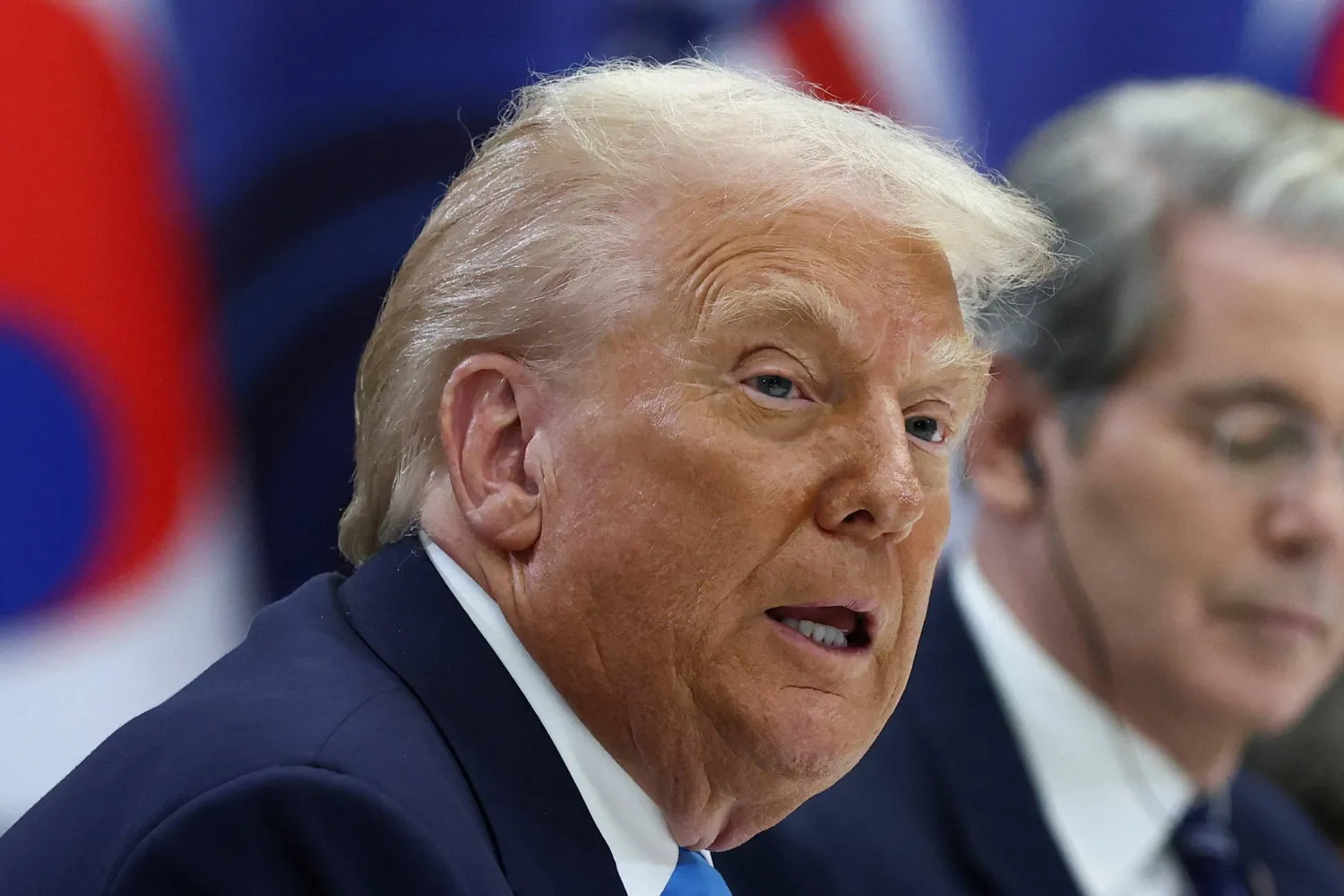
US President Donald Trump speaks during a meeting with South Korean President Lee Jae Myung (not pictured) on the sidelines of the Asia-Pacific Economic Cooperation (APEC) leaders' summit in Gyeongju, South Korea, October 29, 2025. (Reuters)
TT

Trump Tells Pentagon to Immediately Resume Testing US Nuclear Weapons

US President Donald Trump speaks during a meeting with South Korean President Lee Jae Myung (not pictured) on the sidelines of the Asia-Pacific Economic Cooperation (APEC) leaders' summit in Gyeongju, South Korea, October 29, 2025. (Reuters)

US President Donald Trump ordered the US military on Thursday to immediately resume testing nuclear weapons after a gap of 33 years, minutes before beginning a meeting with Chinese President Xi Jinping.

Trump made the surprise announcement on Truth Social while he was aboard his Marine One helicopter flying to meet Xi for a trade negotiating session in Busan, South Korea. He said he was instructing the Pentagon to test the US nuclear arsenal on an "equal basis" with other nuclear powers.

"Because of other countries testing programs, I have instructed the Department of War to start testing our Nuclear Weapons on an equal basis. That process will begin immediately," Trump posted.

"Russia is second, and China is a distant third, but will be even within 5 years."

NUCLEAR TESTING SITES TO BE DETERMINED LATER

Later, on his way back to Washington, Trump said testing was needed to ensure Washington keeps up with its rival nuclear powers.

"With others doing testing, I think it's appropriate that we do also," Trump said aboard Air Force One, adding that nuclear test sites would be determined later.

Asked whether the world was entering a more risky phase around nuclear weapons, Trump dismissed the threat, saying US stocks were "well locked up" before adding he would welcome denuclearization.

"I'd like to see a denuclearization because we have so many and Russia's second and China's third and China will catch up within four or five years," he said.

"We are actually talking to Russia about that and China would be added to that if we do something."

It was not immediately clear whether Trump was referring to nuclear-explosive testing, which would be carried out by the National Nuclear Safety Administration, or flight testing of nuclear-capable missiles.

CHINA MORE THAN DOUBLED NUCLEAR ARSENAL IN LAST 5 YEARS

Trump's decision to restart nuclear weapons testing follows a rapid expansion by China of its nuclear stockpile in recent years, and came just after Russia announced what it called a successful test of a nuclear-powered and nuclear-capable cruise missile as well as a nuclear-powered torpedo.

Trump addressed the Russian moves aboard Air Force One earlier this week, telling reporters that President Vladimir Putin should be working to end the war in Ukraine "instead of testing missiles."

Beijing has more than doubled the size of its arsenal to an estimated 600 nuclear weapons in 2025 from 300 weapons in 2020, according to the Center for Strategic and International Studies, a Washington-based think tank.

It said US military officials estimate that China will have over 1,000 nuclear weapons by 2030. A Victory Day parade in September revealed five nuclear capabilities that can all reach the continental United States, CSIS said.

The Washington-based Arms Control Association says the United States has a stockpile of 5,225 nuclear warheads and Russia has 5,580.

Putin said on Wednesday Russia had successfully tested a Poseidon nuclear-powered super torpedo that military analysts say is capable of devastating coastal regions by triggering vast radioactive ocean swells.

As Trump has toughened both his rhetoric and his stance on Russia, Putin has publicly flexed his nuclear muscles with the test of a new Burevestnik cruise missile on October 21 and nuclear launch drills on October 22.

NEGATIVE REACTIONS TO TRUMP'S POST

The reaction to Trump's announcement on testing was swift. Representative Dina Titus, a Democrat from Nevada, said on X: "I'll be introducing legislation to put a stop to this."

Daryl Kimball, director of the Arms Control Association, said it would take the United States at least 36 months to resume contained nuclear tests underground at the former test site in Nevada.

"Trump is misinformed and out of touch. The US has no technical, military, or political reason to resume nuclear explosive testing for the first time since 1992," Kimball said on X.

He added Trump's announcement could "trigger a chain reaction of nuclear testing by US adversaries, and blow apart the nuclear Non-Proliferation Treaty."

Apart from providing technical data, a US test would be seen in Russia and China as a deliberate assertion of US strategic power. Putin has repeatedly said that Russia will test if the United States does.

In August, Trump said he had discussed nuclear arms control with Putin and wanted China to get involved. Beijing responded by saying it was "unreasonable and unrealistic" to ask the country to join in nuclear disarmament negotiations with the two countries, since its arsenal was much smaller.

Trump had first laid out his intention to pursue nuclear arms control efforts in February, saying he wanted to begin discussions with both Putin and Xi about imposing limits on their arsenals.

The United States last tested a nuclear weapon in 1992.

Most major nuclear powers except North Korea stopped explosive nuclear testing in the 1990s. North Korea conducted its last nuclear test in 2017. Russia's last confirmed test was in 1990, followed by the last US test in 1992, and by China's in 1996.

The United States opened the nuclear era in July 1945 with the test of a 20-kiloton atomic bomb at Alamogordo, New Mexico, and then dropped atomic bombs on the cities of Hiroshima and Nagasaki in August 1945 to force Japan to surrender in World War Two.



Top Trump Iran Negotiator Says Visits US Aircraft Carrier in Middle East

US Special Envoy Steve Witkoff delivers a press conference upon the signing of the declaration on deploying post-ceasefire force in Ukraine, during the so-called "Coalition of the Willing" summit, at the Elysee Palace in Paris, France, January 6, 2026. (Reuters)
TT

Top Trump Iran Negotiator Says Visits US Aircraft Carrier in Middle East

US Special Envoy Steve Witkoff delivers a press conference upon the signing of the declaration on deploying post-ceasefire force in Ukraine, during the so-called "Coalition of the Willing" summit, at the Elysee Palace in Paris, France, January 6, 2026. (Reuters)

US President Donald Trump's lead Iran negotiator Steve Witkoff on Saturday said he visited the USS Abraham Lincoln aircraft carrier currently in the Arabian Sea, with Washington and Tehran due to hold further talks soon.

"Today, Adm. Brad Cooper, Commander of US Naval Forces Central Command, Jared Kushner, and I met with the brave sailors and Marines aboard the USS Abraham Lincoln, her strike group, and Carrier Air Wing 9 who are keeping us safe and upholding President Trump's message of peace through strength," said Witkoff in a social media post.

Iranian Foreign Minister Abbas Araghchi said on Saturday he hoped talks with the United States would resume soon, while reiterating Tehran's red lines and warning against any American attack.


Israel’s Netanyahu Expected to Meet Trump in US on Wednesday and Discuss Iran

Israeli Prime Minister Benjamin Netanyahu delivers a speech during a special session to mark the 77th anniversary of the Knesset's establishment and the 60th anniversary of the dedication of the current building at the Knesset, the Israeli parliament, in Jerusalem, 02 February 2026. (EPA)
TT

Israel’s Netanyahu Expected to Meet Trump in US on Wednesday and Discuss Iran

Israeli Prime Minister Benjamin Netanyahu delivers a speech during a special session to mark the 77th anniversary of the Knesset's establishment and the 60th anniversary of the dedication of the current building at the Knesset, the Israeli parliament, in Jerusalem, 02 February 2026. (EPA)

Israeli Prime Minister Benjamin Netanyahu is expected to meet US President Donald Trump on Wednesday in Washington, where they will discuss negotiations with Iran, Netanyahu's office said on Saturday.

Iranian and US officials held indirect nuclear ‌talks in the ‌Omani capital ‌Muscat ⁠on Friday. ‌Both sides said more talks were expected to be held again soon.

A regional diplomat briefed by Tehran on the talks told Reuters Iran insisted ⁠on its "right to enrich uranium" ‌during the negotiations with ‍the US, ‍and that Tehran's missile capabilities ‍were not raised in the discussions.

Iranian officials have ruled out putting Iran's missiles - one of the largest such arsenals in the region - up ⁠for discussion, and have said Tehran wants recognition of its right to enrich uranium.

"The Prime Minister believes that any negotiations must include limiting ballistic missiles and halting support for the Iranian axis," Netanyahu's office said in a ‌statement.


Italy FM Rules Out Joining Trump’s ‘Board of Peace’

Italy's Minister for Foreign Affairs Antonio Tajani speaks to the press during the EPP Leaders’ meeting, in Zagreb, Croatia, 30 January 2026. (EPA)
TT

Italy FM Rules Out Joining Trump’s ‘Board of Peace’

Italy's Minister for Foreign Affairs Antonio Tajani speaks to the press during the EPP Leaders’ meeting, in Zagreb, Croatia, 30 January 2026. (EPA)

Italy will not take part in US President Donald Trump's "Board of Peace", Italian Foreign Minister Antonio Tajani said Saturday, citing "insurmountable" constitutional issues.

Trump launched his "Board of Peace" at the World Economic Forum in Davos in January and some 19 countries have signed its founding charter.

But Italy's constitution bars the country from joining an organization led by a single foreign leader.

Prime Minister Giorgia Meloni, a Trump ally, last month noted "constitutional problems" with joining, but suggested Trump could perhaps reopen the framework "to meet the needs not only of Italy, but also of other European countries".

Tajani appeared Saturday to rule that out.

"We cannot participate in the Board of Peace because there is a constitutional limit," he told the ANSA news agency.

"This is insurmountable from a legal standpoint," he said, the day after meeting US Secretary of State Marco Rubio and US Vice President JD Vance at the Olympics in Milan.

Although originally meant to oversee Gaza's rebuilding, the board's charter does not limit its role to the Palestinian territory and appears to want to rival the United Nations.