
Camels Replace Cows as Kenya Battles Drought

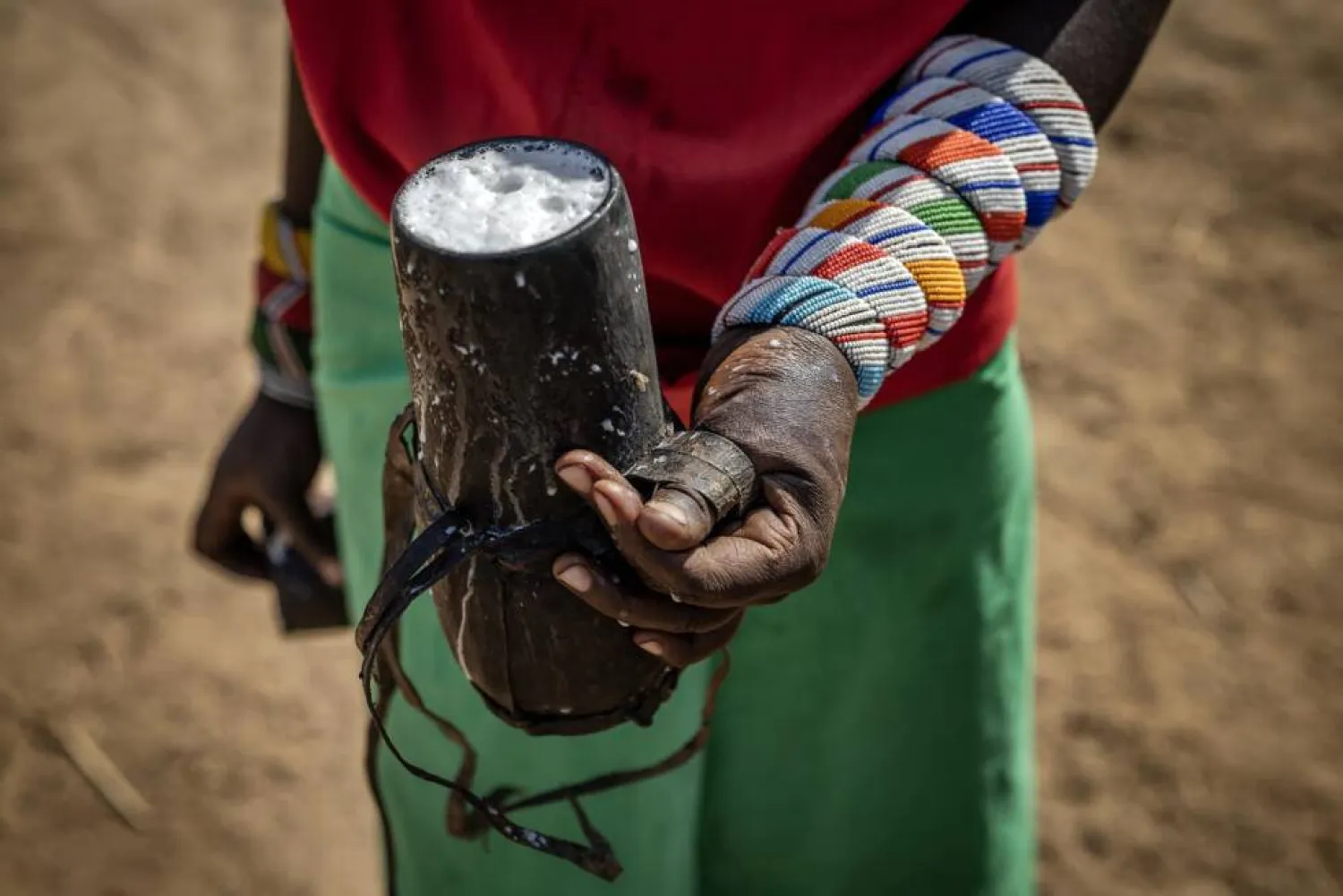
Camel milk contributes up to half the total nutrient intake during droughts. Luis TATO / AFP
TT

Camels Replace Cows as Kenya Battles Drought

Camel milk contributes up to half the total nutrient intake during droughts. Luis TATO / AFP

"God, God, God, protect them," chanted two herders, their eyes following a dozen camels rushing toward acacia trees, oblivious to the dry riverbed in northern Kenya where it hasn't rained since April.

Sitting on the edge of a nearby well, Chapan Lolpusike recounted how his cows and oxen "all died" following the worst drought in four decades, caused by a succession of poor rainfall in 2021 and 2022.

After that, the herder made a sweeping change.

"We no longer have cattle at home. We only raise camels," said Lolpusike, a member of the semi-nomadic Samburu community.

Camels can graze on dry grasses, go more than a week without water, and produce up to six times more milk than cattle -- making them an increasingly necessary option in northern Kenya, an area particularly vulnerable to climate change.

Samburu county officials launched a camel program in 2015 following several droughts that killed off at least 70 percent of the cattle in Kenya's arid and semi-arid regions.

The die-off had a devastating impact on malnutrition among local pastoralists.

Around 5,000 Somali camels -- a larger and more productive breed than the native herd -- have since been distributed, including 1,000 in the last year.

Camels for every family

Lolpusike, who previously knew nothing about camels, received some in 2023.

In his manyatta -- a hamlet of rectangular huts nestled in a shrubby savannah -- a dozen camels lay peacefully chewing dry grass.

The goal is for every family in the county to have their own, said village administrator James Lolpusike (no relation).

"If the drought persists, the cattle will not be anywhere anymore," he said.

Camel herds are at high risk of disease that could lead to losses.

But there are clear, positive changes as they become a regular sight in the region, including healthier children, said the village administrator.

They are certainly popular in the community, for the fact they can be milked up to five times a day.

"Cows are only milked when the grass is green," said Naimalu Lentaka, 40.

"Camels... during the dry season, they are still milked, and that's the whole difference."

Families now "depend on camels, on those who own them," she added.

Racing stars

Camel milk and human breast milk have similar nutritional and therapeutic properties, according to a 2022 study by Meru University in Kenya.

Camel milk contributes up to half the total nutrient intake during droughts among pastoral communities in the north.

The animal is already a star in the region, thanks to a famous endurance race.

At the Maralal International Camel Derby in late September, around 40 camels frolicked before a cheering crowd.

The winner covered 21 kilometers (13 miles), the equivalent of a half-marathon, in one hour and 22 minutes.

But organizers said the event -- whose theme was "peaceful cultural interactions" -- was primarily about bringing together communities that used to fight over resources, since, among their many virtues, camels are also a symbol of peace.

Moving cattle herds to more fertile areas during the dry season can spark conflict between herders that have claimed hundreds of lives over the years.

Camels are happy to stay where they are.

Even this hardy animal needs some water, however, so locals still pray for rain.

"We only pray the situation doesn't get worse," said James Lolpusike.


More Travel Chaos to Hit Europe as Cold Snap Brings More Snow

 People walk along the Baltic Sea shore covered in a thick blanket of snow, in Stralsund, Germany, Tuesday, Jan. 6, 2026. (Stefan Sauer/dpa via AP)
People walk along the Baltic Sea shore covered in a thick blanket of snow, in Stralsund, Germany, Tuesday, Jan. 6, 2026. (Stefan Sauer/dpa via AP)
TT

More Travel Chaos to Hit Europe as Cold Snap Brings More Snow

 People walk along the Baltic Sea shore covered in a thick blanket of snow, in Stralsund, Germany, Tuesday, Jan. 6, 2026. (Stefan Sauer/dpa via AP)
People walk along the Baltic Sea shore covered in a thick blanket of snow, in Stralsund, Germany, Tuesday, Jan. 6, 2026. (Stefan Sauer/dpa via AP)

More flights will be cancelled, trains will run late and roads will be blocked by snow across Europe in coming days as a cold snap is expected to worsen, bringing even more heavy snowfall after several days of travel disruption.

Authorities in the Netherlands told people to plan to stay at home if at all possible on Wednesday, with a fresh blizzard expected to arrive overnight.

French Transportation Minister Philippe Tabarot said on Tuesday that airlines had already been ordered to cancel at least 40% of flights at Paris's main Charles de Gaulle airport the following morning, ‌and a quarter ‌of flights at smaller Orly.

Public transportation in the Paris ‌region ⁠will probably also be ‌disrupted by the snow, he added.

At Amsterdam's Schiphol, where more than 400 flights were cancelled on Tuesday, authorities told travelers whose flights had been called off to stay away from the airport to prevent overcrowding.

"We haven't experienced such extreme weather conditions in years," Dutch airline KLM's spokesperson Anoesjka Aspeslagh said, as winter weather crippled traffic at one of Europe's main transit hubs for a fifth day.

A BIRTHDAY IN TRANSIT

Stranded at Schiphol, Simiao Sun said she feared she'd spend her 40th birthday in transit. ⁠She had been told she would have to wait three days for a rescheduled flight to Beijing.

"My child would miss ‌school and we would both miss work, so I'm queuing ‍here...hoping to get a slightly earlier ‍flight."

KLM said it was offering alternative flights where possible and doing everything to help travelers, ‍but it was "overwhelmed with inquiries".

On top of that, all domestic rail services in the Netherlands were suspended early on Tuesday after an IT outage hit the rail network. Trains began running in parts of the country after 0900 GMT, but problems persisted around Amsterdam, with high-speed Eurostar services from Amsterdam to Paris either cancelled or late.

Roads in France were gradually clearing on Tuesday after snow caused severe accidents all over the country, killing at least five people, according to ⁠BFMTV news station. Traffic in the Paris area hit a record 1,000 kilometers of jams on Monday evening.

SNOW FALLS OVER LARGE PARTS OF GERMANY AND FRANCE

In Germany, temperatures fell well below minus 10 degrees Celsius (14 degrees Fahrenheit) in the south and east early on Tuesday. Much of the country was covered in snow.

In Britain, the Meteorological Office said winter weather hazards could continue throughout the week for most of the country. Temperatures overnight to Tuesday had fallen as low as -12.5 degrees Celsius in Marham, Norfolk, in east England, marking the coldest night of the winter so far.

Heavy snow and rain have also caused havoc across the Western Balkans, closing roads, cutting power and causing rivers to flood. A woman died in the Bosnian capital Sarajevo on Monday after a ‌tree overburdened with wet snow fell on her.


Study: Climate-driven Tree Deaths Speeding Up in Australia

New research show tree mortality is rising across Australia's forest as the climate warms. DAVID GRAY / AFP/File
TT

Study: Climate-driven Tree Deaths Speeding Up in Australia

New research show tree mortality is rising across Australia's forest as the climate warms. DAVID GRAY / AFP/File

Australia's forests are losing trees more rapidly as the climate warms, a new study examining decades of data said Tuesday, warning the trend was likely a "widespread phenomenon".

The research used forest inventory data from 2,700 plots across the country, ranging from cool moist forests to dry savanna.

It excluded areas affected by logging, clearance or fires to examine how "background tree mortality" has changed in recent decades.

"What we found is that the mortality rate has consistently increased over time, in all of the different forest types," said Belinda Medlyn, a professor at Western Sydney University's Hawkesbury Institute for the Environment.

"And this increase is very likely caused by the increase in temperature," she told AFP.

The world has warmed by an average of nearly 1.2 degrees Celsius since the pre-industrial era. Most of this warming has occurred in the last 50 years.

The rate at which trees die off in a forest can vary in response to different types of disturbances, or as forests grow thicker and there is greater competition for resources.

But the research, published in the Nature Plants journal, excluded areas affected by fires or clearing, and also examined the stand basal area -- the sum of the cross-sectional areas of all trees in an area.

"The (mortality) trend over time remains even after we correct for basal area," explained Medlyn, who led the research.

The scale of the increase varied across the four different biomes surveyed, with the sharpest rise in tropical savannas.

There, the number of trees dying on average increased by 3.2 percent a year, from close to 15 per 1,000 in 1996, to nearly double that number by 2017.

The research found that the deaths were not being matched by tree growth, so forest stock overall is declining.

That makes it "very likely that the overall carbon storage capacity in the forests is declining over time", said Medlyn.

And given the trend was observed across four ecosystems -- tropical savanna, cool temperate forest, warm temperate forest and tropical rainforest -- it is likely to be "a widespread phenomenon, not just an Australian thing", she added.

The rising mortality rate tracks warming and drying linked to climate change, and the study found the fastest rise in hotter, dryer regions.

The research comes months after a study found Australia's tropical rainforests were among the first in the world to start emitting more carbon dioxide than they absorb.

Taken together, the findings paint a worrying picture of our continued ability to rely on forests to absorb our emissions.

"Forests globally currently sequester about one-third of anthropogenic carbon dioxide emissions," said Medlyn.

"Our study suggests their capacity to act as buffer will decline over time."


South Korea’s Lee Snaps Xi Selfie with Chinese ‘Backdoor’ Phone

South Korean President Lee Jae Myung (L) and his wife, Kim Hea Kyung (2nd from L), take a selfie with Chinese President Xi Jinping (2nd from R) and his wife, Peng Liyuan, by using a Xiaomi smartphone following a state dinner for the South Korean leader in Beijing, China, 05 January 2026. (EPA/Yonhap)
TT

South Korea’s Lee Snaps Xi Selfie with Chinese ‘Backdoor’ Phone

South Korean President Lee Jae Myung (L) and his wife, Kim Hea Kyung (2nd from L), take a selfie with Chinese President Xi Jinping (2nd from R) and his wife, Peng Liyuan, by using a Xiaomi smartphone following a state dinner for the South Korean leader in Beijing, China, 05 January 2026. (EPA/Yonhap)

South Korean President Lee Jae Myung snapped a selfie with Xi Jinping using a smartphone gifted to him by the Chinese leader, who had joked at their last meeting that the device might be capable of spying.

Lee posted a selfie of himself, Xi and their wives on social media platform X on Monday during a visit to Beijing.

"A selfie with President Xi Jinping and his wife, taken with the Xiaomi I received as a gift in Gyeongju," Lee wrote.

"Thanks to them, I got the shot of a lifetime," he said.

"I will communicate more frequently and collaborate more closely going forward."

In the selfie, all four first families are seen smiling.

Lee's office also posted a short YouTube video of the scene, with Xi complimenting the South Korean leader's photo skills.

The Xiaomi handset made headlines in November when Xi cracked a joke to Lee on the sidelines of an APEC summit in South Korea.

When Lee asked if the communication line on the device was secure, the Chinese leader urged him to "check if there is a backdoor" -- referring to pre-installed software that could allow third-party monitoring.

The banter was a rare display of humor from the Chinese leader, who is not often seen making jokes, let alone about espionage.

The South Korean President has said Xi was "unexpectedly quite good at making jokes".

During their ninety-minute summit on Monday, Xi urged Lee to join Beijing in making the "right strategic choices" in a world that is "becoming more complex and turbulent".

Lee's visit to China followed a US military operation in Caracas that captured Venezuelan President Nicolas Maduro and brought him to New York to face narco-trafficking charges -- a raid condemned by Beijing and Pyongyang.

Lee's selfie post sparked heavy interest online and was shared more than 3,400 times in the first few hours.

One user quipped: "Sir, do you know Nicolas Maduro used the same phone?"

The South Korean leader, who took office in June following the impeachment and removal of his predecessor over a martial law declaration, has sought to improve ties with China after a years-long diplomatic deep freeze.