


US Defense Chief Vows to ‘Stoutly Defend’ Indo-Pacific Interests in Talks with China 

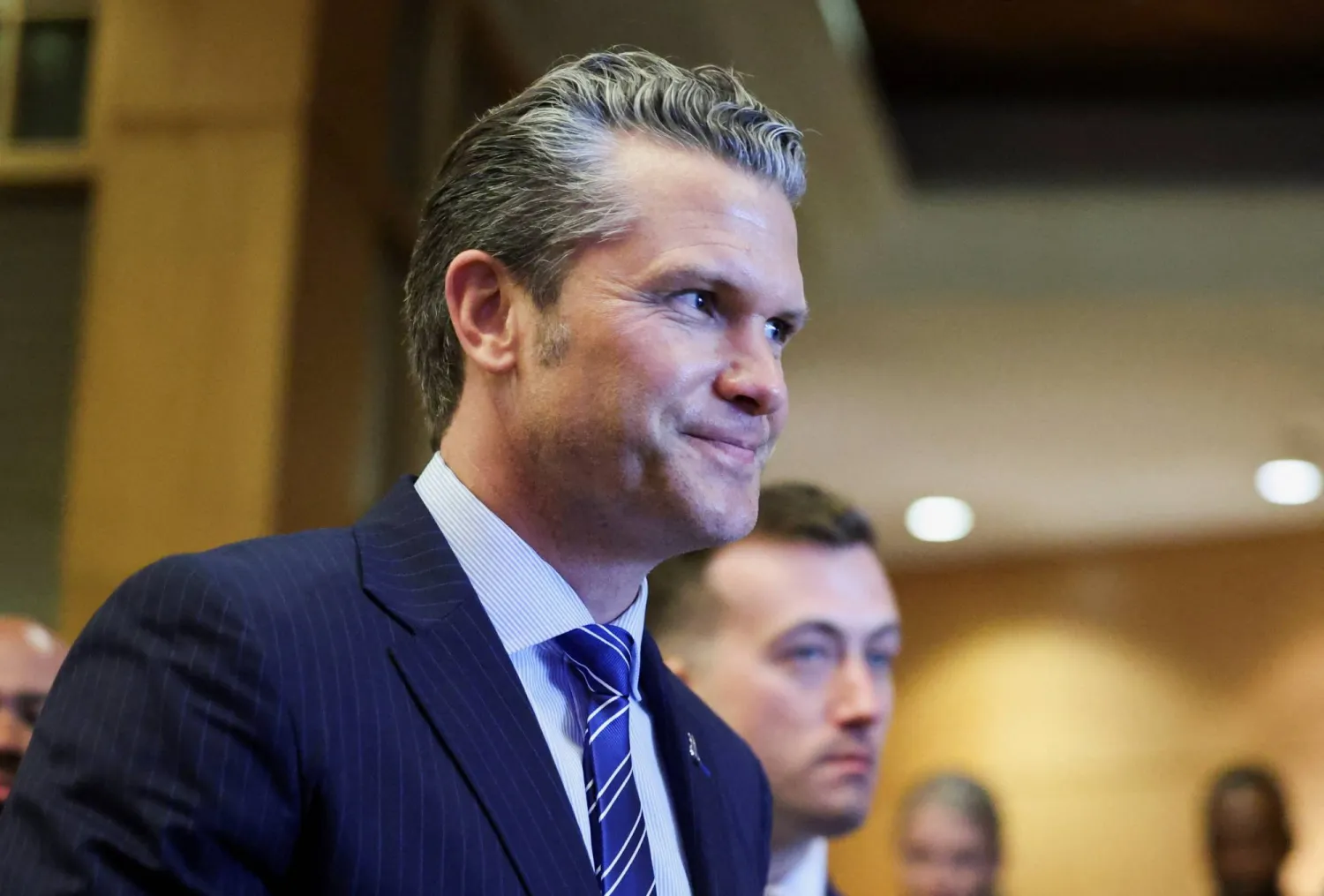
US Defense Secretary Pete Hegseth attends a bilateral meeting with Malaysia's Defense Minister ahead of the 19th ASEAN Defense Ministers' Meeting (ADMM) and 12th ASEAN Defense Ministers' Meeting Plus (ADMM-PLUS) at Kuala Lumpur, Malaysia October 30, 2025. (Reuters)
TT

US Defense Chief Vows to ‘Stoutly Defend’ Indo-Pacific Interests in Talks with China 

US Defense Secretary Pete Hegseth attends a bilateral meeting with Malaysia's Defense Minister ahead of the 19th ASEAN Defense Ministers' Meeting (ADMM) and 12th ASEAN Defense Ministers' Meeting Plus (ADMM-PLUS) at Kuala Lumpur, Malaysia October 30, 2025. (Reuters)

The US Secretary of Defense said Friday he told his Chinese counterpart during talks in Malaysia that Washington would "stoutly defend" its interests in the Indo-Pacific. He also signed a new agreement aimed at strengthening security ties with India.

Pete Hegseth described as "good and constructive" his meeting with Chinese Admiral Dong Jun, held on the sidelines of the Association of Southeast Asian Nations defense ministers meeting in Kuala Lumpur. He said he raised US concerns over Chinese activities in the South China Sea, around Taiwan and toward US allies and partners in the region.

"I highlighted the importance of maintaining a balance of power in the Indo-Pacific," Hegseth wrote on social media platform X. "United States does not seek conflict (but) it will continue to stoutly defend its interests and ensure it has the capabilities in the region to do so."

China's defense ministry issued a cautious response, emphasizing its longstanding positions. Dong Jun stressed the reunification of China and Taiwan is an "unstoppable historical trend" and urged the US to be cautious in its words and actions on the Taiwan issue, the statement said.

"We hope the US will translate its statements of not containing China and not seeking conflict into action, and work with China to inject positive energy into regional and global peace and security," according to the statement.

Their meeting follows a Sept. 9 video call between Hegseth and Dong and reflects ongoing efforts to manage tensions in the Indo-Pacific even as strategic differences, particularly over Taiwan and freedom of navigation, remain pronounced.

Hegseth also met with India's Defense Minister Rajnath Singh, and they signed a 10-year defense framework aimed at expanding military and technological cooperation.

Washington has long sought to develop a deeper partnership with New Delhi, which is seen as a bulwark against China. India is a major defense partner of the US and has in recent years embedded advanced American jets, helicopters, missiles and military gear into its armed forces.

"This advances our defense partnership, a cornerstone for regional stability and deterrence," Hegseth wrote on X. "Our defense ties have never been stronger."

Singh said the US-India partnership is crucial for ensuring a free, open and rules-based Indo-Pacific region. "It is a signal of our growing strategic convergence and will herald a new decade of partnership," he said on X.

The framework agreement comes amid renewed strains in bilateral ties after President Donald Trump imposed a 50% import tariff on Indian goods in August and criticized New Delhi for continued purchase of discounted Russian oil. India is the second biggest buyer of Russian oil after China.

Hegseth also held talks with his Malaysian counterpart on Thursday, where they reaffirmed their commitment to maritime security in the South China Sea.

According to a statement issued earlier Friday, Mohamed Khaled Nordin said "grey-zone tactics, such as hydrographic research conducted under the protection of foreign coast guard vessels, threaten sovereignty and are a clear provocation and threat" in the waterway. He didn't elaborate but it appeared to be a swipe at China.

Malaysia has previously protested the encroachment of Chinese vessels into its waters but usually prefers quiet diplomacy. That’s in contrast to the neighboring Philippines, which has had major confrontations with China at sea in recent years.

Both Khaled and Hegseth agreed that "respect for sovereignty is imperative" in the waterway. China claims virtually the entire South China Sea, overlapping claims made by countries including Malaysia, the Philippines, Vietnam and Taiwan.

Opening the ASEAN defense ministers meeting earlier Friday, Khaled warned that regional peace faces growing pressure from both traditional and emerging threats, including rising tensions in the disputed South China Sea and the spread of cyberattacks that can "disrupt societies, topple governments and undermine critical infrastructure."

"We see the challenges in the South China Sea. But we must also recognize that our digital realm is equally at risk. The threats that test our networks and systems may be invisible, but just as dangerous as those threatening our maritime zones," he said.

ASEAN defense ministers will continue talks Saturday with dialogue partners including the United States, China, Japan, India, Australia, South Korea and Russia.



Türkiye and Armenia Agree to Simplify Visa Procedures to Normalize Ties

Türkiye’s President Recep Tayyip Erdogan, right, and Armenia's Prime Minister Nikol Pashinyan shake hands before a meeting at Prague Castle in Prague, Czech Republic, Thursday, Oct. 6, 2022. (Turkish Presidency via AP, File)
TT

Türkiye and Armenia Agree to Simplify Visa Procedures to Normalize Ties

Türkiye’s President Recep Tayyip Erdogan, right, and Armenia's Prime Minister Nikol Pashinyan shake hands before a meeting at Prague Castle in Prague, Czech Republic, Thursday, Oct. 6, 2022. (Turkish Presidency via AP, File)

Türkiye and Armenia have agreed to simplify visa procedures as part of efforts to normalize ties, Türkiye’s Foreign Ministry announced Monday, making it easier for their citizens to travel between the two countries.

Relations between Türkiye and Armenia have long been strained by historic grievances and Türkiye’s alliance with Azerbaijan. The two neighboring countries have no formal diplomatic ties and their joint border has remained closed since the 1990s.

The two countries, however, agreed to work toward normalization in 2021, appointing special envoys to explore steps toward reconciliation and reopening the frontier. Those talks have progressed in parallel with efforts to ease tensions between Armenia and Azerbaijan.

Türkiye supported Azerbaijan during its 2020 conflict with Armenia for control of the Karabakh region, known internationally as Nagorno-Karabakh, a territorial dispute that had lasted nearly four decades.

The Turkish Foreign Ministry said in a statement posted on social platform X that Ankara and Yerevan agreed that holders of diplomatic, special and service passports from both countries would be able to obtain electronic visas free of charge as of Jan. 1.

“On this occasion, Türkiye and Armenia reaffirm once again their commitment to continue the normalization process between the two countries with the goal of achieving full normalization without any preconditions,” the ministry said.

Türkiye and Armenia also have a more than century-old dispute over the deaths of an estimated 1.5 million Armenians in massacres, deportations and forced marches that began in 1915 in Ottoman Türkiye. Historians widely view the event as genocide.

Türkiye denies the deaths constituted genocide, saying the toll has been inflated and those killed were victims of civil war and unrest. It has lobbied to prevent countries from officially recognizing the massacres as genocide.


Putin Told Trump That Russia Will Review Peace Talks Stance After Drone Attack on Residence

Russian President Vladimir Putin chairs a meeting on the "special military operation" amid the ongoing Russia-Ukraine conflict in Moscow, Russia, December 29, 2025. Sputnik/Mikhail Metzel/Pool via REUTERS
TT

Putin Told Trump That Russia Will Review Peace Talks Stance After Drone Attack on Residence

Russian President Vladimir Putin chairs a meeting on the "special military operation" amid the ongoing Russia-Ukraine conflict in Moscow, Russia, December 29, 2025. Sputnik/Mikhail Metzel/Pool via REUTERS

President Vladimir Putin told US President Donald Trump on Monday that Russia would review its position in peace negotiations after what Moscow said was a Ukrainian drone attack on a Russian presidential residence, the Kremlin said. 

Ukraine has dismissed Russia's accusation that 91 drones attacked Putin's residence in northern Russia as a lie, and has accused Moscow - which has not yet presented evidence to back its assertions - of ‌attempting to undermine ‌peace talks. 

Yuri Ushakov, Kremlin ‌foreign ⁠policy aide, ‌said that Putin and Trump had spoken on Monday and that Putin had been briefed by Trump and his senior advisers about Washington's negotiations with Ukraine. 

"According to the Americans, during these negotiations the American side aggressively pursued the idea of the need ⁠for Kyiv to take real steps towards a final settlement ‌of the conflict, not to hide ‍behind demands for ‍a temporary ceasefire," Ushakov told reporters on a ‍conference call. 

Ushakov said that the Russian side feared that the ideas put forward by Ukraine to the Americans could still be interpreted too broadly by Kyiv. 

Trump had been shocked when Putin told him that Ukraine had attacked a presidential residence ⁠in Novgorod, Ushakov said. 

"Russia's position will be reviewed on a number of agreements reached at the previous stage and on the emerging interchanges," Ushakov said. "This was stated very clearly." 

Ukrainian President Volodymyr Zelenskiy earlier said that the claim of a Ukrainian attack on Putin's residence was "a complete fabrication intended to justify additional attacks against Ukraine, including Kyiv, as well as Russia’s own refusal to take necessary ‌steps to end the war." 


Paris Metro Stabbing Suspect is French, Says Ministry

The attacks happened on a central line of Paris's metro, seen here in a file picture © JULIEN DE ROSA / AFP/File
TT

Paris Metro Stabbing Suspect is French, Says Ministry

The attacks happened on a central line of Paris's metro, seen here in a file picture © JULIEN DE ROSA / AFP/File

The suspect in the stabbing of three women in the Paris metro last week is French, the interior ministry said Monday, after previously saying he was an undocumented Malian ordered to leave the country.

A source with knowledge of the case, requesting anonymity because not allowed to speak to the press, said he had held a French passport since 2018, AFP reported.

The 25-year-old man was arrested on suspicion of having stabbed and injured three women along the Paris metro's Line 3 on Friday, then admitted to a psychiatric hospital the next day.

"The investigation uncovered a French passport belonging to the suspect," the ministry said, adding that he had not once mentioned his French nationality during previous run-ins with police.

The ministry said on Friday the man was a Malian citizen imprisoned in January last year for aggravated theft and sexual assault, and required to leave France after being released in July.

The man had been placed in an administrative detention centre, but failure to obtain a consular travel document required for his deportation meant he was released after 90 days as required by law, it said.

Interior Minister Laurent Nunez last week called for "maximum vigilance" during the festive season in France.