


Trump Hosts White House Halloween Bash with Superheroes and Presidential Lookalikes Amid Shutdown 

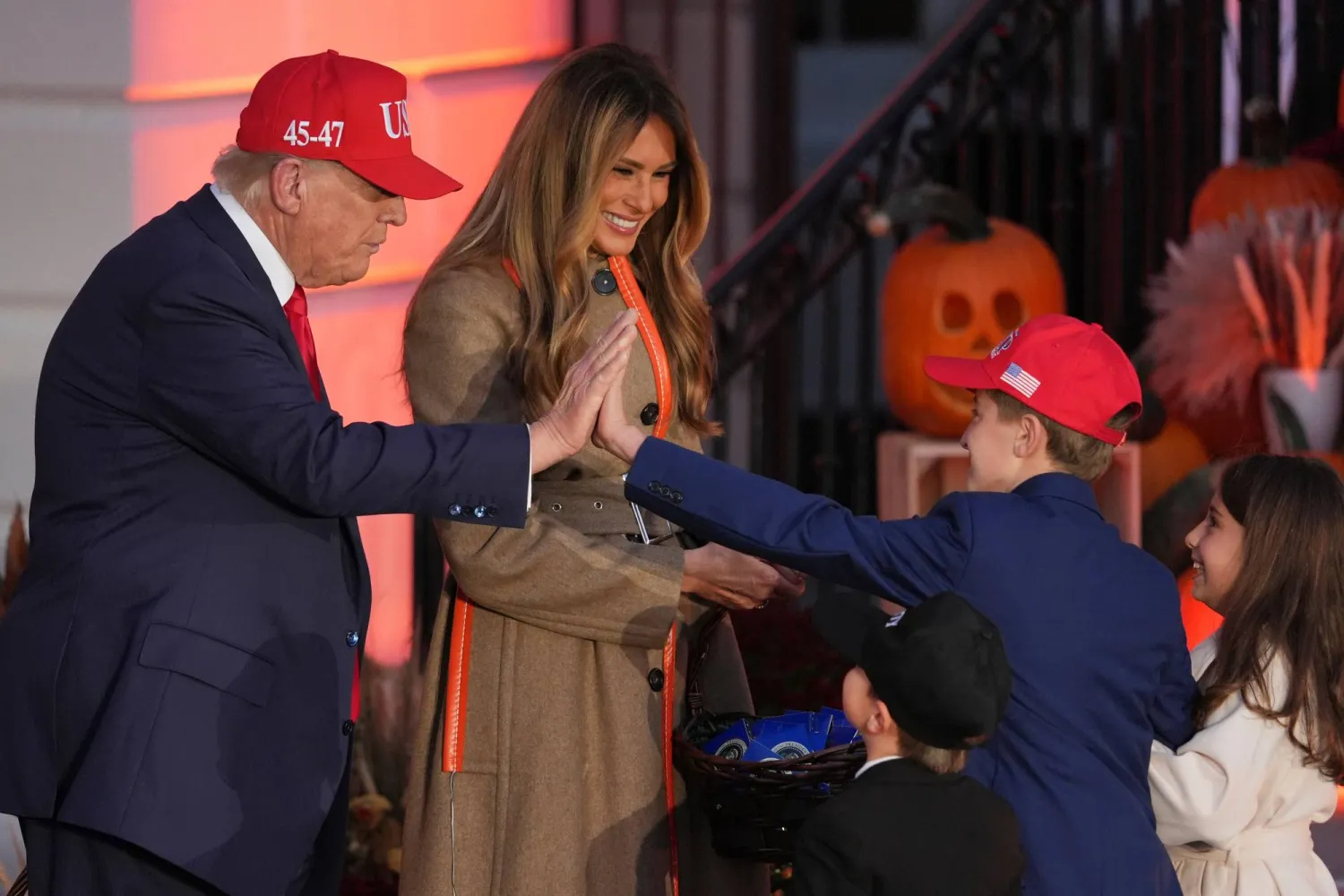
President Donald Trump, left, gives a high-five to a child dressed as him as first lady Melania Trump, second left, a child dressed as her, right, and a child dressed as a member of the Secret Service, third right, look on during a Halloween event on the South Lawn of the White House, Thursday, Oct. 30, 2025, in Washington. (AP) 
TT

Trump Hosts White House Halloween Bash with Superheroes and Presidential Lookalikes Amid Shutdown 

President Donald Trump, left, gives a high-five to a child dressed as him as first lady Melania Trump, second left, a child dressed as her, right, and a child dressed as a member of the Secret Service, third right, look on during a Halloween event on the South Lawn of the White House, Thursday, Oct. 30, 2025, in Washington. (AP) 

President Donald Trump hosted hundreds of costumed guests — from superheroes to dinosaurs and even a few children dressed as the first couple — as part of Thursday night's Halloween celebration at the White House.

He and first lady Melania Trump emerged on the South Lawn as evening was starting to fall to an orchestral version of Michael Jackson's “Thriller.” Neither was in costume. Trump wore a blue suit and red tie with a red “USA” cap; his wife was in a brown coat over an orange dress.

The couple handed out full-sized Hershey bars and Twizzlers in boxes with the presidential seal to a line of children and their parents that stretched down the driveway. Temporary walls obscured the view of the construction of Trump's new White House ballroom, which has led to the demolition of the East Wing, though a parked bulldozer could still be seen hulking on the other side.

“It’s a long line,” Trump said. “It’s almost as big as the ballroom.”

The White House tradition went ahead despite Trump returning mere hours earlier from a six-day Asia trip that took him to Malaysia, Japan, South Korea, and amid a government shutdown in its 30th day.

Trump has called for the government to reopen, but congressional Democrats are demanding an extension of expiring tax credits that have helped millions of people afford health insurance. Their Republican colleagues say they won’t negotiate until the government is reopened.

Trump’s tariffs on Chinese imports have reduced inventory and raised prices for Halloween costumes for American importers, retailers and shoppers. Still, the White House exterior featured dozens of decorations resembling large autumn leaves and fall flowers like orange and red mums. The stairs leading to its balcony were crowded with carved pumpkins.

Among the children attending the Halloween party were those of members of the military and White House staffers. Karoline Leavitt, the White House press secretary, came with her young son dressed as a pumpkin. Katie Miller, a former Trump administration aide, was dressed as a skeleton, while her husband, Stephen, Trump's deputy White House chief of staff, wore only a business suit.

Hundreds of children, tiny toddlers up to kids in their early teens, came dressed as Spider-Man and Captain America, ballerinas, princesses and leprechauns. Two boys wore suits, Trump hats and grins like the president, though they didn't try to pull off his signature hairdo, while a girl with them wore a white coat over a dress like one the first lady might favor.

Several parents had “USA” caps like Trump.

Some children were shy or skittish about talking with the Trumps, but the president said something inaudible to a child whose costume consisted of sitting with his pants down on an inflatable toilet stenciled with “Wide Load” on the back.



NASA's Juno finds Jupiter is a tiny bit smaller than previously thought

An enhanced-color image, using raw data from the JunoCam instrument aboard NASA's Juno spacecraft, shows the planet Jupiter, with a shadow of its moon Ganymede on the left, released by NASA on April 21, 2022. NASA/JPL-Caltech/SwRI/MSSS/Image processing by Thomas Thomopoulos/Handout via REUTERS
TT

NASA's Juno finds Jupiter is a tiny bit smaller than previously thought

An enhanced-color image, using raw data from the JunoCam instrument aboard NASA's Juno spacecraft, shows the planet Jupiter, with a shadow of its moon Ganymede on the left, released by NASA on April 21, 2022. NASA/JPL-Caltech/SwRI/MSSS/Image processing by Thomas Thomopoulos/Handout via REUTERS

Jupiter, without a doubt, is the biggest planet in our solar system. But it turns out that it is not quite as large - by ever so small an amount - as scientists had previously thought.

Using new data obtained by NASA's robotic Juno spacecraft, scientists have obtained the most precise measurements to date of Jupiter's size and shape. This is important information to gain a fuller understanding of this gas giant, including studying its complex interior structure.

The Juno observations showed that Jupiter has an equatorial diameter of 88,841 miles (142,976 km), which is about 5 miles (8 km) smaller than previous measurements had indicated. The observations also showed that Jupiter's diameter from north pole to south pole is 83,067 miles (133,684 km), about 15 miles (24 km) smaller than previously estimated, Reuters reported.

The planet, like our own, is not a perfect sphere, but rather a bit flattened - and, based on the new data, slightly more so than previously known. Jupiter is about 7% larger at the equator than at the poles. For comparison, Earth's equator is only 0.33% larger than its diameter at the poles.

The previous measurements of Jupiter were based on data gathered by NASA's Voyager and Pioneer robotic spacecraft in the late 1970s. Juno, launched in 2011, has been orbiting Jupiter since 2016, transmitting raw data back to Earth. NASA extended the Juno mission in 2021, giving scientists the opportunity to carry out the type of observations needed in order to fine-tune the measurements of its size and shape, including traveling behind Jupiter from Earth's point of view.

"When Juno passed behind Jupiter from Earth's perspective, its radio signal traveled through the planet's atmosphere before reaching Earth," said planetary scientist Eli Galanti of the Weizmann Institute of Science in Israel, lead author of the study published this week in the journal Nature Astronomy.

"Measuring how the signal changed due to Jupiter's atmospheric composition, density and temperature allowed us to probe the atmosphere and determine the planet's size and shape with high precision. Interestingly, this geometrical configuration did not occur during Juno's prime mission, so these experiments were not originally planned," Galanti said.

Earth, which is the third from the sun among the solar system's eight planets, is a relatively small rocky world.

Jupiter, fifth from the sun, is so immense that all the other planets could fit inside it, including more than 1,300 Earths. Jupiter is composed primarily of hydrogen and helium, with traces of other gases. Strong winds seen as stripes and a few storms dominate Jupiter's colorful outward appearance.

Juno has been collecting data about Jupiter's atmosphere, interior structure, internal magnetic field and magnetosphere, the region around the planet created by its internal magnetism.

Precise new measurements of Jupiter are helpful to scientists because its radius - a measure that is half its diameter - is a fundamental reference used in models of the planet's interior and its atmospheric structure.

"Jupiter is the largest planet in the solar system and contains most of its planetary mass, so understanding its composition and internal structure is central to understanding how the solar system formed and evolved. Jupiter likely formed early, and strongly influenced the distribution of material, the growth of other planets and the delivery of volatiles to the inner solar system, including Earth," Galanti said.

Volatiles are substances like water, carbon dioxide and ammonia that evaporate easily. The delivery of these to the inner solar system, where the four rocky planets reside, was essential because volatiles, Galanti said, "supplied Earth with water and key ingredients for its atmosphere and for life."


Saudi Media Forum Discusses State of Arab Media, Global Ambitions

Diplomats and media industry experts highlighted the key dimensions of “soft power.” (SPA)
TT

Saudi Media Forum Discusses State of Arab Media, Global Ambitions

Diplomats and media industry experts highlighted the key dimensions of “soft power.” (SPA)

Diplomats and media industry experts shed light on “soft power” and how it can be leveraged to build national reputations and shape public awareness of contemporary international issues, as the Saudi Media Forum hosted candid discussions on the reality of the Arab media sector and the requirements for elevating its global impact.

During the second day of the forum, held in Riyadh, participants offered frank assessments of the challenges facing Arab media and the steps needed for it to meet the demands of the current phase and extend its influence internationally.

Panels and workshops explored a wide range of topics, including the role of citizen journalism in shaping the news agenda, the challenges of keeping pace with digital infrastructure amid rapid content industry transformations, and the craft of producing high-quality journalistic storytelling in an era of technological abundance and fragmented content trends.

Confronting Fake News and Disinformation

A session titled “Diplomacy of Influence: Media and Image-Making” examined the role of media in shaping perceptions and enhancing states’ soft power, with the participation of several ambassadors accredited to Saudi Arabia.

Diaa Al-Din Bamakhrama, Djibouti’s Ambassador and Dean of the Diplomatic Corps in the Kingdom, said Saudi Arabia offers a prominent model of influence diplomacy through its hosting of international forums and its investment in culture and sports, particularly football, which has helped project Saudi presence across the globe.

“In an increasingly interconnected world that has become a small village, false and fabricated narratives fall quickly and cannot withstand the flow of information and facts,” Bamakhrama said, noting that digital media has made exposing falsehoods faster, and that only truthful narratives can build lasting trust with public opinion.

Spain’s Ambassador to the Kingdom Javier Carbajosa Sánchez stressed that the relationship between media and diplomacy is historic and has grown more complex and influential in the age of modern communications and social media.

Media, he said, has never been merely a transmitter, but an active and influential force, adding that political work cannot be separated from managing media presence.

For his part, Dr. Suhel Ajaz Khan, the Indian Ambassador to Saudi Arabia, said that image-building and perception management lie at the heart of public and cultural diplomacy.

He explained that delivering the right message to the right audience is the key to influence, with art and national cuisine among the most effective soft-power tools.

He added that cultural diplomacy relies on activating soft-power instruments such as arts, music, cinema, and cuisine to enhance human connection and build bridges between peoples.

In Saudi Arabia, he noted, the Indian community, alongside Indian cinema and food culture, plays a major role in shaping perceptions and strengthening partnerships—sometimes with an impact exceeding that of formal diplomatic efforts.

In confronting fake news and digital disinformation, Khan stressed the need for swift, honest, and direct diplomacy to present facts before rumors spread.

South African Ambassador Mogobo David Magabe highlighted mutual respect and dialogue as fundamental pillars of diplomacy, pointing out that the main challenges today are the spread of disinformation and the accelerated pace of modern media, which contrasts with diplomacy’s traditionally gradual, long-term relationship-building approach.

A Candid Look at Arab Media

In a separate dialogue session on the realities of Arab media and the requirements for expanding its global reach, Saudi journalist Jameel Altheyabi said local Arab media is largely inward-looking, driven by a mindset focused on domestic audiences with limited consideration for the global sphere.

He described Arab media as often emotional, with varying approaches to content and engagement across the region.

Writer and journalist Mamoun Fandy said that stories produced in the Arab world are viewed internationally through the lens of their origin and nature, as global audiences apply their own standards of credibility, accuracy, and sourcing.

He added that the Arab world can generate distinctive journalistic stories capable of shaping global discourse through exclusivity and originality, expressing regret that many official Arab institutions still prefer foreign outlets to convey their narratives to the world.


Iran Formally Allows Women to Ride Motorcycles

Women walk past a mural depicting children as future scientists in Tehran on February 3, 2026. (Photo by ATTA KENARE / AFP)
TT

Iran Formally Allows Women to Ride Motorcycles

Women walk past a mural depicting children as future scientists in Tehran on February 3, 2026. (Photo by ATTA KENARE / AFP)

Women in Iran can now formally obtain a license to ride a motorcycle, local media reported Wednesday, ending years of legal ambiguity surrounding two-wheelers.

The law previously did not explicitly prohibit women from riding motorbikes and scooters, but in practice authorities refused to issue licenses, AFP reported.

Due to the legal grey area, women have been held legally responsible for accidents even when victims.

Iran's First Vice President Mohammad Reza Aref signed a resolution on Tuesday aimed at clarifying the traffic code, which was approved by Iran's cabinet in late January, the country's Ilna news agency reported.

The resolution obliges traffic police to "provide practical training to female applicants, organize an exam under the direct supervision of the police, and issue motorcycle driver's licenses to women", Ilna said.

The change follows a wave of protests across Iran that were initially sparked by economic grievances but which grew last month into nationwide anti-government demonstrations.