

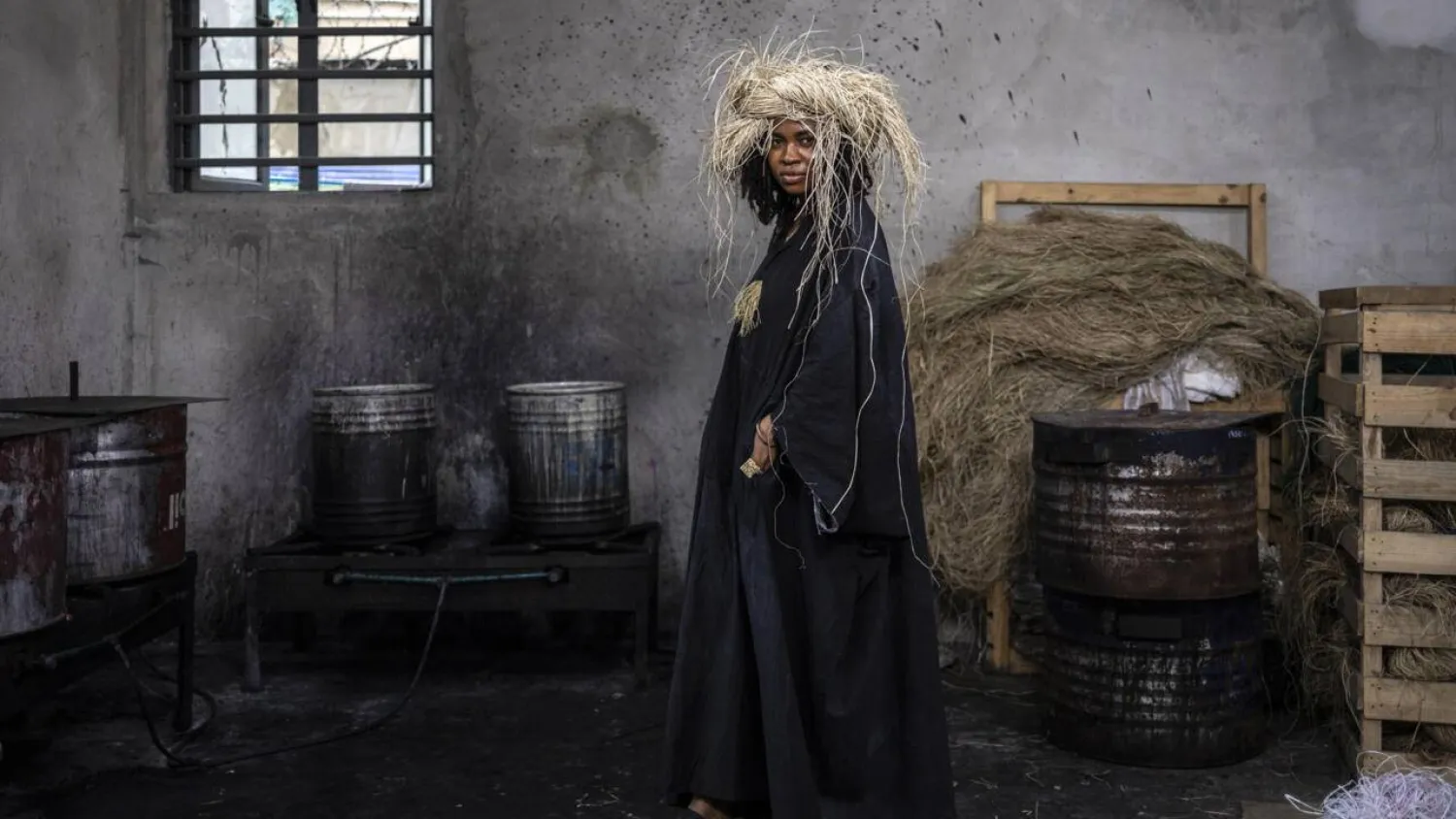

Local Fabrics, Fibers Shine at Eco-centered Lagos Fashion Week

Abasiekeme Ukanireh, founder of Nigerian brand of Eki Kere, is known for incorporating raffia into her designs. OLYMPIA DE MAISMONT / AFP
TT

Local Fabrics, Fibers Shine at Eco-centered Lagos Fashion Week

Abasiekeme Ukanireh, founder of Nigerian brand of Eki Kere, is known for incorporating raffia into her designs. OLYMPIA DE MAISMONT / AFP

Four days ahead of her show at Lagos Fashion Week, the sewing machines at Abasiekeme Ukanireh's workshop were still buzzing.

Ukanireh, the founder of the popular Nigerian brand Eki Kere, met with models and tailors for the final preparations ahead of one of Africa's biggest fashion events, which ran through Sunday.

On the agenda: local materials, upcycling and African craftsmanship.

"Every single year for a brand, for me, as a designer, I always try to take it a step further in terms of being sustainable," Ukanireh, 35, told AFP.

Sustainability -- long both a bugbear and a buzzword in the fashion industry -- was a key feature of this year's Lagos Fashion Week, with designers from across the continent tapping into everything from traditional fabrics to banana fiber and coffee grounds.

Launched in 2020, Ukanireh's brand is known for its use of raffia, a grassy fiber from palm trees used in everything from thatched roofs to trendy bags.

This year, she played up the use of indigo and dyes made from kola nuts -- though she hadn't forgotten her raffia roots.

During her show Sunday, dozens of models walked the runway wearing outfits inspired by traditional wedding ceremonies in Ikot Ekpene, a historic town popularly known as "Raffia City" in southern Akwa Ibom state, where Ukanireh hails from.

The traditional wedding lace was swapped for cardboard, linen and raffia -- which is 100 percent biodegradable and compostable.

In 2018, the Lagos Fashion Week founder Omoyeni Akerele and her team launched Green Access, an incubator program that identifies, trains and supports young African designers.

"Even though sustainability is at the core of their design practice, it is to encourage them to even be more sustainable by rethinking their choices at every stage of the creative process, and understanding that it begins with materials," Akerele said.

Lagos Fashion Week also hosts what it calls "Swapshop" events, which allow people to exchange clothes they no longer wear for new ones.

"We all have clothes at home that we no longer wear," said 43-year-old businesswoman Danielle Chukwuma, who has attended several editions of the show.

"It's great to be able to swap them with people as stylish as those attending this kind of event."

Apart from Nigerian brands, Chukwuma has also discovered other African talents, including the Indian-Kenyan designer Ria Ana Sejpa of the brand LilaBare.

This year was Sejpa's third appearance at Lagos Fashion Week.

"Lagos is the fashion capital of Africa," she told AFP. "Fashion is a part of the culture here. People take pride in the way they dress, they love to stand out, and they aren't afraid to be fearless or glamorous."

The 34-year-old designer is known for making clothes from pineapple fiber, banana fiber and coffee grounds.

"It is essential to take into consideration your ecosystem, the strengths of the environment and the people around you, and to make conscious decisions at every step of the fashion creation process," Sejpa said.

31-year-old Florentina Hertunba, who is making waves with her brand Hertunba, shared the same view.

She said she incorporates traditional Nigerian fabrics such as aso oke and akwete as well as other locally available materials into her designs and uses biodegradable packaging to cut down waste.

"This piece is recycled," the young designer explained, pointing to a patterned black dress in her Lagos studio. "An old fabric was transformed into sewing thread and then reused to create it."

But for her, sustainability is only sustainable if consumers join the movement.

"One of the greatest dangers is this culture of overconsumption, where we constantly buy new clothes for every occasion," she told AFP. "Sustainable fashion is making progress, but overconsumption is too."



Globes Red Carpet: Chic Black, Elegant Dresses and a Bit of Politics

Ariana Grande is a nominee for her turn as Glinda in 'Wicked: For Good'. Frederic J. Brown / AFP
TT

Globes Red Carpet: Chic Black, Elegant Dresses and a Bit of Politics

Ariana Grande is a nominee for her turn as Glinda in 'Wicked: For Good'. Frederic J. Brown / AFP

Hollywood's top stars hit the red carpet on Sunday for the Golden Globes, the first major event on the road to the Oscars, and they delivered lots of old-school glamour.

Here is a glance at some of the looks seen at the Beverly Hilton Hotel:

Ever-chic black

Selena Gomez is a newlywed and her happiness shows. The best comedy actress nominee for her work on "Only Murders in the Building" radiated joy as she arrived on the arm of her husband Benny Blanco.

She oozed sophistication in a black Chanel column gown with a frothy white feathered strapless neckline, her black bob swept into soft waves.

Gomez was not alone in striking an understated pose, with lots of stars opting for black or dark, wintry hues.

Teyana Taylor, a winner for her searing turn as a leftist revolutionary in hotly-tipped film "One Battle After Another," scorched the carpet in a cut-out backless black Schiaparelli gown with a halter neckline -- and a cheeky crystal bow on her backside.

Ariana Grande ("Wicked: For Good"), who competed with Taylor for the award for best supporting actress, turned heads in a black textured Vivienne Westwood ballgown with an asymmetrical neckline and a bubble silhouette before trailing to the floor.

Her hair was swept into her signature ponytail, and she kept the jewelry simple with a diamond choker.

Amy Madigan, also in their category for her villainous turn in "Weapons," went for a tuxedo look with cropped pants and patent leather boots.

Nominee Jenna Ortega embraced the goth chic of her title character in "Wednesday" in a black high-neck Dilara Findikoglu gown with glittering epaulets and cut-offs that revealed a bit of side boob... and part of her hip bone.

Among the male stars in attendance, Colman Domingo was as usual a standout, wearing head-to-toe black Valentino, with silvery appliques scattered from his left shoulder down his lapel to his waist.

Jennifer Lopez is no stranger to strong fashion statements. Her plunging green Versace gown at the Grammys in 2000 is still a reference for winning the red carpet by adopting the "less is more" rule.

On Sunday, Lopez -- whose turn in "Kiss of the Spider Woman" was overlooked by Globes voters -- wore a figure-hugging sheer gown with bronze patterns snaking over her body, ending in a mermaid fishtail.

Jennifer Lawrence --nominated for best drama actress in a film for "Die My Love" -- got the memo as well, rocking a barely-there sheer nude Givenchy gown with only a smattering of strategically placed flowers.

- Stars slam deadly ICE shooting -

Hollywood never quite has a night out without a bit of politics coming into play.

On Sunday, some of the stars including nominee Mark Ruffalo wore pins with the messages "BE GOOD" -- a reference to Renee Good, the Minneapolis woman who was shot and killed by a federal immigration agent.

Comedian Wanda Sykes wore the same pin on her lapel, while actress Natasha Lyonne, a nominee for her TV show "Poker Face," attached one to her clutch handbag.

The campaign is endorsed by the American Civil Liberties Union (ACLU), one of the country's most prominent civil rights organizations.


UK's Next Edges Up Profit Outlook after Christmas Sales Beat Expectations

FILE PHOTO: Shoppers walk past a NEXT retail store on Oxford Street in London, Britain, December 28, 2025. REUTERS/Isabel Infante/File Photo
TT

UK's Next Edges Up Profit Outlook after Christmas Sales Beat Expectations

FILE PHOTO: Shoppers walk past a NEXT retail store on Oxford Street in London, Britain, December 28, 2025. REUTERS/Isabel Infante/File Photo

British fashion retailer Next on Tuesday reported a better-than-expected 10.6% increase in full-price sales for the nine weeks to December 27 and edged up its annual profit guidance for the fifth time over the last year.

Subdued UK ⁠consumer confidence ahead of Christmas coupled with unseasonably mild weather had left analysts cautious about clothing retailers' festive trading prospects.

However, Next reported a 5.9% increase in UK ⁠sales year-on-year, with international sales up 38.3%.

According to Reuters, the group said it now expected to report a pretax profit of 1.15 billion pounds ($1.56 billion) for its year to January 2026, up from previous guidance of 1.135 billion pounds and the 1.011 billion pounds it made in ⁠2024/25 when it breached the 1 billion pounds mark for the first time.

Next forecast a further 4.5% increase in profit to 1.202 billion pounds for its 2026/27 year, on full-price sales up 4.5%.

Shares in Next have risen 43% over the last year.


Saudi Fashion Commission Issues Research Paper on 'Fashion Week Economics'

The Saudi Fashion Commission logo
TT

Saudi Fashion Commission Issues Research Paper on 'Fashion Week Economics'

The Saudi Fashion Commission logo

The Saudi Fashion Commission has issued its research paper for the fourth quarter of 2025, titled Fashion Week Economics, as part of its continued commitment to providing leading sector insights through the Fashion Futures platform.

The paper presents an in-depth analysis of Riyadh Fashion Week's contribution to local economic growth and explores the role of global fashion weeks in the global economy.

It highlights how Riyadh Fashion Week reflects the Kingdom's cultural and creative development, marking the beginning of a new era for Saudi creative industries, one driven by cultural confidence and economic ambition, through a dynamic integration of creativity, commerce, and culture aligned with the vision of a thriving creative economy.

The research also examines themes including the economic and cultural value of fashion weeks worldwide, the role of fashion-week events as global economic drivers, and case studies of various brands showcased at Riyadh Fashion Week 2025.

Through publishing this paper, the Fashion Commission continues to provide essential economic data and sector insights into the rapidly evolving fashion industry.

Riyadh Fashion Week targets designers, brands, creative talent, buyers, retailers, sponsors, and partners, serving as a central platform for opportunities across the market. Its rapid expansion across three editions, featuring more than 100 participating brands and attracting approximately 27,000 visitors, has delivered significant value in terms of media presence, relationship building, and business growth for participants.

The participation of major global fashion houses such as Vivienne Westwood and Stella McCartney in the third edition further reflects Riyadh’s growing influence in international luxury circles and its increasing global standing.