
Much Like a Nursing Home, Penguins at a Boston Aquarium Can Age with Dignity

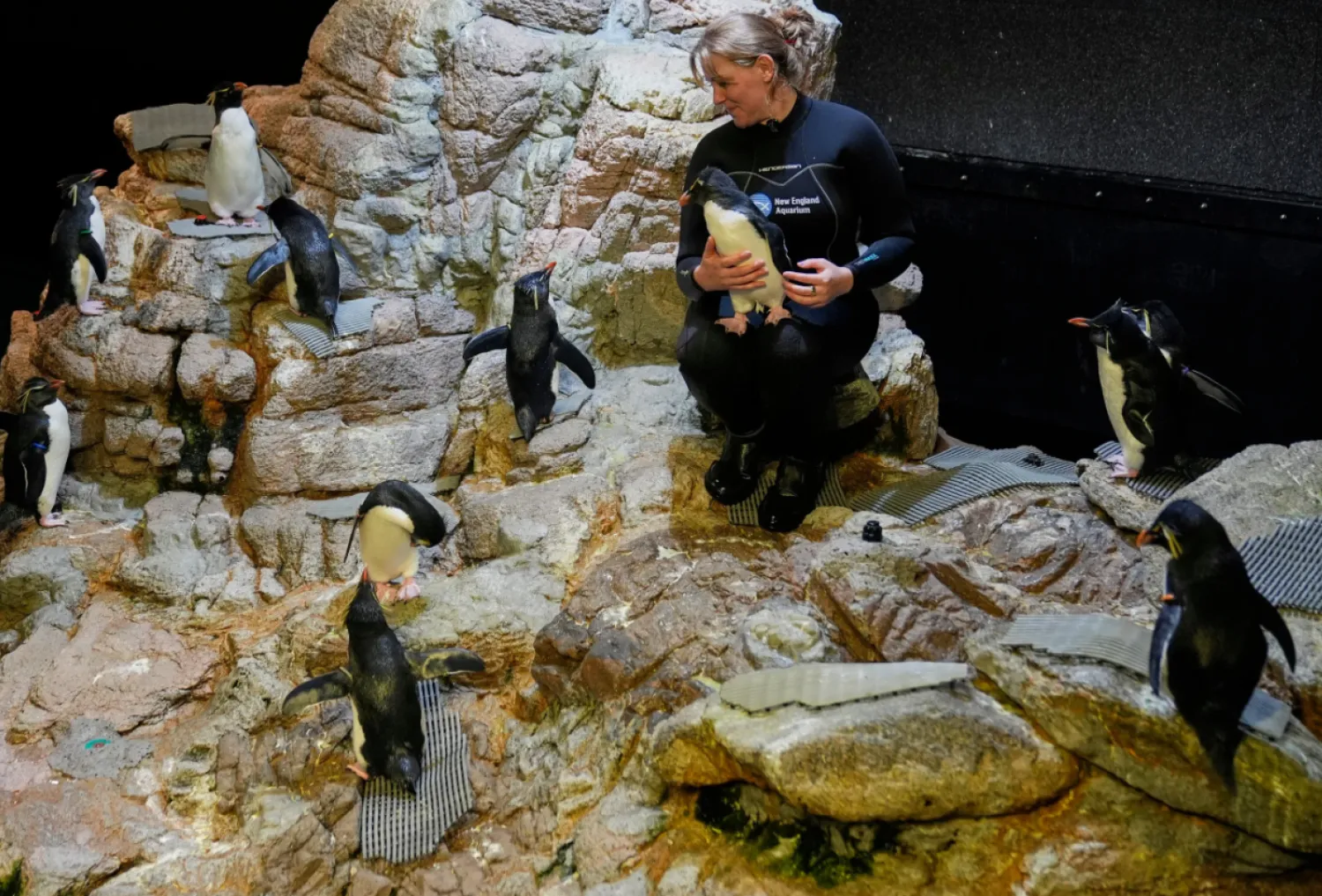
Senior penguin trainer Mia Luzietti sits with southern rockhopper penguins at the New England Aquarium in Boston, on Wednesday, Oct. 29, 2025. (AP Photo/Robert F. Bukaty)
TT

Much Like a Nursing Home, Penguins at a Boston Aquarium Can Age with Dignity

Senior penguin trainer Mia Luzietti sits with southern rockhopper penguins at the New England Aquarium in Boston, on Wednesday, Oct. 29, 2025. (AP Photo/Robert F. Bukaty)

When Lambert started losing his vision and slowing down a few steps, it became clear that he needed to be relocated to a place where he could age safely and still be with his friends.

But he couldn't be placed in just any nursing home — because he is a critically endangered African penguin. Instead, the New England Aquarium in Boston, where the 33-year-old Lambert was born and has lived his entire life, decided in February to open a geriatric island for him and its six other aging penguins.

“Honestly, it sort of started off as a joke. It’s like, ‘Oh, well, why don’t we give them an old folks home?’” Eric Fox, associate curator of penguins at the aquarium, said. “But the more we were looking at their welfare data and understanding what ailments they go through, what physical limitations they have, we started to realize that we were on to something.”

The rocky island near the aquarium entrance is set apart from the rest of the 38-bird colony, ensuring the older penguins don't have to compete for territory with their often aggressive, younger peers. These penguins, with their trademark black and white feathers, stand about 2 feet (0.6 meters) tall and weigh about as much as a large house cat, The AP news reported.

The enclosure has some flatter topography and a carpeted path down to the water, which allows Lambert and the other penguins to better navigate up and down the island. The aquarium has built a stand in front of the island, which makes it easier for the penguins to hop out of the water.

As a result, Mia Luzietti, a senior penguin trainer at the aquarium, said she has seen Lambert become more active since moving to the new island — swimming more with his mate and getting off the island more often.

The concept was inspired by a larger concern that is confronting zoos and aquariums around the world — what to do when their animals are surviving far longer than their counterparts in the wild. In the case of these African penguins, some are in their 30s and one lived into its 40s. That is twice as long as they would live in the wilds of South Africa and Namibia, due to threats like pollution and lack of food from humans’ overfishing.

“It's really important that, as we learned how long these animals could live, if given an optimal environment, that we evolved with that,” Luzietti said.

“So learning on an individual level, how can we best set our animals up for success is really what led to the idea of creating our geriatric island, a place where our oldest penguins have a more comfortable, slower way of life as they live out their days here,” she added.

Caring for the aging penguins goes far beyond a safer enclosure.

The older birds get more checkups than their younger counterparts, and veterinarians offer them treatment for ailments that might be familiar to older humans — such as supplements and anti-inflammatory drugs for arthritis and joint pain, and eye drops for glaucoma. There are also more cameras around the island, so staff can better monitor the birds.

“We are just keeping a little closer of an eye on some of these older birds,” Luzietti said. “It’s important that we’re picking up on those — from how someone’s hips are moving, how they’re walking, how they are acting, if someone’s squinting. The smallest change day to day can be hiding a really big secret.”

On a recent day, Luzietti was in the geriatric enclosure tending to Lambert — who seemed content to stand at the top of the island with his mate Dyer III, preening one another and occasionally letting out a loud call that sounded like a donkey's bray. He previously had his left eye removed due to an infection and has glaucoma in his right eye. He also suffers from chronic inflammation.

Luzietti coaxed him down from his perch, and soon he was sitting on her lap, getting ready for his daily dose of eye drops.

A crowd had formed around the enclosure to watch, including Terri Blessman, a 69-year-old tourist from Canton, Illinois, who was being pushed in a wheelchair by her friend Lou Ann Delost. Hearing about Lambert's age and the care he gets, Blessman said she could relate.

“That's wonderful,” Blessman said. “All of us older people need extra care as we get older.”


Hawaii's Kilauea Volcano Puts on Spectacular Lava Display

Kilauea has been regularly throwing out thousands of tonnes of molten rock and gases since it burst to life in December 2024. UNITED STATES GEOLOGICAL SURVEY/AFP
TT

Hawaii's Kilauea Volcano Puts on Spectacular Lava Display

Kilauea has been regularly throwing out thousands of tonnes of molten rock and gases since it burst to life in December 2024. UNITED STATES GEOLOGICAL SURVEY/AFP

Hawaii's Kilauea was spraying a spectacular fountain of lava on Monday, keeping up its reputation as one of the world's most active volcanoes.

For over a year now, Kilauea has been regularly throwing out thousands of tons of molten rock and gases since it burst to life in December 2024, reported AFP.

Volcanologists with the US Geological Survey said the incandescent lava was being hurled more than 1,500 feet (460 meters) into the air, with plumes of smoke and gases rising as high as 20,000 feet (six kilometers).

Eruptions such as this one tend to last around one day, the USGS said, but can still vent up to 100,000 tons of sulfur dioxide.

This gas reacts in the atmosphere to create a visible haze known as vog -- volcanic smog -- which can cause respiratory and other problems.

Tiny slivers of volcanic glass, known as "Pele's hair," are also being thrown into the air.

Named after Pele, the Hawaiian goddess of volcanoes, the strands can be very sharp and can cause irritation to the skin and eyes.

The eruption poses no immediate danger to any human settlement, with the caldera having been closed to the public for almost two decades.

Kilauea has been very active since 1983 and erupts relatively regularly.

It is one of six active volcanoes located in the Hawaiian Islands, which also include Mauna Loa, the largest volcano in the world.

Kilauea is much smaller than neighboring Mauna Loa, but it is far more active and regularly wows helicopter-riding tourists who come to see its red-hot shows.


Astronaut's Serious Medical Condition Forces NASA to End Space Station Mission Early

Crew-11 mission astronauts departed the Kennedy Space Center in Cape Canaveral, Florida on August 1, 2025 (Gregg Newton/AFP)  
TT

Astronaut's Serious Medical Condition Forces NASA to End Space Station Mission Early

Crew-11 mission astronauts departed the Kennedy Space Center in Cape Canaveral, Florida on August 1, 2025 (Gregg Newton/AFP)  

NASA announced that four astronauts will return from the International Space Station more than a month ahead of schedule after an unnamed crew member experienced a medical issue.

The incident marks the first time in history NASA has brought astronauts home from the space station early because of a medical issue, according to CNN.

NASA has not provided details about the nature of the problem, citing privacy concerns. The agency typically does not discuss the specifics of health matters related to astronauts.

A SpaceX Crew Dragon capsule will bring the four-person crew home, disembarking from the ISS as soon as Wednesday at 5 pm ET. The spacecraft is then expected to splash down off the coast of California early the following morning, NASA said in a statement last week.

The affected astronaut is in stable condition, NASA previously confirmed, and is not expected to receive special treatment during the return trip, said Dr James Polk, NASA’s chief health and medical officer at the agency’s headquarters.

The astronaut would also be best served by being evaluated on the ground, Polk added.

“We have a very robust suite of medical hardware on board the International Space Station,” Polk noted during a news conference. “But we don’t have the complete amount of hardware that I would have in the emergency department, for example, to complete a workup of a patient.”

He added, “And in this particular incident, we would like to complete that work up, and the best way to complete that workup is on the ground.”


Astronomers Spot White Dwarf Star Creating a Colorful Shockwave

The central square image, taken with the MUSE instrument on ESO's Very Large Telescope, shows shock waves around the dead star RXJ0528+2838. (European Southern Observatory (ESO)/K. Ilkiewicz and S. Scaringi et al./Handout via Reuters)
TT

Astronomers Spot White Dwarf Star Creating a Colorful Shockwave

The central square image, taken with the MUSE instrument on ESO's Very Large Telescope, shows shock waves around the dead star RXJ0528+2838. (European Southern Observatory (ESO)/K. Ilkiewicz and S. Scaringi et al./Handout via Reuters)

Astronomers have observed a white dwarf - a highly compact Earth-sized stellar ember - that is creating a colorful shockwave as it moves through space, leaving them searching for an explanation.

The highly magnetized white dwarf is gravitationally bound to another star in what is called a binary system. The white dwarf is siphoning gas from its companion as the two orbit close to each other. The system is located in the Milky Way about 730 light-years from Earth - relatively nearby in cosmic terms - in the constellation Auriga.

A light-year is the distance light travels in a year, 5.9 trillion miles (9.5 trillion km).

The shockwave - more specifically a bow shock - caused by the white dwarf was observed using the European Southern Observatory's Chile-based Very Large Telescope. The shockwave was seen in an image released by the scientists glowing in various colors produced when material flowing outward from the white dwarf collided with interstellar gas.

"A shockwave ‌is created when ‌fast-moving material plows into surrounding gas, suddenly compressing and heating it. A ‌bow shock ⁠is the curved ‌shock front that forms when an object moves rapidly through space, similar to the wave in front of a boat moving through water," said astrophysicist Simone Scaringi of Durham University in England, co-lead author of the study published on Monday in the journal Nature Astronomy.

"The colors come from interstellar gas that is being heated and excited by the shock. Different chemical elements glow at specific colors when this happens," Scaringi added.

In this shockwave, a red hue represented hydrogen, green represented nitrogen and blue represented oxygen residing in interstellar space.

A handful of other white dwarfs have been observed creating shockwaves. But all of those were ⁠surrounded by disks of gas siphoned from a binary partner. Although this white dwarf is siphoning gas from its companion, it lacks any such disk and ‌is releasing gas into space for unknown reasons.

White dwarfs are among the ‍universe's most compact objects, though not as dense as ‍black holes.

Stars with up to eight times the mass of the sun appear destined to end up as ‍a white dwarf. They eventually burn up all the hydrogen they use as fuel. Gravity then causes them to collapse and blow off their outer layers in a "red giant" stage, eventually leaving behind a compact core - the white dwarf.

"There are plenty of white dwarfs out there, as these are the most common endpoints of stellar evolution," Scaringi said.

The sun appears fated to end its existence as a white dwarf, billions of years from now.

This white dwarf has a mass comparable to the sun contained in a body slightly larger than Earth. Its binary companion is ⁠a type of low-mass star called a red dwarf that is about a tenth the mass of the sun and thousands of times less luminous. It orbits the white dwarf every 80 minutes, with the two extremely close to each other - approximately the distance between the moon and Earth.

The gravitational strength of the white dwarf is pulling gas off the red dwarf. This siphoned material is being pulled into the white dwarf along its strong magnetic field, eventually landing at its magnetic poles. While this process releases energy and radiation, it cannot account for the outflow of material needed to produce the observed shockwave, Scaringi said.

"Every mechanism with outflowing gas we have considered does not explain our observation, and we still remain puzzled by this system, which is why this result is so interesting and exciting," Scaringi said.

"The shape and length of the (shockwave) structure show that this process has been ongoing for at least about 1,000 years, making it long-lived rather than a one-off event," Scaringi added.

The ‌researchers took note of the aesthetics of the colorful shockwave.

"Beyond the science, it's a striking reminder that space is not empty or static as we may naively imagine it: it's dynamic and sculpted by motion and energy," Scaringi said.