


Famine Spreads to Two More Areas in Sudan, Global Hunger Authority Says

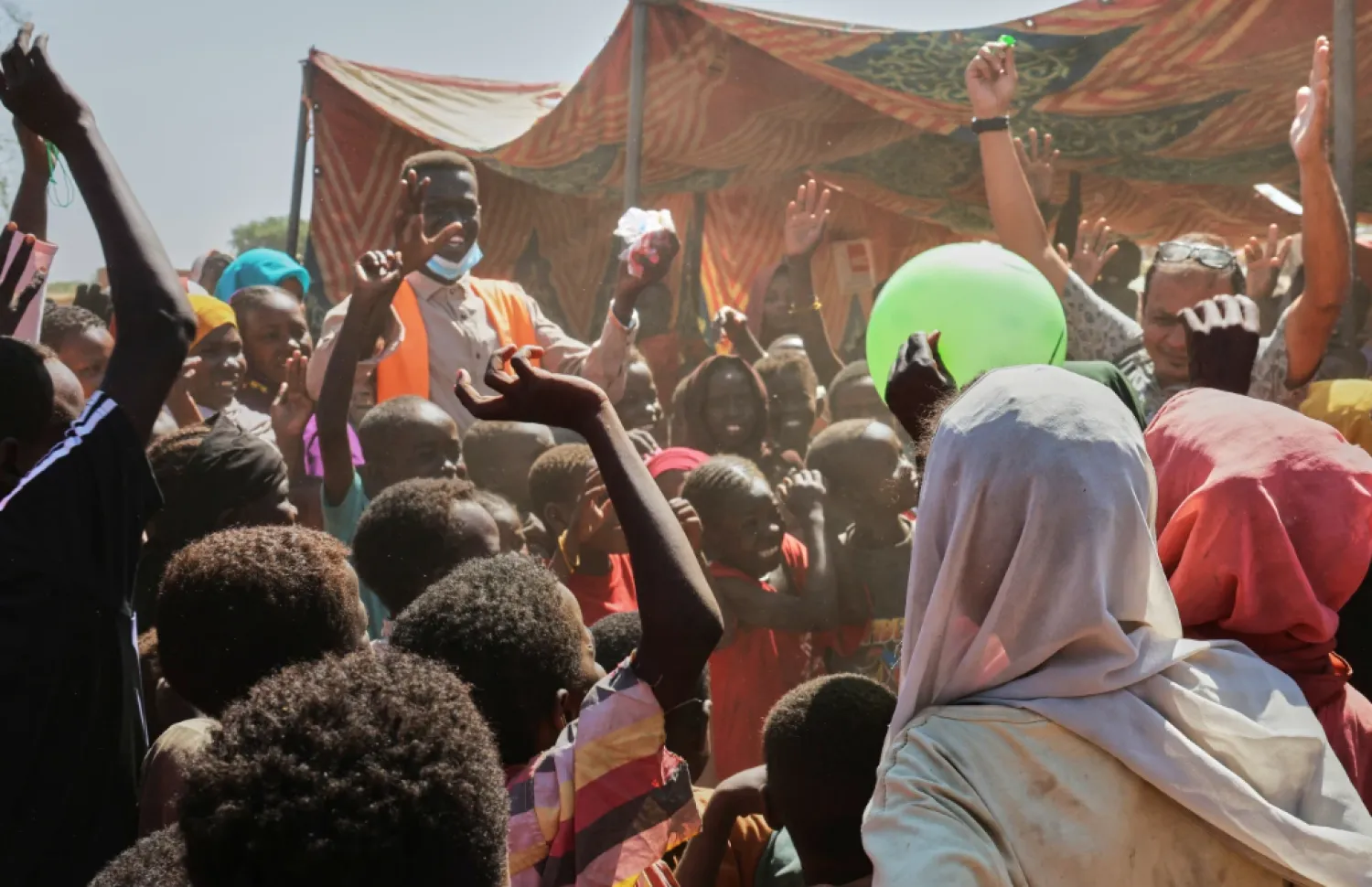
This photo released by The Norwegian Refugee Council (NRC), shows displaced children from el-Fasher playing at a camp where they sought refuge from fighting between government forces and the RSF, in Tawila, Darfur region, Sudan, Monday, Nov. 3, 2025. (Marwan Mohammed/NRC via AP)
TT

Famine Spreads to Two More Areas in Sudan, Global Hunger Authority Says

This photo released by The Norwegian Refugee Council (NRC), shows displaced children from el-Fasher playing at a camp where they sought refuge from fighting between government forces and the RSF, in Tawila, Darfur region, Sudan, Monday, Nov. 3, 2025. (Marwan Mohammed/NRC via AP)

Famine has spread to two regions of war-torn Sudan, including a major city in Darfur where Rapid Support Forces (RSF) fighters have been rampaging, a global hunger monitoring group said Monday, as the war has created the world’s largest humanitarian disaster.

The Integrated Food Security Phase Classification, the leading international authority on hunger crises, said famine has been detected in el-Fasher in Darfur and Kadugli town in South Kordofan province. Twenty other areas in Darfur and Kordofan, where fighting has intensified in recent months, are also at risk of famine, according to the IPC.

El-Fasher had been under siege by the RSF for 18 months, cutting off much food and other supplies to tens of thousands of people. Last week, RSF fighters seized el-Fasher, reportedly unleashing attacks that killed hundreds, though the scope of violence is unclear as communications are poor, The AP news reported.

Kadugli town also has been under RSF siege for months with tens of thousands of people trapped, as the RSF group tries to seize more territory from its rival, the Sudanese military.

‘Extremely high levels of malnutrition’ The war has torn Sudan apart since April 2023. More than 40,000 people have been killed, according to UN figures, but aid groups say the true number could be many times higher. The fighting has driven more than 14 million people from their homes and fueled disease outbreaks.

The latest IPC report said el-Fasher and Kadugli have experienced “a total collapse of livelihoods, starvation, extremely high levels of malnutrition and death.”

Famine is determined in areas where deaths from malnutrition-related causes reach at least two people, or four children under 5, per 10,000; at least one in five people or households severely lack food and face starvation; and at least 30% of children under 5 suffer from acute malnutrition based on a weight-to-height measurement — or 15% based on upper-arm circumference.

The IPC has confirmed famine only a few times, most recently in northern Gaza earlier this year amid Israel’s campaign against Hamas. It also confirmed famine in Somalia in 2011 and South Sudan in 2017 and 2020.

The IPC previously declared famine in five locations in Sudan. Three were sprawling refugee camps near el-Fasher that have emptied as RSF troops advanced, with most people fleeing into el-Fasher or nearby towns. The other locations were in parts of South and West Kordofan provinces that have since also fallen into RSF hands.

The new report warned that towns near el-Fasher, including Tawila, Melit and Tawisha, are at risk of famine.

It said about 375,000 people had been pushed into famine in Darfur and Kordofan as of September, and another 6.3 million people across Sudan face extreme levels of hunger.

RSF focuses on Darfur Since Sudan’s military retook the capital, Khartoum, earlier this year, the RSF has turned its focus to the Darfur region in the west, and on taking Kordofan to secure supply lines toward the country’s center.

Save the Children in September said food supplies had run out in Kadugli, where it said fighting had escalated.

Another Kordofan town, Dilling, has reportedly experienced the same conditions as Kadugli, but the IPC didn’t announce famine there for lack of data, the new report said.

Across Sudan, the IPC said more than 21 million people, or 45% of the population, faced acute food insecurity as of September, a 6% drop from the previous report which covered the period from December 2024 until May this year.

The drop was due to reduced conflict and improved humanitarian access in Khartoum, neighboring Gezira province and the eastern province of Sennar after military regained control of Khartoum and Gezira, allowing more than a million displaced people to return home.

The IPC called for a ceasefire as the sole measure that “can prevent further loss of life and help contain the extreme levels of acute food insecurity and acute malnutrition.”



Syrian Interior Ministry Details Results of Security Campaigns in Latakia, Damascus Countrysides

Security personnel inside the Imam Ali bin Abi Talib Mosque in the Wadi al-Dhahab neighborhood of Homs following a bombing . (AFP)
TT

Syrian Interior Ministry Details Results of Security Campaigns in Latakia, Damascus Countrysides

Security personnel inside the Imam Ali bin Abi Talib Mosque in the Wadi al-Dhahab neighborhood of Homs following a bombing . (AFP)

Syria’s Interior Ministry has announced the results of a series of security operations carried out in recent days in Homs, Latakia, and the Damascus countryside, including the arrest of two alleged ISIS members accused of involvement in the bombing of the Imam Ali bin Abi Talib Mosque in Homs last month.

The ministry said the operations led to the arrest of three senior figures in a cell known as “Lieutenant Abbas,” affiliated with the “Coastal Shield Brigade” led by Miqdad Fteiha, a prominent figure loyal to the former regime.

Security forces also detained an armed group in the al-Wuroud neighborhood of Damascus that was allegedly planning “acts of sabotage.”

The operations form part of broader efforts to dismantle armed groups and restore the state’s exclusive authority over weapons.

Interior Minister Anas Khattab vowed to continue pursuing ISIS operatives and bringing them to justice.

In a post on X, he said security and intelligence services had conducted a “highly precise operation” resulting in the arrest of those involved in the December 26 attack on the Imam Ali bin Abi Talib Mosque in the Wadi al-Dhahab district of Homs, which killed eight people and wounded 18 others.

According to the Interior Ministry, security units in Homs, in coordination with the General Intelligence Service, arrested two persons identified as ISIS members. Authorities said explosive devices, various weapons, ammunition, documents, and digital evidence allegedly linking the suspects to terrorist activities were seized.

The two were referred to the Counterterrorism Directorate to complete investigations ahead of prosecution.

In a separate statement earlier Monday, the Interior Ministry said a “valuable catch” was detained by security and intelligence forces in Latakia. It said he was a key figures in the “Lieutenant Abbas” cell. Initial investigations indicated the cell had targeted internal security and army positions in the province.

Meanwhile, in the Damascus countryside, the ministry said security forces carried out a “preemptive operation” in the al-Wuroud neighborhood of Qudsaya city, arresting three individuals accused of planning armed attacks.

The ministry said security services would continue pursuing remaining members of the groups, pledging to “eradicate them completely” to ensure security and stability.


Gaza Deal: Cairo Talks Aim to Settle Sector’s ‘Administrative Committee’

Displaced Palestinians stand beside a pool of rainwater amid makeshift shelters at the Bureij refugee camp in central Gaza (AFP). 
TT

Gaza Deal: Cairo Talks Aim to Settle Sector’s ‘Administrative Committee’

Displaced Palestinians stand beside a pool of rainwater amid makeshift shelters at the Bureij refugee camp in central Gaza (AFP). 

Cairo is hosting renewed consultations on the Gaza ceasefire agreement, which entered into force on Oct. 10, following the arrival of a delegation from Hamas and amid anticipation of an announcement on the committee that will administer the territory.

Experts told Asharq Al-Awsat that the talks provide an important boost at a critical moment for the second phase of the Gaza agreement, which has been stalled for some time. They stressed that moving forward hinges largely on US will and pressure on Israel.

A Palestinian source said Monday that a Hamas delegation headed by the movement’s leader, Khalil al-Hayya, arrived in Cairo to discuss the second phase and push ahead with the ceasefire deal. The source added that indications suggest the Gaza administration committee will be finalized during the Cairo round, with factions briefed on the names, particularly after recent changes prompted by Israeli objections.

Hamas Political Bureau member Mohammed Nazzal said in televised remarks Sunday night that the delegation would discuss follow-up on implementing the ceasefire amid “major difficulties hindering its application and continued Israeli violations.”

He said the delegation would hold meetings with Palestinian factions and forces, as well as with Egyptian officials, to discuss several files linked to the agreement.

These include ways to consolidate the ceasefire and move to subsequent phases, alongside key issues - foremost the formation of a Palestinian technocratic committee to administer Gaza - aimed at preventing Israeli Prime Minister Benjamin Netanyahu from reneging on or delaying the deal.

Former Egyptian assistant foreign minister and member of the Egyptian Council for Foreign Affairs, Ambassador Rakha Ahmed Hassan, said the Cairo consultations are highly significant and could revive the stalled agreement.

He pointed to anticipation surrounding US President Donald Trump’s announcement of a Peace Council, followed by the Gaza administration committee, adding that discussions would also cover approaches to dealing with weapons in Gaza to undercut Netanyahu’s justifications.

He suggested Hamas would press for full implementation of the first phase first, including opening the Rafah crossing from the Palestinian side, increasing aid, maintaining the ceasefire, and Israel’s withdrawal from Gaza in parallel with any later steps.

On the Egyptian front, Foreign Minister Badr Abdelatty stressed, during a Cairo meeting with Irish Minister for Migration, Trade and Defense Helen McEntee, the importance of announcing a temporary Palestinian technocratic committee to manage daily affairs in Gaza and forming an international stabilization force.


Lebanese Govt Vows to Carry out Second Phase of Plan to Impose State Monopoly over Arms

Lebanese Prime Minister Nawaf Salam and ambassadors of the quintet countries meet at the Grand Serail in Beirut. (Lebanese government's press office)
TT

Lebanese Govt Vows to Carry out Second Phase of Plan to Impose State Monopoly over Arms

Lebanese Prime Minister Nawaf Salam and ambassadors of the quintet countries meet at the Grand Serail in Beirut. (Lebanese government's press office)

Lebanese Prime Minister Nawaf Salam stressed on Monday that his country is determined to carry out the second phase of imposing state monopoly over weapons that the government approved last year.

The army is expected to kick off in February the second phase of the plan, which covers areas north of the Litani River. The first phase, covering south of the river, is close to completion.

Salam received at the Grand Serail in Beirut on Monday ambassadors of the quintet committee overseeing the ceasefire with Israel. The quintet includes Saudi Ambassador to Lebanon Waleed al-Bukhari, French Ambassador Herve Magro, Qatari Ambassador Sheikh Saud bin Abdulrahman Al Thani, Egyptian Ambassador Alaa Moussa, and the United States' Ambassador Michel Issa.

After the talks, Salam said he expressed his gratitude to the envoys for their continued support for his reformist government and the army's disarmament plan.

"I stressed to them our firm determination to implement the second phase of the plan," he added.

Egyptian envoy Moussa said the meeting tackled several issues, including Lebanon's economic reforms and the disarmament plan.

The Lebanese state and army are on the right path, he remarked.

"We have positively assessed the first phase and the state's efforts have been very encouraging," he added.

Moreover, he stressed that Egypt is maintaining its efforts to de-escalate the tensions in Lebanon, especially in the South.

"Our sole goal is to create the circumstances that would ease the tensions," Moussa said.

"We are informing the Lebanese government of all of our efforts. We believe that if the situation is left without Egyptian or non-Egyptian efforts, then the chances of escalation will be greater," he continued.

"We have so far averted the situation from deteriorating," he added.

Meanwhile, Hezbollah has opposed efforts to kick off the second phase of the disarmament plan. It had already objected to its disarmament altogether.

Hezbollah MP Hussein Ezzedine said: "The government should work on getting the enemy to unconditionally withdraw from Lebanese territories it is occupying and release prisoners."

He said it should "avoid making concessions at the expense of the national interest, which will only encourage the enemy to continue to extort" Lebanon.