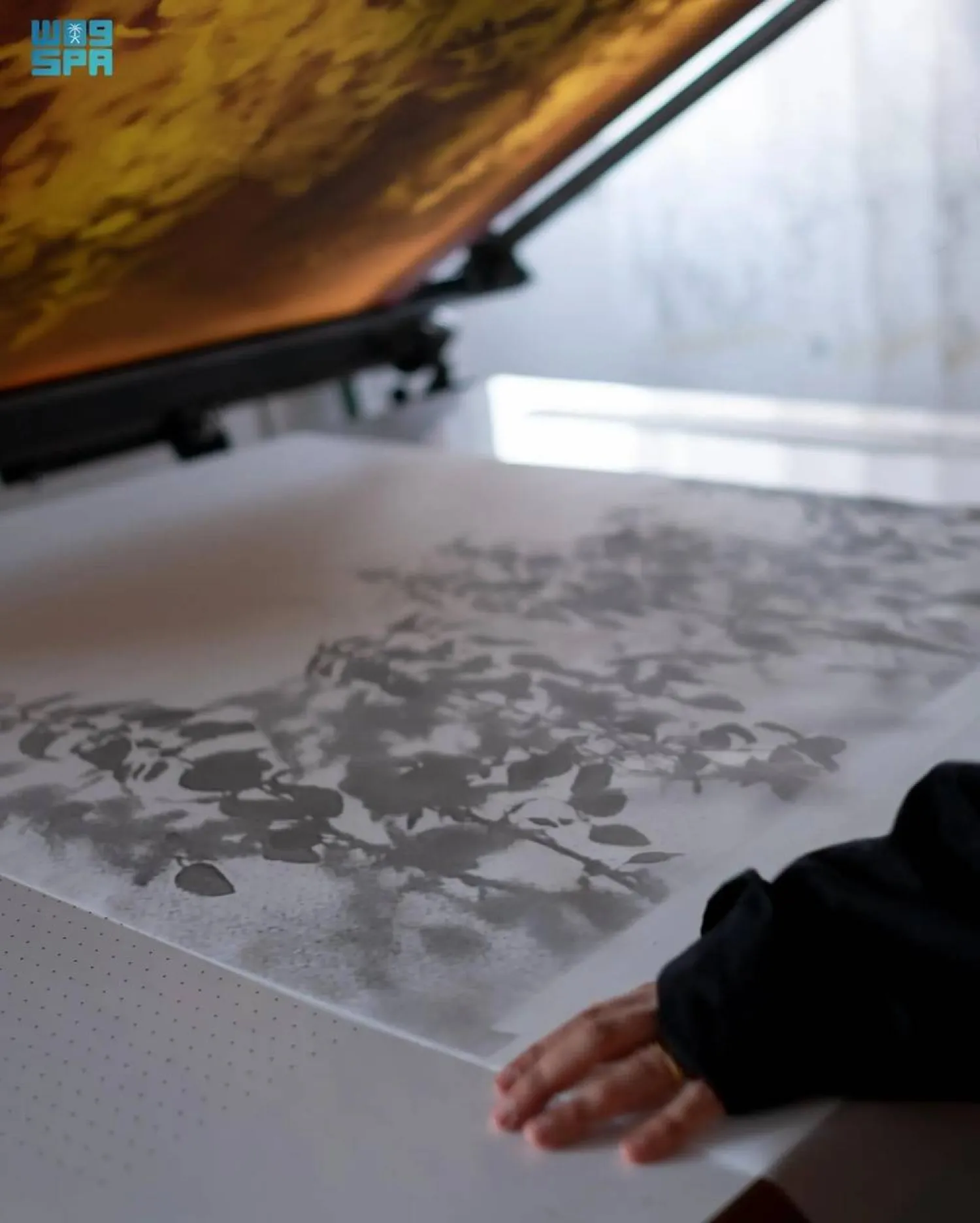
'Diriyah Biennale' Supports New Work by Fatma Abdulhadi, Presented at 14th Taipei Biennial 2025

The Diriyah Biennale Foundation announced that Fatma Abdulhadi will present a new work at the 14th Taipei Biennial 2025. (SPA)
TT

'Diriyah Biennale' Supports New Work by Fatma Abdulhadi, Presented at 14th Taipei Biennial 2025

The Diriyah Biennale Foundation announced that Fatma Abdulhadi will present a new work at the 14th Taipei Biennial 2025. (SPA)

The Diriyah Biennale Foundation announced that Fatma Abdulhadi will present a new work at the 14th Taipei Biennial 2025. The production of the work was partly funded by the Diriyah Biennale Foundation, as part of a continued commitment to supporting Saudi and Saudi-based artists in being well represented on the international stage. Other contributions came from the Taipei Fine Arts Museum.

In a statement on Monday, the Diriyah Biennale Foundation said Abdulhadi’s work, called “What Remains: Stay as Long as You Can,” is an immersive installation that transcends the idea of a physical garden. The work is an evolution of a previous work, titled “I Wish You in Heaven,” which was commissioned by the Diriyah Biennale Foundation for the Islamic Arts Biennale 2025.

Through layered silkscreen prints, a craft central to the artist’s practice, and the scent of basil, the work evokes cultural and ritual symbolism, guiding the soul on a path toward healing. It becomes a shared, universal space for reflection, inviting visitors to linger, find solace, and rediscover peace after grief.

Fatma Abdulhadi stated: “What Remains: Stay as Long as You Can is, to me, a continuous and universal conversation - an invitation to slow down and recycle memory. In Taipei, the work unfolds as a quiet space for reflection, healing, and connection, where time stretches and stories find new shape.”

CEO of the Diriyah Biennale Foundation Aya Al-Bakree said: “Supporting artists is central to our ambition at the Diriyah Biennale Foundation. We are committed to nurturing Saudi talent and enabling them to engage meaningfully with the international art community."

The 14th edition of the Taipei Biennial 2025, titled “Whispers on the Horizon,” is curated by Sam Bardaouil and Till Fellrath. It will be on view from November 1, 2025, to March 29, 2026, at the Taipei Fine Arts Museum.


Hagia Sophia's Hidden Tunnels Uncovered

A painting depicting the Hagia Sophia Mosque, 1852 (Victoria and Albert Museum)
TT

Hagia Sophia's Hidden Tunnels Uncovered

A painting depicting the Hagia Sophia Mosque, 1852 (Victoria and Albert Museum)

The architectural complex around and beneath Hagia Sophia never ceases to amaze. Six underground spaces, nine tunnels and almost 3,000 tons of soil are revealing unknown facets of the monument's history, according to euronews.

Galleries, ancient water networks and architectural remains, which may date back to a period earlier than the construction of the present-day basilica in the 6th century, are coming to light during restoration work on the historic monument.

So far, 420 meters of underground tunnels have been cleaned, while the Turkish authorities are considering opening some of them to visitors, offering a new perspective on the history of Byzantine Constantinople.

The scale and importance of the work was presented by the Turkish Minister of Culture and Tourism, Mehmet Nuri Ersoy, who went down into Hagia Sophia's underground installations, accompanied by scientists involved in the restoration program.

The Turkish television network CNN Türk has for the first time shown images of the underground galleries and the work taking place in areas that for centuries remained covered by earth and other materials.

As Mehmet Nuri Ersoy explained, the works went 1.5 meters below the floor level that was covered with mud, revealing traces of an earlier building phase.

This finding is of particular historical interest, as the present-day church of Hagia Sophia was built under Emperor Justinian, between 532 and 537, on the site of older Christian churches.

For the moment, however, no secure dating of the newly uncovered remains has been announced. The assessment that they predate the current church remains a matter for scientific investigation.

In the western garden of Hagia Sophia, six different underground spaces have been identified, which are connected by nine tunnels.

According to the Turkish minister, three of these spaces were most likely underground parts of the old atrium, the courtyard that was linked to the church complex.

Investigations are continuing in other areas, some of which take the form of elongated corridors, between four and 4.8 meters wide.

Of the nine tunnels, seven have already been cleared of backfill, while in the remaining two work is under way to record and document them.

The total length of the cleaned sections reaches 420 meters.

The longest tunnel is 180 meters long and is of particular archaeological interest, as scientists are examining whether it might be connected with the so-called Roman Road of Constantinople.

According to scientists' assessments, the underground tunnels of Hagia Sophia formed part of a broader system for managing the waters of historic Constantinople.

Some sections appear to have served in the distribution of water and the removal of rainwater, functions that were essential for the protection and daily use of such a large architectural complex.

Their discovery makes it possible to study more closely the technical infrastructure developed around Hagia Sophia during the different periods of its history.

At the same time, the works are not limited to cleaning the tunnels. They include repairs to the vaults, stabilization of the masonry and reinforcement of sections that have suffered damage.

Beyond the archaeological and historical significance of the works, the Turkish government is now also examining how some of the underground spaces could be used as accessible areas of Hagia Sophia.

Mehmet Nuri Ersoy announced that a special plan is being prepared for presenting the underground structures, with the protection of the monument and the safety of visitors as key conditions.

Another issue under consideration by specialists is whether the underground network could be used to improve the ventilation of the monument.

According to the technical assessments presented by the minister, the existing underground opening can currently cover only 3.6% of Hagia Sophia's ventilation needs. Future studies will examine whether some of the historic galleries could contribute to a modern system supplying fresh air, without altering their architectural character.

Hagia Sophia, which has dominated the historic core of Constantinople for almost fifteen centuries, continues to be the subject of archaeological and architectural research.

The new investigations are now turning attention to the less familiar parts of the monument, below ground level, where the different building phases and the infrastructure of old Constantinople largely remain out of sight.



London Museum Makes 'Miraculous' Move to Former Meat Market

People look at exhibits during a photocall at the new London Museum at the site of the former Smithfield Market, it's new home, in central London on November 24, 2026. (Photo by CARLOS JASSO / AFP)
TT

London Museum Makes 'Miraculous' Move to Former Meat Market

People look at exhibits during a photocall at the new London Museum at the site of the former Smithfield Market, it's new home, in central London on November 24, 2026. (Photo by CARLOS JASSO / AFP)

The London Museum, a free museum telling the story of the British capital, reopens this week in former meat market buildings transformed into an exhibition space.

The museum has relocated from a dated 1970s-era site to a 19th-century brick building formerly part of the Smithfield Market in central London, in a project costing £437 million ($570 million).

The atmospheric new space, which incorporates objects from the last 2,000 years, opens to the public Saturday.

"It's thrilling to see people in the museum," Sharon Ament, the museum's director, told AFP at a press preview Tuesday.

She called the completed building "miraculous and I think, much needed: we've got this great new museum for London."

On the ground floor a huge open space with brick walls and iron columns has seating and places to eat and shop.
This is intended to be "a great big indoor public square," Ament told AFP.

"I think this is a new model for a museum and it's all come about because of the market buildings themselves. I couldn't imagine that we would have ever designed a museum like this from scratch."

The displays reflect recent history: a bike courier's outfit, Indian ready meals and a horse-drawn coffee stall donated by the family who ran it for 100 years.

One display commemorates Grenfell Tower, a block of flats in west London where 72 people were killed in a fire in 2017, with a sign saying the community there "have yet to see the change that they are owed".

Shop signs on the walls come from businesses including Top Shop fashion retailer whose store on Oxford Street closed in 2021.

Most spectacular is the Lord Mayor's gilded coach, used for an annual parade.

"When we were offered these buildings in 2015, we thought it would be the perfect home," said Alec Shaw, the museum manager who oversaw the move.

"It's this incredible set of buildings with amazing architecture but also located right in the middle of the city."

But the site had been disused since the 1990s and was "dripping everywhere", Shaw told AFP. Just restoring the glass roof took about three years.

Smithfield Market, the last major food market in central London, is gradually closing down and the last traders are due to move out in the next few years.

The museum gives a nod to the building's history with archival photographs of hanging carcasses.

A sign calls the market closure a "massive change", while suggesting the "business of food may be too messy for a sanitized city".

Downstairs the main museum houses 5,000 objects in a former railway depot.

A viewing window allows museum-goers to watch commuter trains running past on tracks nearby. The vibration is so strong that mugs in the gift shop upstairs clink against each other.

The diverse displays are roughly chronological, running up to the 2012 Olympics.

One focuses on goldsmiths in the City of London in the 16th and 17th centuries, accompanied by sound effects of hammering and chinking and a treasure trove of more than 500 pieces of jewelry from the era.

Queen Victoria's black silk mourning dress is shown on a mannequin, emphasizing her short stature.

A section on City workers includes a bowler hat and an early "brick" Nokia mobile phone as well as a banker's Armani suit and Hermes scarf from the 2000s.

Pictures of pop stars Boy George and David Bowie feature, along with Russian ballerina Anna Pavlova's feathered Dying Swan costume.

The idea is to show that "when you look across history, you see that all humans are kind of the same: even if they lived 2,000 years ago in Londinium," the city's Roman name, said Ament.

"They had the same fears, the same hopes, the same dreams, the same concerns as us today and that gives us a huge common bond."


Saudi Culture Ministry Introduces Insurance Consulting Service for Cultural Assets

Saudi Culture Ministry Introduces Insurance Consulting Service for Cultural Assets
TT

Saudi Culture Ministry Introduces Insurance Consulting Service for Cultural Assets

Saudi Culture Ministry Introduces Insurance Consulting Service for Cultural Assets

The Ministry of Culture has introduced a cultural insurance consulting service that enables individuals, government entities, and cultural establishments to identify risks to cultural assets and activities and make informed insurance decisions, SPA reported.

The service provides specialized advice on insuring artworks, heritage collections, historic buildings, museums, exhibitions, and cultural events. It aims to reduce the financial impact of risks and strengthen the sustainability of cultural assets in the Kingdom.