


Dick Cheney, Powerful Former US Vice President Who Pushed for Iraq War, Dies at 84 

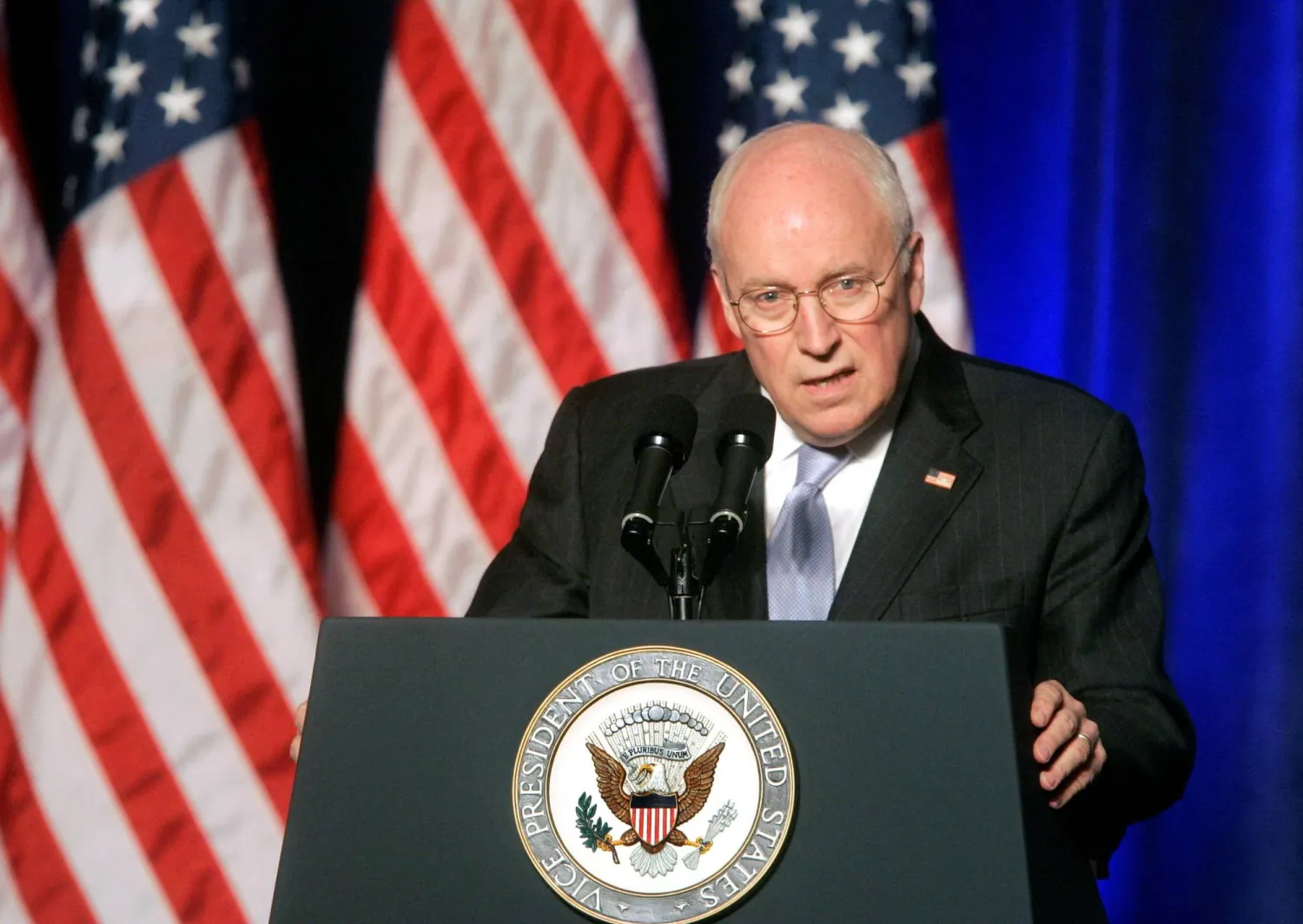
US Vice President Dick Cheney speaks at the American Conservative Union's 2008 Conservative Political Action Conference at the Omni Shoreham Hotel in Washington, February 7, 2008. (Reuters)
TT

Dick Cheney, Powerful Former US Vice President Who Pushed for Iraq War, Dies at 84 

US Vice President Dick Cheney speaks at the American Conservative Union's 2008 Conservative Political Action Conference at the Omni Shoreham Hotel in Washington, February 7, 2008. (Reuters)

Dick Cheney, a driving force behind the US invasion of Iraq in 2003, was considered by presidential historians as one of the most powerful vice presidents in US history.

He died at age 84 on Monday from complications of pneumonia and cardiac and vascular disease, his family said in a statement on Tuesday.

The Republican - a former Wyoming congressman and secretary of defense - was already a major Washington player when then-Texas governor George W. Bush chose him to be his running mate in the 2000 presidential race that Bush went on to win.

As vice president from 2001 to 2009, Cheney fought vigorously for an expansion of the power of the presidency, having felt that it had been eroding since the Watergate scandal that drove his one-time boss Richard Nixon from office. He also expanded the clout of the vice president's office by putting together a national security team that often served as a power center of its own within the administration.

Cheney was a strong advocate for the 2003 invasion of Iraq and was among the most outspoken of Bush administration officials warning of the danger from Iraq's alleged stockpile of weapons of mass destruction. No such weapons were found.

He clashed with several top Bush aides, including Secretaries of State Colin Powell and Condoleezza Rice, and defended "enhanced" interrogation techniques of terrorism suspects that included waterboarding and sleep deprivation. Others, including the US Senate Select Committee on Intelligence and the UN special rapporteur on counter terrorism and human rights, called these techniques "torture."

His daughter Liz Cheney also became an influential Republican lawmaker, serving in the House of Representatives but losing her seat after opposing Republican President Donald Trump and voting to impeach him in the wake of the January 6, 2021 attack on the Capitol by his supporters. Her father, who agreed with her, said that he would vote for Democratic candidate Kamala Harris in 2024.

"In our nation's 248 year-history, there has never been an individual who is a greater threat to our republic than Donald Trump," said the man who had long been a foe of the left.

Cheney was troubled much of his life by heart problems, suffering the first of a number of heart attacks at age 37. He had a heart transplant in 2012.

TAKING ON IRAQ

Cheney and Defense Secretary Donald Rumsfeld, who had been colleagues in the Nixon White House, were key voices pushing for the March 2003 invasion of Iraq.

In the run-up to the war, Cheney suggested there might be links between Iraq and al-Qaeda and the September 11, 2001, attacks on the United States. A commission on the 9/11 attacks later discredited this theory.

Cheney predicted US forces would be "greeted as liberators" in Iraq and that the troop deployment - which would last around a decade - would "go relatively quickly ... weeks rather than months."

Although no weapons of mass destruction were found, Cheney in later years insisted that the invasion was the right decision based on the intelligence at the time and the removal of Iraqi President Saddam Hussein from power.

More than a decade earlier, as defense secretary under President George H.W. Bush, Cheney had directed the US military operation to expel an Iraqi occupation army from Kuwait in the first Gulf War.

He urged Bush senior to take an uncompromising line against Iraq after Saddam Hussein sent his troops to occupy Kuwait in August 1990. But at that point Cheney did not support an invasion of Iraq, saying the United States would have to act alone and that the situation would become a quagmire.

Because of Cheney's long ties to the Bush family and experience in government, George W. Bush chose him to head his vice presidential search in 2000. Bush then decided the man doing the search was the best candidate for the job.

Upon his re-entry into politics, Cheney received a $35 million retirement package from oil services firm Halliburton, which he had run from 1995 to 2000. Halliburton became a leading government contractor during the Iraq war. Cheney's oil industry links were a subject of frequent criticism by opponents of the war.

THE FIRST REPUBLICAN IN GENERATIONS

Richard Bruce Cheney was born in Lincoln, Nebraska, to Marjorie Lorraine (née Dickey) and Richard Herbert Cheney on January 30, 1941, the day then-President Franklin Roosevelt turned 59. His mother was a waitress turned softball player, his father a federal worker with the Soil Conservation Service.

Both sides of the family were staunch New Deal Democrats, he wrote in his 2011 book "In My Time: A Personal and Political Memoir."

Convinced that the president would want to know that he shared a birthday with the newborn, Cheney's grandfather urged Marjorie and Richard to share the news by telegram with the White House.

In his family he "was the first Republican probably since my great-grandfather who fought in the Civil War on the Union side," he told the PBS documentary "Dick Cheney: A Heartbeat Away."

He moved as a boy to Wyoming with his family, before attending Yale University. "I was a mediocre student, at best," he said. He dropped out.

'A DEADLY ALLERGY TO OLIVE DRAB'

Back in Wyoming in 1962, he worked on building electrical transmission lines and coal-fired power stations, before eventually earning undergraduate and master's degrees in political science from the University of Wyoming.

Of that time he recalled a visit by then President John F. Kennedy, who addressed students on the importance of using what they were learning to build a better nation and a better world. "He had inspired us all, and at a time when I was trying to put my life back together, I was particularly grateful for the sense of elevated possibilities he described," Cheney wrote in his memoir.

In his 20s, Cheney strongly disagreed with the students who shut down campuses in protest against the Vietnam War, he recalled in his memoir. "As a general proposition, I supported our troops in Vietnam and the right of the Kennedy and Johnson administrations to make the decision to be involved there," he wrote. He himself was never drafted.

According to his biographer, John Nichols, Cheney repeatedly applied for deferments and exemptions to avoid conscription. "Cheney reacted to the prospect of wearing his country’s uniform like a man with a deadly allergy to olive drab," Nichols wrote in The Nation magazine in 2011. Cheney stated that he would have been happy to serve.

EMBRACING DARTH VADER

Cheney went to Washington in 1969 as a congressional intern and held various White House jobs during the Republican administrations of Nixon and Gerald Ford. One of his earliest mentors was Rumsfeld, who worked as secretary of defense in both the Ford and George W. Bush administrations. When Cheney became Ford's chief of staff, he succeeded Rumsfeld.

During the 10 years he served as Wyoming's only congressman, Cheney had a highly conservative record, consistently voting against abortion rights. He also voted against the release of imprisoned South African leader Nelson Mandela and against gun control and environmental and education funding measures.

His wife Lynne, who had been his high school sweetheart, became a conservative voice on cultural issues. Liz, the couple's eldest daughter, was elected to the House in 2016 after building a reputation for pushing hawkish foreign policy views similar to her father's.

During his time as vice president, late-night television comedians referred to Cheney as Darth Vader. He shrugged it off by joking that he was honored to be compared to the "Star Wars" villain, even dressing as Vader for an appearance on the "Tonight Show" to promote his memoir.

'THANK YOU TO SATAN'

His daughters Mary and Liz both survive him, as does Lynne. All three were with him as he died, the family said.

In 2006 he made headlines during a hunting trip in Texas when he accidentally wounded his friend, Texas lawyer Harry Wittington, in the face with a spray of birdshot.

Controversy continued to dog Cheney even after he left the Bush administration. He was the subject of a scathing biographical film in 2018 titled "Vice," starring Christian Bale, who gained 40 pounds (18 kg) and shaved his head to mimic the former vice president's paunchiness and baldness.

"Thank you to Satan for giving me inspiration on how to play this role," Bale said in accepting a Golden Globes award for his Cheney portrayal.

During a book tour for his memoir, Cheney seemed to relish raising the ire of critics. Just before its release he gleefully predicted it would leave heads "exploding" all over Washington.

He devoted parts of the book to settling scores with former colleagues such as Rice, whom he depicted as naive. Cheney also took aim at then-President Barack Obama's world view, puzzling over the Democrat's concern that the US military prison at Guantanamo Bay in Cuba was harmful to America's image.



Report: North Korean Money Launderer Transfers Funds to IRGC

Revolutionary Guard commanders during a meeting with Iranian Supreme leader (Khamenei’s website)
TT

Report: North Korean Money Launderer Transfers Funds to IRGC

Revolutionary Guard commanders during a meeting with Iranian Supreme leader (Khamenei’s website)

A media report published in South Korea has revealed traces of financial transactions between Iran’s regime and North Korea, both US-sanctioned states, signaling the two countries’ increasing use of non-traditional financial tools to circumvent restrictions on their banking systems.

According to blockchain tracking sources, transactions between both countries were carried out through the money-laundering network of a North Korean operative using cryptocurrencies, with part of the funds transferred to entities affiliated with the Iranian Revolutionary Guard Corps (IRGC), the South Korean Chosun Ilbo newspaper said in an article published last Friday.

It said investigations by TRM Labs show that dollars were transferred this year from a cryptocurrency wallet belonging to Sim Hyon-sop, a North Korean money launderer, to a wallet linked to the Revolutionary Guard.

According to the newspaper, Iran’s regime may have exchanged cryptocurrency to evade sanctions, convert funds into US dollars, or even pay for oil.

It said Iran and North Korea, both under severe US sanctions, have increasingly turned in recent years to opaque financial tools, mainly cryptocurrencies.

Analysts told the newspaper that these transactions are a sign of overlapping financial networks between the two countries aimed at circumventing the sanctions system.

Sim Hyon-sop, who is wanted by the FBI on charges of money laundering and sanctions evasion, has played a key role in this network.

According to the newspaper, Sim saw his bounty rise from $5 million to $7 million (approximately 10 billion Korean won) in July.

Born in Pyongyang in 1983, he is affiliated with North Korea’s Foreign Trade Bank, which has been on US sanctions lists.

He used aliases such as “Sim Ali” and “Sim Hajim” and posed as a representative of Kwangson Bank.

Chosun Ilbo said Sim’s laundering process was meticulous: North Korean “IT workers” sent him cryptocurrency stolen through hacking or received as wages, routing it through multiple digital wallets to obscure traces.

Sim then transferred the funds to pre-selected brokers in an Arab country or China, who converted them into US dollars.

Also, foreign currency earned by North Korean laborers in Russia, China, and Africa flowed into Sim’s accounts via similar laundering routes.

The newspaper showed that part of the earnings were not sent directly to North Korea but were instead spent on purchasing goods, equipment, and even weapons needed by Kim Jong Un’s regime.

Among the examples cited is the use of a company in Zimbabwe to purchase a $300,000 helicopter in Russia and deliver it to North Korea.

Additionally, the newspaper said about $800,000 were spent to procure raw materials for producing counterfeit cigarettes, one of Pyongyang’s main sources of income.

The Chosun Ilbo report stated that US banks, including Citibank, JPMorgan, and Wells Fargo, failed to detect Sim’s money-laundering activities. It said at least 310 transactions totaling $74 million were processed through the US financial system.

Referring to data from the Financial Action Task Force (FATF) and Chainalysis, the report said dozens of North Korean “shadow bankers” are active outside the country. Over several years, they have laundered more than $6 billion in stolen cryptocurrency for the regime.

Chosun Ilbo said that although the US federal court had issued an arrest warrant for Sim in March 2023, his capture remains nearly impossible.


Khamenei Says Confrontation with the West is Over the World Order

A general view shows the Iranian capital Tehran with the snow-covered Alborz mountain range in the background on December 9, 2025. (Photo by ATTA KENARE / AFP)
TT

Khamenei Says Confrontation with the West is Over the World Order

A general view shows the Iranian capital Tehran with the snow-covered Alborz mountain range in the background on December 9, 2025. (Photo by ATTA KENARE / AFP)

Iran’s Supreme Leader Ali Khamenei has said that the conflict between his country and Western powers is not on the nuclear program but opposition to Iranian plans on the international order.

He framed the confrontation as resistance to an “unjust global order and the system of domination.”

The problem between Iran and Western powers “is not the nuclear issue,” but opposition to Iran’s plan to establish a different order, Khamenei said in a message issued Saturday to the annual meeting of Islamic student associations in Europe.

“The heavy assault of the US army and its disgraceful appendage in the region was defeated by the initiative, courage and sacrifice of Iran’s young people,” Khamenei said in a reference to recent regional conflicts.

He also stressed that the killing of a number of scientists, generals, and Iranian civilians has not been able to and nor will it be able to stop the "brave Iranian youth."

“The families of those martyrs are themselves among the pioneers of the movement,” he said.


Lavrov: European Troops in Ukraine Would be Legitimate Targets for Russia

In this photo released by Russian Foreign Ministry Press Service, Russian Foreign Minister Sergei Lavrov listens to his Syrian counterpart Asaad al-Shaibani during their meeting in Moscow, Russia, Wednesday, Dec. 24, 2025. (Russian Foreign Ministry Press Service via AP)
TT

Lavrov: European Troops in Ukraine Would be Legitimate Targets for Russia

In this photo released by Russian Foreign Ministry Press Service, Russian Foreign Minister Sergei Lavrov listens to his Syrian counterpart Asaad al-Shaibani during their meeting in Moscow, Russia, Wednesday, Dec. 24, 2025. (Russian Foreign Ministry Press Service via AP)

Any European troop contingents deployed to Ukraine would become legitimate targets for Russia’s armed forces, Foreign Minister ⁠Sergei Lavrov said in remarks published by state news agency TASS ⁠on Sunday.

Lavrov, without providing evidence, also accused European politicians of being driven by “ambitions” in their relations with Kyiv and ⁠disregarding the people of Ukraine and of their own nations.

EU chiefs Ursula von der Leyen and Antonio Costa on Saturday vowed the European Union's support for Ukraine would not falter ahead of Ukrainian President Volodymyr Zelensky's talks with US President Donald Trump.

They took part in a call with Zelensky and several leaders before the Ukrainian president's meeting with Trump in Florida on Sunday.

Zelensky on Saturday also met Canadian Prime Minister Mark Carney in Halifax.

"We welcome all efforts leading to our shared objective -- a just and lasting peace that preserves Ukraine's sovereignty and territorial integrity," European Commission President von der Leyen said on X.

"And that strengthens the country's security and defense capabilities, as an integral part of the security of our continent," she added.

"In 2026, the EU Commission will continue to keep up the pressure on the Kremlin, sustain our support to Ukraine, and work intensely to accompany Ukraine on its path toward EU membership," she also said.

Costa, the president of the European Council, which represents the bloc's 27 member states, echoed her promise to continue backing Ukraine, saying on X: "The EU's support for Ukraine will not falter. In war, in peace, in reconstruction."

Costa warned the EU was ready to slap further sanctions on Russia if needed.

He listed EU moves which "have made Ukraine stronger" including "prolonging sanctions against Russia, with further measures under way if need be.”

Costa added: "A strong and prosperous Ukraine in the EU is a core security guarantee. We continue to work for a robust and lasting peace for Ukraine, in close cooperation with our US partners."

Trump and Zelensky will meet at Mar-a-Lago, Trump’s private club in Palm Beach, Florida, where the US president is spending the holidays and has an agenda mostly filled with daily rounds of golf.

Zelensky said the two planned to discuss security and economic agreements and he will raise “territorial issues” as Moscow and Kyiv remain fiercely at odds over the fate of the Donbas region in eastern Ukraine.