


Shout-Out for Yodeling? Swiss Seek Recognition from UN Cultural Agency as Tradition Turns Modern 

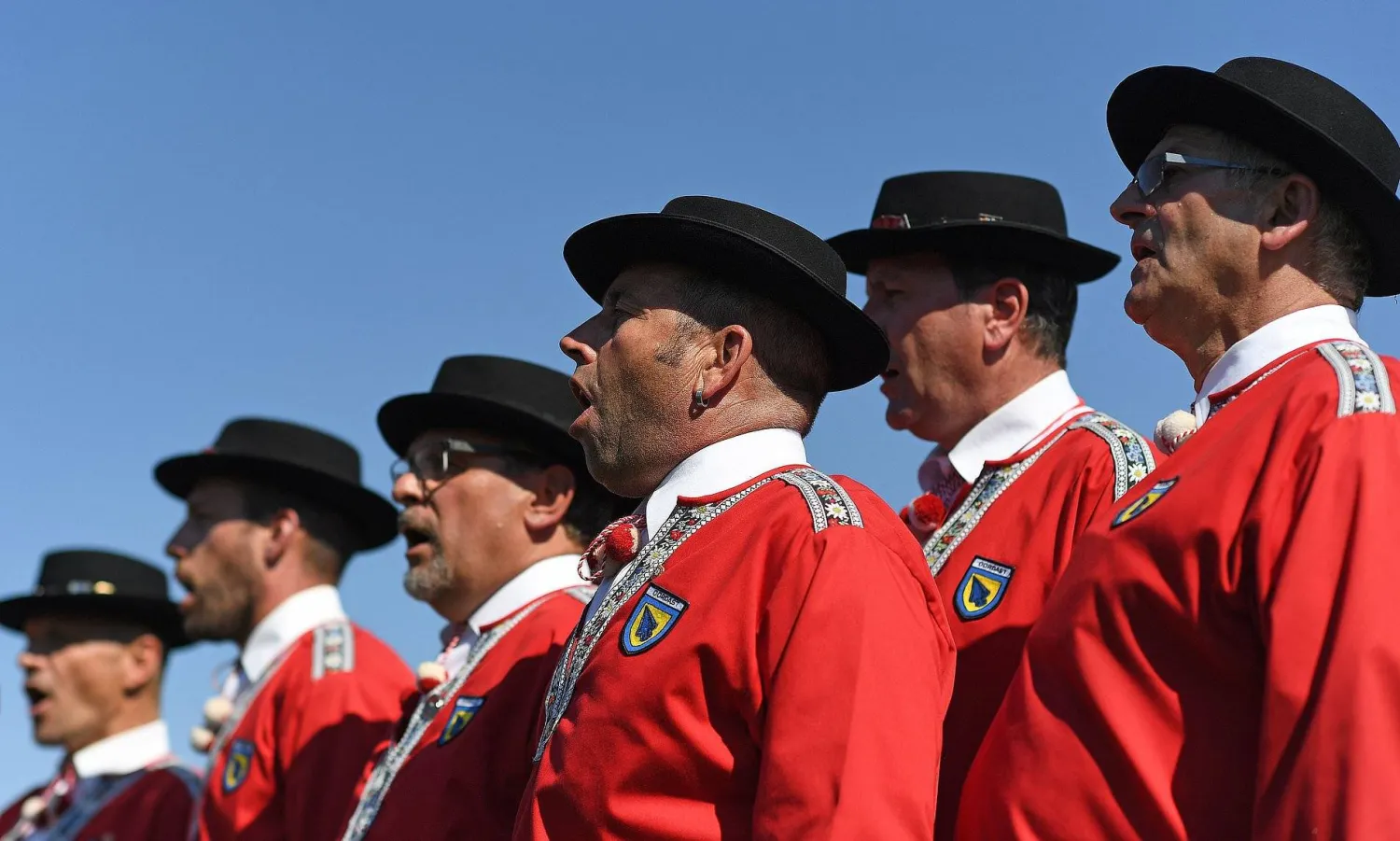
A yodel group sings at a Swiss festival in 2016. (AFP/Getty Images) 
TT

Shout-Out for Yodeling? Swiss Seek Recognition from UN Cultural Agency as Tradition Turns Modern 

A yodel group sings at a Swiss festival in 2016. (AFP/Getty Images) 

Yodel-ay-hee ... what?! Those famed yodeling calls that for centuries have echoed through the Alps, and more recently have morphed into popular song and folk music, could soon reap a response — from faraway Paris.

Switzerland's government is looking for a shout-out from UN cultural agency UNESCO, based in the French capital, to include the tradition of yodeling on its list of intangible cultural heritage. A decision is expected by year-end.

Modern-day promoters emphasize that the yodel is far more than the mountain cries of yesteryear by falsetto-bellowing male herders in suspenders who intone alongside giant Alphorns atop verdant hillsides. It’s now a popular form of singing.

Over the last century, yodeling clubs sprouted up in Switzerland, building upon the tradition and broadening its appeal — with its tones, techniques and tremolos finding their way deeper into the musical lexicon internationally in classical, jazz and folk. US country crooners prominently blended yodels into their songs in the late 1920s and 30s.

About seven years ago, the Lucerne University of Applied Sciences and Arts, or HSLU by its German-language acronym, became the first Swiss university to teach yodeling.

"For me, actually, in Switzerland we have four languages but I think really we have five languages. We have a fifth: The yodel," said HSLU professor Nadja Räss, alluding to the official German, French, Italian and Romansh languages in Switzerland. Yodeling exists in neighboring Austria, Germany and Italy, but Swiss yodeling is distinctive because of its vocal technique, she said.

In its early days, yodeling involved chants of wordless vowel sounds, or "natural yodeling," with melodies but no lyrics. More recently, "yodeling song" has included verses and a refrain.

The Swiss government says at least 12,000 yodelers take part through about 780 groups of the Swiss Yodeling Association.

In Switzerland, Räss said, yodeling is built on the "sound colors of the voice" and features two types: one centering on the head — with a "u" sound — and one emanating from deeper down in the chest — with an "o" sound.

And even within Switzerland, styles vary: Yodeling in the northern region near Appenzell is more "melancholic, slower," while in the country's central regions, the sounds are "more intense and shorter," she said.

What began as mostly a male activity is now drawing more and more women in a country that only finalized the right to vote for all women in the 1980s — long after most of its European neighbors.

Julien Vuilleumier, a scientific adviser for the Federal Office of Culture who is spearheading the Swiss request, said it's tough to trace the origins of yodeling, which factors into the imagery of the Swiss Alps.

"Some say it's a means of communication between valleys, using these very distinctive sounds that can carry a long way. Others believe it's a form of singing," he said. "What we know is that ... yodeling has always been transformed and updated."

UNESCO's government-level committee for Intangible Heritage in New Delhi will decide in mid-December. The classification aims to raise public awareness of arts, craftsmanship, rituals, knowledge and traditions that are passed down over generations.

Also among the 68 total nominations this year are traditions like Thanakha face powder in Myanmar; Ghanaian highlife music; the fermented Kyrgyz beverage Maksym; and the El Joropo music and dance tradition in Venezuela.

The list is different from the UNESCO World Heritage List, which enshrines protections for physical sites that are considered important to humanity, like the Pyramids of Giza in Egypt.

Räss of the Lucerne university says that candidates for the intangible heritage list are asked to specify the future prospects of cultural traditions.

"We figured out some projects to bring it to the future. And one of those is that we bring the yodel to the primary school," said Räss, who herself grew up yodeling. She said 20 Swiss school teachers know how to yodel and are trying it with their classes.

"One of my life goals is that when I will die, in Switzerland every school child will be in contact with yodeling during their primary school time," she said. "I think it’s a very good chance for the future of the yodel to be on that (UNESCO) list."



UNESCO Honors Al-Bisht Al-Hasawi as Thousands Flock to Al-Ahsa Festival

Visitors can explore interactive displays, participate in live workshops, and witness the meticulous process of tailoring this iconic symbol of prestige - SPA
TT

UNESCO Honors Al-Bisht Al-Hasawi as Thousands Flock to Al-Ahsa Festival

Visitors can explore interactive displays, participate in live workshops, and witness the meticulous process of tailoring this iconic symbol of prestige - SPA

The third edition of Al-Bisht Al-Hasawi Festival is drawing thousands of regional and international visitors to Ibrahim Palace in historic Al-Hofuf.

Organized by the Heritage Commission, this year’s festival celebrates the inscription of the Bisht on UNESCO’s Representative List of the Intangible Cultural Heritage of Humanity.

The event showcases Al-Ahsa’s centuries-old tradition of hand-weaving and gold embroidery, a craft passed down through generations of local families, SPA reported.

Visitors can explore interactive displays, participate in live workshops, and witness the meticulous process of tailoring this iconic symbol of prestige.

With UNESCO's participation and representatives from six countries, the festival has evolved into a global platform for cultural dialogue, cementing the Bisht’s status as a world-class cultural treasure.


Saudi, Syrian Culture Ministers Tour National Museum of Damascus

The ministers observed the museum’s extensive collections spanning prehistoric eras to modern art. SPA
TT

Saudi, Syrian Culture Ministers Tour National Museum of Damascus

The ministers observed the museum’s extensive collections spanning prehistoric eras to modern art. SPA

Saudi Minister of Culture Prince Badr bin Abdullah bin Farhan and his Syrian counterpart, Mohammed Yassin Saleh, have toured the National Museum of Damascus during the Kingdom’s participation as guest of honor at the 2026 Damascus International Book Fair.

The ministers observed on Thursday the museum’s extensive collections spanning prehistoric eras to modern art.

A particular focus was placed on the Arab-Islamic wing, featuring significant artifacts from the Umayyad period.

The Kingdom's participation as guest of honor at the 2026 Damascus International Book Fair, which runs until February 16, stems from the role culture plays within Saudi Vision 2030.


Saudi Culture Minister Inaugurates Kingdom's Pavilion as Guest of Honor at Damascus Book Fair

Saudi Culture Minister Inaugurates Kingdom's Pavilion as Guest of Honor at Damascus Book Fair
TT

Saudi Culture Minister Inaugurates Kingdom's Pavilion as Guest of Honor at Damascus Book Fair

Saudi Culture Minister Inaugurates Kingdom's Pavilion as Guest of Honor at Damascus Book Fair

Saudi Minister of Culture Prince Badr bin Abdullah bin Farhan, who is the Literature, Publishing and Translation Commission Board Chairman, has inaugurated the Kingdom’s pavilion as guest of honor at the 2026 Damascus International Book Fair.

The inauguration took place on Thursday in the Syrian capital in the presence of Syrian Minister of Culture Mohammed Yassin Saleh and his Qatari counterpart, Sheikh Abdulrahman bin Hamad bin Jassim bin Hamad Al Thani.

The Kingdom's participation as guest of honor at the fair, which runs until February 16, stems from the role culture plays within Saudi Vision 2030.

Literature, Publishing, and Translation Commission Chief Executive Dr. Abdul Latif Al-Wasil affirmed that the Kingdom's presence as guest of honor at the fair reflects its leading role in the Arab cultural landscape and embodies its belief in the role of culture as a bridge for communication, a space for dialogue, and a tool for supporting joint cultural initiatives.

He explained that the Kingdom's presence in Damascus affirms the depth of Saudi-Syrian relations, based on partnership and mutual respect, and stems from the Kingdom's commitment to strengthening cultural exchange.

The Kingdom's pavilion showcases the cultural and creative diversity of the Saudi cultural and literary scene through a comprehensive cultural program that includes intellectual seminars, poetry evenings, a manuscripts exhibition, a Saudi fashion corner, a hospitality corner, and a corner displaying archaeological replicas, in addition to Saudi performing arts performances that express the depth of the Kingdom's cultural heritage.

The pavilion offers visitors to the exhibition the opportunity to explore aspects of Saudi culture in its literary, heritage, and human dimensions within a cultural experience presented in a unifying Arab spirit, affirming that culture remains one of the most effective means of fostering understanding and building shared meaning.

Syrian President Ahmed al-Sharaa met on Thursday with Prince Badr at the Conference Palace in Damascus.

The meeting was attended on the Saudi side by Advisor at the Royal Court Mohammed Al-Tuwaijri, along with other officials.