

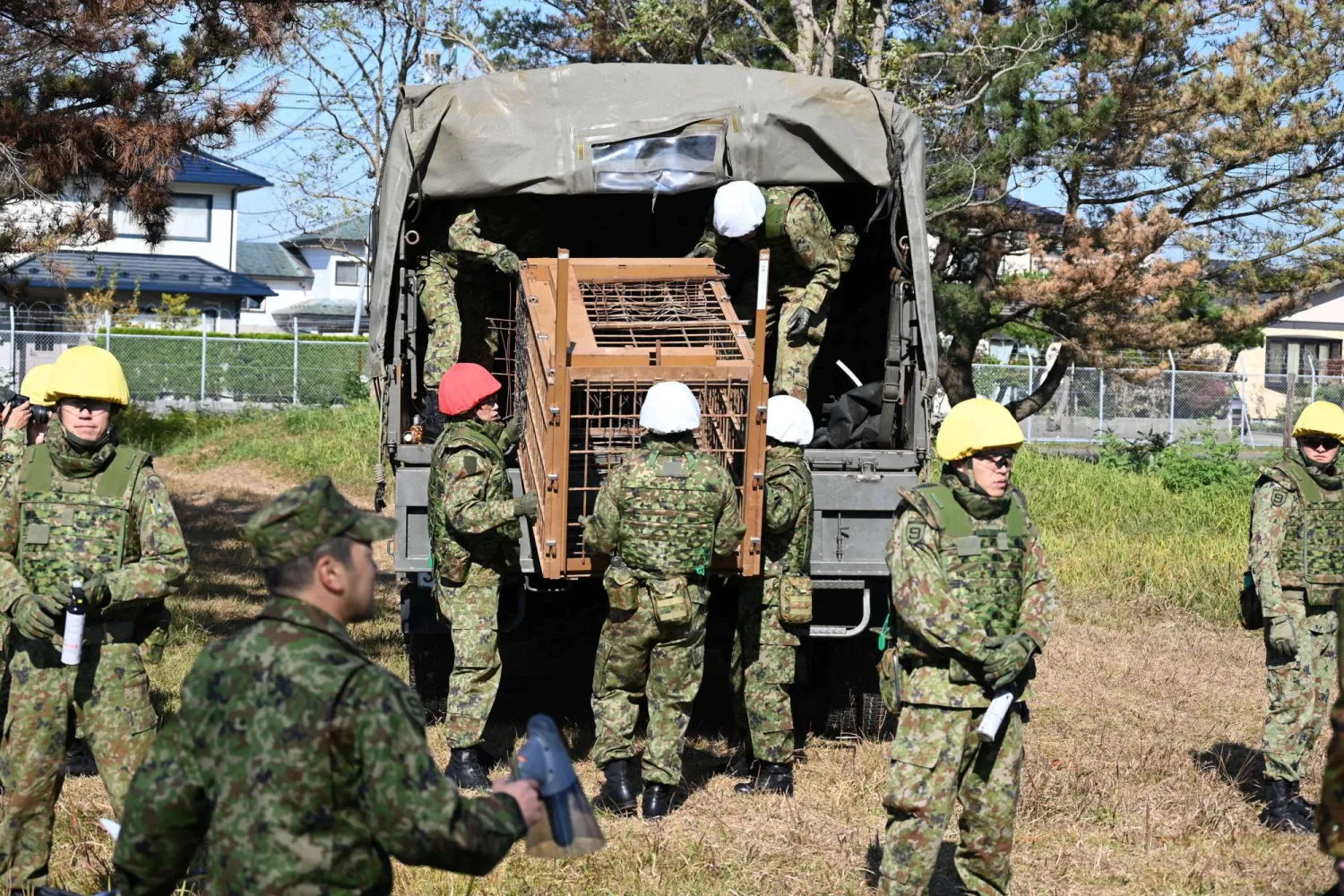

Japan Dispatches Troops to Help Combat Deadly Wave of Bear Attacks 

In this photo provided by the Japan Self-Defense Forces Akita Camp, Self-Defense forces personnel unload a bear cage from a military truck in JSDF Akita Camp, Akita, northern Japan, Thursday, Oct. 30, 2025. (JSDF Akita Camp via AP) 
TT

Japan Dispatches Troops to Help Combat Deadly Wave of Bear Attacks 

In this photo provided by the Japan Self-Defense Forces Akita Camp, Self-Defense forces personnel unload a bear cage from a military truck in JSDF Akita Camp, Akita, northern Japan, Thursday, Oct. 30, 2025. (JSDF Akita Camp via AP) 

Japan's military deployed troops to the country's mountainous north on Wednesday to help trap bears after an urgent request from local authorities struggling to cope with a wave of attacks.

The operation began in the town of Kazuno, where residents for weeks have been told to avoid the thick forests that surround it, stay home after dark and carry bells to deter bears that might forage near their homes for food.

There have been more than 100 bear attacks with a record 12 people killed across Japan in the year since April, according to the environment ministry. Two-thirds of those deaths were in Akita prefecture, where Kazuno is located, and nearby Iwate.

"The townspeople feel the danger every day," Kazuno Mayor Shinji Sasamoto said after meeting 15 or so soldiers who rolled into town in an army truck and several jeeps, equipped with body armor and large maps.

"It has affected how people live their lives forcing them to stop going out or cancel events," Sasamoto said.

The troops will help transport, set and inspect the box traps used to capture the bears but they are culled by trained hunters with weapons more suited to that purpose.

Authorities in Akita say bear sightings have jumped six-fold this year to more than 8,000, prompting the prefecture's governor to request help from Japan's Self-Defense Forces last week.

After Kazuno, a town of around 30,000 people known for its hot springs, dramatic landscapes and variety of sweet apples, the soldiers will head for the cities of Odate and Kitaakita under an agreement due to last until the end of the month.

ATTACKS IN SUPERMARKET, HOT SPRING RESORT

Rising bear numbers, climate change-driven shifts in natural food sources and depopulation of rural areas are increasingly bringing people into contact with bears in Japan. An ageing band of hunters that authorities once relied on are overwhelmed.

In recent weeks, bears have attacked customers inside a supermarket, jumped a tourist waiting at a bus stop near a UNESCO World Heritage site and mutilated a worker at a hot spring resort. Some schools have had to temporarily close after bears were spotted wandering in and around their grounds.

Bear attacks often peak in October and November, as the animals forage intensively before winter hibernation.

Japanese black bears, common across most of the country, can weigh up to 130 kg (287 pounds). Brown bears on its northern island of Hokkaido can weigh as much as 400 kg.

Japan previously deployed the military to assist in wildlife control around a decade ago when they provided aerial surveillance for hunts of wild deer. Elsewhere, the British army provided logistical support in the mass culling of animals infected with foot-and-mouth disease in 2001.

Japan plans to recruit more licensed hunters as part of a package of emergency measures to deal with the bear problem due to be announced later this month, Deputy Chief Cabinet Secretary Kei Sato told a press conference in Tokyo. In September, it relaxed gun rules to make it easier for hunters to shoot bears in urban areas.

"As bears continue to enter populated areas in many regions and injuries from bear attacks increase daily, we absolutely cannot afford to put off bear countermeasures," he said.



AI Helps Fuel New Era of Medical Self-testing

Neurable research scientist Alicia Howell-Munson demonstrates the company's headset, which it says can detect early signs of Alzheimer's disease. Patrick T. Fallon / AFP
TT

AI Helps Fuel New Era of Medical Self-testing

Neurable research scientist Alicia Howell-Munson demonstrates the company's headset, which it says can detect early signs of Alzheimer's disease. Patrick T. Fallon / AFP

Beyond smart watches and rings, artificial intelligence is being used to make self-testing for major diseases more readily available -- from headsets that detect early signs of Alzheimer's to an iris-scanning app that helps spot cancer.

"The reason preventive medicine doesn't work right now is because you don't want to go to the doctor all the time to get things tested," says Ramses Alcaide, co-founder and CEO of startup Neurable.

"But what about if you knew when you needed to go to the doctor?"

Connected rings, bracelets and watches -- which were everywhere at last week's Consumer Electronics Show in Las Vegas -- can already monitor heart rate, blood pressure and glucose levels, with varying degrees of accuracy.

These gadgets are in high demand from consumers. A recent study published by OpenAI showed that more than 200 million internet users check ChatGPT every week for information on health topics.

On Wednesday, OpenAI even launched a chatbot that can draw on a user's medical records and other data collected by wearable devices, with their consent, to inform its responses.

Using electroencephalogram (EEG) technology, Neurable has developed a headset that records and deciphers brain activity.

The linked app compares data with the user's medical history to check for any deviation, a possible sign of a problem, said Alcaide.

"Apple Watch can pick up Parkinson's, but it can only pick it up once you have a tremor," Alcaide said. "Your brain has been fighting that Parkinson's for over 10 years."

With EEG technology, "you can pick these things up before you actually see physical symptoms of them. And this is just one example."

Detection before symptoms

Some people have reservations about the capabilities of such devices.

"I don't think that wearable EEG devices are reliable enough," said Anna Wexler, a University of Pennsylvania professor who studies consumer detection products, although she acknowledges that "AI has expanded the possibilities of these devices."

While Neurable's product cannot provide an actual diagnosis, it does offer a warning. It can also detect signs of depression and early development of Alzheimer's disease.

Neurable is working with the Ukrainian military to evaluate the mental health of soldiers on the front lines of the war with Russia, as well as former prisoners of war, in order to detect post-traumatic stress disorder (PTSD).

French startup NAOX meanwhile has developed EEG earbuds linked to a small box that can help patients with epilepsy.

Rather than detect seizures, which are "very rare," the device recognizes "spikes" -- quick, abnormal electrical shocks in the brain that are "much more difficult to see," said NAOX's chief of innovation Marc Vaillaud, a doctor by training.

NAOX's device -- which has been cleared by the US Food and Drug Administration -- is designed to be worn at night, to track several hours of data at a time.

The company is working with the Rothschild and Lariboisiere hospitals in Paris to try to better understand the links between these brain "spikes" and Alzheimer's disease, which have been raised in scientific papers.

Advances in AI and technology in general have paved the way for the miniaturization of cheaper detection devices -- a far cry from the heavy machinery once seen in medical offices and hospitals.

IriHealth is preparing to launch, for only about $50, a small smartphone extension that would scan a user's iris.

The gadget relies on iridology, a technique by which iris colors and markings are believed to reveal information about a person's health, but which is generally considered scientifically unreliable.

But the founders of IriHealth -- a spin-off of biometrics specialist IriTech -- are convinced that their device can be effective in detecting anomalies in the colon, and potentially the lungs or the liver.

Company spokesman Tommy Phan said IriHealth had found its device to be 81 percent accurate among patients who already have been diagnosed with colon cancer.


Hawaii's Kilauea Volcano Puts on Spectacular Lava Display

Kilauea has been regularly throwing out thousands of tonnes of molten rock and gases since it burst to life in December 2024. UNITED STATES GEOLOGICAL SURVEY/AFP
TT

Hawaii's Kilauea Volcano Puts on Spectacular Lava Display

Kilauea has been regularly throwing out thousands of tonnes of molten rock and gases since it burst to life in December 2024. UNITED STATES GEOLOGICAL SURVEY/AFP

Hawaii's Kilauea was spraying a spectacular fountain of lava on Monday, keeping up its reputation as one of the world's most active volcanoes.

For over a year now, Kilauea has been regularly throwing out thousands of tons of molten rock and gases since it burst to life in December 2024, reported AFP.

Volcanologists with the US Geological Survey said the incandescent lava was being hurled more than 1,500 feet (460 meters) into the air, with plumes of smoke and gases rising as high as 20,000 feet (six kilometers).

Eruptions such as this one tend to last around one day, the USGS said, but can still vent up to 100,000 tons of sulfur dioxide.

This gas reacts in the atmosphere to create a visible haze known as vog -- volcanic smog -- which can cause respiratory and other problems.

Tiny slivers of volcanic glass, known as "Pele's hair," are also being thrown into the air.

Named after Pele, the Hawaiian goddess of volcanoes, the strands can be very sharp and can cause irritation to the skin and eyes.

The eruption poses no immediate danger to any human settlement, with the caldera having been closed to the public for almost two decades.

Kilauea has been very active since 1983 and erupts relatively regularly.

It is one of six active volcanoes located in the Hawaiian Islands, which also include Mauna Loa, the largest volcano in the world.

Kilauea is much smaller than neighboring Mauna Loa, but it is far more active and regularly wows helicopter-riding tourists who come to see its red-hot shows.


Astronaut's Serious Medical Condition Forces NASA to End Space Station Mission Early

Crew-11 mission astronauts departed the Kennedy Space Center in Cape Canaveral, Florida on August 1, 2025 (Gregg Newton/AFP)  
TT

Astronaut's Serious Medical Condition Forces NASA to End Space Station Mission Early

Crew-11 mission astronauts departed the Kennedy Space Center in Cape Canaveral, Florida on August 1, 2025 (Gregg Newton/AFP)  

NASA announced that four astronauts will return from the International Space Station more than a month ahead of schedule after an unnamed crew member experienced a medical issue.

The incident marks the first time in history NASA has brought astronauts home from the space station early because of a medical issue, according to CNN.

NASA has not provided details about the nature of the problem, citing privacy concerns. The agency typically does not discuss the specifics of health matters related to astronauts.

A SpaceX Crew Dragon capsule will bring the four-person crew home, disembarking from the ISS as soon as Wednesday at 5 pm ET. The spacecraft is then expected to splash down off the coast of California early the following morning, NASA said in a statement last week.

The affected astronaut is in stable condition, NASA previously confirmed, and is not expected to receive special treatment during the return trip, said Dr James Polk, NASA’s chief health and medical officer at the agency’s headquarters.

The astronaut would also be best served by being evaluated on the ground, Polk added.

“We have a very robust suite of medical hardware on board the International Space Station,” Polk noted during a news conference. “But we don’t have the complete amount of hardware that I would have in the emergency department, for example, to complete a workup of a patient.”

He added, “And in this particular incident, we would like to complete that work up, and the best way to complete that workup is on the ground.”