


Attack on Key City in Sudan's Kordofan Region Kills 40, Says UN

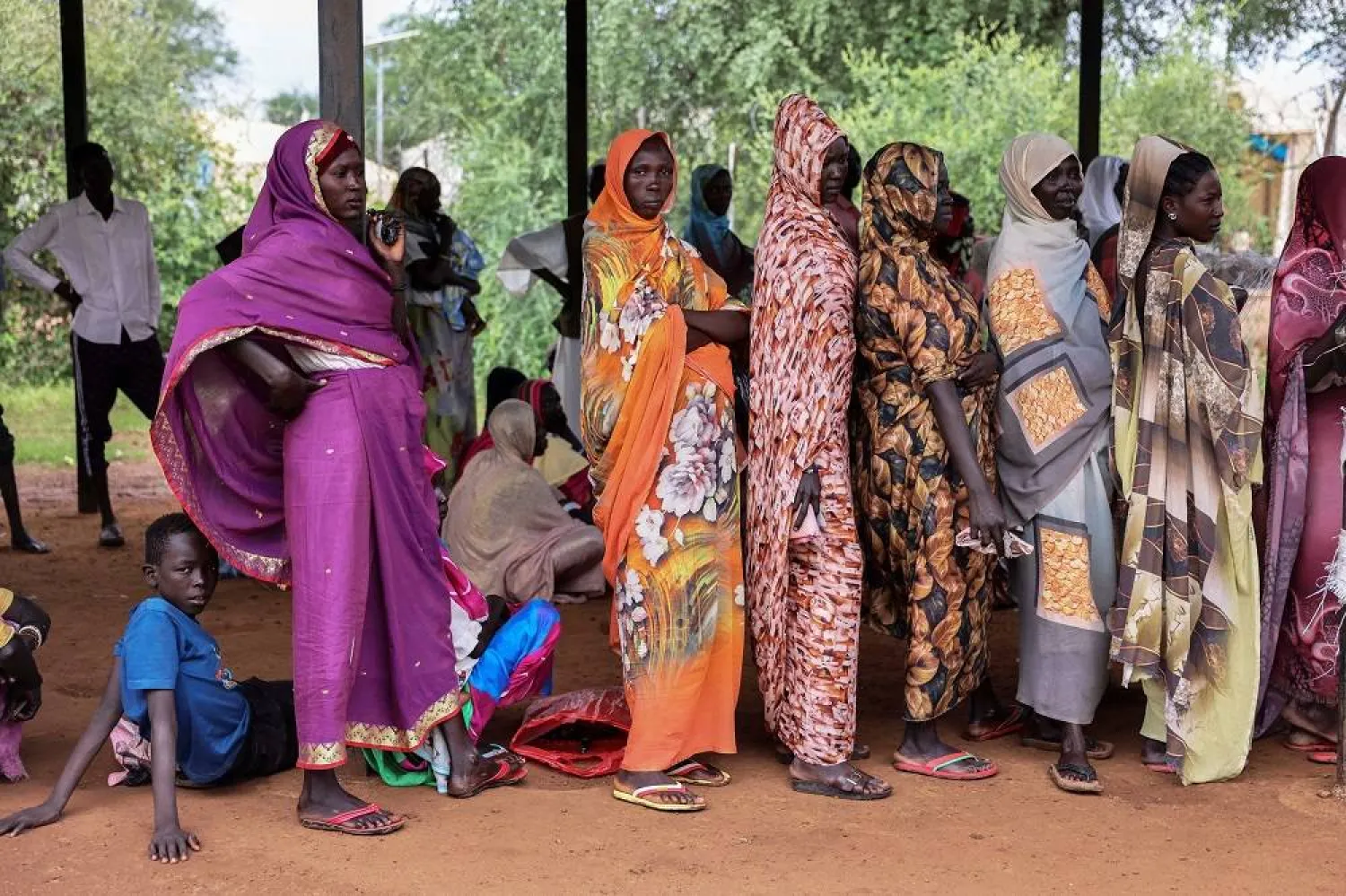
 Women wait for cash assistance and dry grain from the UN World Food Program in Gendrassa refugee camp, Maban, South Sudan, on Aug. 20, 2025. (AP)
Women wait for cash assistance and dry grain from the UN World Food Program in Gendrassa refugee camp, Maban, South Sudan, on Aug. 20, 2025. (AP)
TT

Attack on Key City in Sudan's Kordofan Region Kills 40, Says UN

 Women wait for cash assistance and dry grain from the UN World Food Program in Gendrassa refugee camp, Maban, South Sudan, on Aug. 20, 2025. (AP)
Women wait for cash assistance and dry grain from the UN World Food Program in Gendrassa refugee camp, Maban, South Sudan, on Aug. 20, 2025. (AP)

An attack on a funeral in the key city of El-Obeid in Sudan's central Kordofan region killed 40 people, the UN said Wednesday, as paramilitaries looked poised to launch an offensive.

The United Nations' humanitarian office did not specify when the attack took place or who was behind it, but said that the situation in the Kordofan region was continuing to worsen.

The war in Sudan, which has killed tens of thousands of people and displaced millions more, has spread to new areas in recent days, sparking fears of an even greater humanitarian catastrophe.

The paramilitary Rapid Support Forces (RSF), at war with the military since 2023, was preparing to launch an assault in Kordofan after capturing el-Fasher, the last army stronghold in the vast western Darfur region.

"Local sources report that at least 40 civilians were killed and dozens injured yesterday in an attack on a funeral gathering in El-Obeid, the capital of North Kordofan State," the UN's OCHA agency said.

"Once again, OCHA calls for an immediate cessation of hostilities and for all parties to protect civilians and respect international humanitarian law."

People forced to flee el-Fasher have described horrific abuse, including rape, at the hands of the RSF.

"The rapes were gang rapes. Mass rape in public, rape in front of everyone and no one could stop it," mother of four Amira said from a makeshift shelter in Tawila, some 70 kilometers (43 miles) west of el-Fasher.

Doctors Without Borders (MSF) said more than 300 survivors of sexual violence had sought care from its teams in Tawila after a previous RSF assault on the nearby Zamzam camp, which displaced more than 380,000 people last spring.

"You'd be asleep and they'd come and rape you," said Amira, using a pseudonym while speaking during a webinar organized by campaign group Avaaz.

"I saw with my own eyes people who couldn't afford to pay and the fighters took their daughters instead. They said, 'Since you can't pay, we'll take the girls.' If you had daughters of a young age, they would take them immediately."

Both sides in the war have been accused of committing atrocities.

- US truce proposal -

The fall of el-Fasher gave paramilitaries control over all five state capitals in Darfur, raising fears that Sudan would effectively be partitioned along an east-west axis.

The RSF now dominates Darfur and parts of the south, while the army holds the north, east and central regions along the Nile and Red Sea.

Sudan's army-backed defense minister on Tuesday said the military would press on with its fight against the RSF after the security and defense council met to discuss a US proposal for a ceasefire.

"We thank the Trump administration for its efforts and proposals to achieve peace," Hassan Kabroun said in a speech broadcast on state television, while adding that "preparations for the Sudanese people's battle are ongoing".

"Our preparations for war are a legitimate national right," he said.

No details of the US truce proposal have been made public.

White House Press Secretary Karoline Leavitt told reporters on Tuesday that Washington wanted "to see this conflict come to a peaceful end, just as we have with so many others, but the reality is it's a very complicated situation on the ground right now".

She said the United States was "actively engaged" in seeking a peace deal alongside Egypt, Saudi Arabia and the UAE.

- 'Nightmare of violence' -

The army-aligned authorities had rejected an earlier truce proposal from the four countries -- referred to as the Quad -- under which both the army and the RSF would be excluded from a transitional political process.

The International Criminal Court on Monday voiced "profound alarm and deepest concern" over the reports from el-Fasher, adding that such acts "may constitute war crimes and crimes against humanity".

Speaking at a forum in Qatar on Tuesday, UN Secretary-General Antonio Guterres called on the warring parties to "come to the negotiating table, bring an end to this nightmare of violence -- now".



Syrian Interior Ministry Details Results of Security Campaigns in Latakia, Damascus Countrysides

Security personnel inside the Imam Ali bin Abi Talib Mosque in the Wadi al-Dhahab neighborhood of Homs following a bombing . (AFP)
TT

Syrian Interior Ministry Details Results of Security Campaigns in Latakia, Damascus Countrysides

Security personnel inside the Imam Ali bin Abi Talib Mosque in the Wadi al-Dhahab neighborhood of Homs following a bombing . (AFP)

Syria’s Interior Ministry has announced the results of a series of security operations carried out in recent days in Homs, Latakia, and the Damascus countryside, including the arrest of two alleged ISIS members accused of involvement in the bombing of the Imam Ali bin Abi Talib Mosque in Homs last month.

The ministry said the operations led to the arrest of three senior figures in a cell known as “Lieutenant Abbas,” affiliated with the “Coastal Shield Brigade” led by Miqdad Fteiha, a prominent figure loyal to the former regime.

Security forces also detained an armed group in the al-Wuroud neighborhood of Damascus that was allegedly planning “acts of sabotage.”

The operations form part of broader efforts to dismantle armed groups and restore the state’s exclusive authority over weapons.

Interior Minister Anas Khattab vowed to continue pursuing ISIS operatives and bringing them to justice.

In a post on X, he said security and intelligence services had conducted a “highly precise operation” resulting in the arrest of those involved in the December 26 attack on the Imam Ali bin Abi Talib Mosque in the Wadi al-Dhahab district of Homs, which killed eight people and wounded 18 others.

According to the Interior Ministry, security units in Homs, in coordination with the General Intelligence Service, arrested two persons identified as ISIS members. Authorities said explosive devices, various weapons, ammunition, documents, and digital evidence allegedly linking the suspects to terrorist activities were seized.

The two were referred to the Counterterrorism Directorate to complete investigations ahead of prosecution.

In a separate statement earlier Monday, the Interior Ministry said a “valuable catch” was detained by security and intelligence forces in Latakia. It said he was a key figures in the “Lieutenant Abbas” cell. Initial investigations indicated the cell had targeted internal security and army positions in the province.

Meanwhile, in the Damascus countryside, the ministry said security forces carried out a “preemptive operation” in the al-Wuroud neighborhood of Qudsaya city, arresting three individuals accused of planning armed attacks.

The ministry said security services would continue pursuing remaining members of the groups, pledging to “eradicate them completely” to ensure security and stability.


Gaza Deal: Cairo Talks Aim to Settle Sector’s ‘Administrative Committee’

Displaced Palestinians stand beside a pool of rainwater amid makeshift shelters at the Bureij refugee camp in central Gaza (AFP). 
TT

Gaza Deal: Cairo Talks Aim to Settle Sector’s ‘Administrative Committee’

Displaced Palestinians stand beside a pool of rainwater amid makeshift shelters at the Bureij refugee camp in central Gaza (AFP). 

Cairo is hosting renewed consultations on the Gaza ceasefire agreement, which entered into force on Oct. 10, following the arrival of a delegation from Hamas and amid anticipation of an announcement on the committee that will administer the territory.

Experts told Asharq Al-Awsat that the talks provide an important boost at a critical moment for the second phase of the Gaza agreement, which has been stalled for some time. They stressed that moving forward hinges largely on US will and pressure on Israel.

A Palestinian source said Monday that a Hamas delegation headed by the movement’s leader, Khalil al-Hayya, arrived in Cairo to discuss the second phase and push ahead with the ceasefire deal. The source added that indications suggest the Gaza administration committee will be finalized during the Cairo round, with factions briefed on the names, particularly after recent changes prompted by Israeli objections.

Hamas Political Bureau member Mohammed Nazzal said in televised remarks Sunday night that the delegation would discuss follow-up on implementing the ceasefire amid “major difficulties hindering its application and continued Israeli violations.”

He said the delegation would hold meetings with Palestinian factions and forces, as well as with Egyptian officials, to discuss several files linked to the agreement.

These include ways to consolidate the ceasefire and move to subsequent phases, alongside key issues - foremost the formation of a Palestinian technocratic committee to administer Gaza - aimed at preventing Israeli Prime Minister Benjamin Netanyahu from reneging on or delaying the deal.

Former Egyptian assistant foreign minister and member of the Egyptian Council for Foreign Affairs, Ambassador Rakha Ahmed Hassan, said the Cairo consultations are highly significant and could revive the stalled agreement.

He pointed to anticipation surrounding US President Donald Trump’s announcement of a Peace Council, followed by the Gaza administration committee, adding that discussions would also cover approaches to dealing with weapons in Gaza to undercut Netanyahu’s justifications.

He suggested Hamas would press for full implementation of the first phase first, including opening the Rafah crossing from the Palestinian side, increasing aid, maintaining the ceasefire, and Israel’s withdrawal from Gaza in parallel with any later steps.

On the Egyptian front, Foreign Minister Badr Abdelatty stressed, during a Cairo meeting with Irish Minister for Migration, Trade and Defense Helen McEntee, the importance of announcing a temporary Palestinian technocratic committee to manage daily affairs in Gaza and forming an international stabilization force.


Lebanese Govt Vows to Carry out Second Phase of Plan to Impose State Monopoly over Arms

Lebanese Prime Minister Nawaf Salam and ambassadors of the quintet countries meet at the Grand Serail in Beirut. (Lebanese government's press office)
TT

Lebanese Govt Vows to Carry out Second Phase of Plan to Impose State Monopoly over Arms

Lebanese Prime Minister Nawaf Salam and ambassadors of the quintet countries meet at the Grand Serail in Beirut. (Lebanese government's press office)

Lebanese Prime Minister Nawaf Salam stressed on Monday that his country is determined to carry out the second phase of imposing state monopoly over weapons that the government approved last year.

The army is expected to kick off in February the second phase of the plan, which covers areas north of the Litani River. The first phase, covering south of the river, is close to completion.

Salam received at the Grand Serail in Beirut on Monday ambassadors of the quintet committee overseeing the ceasefire with Israel. The quintet includes Saudi Ambassador to Lebanon Waleed al-Bukhari, French Ambassador Herve Magro, Qatari Ambassador Sheikh Saud bin Abdulrahman Al Thani, Egyptian Ambassador Alaa Moussa, and the United States' Ambassador Michel Issa.

After the talks, Salam said he expressed his gratitude to the envoys for their continued support for his reformist government and the army's disarmament plan.

"I stressed to them our firm determination to implement the second phase of the plan," he added.

Egyptian envoy Moussa said the meeting tackled several issues, including Lebanon's economic reforms and the disarmament plan.

The Lebanese state and army are on the right path, he remarked.

"We have positively assessed the first phase and the state's efforts have been very encouraging," he added.

Moreover, he stressed that Egypt is maintaining its efforts to de-escalate the tensions in Lebanon, especially in the South.

"Our sole goal is to create the circumstances that would ease the tensions," Moussa said.

"We are informing the Lebanese government of all of our efforts. We believe that if the situation is left without Egyptian or non-Egyptian efforts, then the chances of escalation will be greater," he continued.

"We have so far averted the situation from deteriorating," he added.

Meanwhile, Hezbollah has opposed efforts to kick off the second phase of the disarmament plan. It had already objected to its disarmament altogether.

Hezbollah MP Hussein Ezzedine said: "The government should work on getting the enemy to unconditionally withdraw from Lebanese territories it is occupying and release prisoners."

He said it should "avoid making concessions at the expense of the national interest, which will only encourage the enemy to continue to extort" Lebanon.