

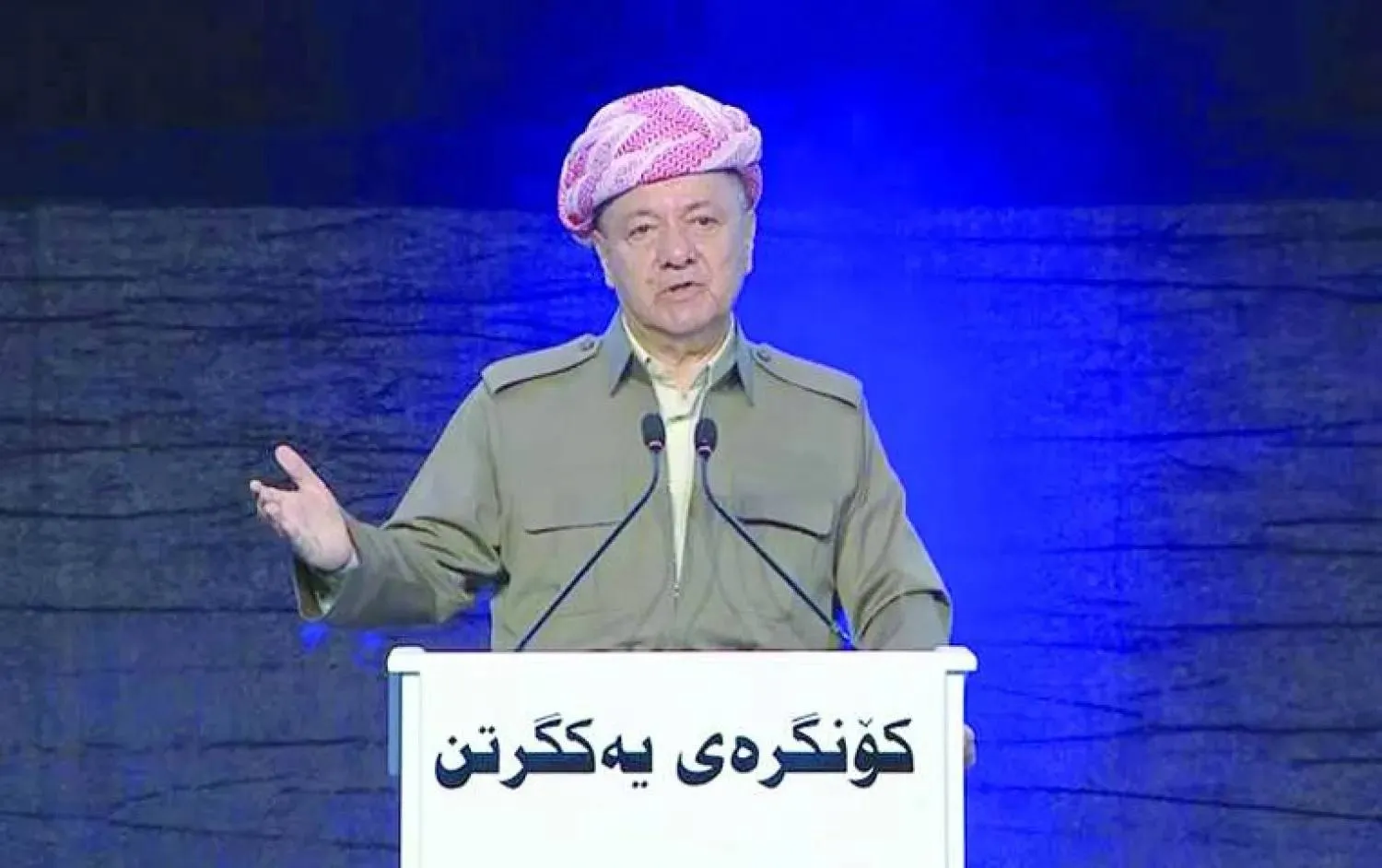

Barzani Says Armed Factions Stronger Than the State in Iraq, Lebanon

Kurdistan Democratic Party leader Masoud Barzani (Rudaw Network)
TT

Barzani Says Armed Factions Stronger Than the State in Iraq, Lebanon

Kurdistan Democratic Party leader Masoud Barzani (Rudaw Network)

Kurdish leader Masoud Barzani said the Iraqi presidency carries symbolic weight for the Kurds under a political convention in place since 2005, and argued that Prime Minister Mohammed Shia al-Sudani lacks the ability to rein in armed factions that dominate political decision-making, in a situation he likened to Hezbollah’s hold over the Lebanese state.

‘Iraq’s mini-states’

In a televised interview aired on Thursday evening, the Kurdistan Democratic Party (KDP) leader said “every side in Iraq sees itself as a state”, adding that “there are mini-states within the state that control the constitution, the parliament and the government”, in reference to armed groups tied to powerful political blocs.

Barzani said the KDP had considered boycotting the elections in protest against what he called an “unjust law”, explaining that seat allocations based on the food-ration card system made the results “almost predetermined”.

He added that the party chose to participate after receiving signals from “genuine forces” in Baghdad that expressed readiness to pursue political reform after the vote.

The “ration card” system was created under Saddam Hussein’s rule to distribute food to Iraqi families during the economic embargo of the 1990s, and has long been used as a statistical reference in the post-2003 political order.

A settled entitlement

Barzani said the presidency had become “a customary entitlement for the Kurds”, given its symbolism after the region’s suffering during the Anfal campaigns and chemical attacks.

He said the post was “symbolic and largely non-executive”, noting that “the speaker of parliament holds wider powers under the current political system”.

He said “there is a Sunni individual aspiring to the presidency, as if not realizing that the speakership is more influential and more powerful, while the presidency is not a personal ambition for anyone, but a settled entitlement and convention for the Kurds”.

Former parliament speaker Mohammed al-Halbousi, leader of the Sunni Taqaddum (Progress) party, said earlier that “if the Sunni community, through its representatives, sees the presidency as its entitlement and the post it prefers, then we will move toward it”.

‘Sudani is unable’

On the debate over Iraq’s armed groups, Barzani said “Prime Minister Mohammed Shia al-Sudani does not have the ability to confront these factions”, warning that the situation is undermining state institutions and deepening political and sectarian divisions.

He said Iraq’s current reality resembles Lebanon, where Hezbollah wields power beyond that of the state.

“The factions in Iraq have become a force above the constitution, controlling political and economic decisions and imposing their will on the government”, he said, stressing that weapons “must be within the national defense system, not a tool for imposing political influence”.

Barzani said the Kurdistan Region helped build a “new Iraq” after 2003, but added that “circumstances imposed a separation between Kurdistan and Baghdad because of exclusionary and marginalizing policies”.

He said “some still treat the Kurds as outsiders”, adding that “cutting the region’s public sector salaries is an example of unfairly punishing the Kurdish people”. He said the region “will not bow and will not bargain over its constitutional rights”.

‘One of the best constitutions’

Barzani said Iraq’s constitution was “one of the best in the region despite its flaws”, but criticized the Federal Supreme Court, calling it “politicized and targeting the Kurdistan Region”.

He stressed the need to form the “Federation Council”, a body mandated by the constitution, to serve as the proper constitutional reference.

He added that the current Federal Supreme Court “dates back to the era of Paul Bremer, the former US civil administrator, and cannot be considered a constitutional institution”.

Barzani also warned that the withdrawal of the international coalition could pave the way for ISIS to return, recalling the experience of 2011 when US forces pulled out before the group expanded three years later.

“The coalition’s departure means the return of ISIS”, he said, adding that any foreign military presence must be based on “a clear agreement with Baghdad and Erbil”.



Iraq ‘Mistakenly Lists’ Iran Allies as Terrorists, Unsettling Coordination Bloc

Iraqi Prime Minister Mohammed Shia al-Sudani beside Nouri al-Maliki during a religious event in Baghdad (Government Media)
TT

Iraq ‘Mistakenly Lists’ Iran Allies as Terrorists, Unsettling Coordination Bloc

Iraqi Prime Minister Mohammed Shia al-Sudani beside Nouri al-Maliki during a religious event in Baghdad (Government Media)

Iraq on Thursday stunned observers by abruptly adding Hezbollah and Yemen’s Houthi movement to a terrorism list that triggers immediate asset freezes, only to retract the move within hours by claiming the two names had appeared in an “unedited list” slated for correction.

The whiplash decision set off confusion and disbelief in Baghdad.

The Official Gazette, which is run by the Ministry of Justice, had published last month and formally announced on Thursday a list of entities subject to asset freezes that included Hezbollah and the Houthis.

Observers said the step was expected to win praise from Washington and tighten pressure on Tehran before the government withdrew it.

The paper said a government committee had decided to freeze the assets of individuals and entities linked to the Houthis and Hezbollah, and that the Iraqi announcement, later deleted, covered more than one hundred entities and individuals worldwide.

It said the terrorism list update came in accordance with resolutions of the committee tasked with freezing funds for identifying entities and individuals subject to counter terrorism and counter terrorism financing measures.

The developments came a day after s, urged Iraqi partners to undermine Iranian militias and prevent them from threatening Iraqis and Americans.

Asset freeze for terrorists

The text in the Official Gazette shows that the Anti-Money Laundering and Counter Terrorism Financing Committee had submitted in March 2025 a list of terrorist individuals and entities for asset freezes before the Committee for Freezing Terrorists’ Funds endorsed it in October 2025.

The Ministry of Justice website published the edition that carried the decision before deleting it following a wave of outrage among pro Iran circles in Iraq.

Hossein Moanes, the head of Kataib Hezbollah affiliate group Harakat Hoquq (The Rights Movement), attacked the government as lacking dignity.

Ali Al-Asadi, head of the political council of the Harakat al-Nujaba movement, said listing Hezbollah and Ansar Allah, the Houthis, as terrorists was an act of treason, adding that the government does not represent the Iraqi people.

A confidential letter from the Central Bank of Iraq said the publication of the two names was an oversight, and that pursuant to Committee for Freezing Terrorists’ Funds Decision 61 of 2025, paragraphs 18 and 19 should be deleted because the committee did not approve them.

The bank requested that an official amendment be issued in the Official Gazette.

Iraqi bloggers reposted paragraphs from the law governing publication in the Official Gazette, which states that ignorance of what is published in the Official Gazette does not excuse its content.

However, legal experts said rescinding what is published in the Official Gazette is possible and permissible from a legal standpoint, noting that the publication law allows corrections through a statement issued by the authority that produced the decision.

Iraq’s state news agency said Baghdad would fix the list after Hezbollah and the Iran backed Houthis were added.

The asset freeze committee said the publication dated November 17 applied solely to individuals and entities linked to ISIS and Al-Qaeda, in line with a Malaysian request and with United Nations Security Council Resolution 1373. It said adding other groups occurred before the final review was completed and would be deleted in a corrected version.

Iraqi regulations state that the only way to amend or cancel what is published in the Official Gazette is through a new law that repeals or modifies the earlier one, and until then anything published is considered an official and binding announcement.

A technical step

Legal expert Ali Al-Tamimi said the Committee for Freezing Funds of Terrorist Groups is attached to the General Secretariat of the Council of Ministers and chaired by the central bank governor, with members from counter terrorism and counter narcotics agencies, the interior and communications ministries, and the Integrity Commission.

It was established under the 2012 Anti Money Laundering Law.

He told Asharq al-Awsat that the committee’s mandate is to implement Security Council decisions and that the measure is financial and economic rather than political, noting that Security Council Resolution 2140 of 2025 calls for freezing the funds of Hezbollah and the Houthis.

The controversy quickly fed into political jockeying over whether Prime Minister Mohammed Shia al-Sudani should serve a second term. Yasser Al-Maliki, secretary general of the Al Bashaer Movement, wrote on X that respect for the dead requires their burial, in a remark widely interpreted as a declaration that Sudani’s term had ended.

Yasser Al-Maliki is close to Nouri Al-Maliki, leader of the State of Law coalition and a prominent opponent of Sudani remaining in office.

Government probe

The government responded with a statement saying Sudani had ordered an urgent investigation, identification of those responsible and accountability for the negligence related to the committee’s decision.

It said Iraq’s political and humanitarian positions toward the aggression against its people in Lebanon and Palestine are principled and not subject to political point scoring.

Arab media outlets quoted what they described as informed sources as saying Hezbollah in Lebanon was displeased by the uproar in Iraq over its appearance on the terrorism list.

They said a senior Hezbollah figure contacted Baghdad to clarify the mistake and urged Iraqi authorities to hold those responsible to account.

Washington has for years sought to curb Iran’s influence in Iraq and other parts of the Middle East, where Tehran aligned factions operate under what is known as the axis of resistance, which has come under heavy Israeli strikes since the Gaza war erupted in 2023.

Iran, a neighbor and key economic lifeline for Iraq under sanctions, is vital to Baghdad, which continues to balance its partnership with Washington against its complex ties with Tehran at a time when Iran’s regional sway has ebbed after a string of Israeli attacks on its allies over the past year.


Sudan's RSF Detains El-Fasher Survivors for Ransom

Sudanese displaced people who fled El-Fasher after the city fell to the Rapid Support Forces on 26 October (AFP)
TT

Sudan's RSF Detains El-Fasher Survivors for Ransom

Sudanese displaced people who fled El-Fasher after the city fell to the Rapid Support Forces on 26 October (AFP)

Witnesses, aid workers and researchers said the Rapid Support Forces, which surrounded El-Fasher in Darfur before capturing it in late October, have been holding survivors from the siege in a systematic campaign, demanding ransom for their release and killing or beating those whose families cannot pay, according to a Reuters report.

Reuters said it could not determine how many people are being held by the RSF and allied armed groups in and around El-Fasher, the capital of North Darfur.

However, accounts indicate that large groups are being detained in several villages about 80 kilometers from the city, while others were taken back into El-Fasher where the RSF demands payments worth thousands of dollars from their relatives.

The detention of survivors underlines the risks facing those who failed to escape El-Fasher, which had been the last major stronghold against the RSF in Darfur before its fall.

Witnesses described collective reprisals since the takeover, including summary executions and sexual violence.

The accounts also highlight the plight of tens of thousands still unaccounted for as relief agencies try to reach famine hit El-Fasher and its outskirts, which have become a focal point in the two and a half year war between the RSF and the Sudanese army.

Pay or be killed

Reuters said it interviewed 33 former detainees and 10 aid workers and researchers who provided previously unreported details about the violence faced by detainees, the locations where they were held and the scale of the arrests.

Survivors described ransoms ranging from five million Sudanese pounds, about 1400 dollars, to 60 million pounds, about 17 thousand dollars, sums that are enormous for residents of such a poor region.

Eleven survivors said some of those unable to pay were shot at close range or killed in groups, while others were severely beaten.

According to the agency, survivors who fled across the border to Chad were documented with injuries that appeared to result from beatings and gunshots. Reuters said it could not fully verify their accounts.

Mohamed Ismail, who spoke to Reuters by phone from Tawila, a neutral-held town near El-Fasher, said the RSF gives families three or four days to pay. If no transfer is sent, “they kill him,” he said.

He said he left El-Fasher when the RSF seized the city on 26 October but was arrested with 24 men in the village of Um Jalbakh. He and his nephew were forced to collect 10 million pounds from their family for their release. Nine other men were killed in front of them, he said.

RSF denies responsibility and says it is investigating

RSF legal adviser Mohamed al-Mukhtar told Reuters that most cases of detention and extortion of people from El-Fasher were carried out by a rival group wearing uniforms similar to the RSF.

A committee within the RSF is investigating more than 100 alleged abuses a day in El-Fasher, and many suspects have been detained while nine have been convicted, said committee head Ahmed al-Nour al-Hala.

The fall of El-Fasher after an 18-month siege marked a turning point in a war triggered by a power struggle between the army and the RSF, which the United Nations has described as the world’s worst humanitarian crisis. Both sides face accusations of war crimes.

Survivors of RSF detention in and around El-Fasher told Reuters they were often asked about their tribal identity and were subjected to racial insults.

The International Organization for Migration estimates that more than 100 thousand people fled El-Fasher after the RSF took control. Aid agencies say more than 15 thousand have reached Tawila and about 9500 have crossed into Chad, but most remain in RSF controlled villages around the city, including Garney and Um Jalbakh.

Aid groups say it remains unclear how many have stayed inside El-Fasher itself. Some residents could not flee because they could not afford the cost of leaving, while others were too sick or injured to travel.

Negotiations with families

Yassir Hamad Ali, 36, a former detainee who reached Chad, said RSF fighters arrested him on 29 October with 16 other men after he fled El-Fasher. He said they beat him heavily and demanded 150 million pounds for his release.

Speaking to Reuters from a hospital in Tine near the Chad Sudan border, he said the fighters used a Starlink satellite internet device mounted on their Toyota Land Cruiser to contact his family on Facebook Messenger.

Large areas under RSF control have been cut off from telecommunications since the start of the war, prompting widespread use of Starlink devices. Starlink did not respond to a request for comment.

Ali said his family negotiated the amount down to five million pounds, which they sent via a Sudanese mobile money platform, according to transfer receipts seen by Reuters.

Another man in Tine, Ibrahim Kitr, 30, said his family borrowed against their home in Atbara to pay the 35 million pound ransom, saying he doubted they would be able to repay the loan.

His brother, Alhaj Altijany Kitr, 31, said fighters placed a gun to his head and beat him severely during a video call with their family, a method similar to that used by smuggling gangs on migrant routes in neighboring Libya, where captors show relatives the abuse to pressure them for higher ransom.

The RSF has often recruited fighters or allied factions with the promise of looting rather than a fixed salary, and widespread looting has taken place in areas under its control.

But aid workers said the large ransom demands around El-Fasher represent a new phenomenon.

Satellite images of Garni village on 28 November show hundreds of newly built temporary shelters over the past month. Two aid workers said this suggests people could be held there for extended periods.

Detention inside El-Fasher

Reuters said men and women were separated on arrival in Garney, but women were also detained there. One woman said she was blindfolded and raped repeatedly over several days. Another said she witnessed similar assaults.

The second woman cried as she spoke by phone from Tawila. She said RSF fighters threatened to kill her when she tried to intervene.

Eight former detainees said they were taken back to El-Fasher and held for ransom in buildings that included military facilities and university dormitories.

A 62-year-old teacher, who requested anonymity, said he found himself in El-Fasher Children’s Hospital with hundreds of other men.

They were packed in rows, he said, with nothing to drink, so they took water from a stagnant pool in the hospital grounds that they later discovered was sewage. The teacher said about 300 men died.

Two human rights researchers who spoke to witnesses gave Reuters similar estimates.

Mujahid Eltahir, 35, who was detained in El-Fasher, said he was released after a beating for a ransom of 30 million pounds, only to be detained again in Zalingei, where his captors forced his family to pay another six million pounds.

Speaking to Reuters in N’Djamena, Chad, he said he saw the bodies of seven men he had fled with lying along the road, shot in the head and chest. Eltahir displayed a photo of his feet covered in sores from walking barefoot after RSF fighters took his shoes.

Since taking El-Fasher, the RSF has posted videos showing people receiving food and medical care in the city.

A nurse who said she had been detained by the RSF told Reuters that fighters filmed her receiving food and saying she was treated well. She said they abuse people, then show them moments later on livestreams.


‘Deeply Worried’ Macron to Work to Free French Journalist Held in Algeria

(FILES) This undated handout photograph released on June 30, 2025, shows Christophe Gleizes, a prominent French sports journalist, at an unknown location. (Photo by Handout / SO PRESS - RSF / AFP)
TT

‘Deeply Worried’ Macron to Work to Free French Journalist Held in Algeria

(FILES) This undated handout photograph released on June 30, 2025, shows Christophe Gleizes, a prominent French sports journalist, at an unknown location. (Photo by Handout / SO PRESS - RSF / AFP)

France’s President Emmanuel Macron will work toward the release of a French journalist in jail in Algeria “as soon as possible,” his office said Thursday, a day after an Algerian court confirmed his incarceration.

An appeals court upheld a seven-year prison term against Christophe Gleizes, a sports journalist who was jailed in June on terrorism-related charges.

Gleizes, 36, is France’s only journalist imprisoned abroad, according to Reporters Without Borders (RSF).

Macron was “deeply worried” to learn the news, his office said, according to Agence France Presse.

“We will continue to engage with the Algerian authorities to secure his release and his return to France as soon as possible,” it added.

Gleizes was arrested and placed under judicial control in May 2024 after traveling to Tizi Ouzou in northeastern Algeria’s Kabylia region — home to the Amazigh Kabyle people — to write about the country’s most decorated football club, Jeunesse Sportive de Kabylie.

He was accused of having been in contact with a local football figure prominent in the Movement for the Self-Determination of Kabylie (MAK), designated a “terrorist” organization by the authorities in 2021.

French Interior Minister Laurent Nunez said on Thursday that the journalist’s release was “a major element” in current talks between the two countries.

Macron said he was “available” to speak to Algerian President Abdelmadjid Tebboune if it were to allow progress in tense relations between both sides.

Tebboune last month pardoned French-Algerian novelist Boualem Sansal after a year-long imprisonment in Algeria, following comments made by the writer.