


Some US States Now Require Public Schools to Teach Kids about Gun Safety

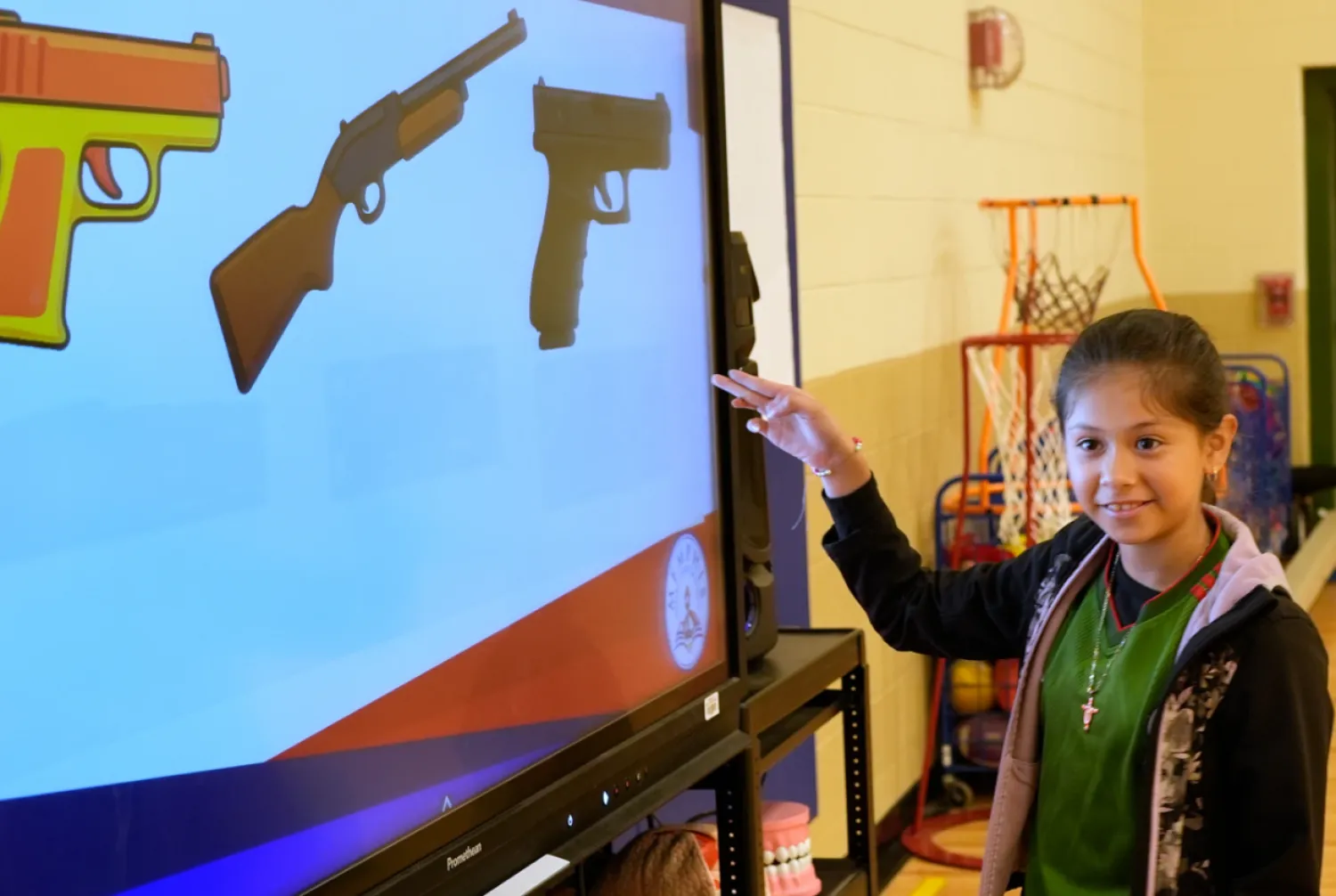
Jailyn Martinez points to a real firearm during a gun safety lesson at Berclair Elementary School, Monday, Oct. 27, 2025, in Memphis, Tenn. (AP Photo/George Walker IV)
TT

Some US States Now Require Public Schools to Teach Kids about Gun Safety

Jailyn Martinez points to a real firearm during a gun safety lesson at Berclair Elementary School, Monday, Oct. 27, 2025, in Memphis, Tenn. (AP Photo/George Walker IV)

This school year, students in elementary, middle and high schools in some states will get a new lesson on safety: what to do if they find a firearm.

Arkansas, Tennessee and Utah are the first states to enact laws that require public schools to teach children as young as 5 the basics of gun safety and how to properly store guns in the home. Only Utah's law allows students to opt out of the lesson if requested by parents or guardians.

A similar law in Arizona was vetoed by the Democratic governor, and lawmakers in at least five other states have introduced such proposals, putting schools at the forefront of yet another debate about gun violence, The AP news reported.

In Tennessee, lesson plans could include stickers, games, quizzes, or videos with music and colorful firearm illustrations, including a gun made out of Lego-style bricks and an explanation of what a muzzleloader is.

The reality is that many children in the US grow up around firearms.

At Berclair Elementary School in Memphis, a class of 16 fifth graders were asked how many had seen a real gun. Nearly all raised their hands.

“It just shows you how much a class like this is needed,” said Tammie Chapman, a health and physical education instructor, who has been leading the lessons at this school.

“While there is some controversy around guns, there doesn’t always have to be,” said Emily Buck, director of public relations for the Tennessee Wildlife Resources Agency, which created a curriculum with the state Department of Education. “I think that having some education and foundational knowledge really can be beneficial in the long run.”

Stop, don’t touch, leave quickly, tell an adult The lessons are often adapted from hunting safety courses already administered by state hunting and wildlife agencies, but with key differences.

Hunter safety courses typically involve hands-on instruction and explanations of how to safely handle and fire a gun. These classroom lessons, on the other hand, emphasize that children should not touch a firearm.

In Tennessee, the legislation prohibits any use of actual firearms, but in Arkansas, the law allows parents to opt into alternative curriculums, such as an off-campus firearm safety course that could include live guns.

The main takeaway is a series of steps for when a child finds a gun: Stop, don't touch, leave quickly, tell an adult. This is consistent with instructions created by other organizations, including one from the National Rifle Association that features animated characters, videos and coloring pages.

At Berclair Elementary School, the faculty designed a relay-race game to keep students engaged. In the gym, students took turns running to buckets that had different photos. Students who found a picture of a gun then reported it to one of the adults. They also listened to a catchy jingle emphasizing the steps.

Buck acknowledged that adults might be the ones responsible for creating unsafe situations at home and said children should be prepared if they find guns in unusual spots, like on shelves or under a mattress.

“We hope that maybe students will take some of what they learned back to their house, back to the parents and maybe they’ll encourage their parents to adjust their storage method,” said Buck.

The lessons are supposed to be neutral Gun legislation is a partisan issue across the US, with Democratic-led states enacting more limits on access to guns and efforts to tighten gun laws often failing in Republican-controlled legislatures.

Republicans sponsored and supported the education bills in Arkansas, Tennessee and Utah. The legislation says the curriculum must have neutral viewpoints on any gun-related topics, such as gun ownership in general.

Voices for a Safer Tennessee, a nonpartisan nonprofit created by parents after The Covenant School shooting in Nashville, supported the legislation. The organization supports gun ownership and advocates for policies like expanded background checks.

These lessons may encourage families to start necessary conversations, said Jessica Jaglois, director of communications for the organization.

“It could possibly prevent a firearm tragedy from occurring, because we know that a moment of access can lead to a lifetime of tragedy,” said Jaglois.

In 2022, the US Centers for Disease Control and Prevention found that firearms were the leading cause of death among children and teens. Arkansas and Tennessee have rates of firearm deaths among children and teens that exceed the national average, according to an AP analysis. But some Democrats and gun control advocates argue this kind of legislation is the wrong approach to gun violence.

“Using the school day to teach kids about guns won’t stop adults from leaving their firearms unsecured or keeping deadly weapons out of dangerous hands,” said Meg Beauregard, policy counsel fellow at Everytown for Gun Safety, in a statement. “If lawmakers were serious about protecting students, they’d pass laws that hold adults accountable, such as secure storage — not put the burden on kids to keep themselves safe.”

How will schools teach the lessons? The states gave school districts some discretion on whether to use provided lesson plans or go with other instructions that adhere to the laws' language. The schools also can decide which faculty or staff will lead the lessons, or in some instances bring in police officers to talk about gun safety.

In Arkansas, schools might choose to incorporate the lessons as a part of annual safety training, such as when they are practicing fire safety or tornado drills, said Spencer Griffith, a deputy director with Arkansas Game and Fish Commission.

“We hope they will interject this in a way that kind of helps to maybe prevent some of these accidents from occurring, but not in a way that puts a political focus or fear around that, because it’s just not the place for that,” said Griffith.

Berclair Principal Clint Davis said the issue of children getting hurt in firearm accidents is not new, even if this curriculum is.

“It’s not something that’s necessarily just become a modern issue. It’s always been there,” said Davis. “And I think we’re just now really responding to the need to provide that sort of training in school.”



Astronomers Spot White Dwarf Star Creating a Colorful Shockwave

The central square image, taken with the MUSE instrument on ESO's Very Large Telescope, shows shock waves around the dead star RXJ0528+2838. (European Southern Observatory (ESO)/K. Ilkiewicz and S. Scaringi et al./Handout via Reuters)
TT

Astronomers Spot White Dwarf Star Creating a Colorful Shockwave

The central square image, taken with the MUSE instrument on ESO's Very Large Telescope, shows shock waves around the dead star RXJ0528+2838. (European Southern Observatory (ESO)/K. Ilkiewicz and S. Scaringi et al./Handout via Reuters)

Astronomers have observed a white dwarf - a highly compact Earth-sized stellar ember - that is creating a colorful shockwave as it moves through space, leaving them searching for an explanation.

The highly magnetized white dwarf is gravitationally bound to another star in what is called a binary system. The white dwarf is siphoning gas from its companion as the two orbit close to each other. The system is located in the Milky Way about 730 light-years from Earth - relatively nearby in cosmic terms - in the constellation Auriga.

A light-year is the distance light travels in a year, 5.9 trillion miles (9.5 trillion km).

The shockwave - more specifically a bow shock - caused by the white dwarf was observed using the European Southern Observatory's Chile-based Very Large Telescope. The shockwave was seen in an image released by the scientists glowing in various colors produced when material flowing outward from the white dwarf collided with interstellar gas.

"A shockwave ‌is created when ‌fast-moving material plows into surrounding gas, suddenly compressing and heating it. A ‌bow shock ⁠is the curved ‌shock front that forms when an object moves rapidly through space, similar to the wave in front of a boat moving through water," said astrophysicist Simone Scaringi of Durham University in England, co-lead author of the study published on Monday in the journal Nature Astronomy.

"The colors come from interstellar gas that is being heated and excited by the shock. Different chemical elements glow at specific colors when this happens," Scaringi added.

In this shockwave, a red hue represented hydrogen, green represented nitrogen and blue represented oxygen residing in interstellar space.

A handful of other white dwarfs have been observed creating shockwaves. But all of those were ⁠surrounded by disks of gas siphoned from a binary partner. Although this white dwarf is siphoning gas from its companion, it lacks any such disk and ‌is releasing gas into space for unknown reasons.

White dwarfs are among the ‍universe's most compact objects, though not as dense as ‍black holes.

Stars with up to eight times the mass of the sun appear destined to end up as ‍a white dwarf. They eventually burn up all the hydrogen they use as fuel. Gravity then causes them to collapse and blow off their outer layers in a "red giant" stage, eventually leaving behind a compact core - the white dwarf.

"There are plenty of white dwarfs out there, as these are the most common endpoints of stellar evolution," Scaringi said.

The sun appears fated to end its existence as a white dwarf, billions of years from now.

This white dwarf has a mass comparable to the sun contained in a body slightly larger than Earth. Its binary companion is ⁠a type of low-mass star called a red dwarf that is about a tenth the mass of the sun and thousands of times less luminous. It orbits the white dwarf every 80 minutes, with the two extremely close to each other - approximately the distance between the moon and Earth.

The gravitational strength of the white dwarf is pulling gas off the red dwarf. This siphoned material is being pulled into the white dwarf along its strong magnetic field, eventually landing at its magnetic poles. While this process releases energy and radiation, it cannot account for the outflow of material needed to produce the observed shockwave, Scaringi said.

"Every mechanism with outflowing gas we have considered does not explain our observation, and we still remain puzzled by this system, which is why this result is so interesting and exciting," Scaringi said.

"The shape and length of the (shockwave) structure show that this process has been ongoing for at least about 1,000 years, making it long-lived rather than a one-off event," Scaringi added.

The ‌researchers took note of the aesthetics of the colorful shockwave.

"Beyond the science, it's a striking reminder that space is not empty or static as we may naively imagine it: it's dynamic and sculpted by motion and energy," Scaringi said.


Australian Firefighters Warn of ‘High-Risk’ Bushfire Season

Country Fire Authority (CFA) crew fill up tankers in the bushfire affected town of Ruffy, Victoria, Australia, 12 January 2026. (EPA)
TT

Australian Firefighters Warn of ‘High-Risk’ Bushfire Season

Country Fire Authority (CFA) crew fill up tankers in the bushfire affected town of Ruffy, Victoria, Australia, 12 January 2026. (EPA)

Australian firefighters warned people on Monday to prepare for more bushfires in a "high-risk" summer, after blazes killed one person and incinerated more than 350 buildings in the southeast.

Weather conditions have eased since strong winds and temperatures topping 40C fed dozens of wildfires in southeastern Australia's Victoria, which declared a state of disaster on Saturday.

But officials said 12 major fires were still burning across the state.

Country Fire Authority chief officer Jason Heffernan said another "heating event" was expected towards the end of January, though its intensity was uncertain.

"We are early in the high-risk weather season," Heffernan told a news conference.

"There's been a lot of fire in the landscape. Much work will be done between now and then to contain these fires," he said.

"Whilst we join with community in the rebuilding and the relief and recovery of the fires that have been, we need to turn our minds to the fires that could be as the season continues."

More than 350 structures -- including over 65 homes -- have been lost so far in the state, officials said, with the number likely to rise as fire damage is assessed.

One person died in a fire near the town of Longwood, about two hours' drive north of state capital Melbourne, police say.

Emergency Management Commissioner Tim Wiebusch said weather conditions had become more favorable for firefighters.

"But that doesn't mean that the risk is over," he said.

"Whilst the conditions are easing in some parts of the state, even the slightest of winds are still causing those fires to move around."

High temperatures and dry winds combined last week to form some of the most dangerous bushfire conditions since the "Black Summer" blazes.

The Black Summer bushfires raged across Australia's eastern seaboard from late 2019 to early 2020, razing millions of hectares, destroying thousands of homes and blanketing cities in noxious smoke.

Australia's climate has warmed by an average of 1.51C since 1910, researchers have found, fueling increasingly frequent extreme weather patterns over both land and sea.


Some Supplements Can Make Your Medication Less Effective

Some vitamin and mineral supplements can interfere with absorption of medications (Oklahoma State University) 
TT

Some Supplements Can Make Your Medication Less Effective

Some vitamin and mineral supplements can interfere with absorption of medications (Oklahoma State University) 

Health experts warned that some supplements can interact with certain medications and reduce their effectiveness, according to Eating Well website.

While these supplements are usually sold over-the-counter, taking them without asking a health care provider can have dangerous impact on your health.

Naturopathic doctor Jacob Wolf said that for instance, some vitamin and mineral supplements can interfere with absorption of medications.

Other supplements can bind with medications, preventing the drug from being utilized in the body, or they may be metabolized by the same or similar pathways as medications, explains Wolf. That can have a dangerous impact on your health.

Top offenders include calcium, magnesium, iron, fiber, activated charcoal and vitamins C and K.

Minerals like calcium, magnesium and iron can bind with medications, especially levothyroxine, a drug used to treat hypothyroidism, said Wolf.

“This can impact how levothyroxine is utilized in the body, adversely affecting treatment,” he explained.

These minerals can also interact with antibiotics in the tetracycline and fluoroquinolone class, said pharmacist Amanda Corbett.

Taking these mineral supplements at the same time as antibiotics may reduce the bioavailability of the antibiotic, creating risks like bacterial resistance or ineffective treatment.

And while scientists affirm fiber is an important nutrient for digestive regularity, healthy cholesterol levels and blood sugar management, supplementing isn’t always a great idea, as large doses can impact the absorption of certain medications.

Fiber-rich foods are a cornerstone of blood sugar management, even for those taking blood sugar–lowering medications, like metformin.

Fiber may also impair the effectiveness of other drugs, including digoxin (which treats certain heart conditions) and levothyroxine for hypothyroidism, Wolf said.

Therefore, if you do choose to take a fiber supplement, Wolf recommended speaking with your health care provider about spacing out your fiber and medication doses.

As for activated charcoal, it is a form of carbon that is used in the emergency room to treat the ingestion of toxic drugs and poisons.

“Activated charcoal acts like a sponge and can bind to many medications. It is best to completely avoid activated charcoal if on any life-critical medication,” said Wolf.

For Vitamin C, it is an important antioxidant that protects cells from free radical damage and supports proper immune system function.

However, if you are undergoing chemotherapy treatment for cancer, experts strongly caution against taking vitamin C supplements.

“Vitamin C can lead to certain chemotherapies being less effective or ineffective in treating cancer,” said Corbett.

Vitamin E, another antioxidant, can also interfere with chemotherapy’s effectiveness.

If taking Vitamin K, which is a fat-soluble vitamin that helps blood clot and shores up bone health, you should know that it can reduce the effectiveness of a blood-thinning medication called warfarin (Coumadin).

That, in turn, can make blood more likely to clot, which can lead to a heart attack or stroke.

If you are taking warfarin, you don’t necessarily need to avoid vitamin K, but it is critical to keep the amount you consume—from both foods and supplements—consistent to avoid clotting problems.

Experts advise that to take supplements safely, consult with your health care provider.

Many supplements can interact with medications, and so it’s critical to connect with your prescribing health care provider to make sure that the supplements you’re taking play nice with your medications.

Also, look for those that have been independently tested in a laboratory, recommended Corbett.

Experts say you should also know how much to take. Supplement dosages are listed on the label, but they aren’t standardized.

That means they can vary from product to product, and may far exceed safe levels.
