

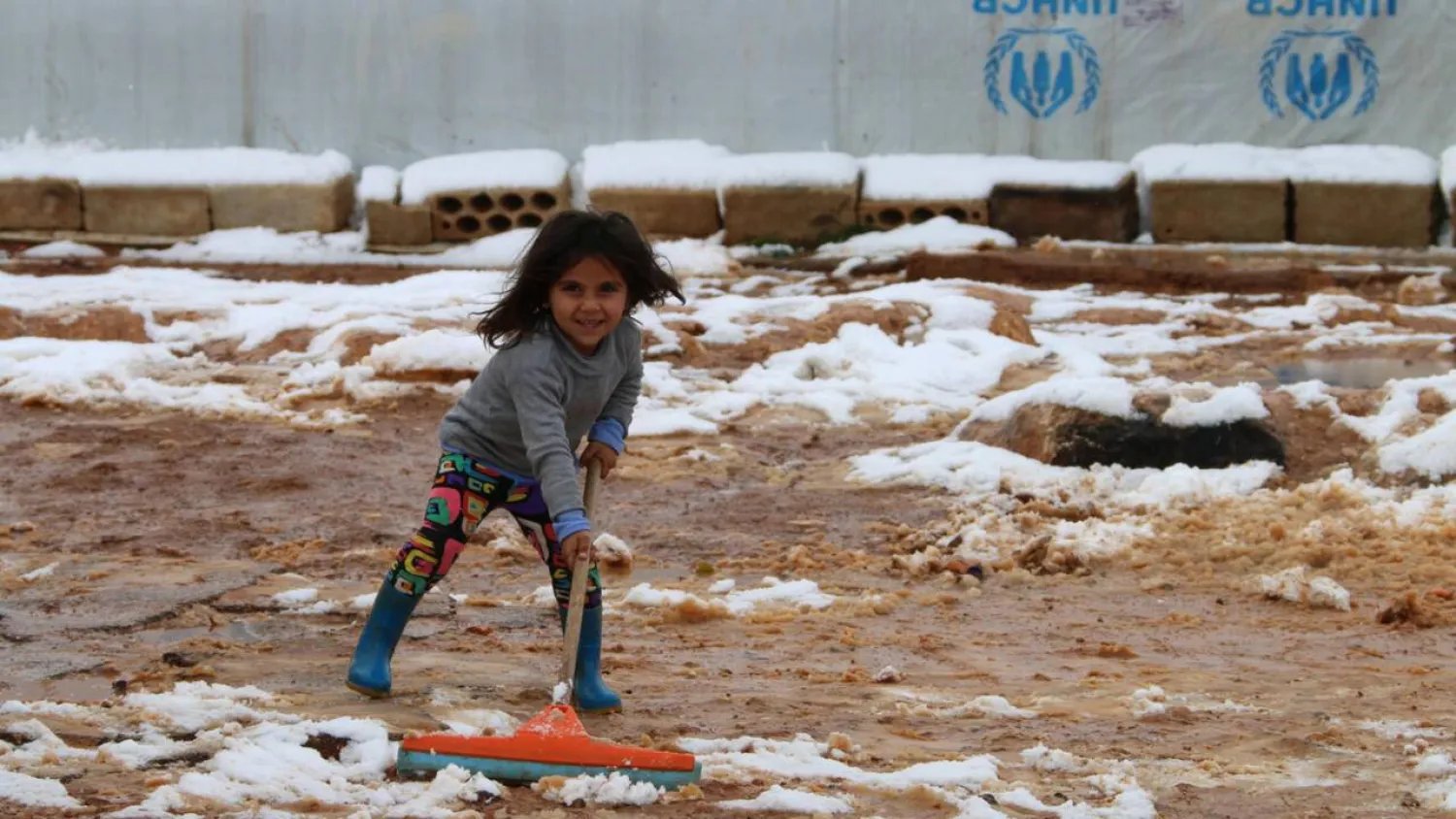

UN Warns of Rough Winter ahead for Refugees

The UNHCR said it would not be able to offer as much support this coming winter, as returning Syrian refugees try to rebuild their lives. AFP
TT

UN Warns of Rough Winter ahead for Refugees

The UNHCR said it would not be able to offer as much support this coming winter, as returning Syrian refugees try to rebuild their lives. AFP

The United Nations warned Tuesday that millions of refugees and displaced people face a grueling winter, with far less humanitarian aid available this year as the coldest months arrive in the northern hemisphere.

UNHCR, the UN refugee agency, has seen its funding from governments slashed and is trying to raise at least $35 million in public donations to help Syrian, Afghan and Ukrainian refugees through the winter, AFP said.

"Families will have to endure freezing temperatures without things many of us take for granted: a proper roof, insulation, heating, blankets, warm clothes or medicine," UNHCR's external relations chief Dominique Hyde said in a statement.

Under President Donald Trump, the United States, traditionally the world's top donor, has slashed foreign aid.

Washington previously accounted for more than 40 percent of the UNHCR's budget, and other major donor countries have also been tightening their belts, leaving the agency's finances looking bleak.

"Humanitarian budgets are stretched to breaking point and the winter support that we offer will be much less this year," said Hyde.

"We need more funding to help make many lives slightly more tolerable."

UNCHR said it was critical that private donors now step in to help save lives.

"UNHCR plans to raise at least $35 million to help repair homes that have been bombed, insulate houses, provide warmth and blankets to children and the elderly, and money to buy medicines and hot food," it said.

Millions on the move

Returning refugees will also be affected, the agency warned.

More than a million Syrian refugees have returned since the overthrow of president Bashar al-Assad's regime last December.

UNHCR said many were returning to find their houses destroyed by the 14-year Syrian civil war.

"The most vulnerable families face the cold with nothing to shield them; funding cuts risk leaving 750,000 people without vital support through the season," it said.

More than 2.2 million Afghans have returned from Pakistan and Iran this year, some empty-handed, with few prospects and having never set foot in the crisis-riddled country before, UNHCR said.

Two earthquakes in recent months have left families in an even more precarious position.

In Ukraine, temperatures could drop to minus 20C as people face a fourth winter in full-scale war following the 2022 Russian invasion.

"Humanitarian needs continue to grow as intensifying attacks claim civilian lives and destroy infrastructure, cumulatively adding to disruptions to gas, electricity and water," UNHCR said.

The agency said that despite its best efforts, many refugees worldwide would be left with little to shield them from freezing temperatures.

Hyde said: "Our teams are on the ground, determined to protect refugees from the cold -- but we are running out of time and resources."



Trump Says US-UK Relationship ‘Not Like It Used to Be’

US President Donald Trump and British Prime Minister Keir Starmer announce an agreement between the two countries as they hold a press conference at Chequers at the conclusion of a state visit on September 18, 2025, in Aylesbury, Britain. (Reuters)
TT

Trump Says US-UK Relationship ‘Not Like It Used to Be’

US President Donald Trump and British Prime Minister Keir Starmer announce an agreement between the two countries as they hold a press conference at Chequers at the conclusion of a state visit on September 18, 2025, in Aylesbury, Britain. (Reuters)

US President Donald Trump said the historical relationship between his country and Britain was "not like it used to be", in an interview to British daily newspaper The Sun, amid a major transatlantic fall out over US-Israeli strikes against Iran.

"This was the most solid relationship of all. And now we have very strong relationships with other countries in Europe," he said, singling out France and Germany, after UK Prime Minister Keir Starmer's initial refusal to allow the United States to use British military bases in its war with Iran.

Trump said Starmer "has not been helpful", adding: "I never thought I'd see that. I never thought I'd see that from the UK. We love the UK."

In a telephone interview from the White House on Monday evening, Trump said: "This was the most solid relationship of all. And now we have very strong relationships with other countries in Europe."

"It's a different world, actually. It's just a much different kind of relationship that we've had with your country before.

"It's very sad to see that the relationship is obviously not what it was," he added.

The scathing comments come a day after Trump described Starmer's reaction as "very disappointing" in an interview with The Daily Telegraph.

He added that Starmer's later decision to allow the use of UK bases on specific grounds as "useful" but said it "took far too much time".

Any potential military action in the Middle East is politically sensitive in the UK following former prime minister Tony Blair's disastrous support for the US-led invasion of Iraq.

- 'National interest' -

Starmer defended his position to parliament on Monday.

"President Trump has expressed his disagreement with our decision not to get involved in the initial strikes, but it is my duty to judge what is in Britain's national interest," he told lawmakers.

"That is what I have done and I stand by it," he added.

After initially refusing to have any role in the strikes, Starmer on Sunday announced that he had agreed to a US request to use British military bases for a "specific and limited defensive purpose".

His Downing Street office said Starmer took the decision after Iran fired missiles over the weekend that put British interests and people "at risk".

"We all remember the mistakes of Iraq, and we have learnt those lessons. Any UK actions must always have a lawful basis and a viable thought-through plan," he added in parliament.

The prime minister also said that British military bases in Cyprus "are not being used by US bombers" during the US-Israeli war with Iran.

Britain's Akrotiri air force base on Cyprus came under attack by an unmanned Iranian drone that hit the base's runway early on Monday.

Starmer said the strike "was not in response to any decision that we have taken," adding that the British government believed the drone "was launched prior to our announcement".

Iran's approach is becoming "more reckless and more dangerous", Starmer said.

"They are working ruthlessly and deliberately through a plan to strike, not only military targets, but also economic targets in the region, with no regard for civilian casualties. That is the situation we face today and to which we must respond," he added.


China Urges all Sides to Maintain Safety in Hormuz Strait

The Chinese national flag is seen in Beijing, China April 29, 2020. REUTERS/Thomas Peter/File Photo
TT

China Urges all Sides to Maintain Safety in Hormuz Strait

The Chinese national flag is seen in Beijing, China April 29, 2020. REUTERS/Thomas Peter/File Photo

China called on all sides in the Middle East war to maintain safety in the Strait of Hormuz, a vital shipping route for oil and gas, and vowed measures to ensure its energy security.

Nearly a quarter of the world's seaborne oil supplies pass through the strait, as well as a significant amount of cargo, AFP said.

Iran's Revolutionary Guards declared it closed on Saturday, prompting several international shipping groups to halt passage through the waterway.

"China urges all parties to immediately cease military operations, avoid further escalation of tensions, maintain the safety of shipping lanes in the Strait of Hormuz, and prevent a greater impact on the global economy," foreign ministry spokeswoman Mao Ning told a regular news conference on Tuesday.

"Energy security is of great importance to the global economy... China will take necessary measures to ensure its energy security," she said.

China is the main buyer of Iranian oil, most of which passes through the strait.


At Least 42 Civilians Killed in Afghanistan in Conflict with Pakistan, UN Agency Says

A Taliban security personnel operates an anti-aircraft gun while keeping watch for Pakistani airstrikes in the Tere Zayi district of Khost province on March 2, 2026. (AFP)
TT

At Least 42 Civilians Killed in Afghanistan in Conflict with Pakistan, UN Agency Says

A Taliban security personnel operates an anti-aircraft gun while keeping watch for Pakistani airstrikes in the Tere Zayi district of Khost province on March 2, 2026. (AFP)

At least 42 civilians have been killed and 104 wounded in Afghanistan in the fighting with Pakistan between February 26 and March 2, the United Nations Assistance Mission in Afghanistan (UNAMA)said on Tuesday, as the military conflict between the neighbors entered its sixth day. 

Military tensions between the South Asian nations remained high on Tuesday, with Afghanistan saying it had captured another Pakistani post in the ‌Kandahar region and ‌the fighting between the allies-turned-foes was "still ongoing". 

"The civilian casualties ‌include ⁠those caused by ⁠indirect fire in cross-border clashes...as well as those caused by airstrikes," the UN agency said, adding that the numbers were "preliminary". 

The conflict — the worst between the countries in years — was sparked last week by what Afghanistan's Taliban rulers said were retaliatory strikes on Pakistani installations in response to Pakistan's targeting of militants in Afghanistan. 

Afghanistan says Pakistani forces targeted its civilians, a charge Islamabad denies. 

Islamabad has ⁠launched air-to-ground missiles at Taliban military sites over the ‌last week, and even directly targeted the ‌Taliban government for the first time over allegations it harbors militants executing attacks on ‌Pakistan from its soil. 

Pakistani forces destroyed a military base in ‌Nangarhar province of Afghanistan in a successful air operation, Pakistani security sources said on Tuesday. 

UNAMA CALLS FOR HALT TO FIGHTING 

Both sides have claimed to have killed scores of troops of the other and inflicted heavy damage on military facilities since the fighting ‌began. 

Reuters has not been able to verify the numbers. 

Pakistani President Asif Ali Zardari, while addressing a joint session ⁠of parliament ⁠on Monday, reiterated that Islamabad would not allow territory in its neighborhood to be used for attacks against it. 

"The soil of Pakistan is sacred. We will not allow any entity — domestic or foreign — to use neighboring territory to destabilize our peace," he said. 

UNAMA called for a halt to the fighting and warned that the violence, which has displaced an estimated 16,400 households, has worsened the situation of Afghanistan's people who were still recovering from successive earthquakes in August and September that killed more than 1,400 people. 

"Restrictions on movements in the border area due to the active conflict have reduced the capacity of humanitarian agencies and partners to deliver life-saving and other assistance in the most-affected areas," it said.